Abstract:
The article argues that feeling sore, depleted, and “behind on health” after an interruption-filled desk day is usually not a motivation failure but a design mismatch: modern knowledge work functions like a preemptive scheduler where Slack pings, early meetings, and “quick questions” constantly force context switches that carry a restart tax, making many common wellness plans (like a neat 30-minute lunch workout) collapse in real calendars. It introduces the idea of “pause-safe” versus “pause-unsafe” habits and offers a blunt diagnostic—what happens if you get interrupted at minute 4—because routines with long setup chains (changing clothes, travel, warm-up, sweat/shower logistics, social awkwardness) often become “ruined,” turning “later” into “never” through high re-entry cost and a guilt-driven spiral. Instead of adding another system, the piece recommends debugging the one brittle link that keeps breaking, building a default re-entry ramp with simple if-then rules (e.g., switch to a 6-minute version, use an “assembly meal,” or do minimum dose tomorrow with no make-up), and redesigning movement into desk-native atomic units that still count (stairs, a 2-minute walk loop, a single clean set of squats or desk-edge push-ups, a brief dead hang, calf raises while waiting, eyes-off-screen microbreaks) tied to existing cues like meetings ending or kettles boiling. Finally, it advises changing the scoreboard from binary “full session or zero” to continuity metrics (any movement minutes, active days, checkmarks for micro-bouts) and using quick tools like a 5-day engineering log or a 3-minute “interrupt autopsy” to pinpoint where interruptions hit and patch the routine—aiming not for perfect execution, but for habit uptime under chaos.
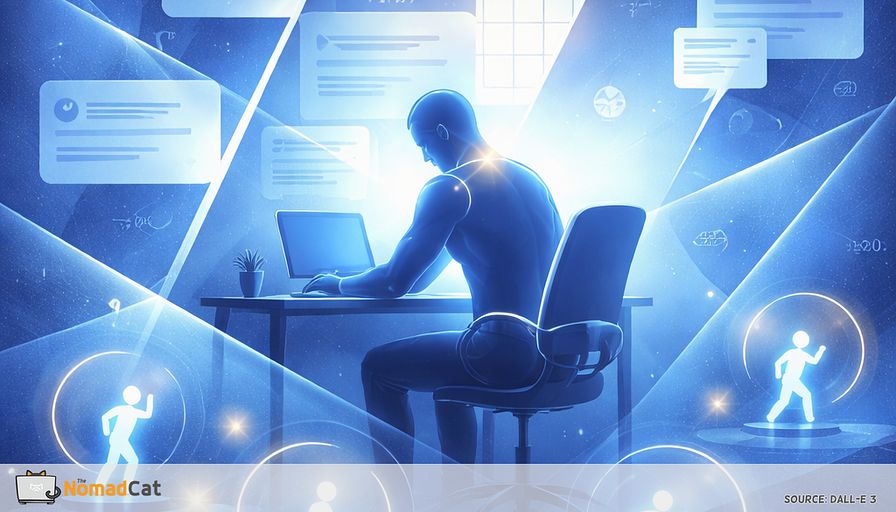
If your workday runs like a preemptive scheduler, you already know the pattern. You get a small slice of focus, then Slack pings, a meeting shows up early, someone says “quick question”, and your brain thread gets swapped out mid-sentence. By 16:00 you realise lunch was “later”, water was “later”, and the only thing that stayed consistent is the stiff neck, tight shoulders, lower back stiffness, and that weird energy dip even when you did not really eat.
I spent 2017–2023 in Berlin, mostly working remote (sometimes on bad chairs and worse desks), and the pattern was always the same: tight upper back first, then the rest.
If you feel a bit guilty about it, that’s normal. Also, it’s easy to put a label on it: “motivation problem”. Most of the time, it’s simpler than that. The day is designed to interrupt you, and a lot of “healthy habits” assume clean edges that do not exist in real calendars.
This article is here to debug that mismatch without adding yet another system to manage. The goal is simple. Make the lunch workout survive a day that keeps getting interrupted, instead of requiring a perfect 30-minute block you never get.
Here is what will be covered, in plain terms.
- Why interruptions win by default, and why each switch has a restart tax
- The difference between pause-safe habits and pause-unsafe habits, with the blunt minute 4 test
- How re-entry cost turns “later” into “never”, and how to avoid the lapse becoming a spiral
- How to find the 1 brittle link in a routine that keeps breaking
- How to design small atomic units that still count on messy days
- How to change the scoreboard to continuity, so an interrupted week stops looking like a string of failures
No hero stories, no glossy motivation speech. Just a practical way to make your plan fit the environment you actually work in.
Desk days preempt you
Interruptions are the default setting
A desk day works like a preemptive system. You get a time slice, then something interrupts, and your brain thread gets swapped out.
The lived version is familiar. Tabs multiply. Messages land mid-sentence. A meeting starts right when you finally had a clean idea. Lunch is “later”, then it’s 16:00 and you realise you drank nothing. The body stays parked, so the signals get quieter. You only notice the bill later with the stiff neck, tight shoulders, low-back stiffness, poor sleep, and that post-lunch energy dip even when lunch never happened.
Field studies of knowledge work describe work as frequently interrupted and rapidly switching between “threads” of activity (González & Mark, 2004; Mark, González, & Harris, 2005).
If your day is built from forced pauses, any plan that needs uninterrupted time is mismatched to the environment, not to your motivation.
Why interruptions win
Every switch adds a restart tax
On a 10-hour desk day, each ping is not just a distraction. It is a forced context switch.
Switching is not free. The main cost is what happens right after: you lose your place, and you pay to find it again (Leroy, 2009).
Concrete version. You start an email. Slack pops up with “quick question”. You answer. Back to the email, and now you reread the whole thread to remember what you were trying to say. The interruption stole 15 seconds, then it stole the will to restart.
That cognitive cost is only half the story. The other half is that many “healthy” habits are not pause-safe.
Work resumes, habits don’t
Most work tasks are pause-safe by design. There is a subject line, a ticket, a highlighted diff, a clear next step. And there is social reward for being responsive.
A lunch workout is often pause-unsafe. It has extra steps that are real costs, not personality flaws. Change clothes. Find space. Maybe sweat. Maybe explain why you are not at your desk. Then reverse it all.
So the useful question becomes design, not discipline.
The minute 4 failure mode
Plans that assume clean edges
The failed attempt is always the same: the lunch workout that only works on calendar fantasy days.
“Just do a 30-minute workout at lunch” looks simple until you expand the dependency chain. It quietly assumes stable time and the right environment.
Hidden checklist
- a gap in the calendar
- permission to be unavailable
- changing clothes
- space to move
- warm-up
- sweat management
- maybe a shower
- re-dress
- return on time without looking chaotic
The chain matters because the real test is not your intention at 11:00. It is what happens when the chain gets interrupted early.
Minute 4 and the restart odds collapse
The damage isn’t the missed session. It is what the interruption does to the odds of restarting today.
You are 4 minutes in. Shoes on, bottle filled, warm-up started. Then a meeting gets moved earlier, or a teammate pings with the urgent question. Someone else decided your timeline (O’Conaill & Frohlich, 1995).
If you continue, you return late and sweaty and pay a visible penalty. If you stop, you tell yourself “later”, but later is already booked. And because workdays fragment by default (González & Mark, 2004), that “later” slot rarely stays real long enough to rebuild the whole chain.
The pause-safe test
A pause-safe habit can stop instantly and resume later with low “where was i again” overhead. It does not punish you for being interrupted.
A pause-unsafe habit is one where setup steps become dropout taxes. More steps means more places to quit.
Quick spec
-
Pause-safe
- 2–5 minutes
- no travel
- no costume change
- low sweat
- normal clothes
- easy to stop mid-way
-
Pause-unsafe
- travel time
- warm-up dependency
- shower logistics
- privacy needs
- anything that feels “ruined” if paused
The diagnostic question is blunt
What happens if you get interrupted at minute 4
If the honest answer is “then it’s ruined”, the habit is incompatible with a preemptive schedule. Nothing is wrong with you; the habit just can’t survive this schedule.
Re-entry cost turns later into never
A lapse is not a relapse
On a long desk day, the problem is rarely the miss itself. It is the story the brain tells about the miss while the calendar keeps moving.
A lapse is a slip. A relapse is the spiral that sometimes follows (Marlatt & Donovan, 2005).
Common desk-day cascade
- interruption
- incomplete session
- reads as failure
- avoidance to dodge the “failed” feeling
- higher restart friction
- the day is gone
The boring reassurance is that habit strength builds gradually and does not reset to zero because of 1 disruption (Lally et al., 2010). What helps is a calmer interpretation. Practically, less drama makes re-entry cheaper.
Find the brittle link
Most routines fail at 1 link. Usually a small step becomes expensive or socially awkward. For many people it’s the shower step — it turns a “quick break” into a visible disruption.
Typical single points of failure
- change clothes
- pack a bag
- leave the building
- need a shower
- find a private space
- open an app and then pick a plan
Write the routine as 6–10 verbs, then circle the first verb that breaks when the day shifts. Example
- change, pack, leave, commute, warm up, train, shower, change, return
That circled verb is the breakpoint to engineer around, not a vague “motivation problem”.
Design for interruption
Build a default re-entry ramp
A re-entry ramp is a pre-decided resume-here point that still works after an abrupt stop. It removes negotiation. Instead of guilt plus bargaining, there is just a small next step.
This matches if-then planning and implementation intentions, which tend to improve follow-through in meta-analyses (Gollwitzer & Sheeran, 2006).
Filters for a good ramp
- removes steps
- survives low privacy
- survives low time
- survives low energy
Examples (keep it tied to the lunch-workout plan)
- If the lunch workout gets interrupted, then do the 6-minute version and stop
- If lunch disappears, then do 1 atomic unit at 16:00 and call it done
- If today gets missed, then tomorrow is minimum dose only, no “make up”
It is not magic. It is fewer decisions when your brain is already paying the restart tax.
Split the habit into atomic units that still count
Brittle plans only “count” if they run end-to-end. Then an interruption turns the day into a red zero even if 80% happened.
Atomic design flips that. The unit is small enough to survive fragmentation, and it still counts.
This also fits where guidelines moved. The 2018 US Physical Activity Guidelines removed the old ≥10-minute bout rule. Short bouts can add up when total volume is similar (US Physical Activity Guidelines, 2018).
Desk-native units should be boring on purpose
- 2 flights of stairs, normal pace
- 2-minute walk loop, inside or outside
- 1 set of squats, slow and clean
- 1 set of push-ups on desk edge
- 30-second dead hang on a door bar
- 60-second calf raises while waiting
- 90-second eyes-off-screen microbreak for fatigue
Pin them to cues that already exist. After a meeting ends. While a build runs. When the kettle boils. When a call starts with cameras off. The cue is already there, so “planning” is mostly choosing an atomic unit you can tolerate on a bad day.
Change the scoreboard to continuity
A binary scoreboard is a fast way to turn a normal interrupted week into fake failures. If only “full sessions” count, meetings that creep, desk lunches, and 16:00 surprises create repeated zeros. Zeros then become “proof” the system is broken.
Continuity metrics fix this without adding admin
- rolling 7-day minutes of movement including micro-bouts
- active days per week where “active” means you did something
- percent of days with any movement even 2–5 minutes
- atomic units completed counted like checkmarks
I’m the kind of person who tracks sessions with a Polar H10 chest band and a Decathlon watch, and it made one thing obvious on chaotic weeks: the only metric that matters is “did anything happen at all?”
This is not a new system to manage. It is simple monitoring and feedback in the smallest useful form, which is associated with better goal attainment in meta-analysis (Harkin et al., 2016).
A 3-minute interrupt autopsy
A tiny postmortem that turns a derail into a patch
- Where exactly did the interruption hit (minute and step)
- What made restarting annoying
Then convert the strongest answer into an if-then. Pre-deciding the response is often what makes re-entry cheap (Gollwitzer & Sheeran, 2006).
Keep the interpretation boring on purpose. Find the single step with the highest burden and remove steps there, not everywhere. Small edits are often enough.
- Replace lunch gym with 2 stair bouts plus 1 set
- Replace 30-minute run with 8 minutes outside plus optional pickups
If your days keep getting preempted by pings, meetings, and “quick questions”, the soreness and the 16:00 crash are not a moral verdict. They are a system output.
Most people don’t need a bigger plan. They need a lunch-workout plan that still works the first time a meeting moves.
You might be interested by these articles:


A health plan that still works in 3 stolen minutes

Microbreaks that survive pings and meeting overruns

Build health habits that work when your workday never ends

When your habits fail it is usually executive function not laziness

Design health habits for calendar chaos without restarting monday

Building a minimalist portfolio career in tech

Julia Language For High-Performance Computing