Abstract:
The article argues that when independent work (“indie freedom”) suddenly falls apart during travel, client emergencies, dark winter mornings, or heavy family demands, the issue usually isn’t motivation but reliability: traditional jobs quietly provide stabilizers—rhythm, feedback, incidental social contact, and low-capacity safety nets—that solo work unbundles, leaving you without shock absorbers and accumulating “recovery debt” when evenings stop restoring you. Instead of chasing a perfect wellness routine that only works on calm Sundays, it proposes designing for “graceful degradation” by building a minimalist, boring-on-purpose support system that still functions on low battery across five layers—self (tiny micro-regulation like 60–90 seconds of breathing or a one-line brain dump), people (low-pressure, low-coordination touchpoints such as a recurring 10-minute check-in or an async “alive” thread), place (boundary cues like a short outside loop or a weekly third-space work session), pace (hard endings, a two-minute shutdown ritual, and stop rules), and meaning (values-based anchors that don’t depend on productivity metrics). The core method is a one-page map that lists supports by layer and scores each for reliability and friction, then “stress tests” the setup against two predictable bad-week modes—a “client fire” crunch week and a flat, lonely low-energy week—to spot single points of failure (like relying on one person for all connection or using deadlines as the only structure) and add tiny redundancies that are travel-proof, defaultable, and low shame-cost. It also draws a clear boundary between self-optimization and when to step up support—especially if distress persists, worsens, or impairs sleep, work, relationships, or basic care—framing professional help as the right move rather than a better checklist.
You can do everything “right” and still watch the week collapse the moment life gets sharp.
The board is clean. The tools are there. The plan is reasonable. Then comes the client fire, the travel day, the dark mornings, the family load that doesn’t ask if you have space. Replies slip. Meals get weird. Even rest starts to feel like another task you’re failing.
That’s not a motivation problem. It’s a reliability problem.
Employment, for all its flaws, bundles a bunch of stabilizers by default. Rhythm. Feedback. Accidental social contact. A safety net for low-capacity days. Indie life quietly removes those buffers, and suddenly every bump hits your nervous system directly. Freedom is real, but it can be fragile.
This article is about making it less fragile.
Not by building a perfect wellness lifestyle you only manage on calm Sundays. But by designing for graceful degradation. A system that still runs when you are tired, stressed, or lonely. The goal is simple. Fewer weeks that crack because one thing went wrong.
Here’s what you’ll get, in practical terms.
- A one-page way to map your personal support stack across five layers
Self, people, place, pace, meaning - A quick method to score what’s actually reliable when capacity drops
And spot the single points of failure before they bite - Tiny redundancies that keep you steady without adding a second job called self-care
Low friction, low coordination, travel-proof when possible - Two lightweight if-then protocols for the weeks you can predict
Crunch weeks and flat lonely weeks - A clear line for when it’s time to step up support beyond self-optimization
Because sometimes the right move is professional help, not a better checklist
If you’re building “enough money, more freedom”, this is part of the work. Not glamorous. A bit boring, even. But boring is good. Boring survives bad weeks.
The hidden failure mode of indie freedom
When one crack breaks the whole week
You can have a decent routine and still feel like everything falls apart the minute the week gets rough.
A clean task board. A few good tools. Maybe a small peer group that reacts with a thumbs-up when things go well.
Then comes a crunch week, travel, dark winter mornings where everything feels heavier, or a family load that doesn’t negotiate.
Replies get late. The calendar turns into soup. Around this point, your “simple setup” has also somehow multiplied into twelve apps and three notebooks, none of which can cook you dinner.
The surprising part is not the stress. It’s the fragility.
So let’s name the missing piece: the buffers that jobs silently included, and indie work silently removed.
Jobs tend to bundle stabilizers by default, even when the job is imperfect
- time structure and a forced rhythm
- feedback loops, even annoying ones
- incidental social contact that keeps you human without planning it
- some kind of safety net for sick days and low-capacity days
Independence unbundles a lot of this. It’s like taking the shock absorbers off a car, then being surprised the road feels rough.
So the goal changes.
Not perfect wellness. Not motivation.
Design for graceful degradation.
A good week version of a system can be meal prep, workouts, deep work blocks, and tidy evenings.
A bad week version is one walk, one proper meal, and one hard stop at a reasonable hour.
Still boring. Still effective.
Because recovery is not a weekend-only feature.
If evenings do not restore you, weekends and vacations become a patch rather than a cure. You know the feeling when Monday arrives and it feels like you never stopped. That’s recovery debt, not laziness.
The useful question becomes
What is the smallest set of supports that still runs when you are at low capacity
A minimalist safety net that survives bad weeks
What you build on one page
This is meant to stay light.
You sketch one page with your core supports, circle the fragile dependencies, then add one small redundancy per weak area. Not a new lifestyle. Just a backup that still works on low battery.
This constraint matters because extra steps are not neutral. When stress goes up, bandwidth goes down. The system must be designed for the stressed version of you, not the calm Sunday version.
What this is not and when to get more help
This is not therapy. It’s not a deep guide to trauma, diagnosis, or community building.
It is personal scaffolding. The goal is steadier mood, connection, and work capacity when independent life removes the defaults that jobs used to provide.
It’s also smart to know the line.
If distress is persistent, worsening, or starts to impair sleep, work, relationships, or basic self-care, it’s a good moment to consider professional support rather than trying to optimize alone.
And if there are any safety concerns or thoughts of self-harm, the right move is urgent help through local medical or crisis services.
Why a systems lens fits this topic
I studied fundamental physics, and I still like models that show where systems fail under stress, and where a small buffer changes everything.
That preference got sharper after moving around: Beijing (2008–2017), then Berlin (2017–2023), and Lisbon since 2023. Same work, different defaults. In Berlin, “incidental contact” happened without trying; in Lisbon, I had to be more deliberate, or the days got quieter than I expected. It made the systems view feel less abstract: change the environment, and the failure modes change too.
Applied to well-being, it shifts the vibe from willpower to design.
Too many demands and not enough control is not a moral weakness. It’s a predictable failure mode.
The support stack for bad weeks
Five layers you can sketch in one minute
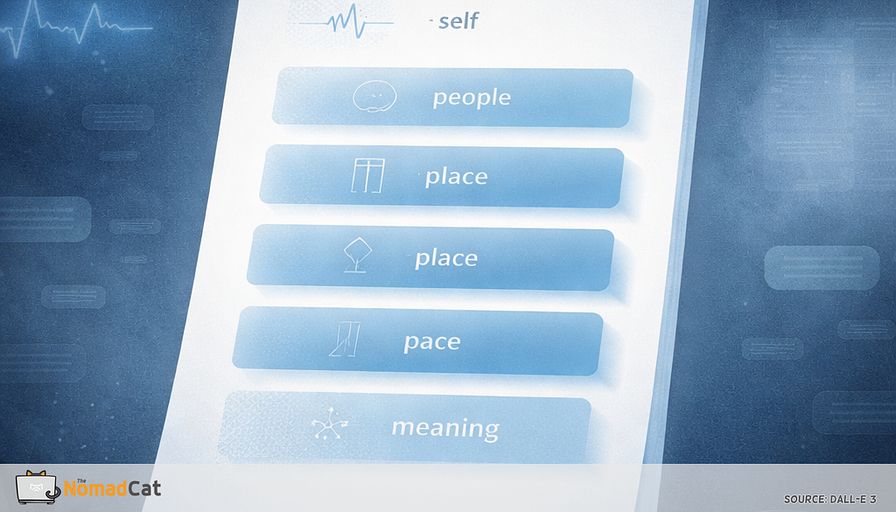
Use five layers
- self
- people
- place
- pace
- meaning
Design rule
Each layer needs at least one low-friction support that still works in a bad week. Not the perfect version. The tired version.
Take a sheet of paper. Draw five horizontal lines. Label them bottom to top.
Stability comes from coverage across layers, so when one cracks, the whole week does not.
Layer 1 self is micro regulation not a full lifestyle
Self is your ability to notice early signals and downshift fast.
Not a long morning routine. Small regulation that fits between meetings or after a hard email.
Examples that survive real days
- 60 to 90 seconds of slower breathing before replying
- a two minute walk when attention starts to smear
- one line brain dump to stop carrying work after hours
- a transition cue like closing the laptop and standing up
Layer 2 people is low pressure contact not a big social project
People support has to keep working when you are busy, depleted, or not very fun.
High-effort social plans often die first.
Low-pressure contact is different.
A simple pattern
- a recurring ten minute check-in with one peer
- same time each week
- if one person can’t do it, you still send a one line update
Under load, social support buffers stress, but only if it’s reliable.
Layer 3 place is boundary cues and a bit of outside
Place is the context that stabilizes attention and reduces cabin-fever loops.
Remote work can be great, and it also increases two common risks
- boundary erosion
- isolation
If home becomes office, it’s easy to keep half-working all evening, and harder to detach.
Low-battery support
- a ten minute outside loop between blocks or before dinner
- no perfect weather required
Often the boundary cue does as much work as motivation.
Layer 4 pace protects capacity
Pace is your ceilings and closure.
Independent work makes it easy for hours to expand until a deadline forces a stop. Then your nervous system starts running on pings.
A useful pace support is a small ending that marks the end, captures loose tasks, and reduces after-hours rumination.
Layer 5 meaning protects motivation
Meaning is what keeps you moving when output metrics stop working, or when the week is messy and nothing shipped.
For tech people who love numbers, this is not fluffy.
Values are a different kind of constraint. They help you decide what is worth doing when everything is possible and attention is limited.
Reliability rules that keep it minimalist
Rule one survive low capacity
Supports must work when capacity is low.
Friction is any extra step that makes a support harder to start
- coordination
- setup
- travel
- logins
- too many options
- one more decision
Reliability beats intensity.
Rule two make good choices the default
Defaults beat decisions, especially in bad weeks.
A small default set could be
- a default work location outside home one or two times a week
- a default walk loop that starts from your door
- a default buddy ping on a fixed day
This is for your future tired self.
Rule three build for graceful degradation
In a bad week, keep one small support per layer.
In a good week, add extras without making them mandatory.
Think minimum viable stack.
Map your stack on one page
The five minute sketch
Draw five rows for self, people, place, pace, meaning.
Add three columns
- current supports
- reliability 1 to 5
- friction 1 to 5
Do it fast and a bit brutal. Visibility, not judgment.
Example
- People | weekly 10 min peer call + one low-pressure text thread | reliability 4 | friction 2
- Self | 90 seconds breathing after hard emails + 2-minute walk reset | reliability 3 | friction 1 (easy to start, easy to forget)
- Pace | 2-minute shutdown + write tomorrow’s top three | reliability 2 | friction 2 (works, but I skip it when I’m “almost done”)
A support is reliable if it still happens when life is messy.
Travel. Sickness. Client crunch. Low mood. Those remote weeks where boundaries melt.
A support can be reliable and still too hard to start.
Use a quick friction checklist
- too many steps
- requires coordination
- costs money or travel you’ll avoid in a bad week
- big emotional entry fee like shame, dread, or decision fatigue
If it’s high friction, treat it as a bonus, not your base.
Stress test it like a bad week
Pick two predictable failure modes and re-score the rows under each.
1 client fire week
Long hours, constant pings, tight deadlines.
2 lonely low-energy week
Work is not exploding, but motivation is flat and you feel isolated.
Then sort supports into two buckets.
- base layer is high reliability and low friction
- nice to have is low reliability or high friction
Nice to have is not bad. It’s just not protection.
Keep the page and revisit it once a month.
Change one thing only.
Measurement is a tool, not a hobby.
A nice trick is to keep the protocols for those two weeks right next to the map, so you don’t have to invent decisions under pressure.
Single points of failure to spot fast
When the map is visible, look for places where one support is doing the job of three.
Trap one people depends on one person
Often a partner becomes the default social world.
Then peak work weeks remove time and emotional bandwidth, and the relationship gets loaded with decompression plus all social contact.
Low-friction redundancy can be boring but effective
- a couple of weak-tie touchpoints
- a lightweight peer check-in
- a familiar barista or neighbor chat
It spreads the load.
Trap two pace depends on deadlines as the only structure
If the only stop signal is a hard date, you end up working until something breaks.
Evenings become half-work, half-recovery.
Sleep gets fragile.
Over time you stop trusting calm days, so you create urgency to feel safe. Urgency then creates more strain. It’s a dumb loop, but very common.
One simple metric to catch it early: how many nights per week do you fully close the laptop by a set time you chose (not the time you crashed). If that number slides toward zero, pace is already failing.
Trap three place depends on home office every day
Not anti-remote work.
Just realistic about the symptoms
- restlessness and tab switching
- scrolling that doesn’t even feel fun
- the always at work feeling
Trap four meaning depends on productivity
Output is a clean scoreboard until it isn’t.
When the scoreboard goes silent, the mood drop feels personal even if nothing is wrong.
A steadier anchor is values and contribution, the stuff that stays true when metrics wobble.
Trap five self-regulation depends on weekend recovery
Push Monday to Friday, repair on Saturday.
The issue is simple.
Load accumulates when recovery is incomplete.
You don’t need perfection every day. You need daily micro supports that survive Tuesday at 6pm.
Add redundancy one tiny upgrade per layer
Patch the stack with one small redundancy per weak layer.
Start with the two that fail most often in solo work
- self
- people
Use this checklist before adding anything
- bad-week proof
- travel proof
- under a few minutes
- defaultable
- low coordination
- low shame cost
Micro self supports between meetings
Small self-regulation is an interrupt.
A two-minute state change can save an evening from turning into recovery debt.
Options
- paced breathing for 60 to 90 seconds after a stressful call
- brief grounding notice 3 things you see, 2 you feel, 1 you hear
- short self-compassion break after a mistake or harsh email
- stand and reset when fatigue shows up as tab-hopping
Low pressure connection that works async
Connection doesn’t need a big plan.
It needs a reliable channel that stays open when calendars get weird.
Options
- an async alive thread with 2 to 4 peers, one line per day or two
- one buddy check-in with a fixed format energy 1 to 5, one win, one worry, one next step
- a weak-tie routine in a third place, regular hello to the same barista, librarian, or neighbor
Keep expectations realistic. Async groups often go quiet. Design it so it still works if only one or two people are active.
Defaults that stabilize place pace and meaning
Place upgrades work because they change cues.
- one default third space per week, low-cost and predictable
- one default outdoor route close to home, same loop
- a portable desk setup for travel with one boundary cue that signals start and stop
Pace is protected by endings, not good intentions.
- a closing ritual that captures open loops in two minutes, write tomorrow’s top three, park the rest, close laptop
- a stop rule, if you start rereading the same paragraph or sending sloppy messages, stop and close
Meaning anchors that stay stable when metrics get noisy
- a weekly values receipt sentence, this week I helped X move forward
- a one line why before annoying tasks, this matters because it protects revenue or reduces future chaos
- a values-based yes-no filter, does this support freedom later, or does it buy me a new cage
If then protocols for predictable stress weeks
A sticky note plan for fire weeks
Stress makes decision load spike and attention narrow.
So decide before the week explodes.
A simple template
- If I feel my nervous system ramping up, then I do 60 seconds of slower breathing before replying.
- If I go a full day without real contact, then I send one one-line async check-in.
- If I am stuck at home all day, then I step outside for 10 minutes, no phone.
- If it’s late and I’m still pushing, then I do a 2-minute shutdown, write tomorrow’s top three, park the rest, close laptop.
One small lived note from moving cities: when I left Beijing (a lot of built-in noise, motion, and accidental interaction) for quieter routines in Europe, I noticed “fire weeks” got more internal. Same workload, fewer external stop signs. That’s where the sticky note rules helped: less thinking, more defaults.
This is the shallow version on purpose; the deeper burnout-prevention playbook deserves its own piece.
A low mood protocol that does not require high energy
Lonely weeks are a predictable mode of remote and independent work.
Because energy is low, keep the protocol small.
- if two days feel flat, then do one work session in a third space, even short.
- if 48 hours pass without speaking to anyone, then send a buddy message with the fixed format energy 1 to 5, one win, one worry.
- if you feel stuck in your head, then take the nature walk route as a state change.
- if the day has zero human contact, then say a real hello to one stranger in a low-stakes place.
- if you keep cancelling plans, then downgrade the plan instead of deleting it, ten minutes counts.
And again, know the line.
If low mood, anxiety, or sleep issues persist, worsen, or start to impair daily functioning, step up support and consider a professional.
Reliability over pride.
Keep it boring so it survives
Make the base stack opt out
Supports survive when they are opt-out.
A few examples
- one third space block on the calendar every week, same day, same hour
- walking shoes visible near the door
- a repeating buddy ping that says alive check
- a prewritten values receipt prompt in notes, one line to fill fast
Also keep the menu small.
A useful constraint is at most two supports per layer.
Too many options creates its own friction.
Review lightly and adjust with real life
Do a monthly 10-minute stack review.
Update reliability and friction scores.
Pick the one fragile layer.
Make one change only.
Money matters too.
Employment bundles support by default, including benefits and coverage. Independence often unbundles them.
So it’s sensible to build a free or cheap base layer first, and only pay for supports that reliably reduce strain or protect income capacity. If a paid support is only used on good weeks, it’s not a safety net.
Independence is not supposed to feel unsupported.
The goal is not to recreate an office at home.
It is to design a personal system that gives enough structure, contact, boundaries, and meaning to stay steady across messy seasons.
When the fit is wrong, the answer is rarely try harder.
It’s usually change the inputs.
And yes, it means being your own HR department sometimes, but with better taste and fewer meetings.
Indie freedom is real, and it’s also strangely easy to break when one week goes sharp. Build a support stack that still runs on low battery across self, people, place, pace, and meaning. Keep it boring on purpose. Pick low-friction defaults, add tiny redundancies, and stress test for two predictable modes: the client fire week and the flat lonely week. A one-page map with quick reliability and friction scores makes the weak links visible before they cost you sleep, focus, or relationships.
Most of all, know the line. If things are persistent or worsening, stepping up support can be the most professional move you make.
For me, the first crack is usually pace, and I only notice it when evenings stop restoring me.
You might be interested by these articles:


Your desk health plan needs a runbook for week 2

Build a health plan that stays online during deadline weeks

Keep habits online with normal heavy emergency mode for desk weeks

A health plan that still works in 3 stolen minutes

Your 10-hour desk day needs pause-safe health habits

Retirement saving for freelancers without the liquidity cliff

When 10 Hours in the Same Chair Makes Everything Feel Sticky