Abstract:
The article argues that “desk job health” isn’t a motivation problem but a compatibility problem: modern knowledge work runs like a tightly constrained runtime of endless tabs, meetings, and pings where being constantly reachable, calm, and visibly busy often functions as a performance signal, so standard advice like “take breaks” or “go for a walk” fails because it violates unwritten rules about responsiveness, optics, and low disruption. It explains how reply speed, green dots, and read receipts turn availability into a scoreboard that pushes people into strategic behaviors (reading from notifications, delaying opens, using DND as a stealth cloak) and makes breaks the first casualty, while meetings erase the day’s natural edges so food, water, and movement lose their slots and stillness becomes the safest way to look engaged—especially on video, where “Zoom fatigue” is framed as both constant gaze/self-monitoring and a posture trap. To make habits survive, the piece offers a “failure map” of five constraints that kill routines (optics, latency, dependencies, monitoring pressure, pauseability) plus a quick workplace audit, then proposes low-drama designs that “look like work” (brief standing, subtle weight shifts, off-camera calf raises, a long exhale, short audio-only walks) and tiny, reliability-flavored break protocols (signal a return time, route routine asks async, escalate true urgent items through one channel) modeled on ops escalation discipline. Woven through is a personal detail—years spent working at desks across Beijing, Berlin, and Lisbon, with upper-back tightness as the author’s early warning—used to underline the point that desk stillness can masquerade as competence while quietly accumulating “error logs,” and that the practical goal is not heroic overhauls but small, reversible defaults that fit the local workplace spec and, where possible, gradually renegotiate norms (with examples like protected lunches, walking 1:1s, or camera-off segments) alongside broader policy signals such as right-to-disconnect frameworks in France, Ireland, and Australia.
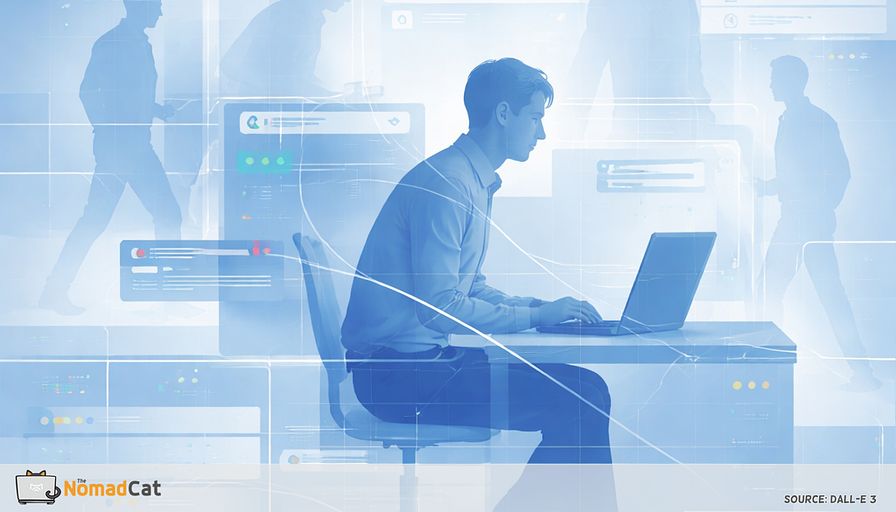
A desk day is not just “do work.” It is a runtime with tight constraints. 18 tabs, 6 meetings, and a steady drip of pings that quietly turns your attention into shared property. In a lot of knowledge jobs, being reachable, calm, and presentable while watched counts almost as much as output. Which is why so much standard health advice feels like it was written for a different operating system.
This is for the moment you try a sensible habit and it dies by Tuesday. Not because you are lazy. Because it clashes with the unwritten job description. The real spec includes fast reply expectations, visible busyness, calendar confetti, and the weird social risk of standing up at the wrong time. Once you see that, the problem stops being motivation and starts being compatibility.
My version of this was the “10-minute walk at lunch” habit. It lasted two days. Then the meetings ate the edge, lunch got “moved” into a Slack thread, and I was back to eating at the keyboard like it was a normal adult choice.
What you’ll get here is a practical map of what’s actually breaking your habits, plus designs that survive a normal workday.
We’ll cover
- the hidden rules that punish “healthy” behavior without anyone saying it out loud
- how response time becomes a performance signal, and why breaks are the first casualty
- why meetings remove the edges of the day, and why stillness can become the safest way to look engaged
- a simple failure map with 5 constraints that kill habits first
- small, low-drama options for movement and breaks that don’t wreck reachability or optics
The goal is not to add another program to manage. It is to make tiny adjustments that fit inside the system you already have. Less heroics, more reliable defaults. Your body is already sending error logs. This is just reading them like a colleague, not a coach.
The workplace spec you are actually running
The unwritten job description
Here’s what the job silently rewards: fast replies, calm face, and zero friction for other people.
So when a habit fails, treat it like a compatibility bug, not a character flaw.
Typical health advice quietly assumes freedoms many jobs do not grant.
- Immediate responsiveness. IM arrives and “quick reply” becomes the default, because IM behaves like conversation, not mail.
- Low friction contact means higher expectations. When it’s easy to reach you, people reach you now.
- Visible busyness. “Back to back” becomes a status badge, not a problem to fix.
- Schedule surrender. Meetings appear on your calendar and you adapt. Lunch becomes a movable object.
- Low disruption. Standing up, stretching, going to eat can feel like creating “noise” in the system, even if nobody says it.
The mismatch is boring but brutal. Many plans assume you can protect 10–30 minute blocks, leave your desk, and reply slowly with no social cost. Reality is often the opposite.
No blame here. If the workplace rewards professional stillness and constant presence, your body’s needs collide with local policy. The plan fails because it bumps into norms that get enforced quietly, not because you are weak.
Availability signaling is the hidden tax
How response time turns into a performance signal
Once reply speed carries meaning, “availability” becomes a scoreboard people manage. In many teams, a slow answer reads as low urgency, low commitment, or just not cooperative, even when the work is excellent. IM pushes this because it behaves like a conversation with quick back and forth.
The green dot and “active 2 min ago” turn your focus into something others feel allowed to query. Being unavailable stops looking like bad timing and starts looking like a choice.
Read receipts are the cleanest pressure mechanic. They turn “maybe they didn’t see it” into “they saw it.” People then get strategic, not because they are dishonest, but because they are avoiding small social penalties.
- reading from notifications without opening the thread
- opening later on purpose to avoid triggering “seen”
- airplane mode or “do not disturb” used like a stealth cloak
Once everyone is optimizing for perceived availability, breaks become the first casualty. If a 2-minute stretch makes your response time look worse, it feels risky and gets postponed. Add constant interruptions and you get more stress and more fragmented attention.
When stillness becomes a performance metric
Meetings make the day edge-less
Meetings do not only steal time. They remove the edges of the day. With calendar confetti and back-to-back blocks, hydration and food stop having a slot. It’s easy to end up eating at your desk, or not eating at all, just because there was no clean gap.
Stillness wins socially (even when it loses physically)
Microbreaks help in real life. In my week, a 60-second stand-up lowers the end-of-day neck and upper-back tension—even when the meeting vibe says “don’t move.”
But in a meeting, moving can look like impatience, multitasking, or disrespect. When everyone feels watched, the lowest-risk move is to freeze. And then you do the rational thing: you stop doing the thing that makes you look weird.
Video merges front stage and back stage
Video makes it worse. Work mode and home mode collapse into the same rectangle. Stretching, shifting, even standing to grab water becomes something other people see and interpret.
Constant gaze and self-view turn a normal fidget into a performance. So yes, “Zoom fatigue” is also a posture trap.
Important boundary: camera pressure varies a lot by manager and team. The same habit can be safe in one group and career-risky in another. The most useful design is local, not internet-generic.
A failure map for habits in real workplaces
The 5 constraints that kill habits first
A habit fails when it violates the local rules of looking professional while observed. That is mostly environment fit, not motivation psychology.
A quick map that explains most failures
- Optics. If it looks weird on camera, it dies fast.
- Latency. If it adds response time, it gets postponed.
- Dependencies. If it needs gear, clothes, sweating, shower, privacy, it will not run on normal weekdays.
- Monitoring pressure. When time is accountable, extra steps feel expensive.
- Pauseability. If you can’t stop instantly when someone pings, you often won’t start.
That last one matters more than people admit. Mid-rep is awkward. Mid-shower is a hard no.
A fast self audit without turning life into a spreadsheet
- How often is camera on, really
- What reply time is expected on IM
- Is lunch protected or casually erased
- Do leaders take breaks visibly
- Is stepping away joked about or punished
- Are you tracked by status or time
Pick the loudest rule. The dominant constraint usually explains multiple failures at once—food, water, movement, even bathroom timing.
Then convert it into 2 lists.
- Public mode designed for optics, low latency, high pauseability.
- Private mode for anything longer and messier.
Tiny breaks still count.
Two constraint-specific “survive-the-day” fixes
- If latency is the blocker: use a tiny reply rhythm (for example, check and respond every ~25 minutes) and let everything else sit in the async queue in between. It’s not perfect, but it stops “always on” from eating your whole day.
- If optics is the blocker: set your camera once so standing looks normal (raise the laptop, step back a bit), then use “listening = standing” as your default instead of “standing = exercise.”
Habit designs that survive a real workday
Movement that looks like work
Treat looks-like-work as a design requirement. Under evaluation, the safest behaviors are the ones that resemble normal thinking and listening, not “exercise.” Standing while listening reads fine. Getting on the floor to stretch does not.
A small menu beats a perfect move because context changes every hour.
- Stand for the first 2 minutes
- Shift weight left and right slowly
- 10 quiet calf raises off-camera
- One long nasal exhale, shoulders drop
- Step back 2 steps, then return
- Sit back down slightly taller
- Walk during audio-only listening moments
- Stretch fingers while scanning notes
If you want one boring cadence, try every 20–30 minutes, 30–90 seconds. Not magic, just fewer long unbroken blocks.
A small human note, because desk life lies. Stillness feels fine until the error logs catch up. I have spent most of my adult life at a desk, first in Beijing, then Berlin, now Lisbon, and the early warning for me is always the same upper-back tightness that grows quietly. Add workations across Europe on bad chairs and worse desks and it gets comically consistent. My least glamorous fix is also the most reliable: I stand for the first couple minutes of calls, especially the ones where I’m “just listening.”
I can work a full day without eating, drinking, or moving, and yes it looks like competence. It is just a bug with delayed feedback, not a superpower.
Breaks that do not break reachability
A latency-safe break does not trigger the “where are you” spiral because the return time and escalation path are explicit. Ops teams do this with severity and escalation discipline so the system stays reliable without paging everyone for everything.
A tiny protocol usually fits without a process overhaul.
-
Signal a break with a return time
-
Route routine asks to an async queue
-
Escalate true urgent items via 1 channel
This isn’t bureaucracy. It is just protecting everyone from interruption costs. Interruptions make it harder to resume.
This depends on how strict your team is. In monitoring-heavy environments, “away” can be punished even when the work is fine. So the design target changes: not eliminate risk, just shrink it.
The nice part is that tiny breaks still pay rent. A 30–90 second stand, a quick water refill, even a slow exhale buys back some attention and reduces the end-of-day stiffness.
Comply first then renegotiate
Default compliance mode means choosing behaviors that require no permission and signal no drop in commitment. It avoids social debt in teams where visible busyness shapes evaluation.
Selective renegotiation is the opposite of “change everything.” Pick 1 norm with high payoff. Often it is protected lunch 2 days a week, walking 1:1s, or a camera-off segment for listening only. Whether this is easy or career-dangerous depends on the team. Keep it small and reversible.
Low-backlash patterns help.
- Frame it as team reliability, not personal comfort
- Offer 2 options, ask which is preferable
- Propose a 2-week pilot, then review
- Use a clear rule like “audio ok”
If reply-speed is treated like performance, written norms are one of the only things that can dial it down without someone looking “less committed” first.
Policy can also give social cover. France’s 2017 right-to-disconnect model pushes companies to negotiate expectations. Ireland’s 2021 WRC Code shapes norms via guidance. Australia’s 2024 approach uses a reasonableness test for after-hours contact. The direction is pretty clear. Build habits that fit the local spec, then slowly edit the spec.
If your days are screens, meetings, and pings, it makes sense that the “just take breaks” advice keeps bouncing off reality. The real problem is rarely motivation. It’s compatibility with the workplace spec, where reply speed and visible stillness quietly signal competence.
Designing for the loudest constraint—optics, latency, dependencies, monitoring pressure, or pauseability—turns “failed” habits into something more accurate: a plan that didn’t fit the system yet. Most offices have 1 rule louder than the rest. Name it, and your week starts making sense.
You might be interested by these articles:


Your habits are fine your calendar is the bug

The invisible work rules that make desk health feel awkward

Why your 3-minute break still needs permission at work

Stop losing breaks to the shared calendar

Your habits keep crashing on normal Tuesdays

Unlocking PHP's Secrets with phpinfo()

Remote work removed the handles and your hands are paying for it