Abstract:
The article argues that when desk workers feel physically wrecked despite a “normal” calendar, the issue usually isn’t motivation but missing “runtime” conditions—habits fail like software features that can’t run in real-world production because the day is fragmented by meetings, Slack pings, camera-on calls, and too-short desk lunches that leave “delayed error messages” like stiff necks and afternoon crashes. It reframes health intentions as dependency graphs and предлагает a quick three-minute “dependency audit” built around four overlooked buckets (environmental, social, operational, attention) to reveal what a habit quietly assumes (privacy, permission to look a little weird, buffer time, shower access, unreachable moments, gear). A distinctive emphasis is the “awkwardness cost,” where even two minutes of stretching can feel too expensive socially, and the idea that “professional stillness” becomes an unspoken KPI rewarded by being seated, visible, and instantly responsive—turning standing desks into coat racks and walks into endlessly postponed plans. Instead of perfect routines, it recommends designing low-dependency habits that can “ship” on a random Tuesday: gearless, sweatless, space-minimal, interruptible, camera-safe micro-actions (e.g., shoulder rolls between meetings, calf raises while listening, an off-camera hallway loop, water refills chained to bathroom breaks, protein-forward desk snacks), plus having both “public mode” (visually boring, safe under observation) and “private mode” (longer walks, strength, meal prep) implementations. The durability standard becomes “coverage,” meaning there’s always a runnable option across chaotic contexts like deadline days, travel, open offices, camera-on weeks, and low-sleep days, and if it fails predictably, you treat it as a dependency bug to remove and re-test.
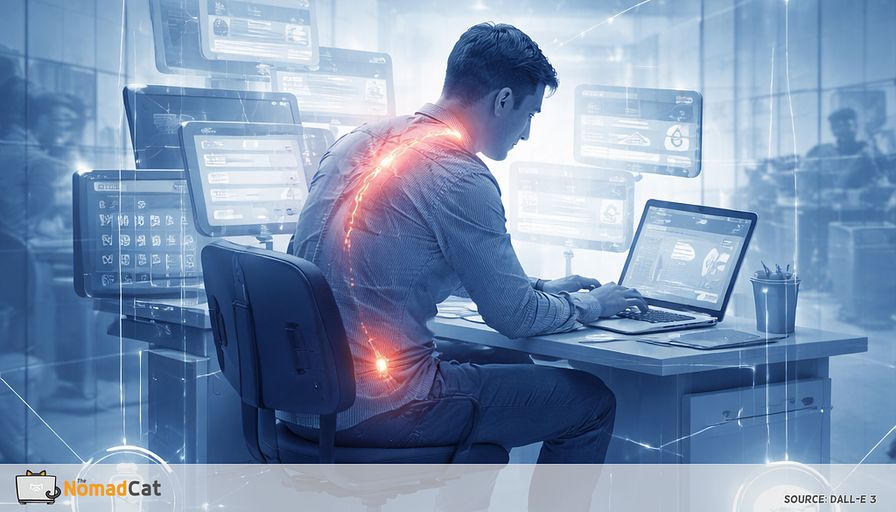
If your calendar looks fine but your body disagrees, you are not alone. The day is “just meetings,” yet somehow you end up with a stiff neck, tight shoulders, a lower back that feels glued to the chair, and that familiar dip in energy after lunch. Add Slack, camera-on calls, and a desk lunch that lasts 12 minutes, and the idea of “just go for a walk” starts to sound like advice from someone who does not have your job.
This is not a motivation problem. It is a runtime problem. I did this for years in Beijing, then Berlin, and now in Lisbon: calendar looked “reasonable,” upper back still tightened until it forced me to move.
This article reframes habits like software features that need certain conditions to run (if you’re not technical: think “requirements” and “things that can break it”). The goal is to spot the hidden requirements that quietly break good intentions, especially in open offices and camera-on culture, where privacy and permission are scarce.
Here is what will be covered
- Why reasonable habits fail on a normal Tuesday even when you want them
- A quick way to name what your plan quietly assumes
- Design rules for habits that still run in open offices and camera-on weeks
No hype. No perfect routine. Just a more accurate model of what is happening, and small configurations that fit inside the day you actually have.
The hidden requirements behind habits
When a habit is not runnable
The calendar looks clean, but the day is not. Meetings stack, Slack pings land mid-sentence, and lunch becomes 12 minutes at the desk; at 8pm the body sends delayed error messages: stiff neck, tight shoulders, low energy after 3pm.
That is not a motivation problem. A habit can be reasonable and still fail in production because its runtime requirements are missing. What looks like “just go for a walk” may depend on an uninterrupted block, a place to get a bit sweaty, a corridor where nobody watches, or a moment where the phone cannot reach you.
Desk days get chopped into small episodes, and the startup cost gets paid again and again. Each switch adds a little restart time: re-open the doc, reload context, re-find focus. Under time pressure, discretionary activities shrink first, which is exactly where “move” and “cook” usually sit. So “I meant to” becomes “I didn’t” without anyone being lazy.
The useful move is not “try harder” but “name the scarce resources your plan assumes.”
Many health plans quietly assume access to things that are rare on desk days
- A quiet space where nobody can hear you breathing harder
- Predictable meal timing that does not collapse into desk snacks
- Shower or sink access that makes moving feel socially safe
- A dead zone where pings cannot reach for 10 minutes
- Low observability, meaning you are not being watched while you do it
- Permission to look slightly weird without it becoming a performance signal
- A buffer between meetings, not a hard cut at the hour
Once you see dependencies, the next question is why desk work breaks them so reliably.
The 3-minute dependency audit
Audit against a random Tuesday
If a habit keeps failing, treat it like a feature that never ships. The point is not to prove you are disciplined. It is to list what the habit needs to run on a random Tuesday, not on the fantasy calendar where meetings end on time.
A concrete example: I tried a standing desk setup, and it turned into a coat rack. The problem wasn’t “I don’t care about my back.” It was visibility and permission: standing felt like announcing myself in an open office, so I defaulted back to sitting. The version that actually ran was boring: I stood for the first 5 minutes of a call while listening, then sat again.
Ask 1 question
What has to be true for this to happen at 4pm on a normal workday?
No judging, just listing.
The 4 buckets most plans forget
To keep it fast, use 4 buckets. Most blockers live here, not in the “how many minutes does it take” estimate.
- Environmental Floor space, a corridor, a shower, a kitchen, a place to stash shoes.
- Social Camera-on culture, open office visibility, people asking “where are you going”.
- Operational Clothes, gear, laundry, food already in the fridge, the meeting ending on time.
- Attention The ability to switch roles without mental whiplash, not being mid-thread, not carrying the last meeting in your head.
When boundary transitions are missing, even small actions get harder to start. And open-plan setups turn “quick break” into “public event.” Not a personality flaw. Just the runtime you are deploying into.
A tiny spec that makes fragility obvious
A common surprise is that even tiny habits can have a high social or operational cost.
Habit
Requires: [time block] + [place] + [privacy] + [gear] + [transition]
Fails when: [most common Tuesday constraint]
Example output
Requires: 20 min + off-camera + sneakers + 5 min buffer after meetings
Fails when: meetings run back-to-back and camera stays on
Decision rule
If 1 to 2 key dependencies are rare on normal Tuesdays, motivation is not the bottleneck. The spec is brittle.
When 2 minutes still costs too much
A useful model is 2 costs, not 1.
- Time cost “2 minutes.”
- Awkwardness cost “Do I look unprofessional.”
In offices and camera-on cultures, the second one often dominates. Standing up to stretch, pacing during a call, doing mobility next to the desk, eating a real lunch on camera, leaving the chair between back-to-back calls: it can be tiny in duration and huge in perceived social risk.
Video calls crank up visibility and shrink the set of movements that feel acceptable. You are not just present, you are framed. So “take microbreaks” is often written as if you are off-camera, offstage, and allowed to disappear for 90 seconds.
If work already bleeds into evenings and weekends become catch-up, reputation can feel like a scarce resource. Protecting it becomes rational. That is how stillness turns into an unspoken KPI.
Stillness is the unspoken KPI
Professional stillness is the quiet rule where being seen seated, calm, and instantly responsive reads as seriousness. It is not written anywhere, but it is rewarded. Some days I’m basically a very expensive houseplant with Slack.
Once the incentive is “be visible and available,” habit failures stop being mysterious
- If a standing desk makes you look conspicuous, it becomes a coat rack.
- If missing a ping feels costly, walks get postponed “until later,” then later never comes.
- If lunch off-camera feels like disappearing, meals get delayed and turn into desk snacks.
- If refilling water means being seen leaving again, hydration becomes a late-afternoon catch-up task.
- If stretching reads as “not working,” tight shoulders become the default.
Permission is a real dependency. If your plan required breaking the ideal worker script, the blocker was often permission, not willpower.
So the more useful question is how to design habits that still run when permission and privacy are scarce.
Design rules that still run on desk days
Pick actions with a low dependency load
Once the dependency spec is visible, choosing habits gets less moral and more technical.
The robust desk-life version tends to be
- gearless
- sweatless
- space-minimal
- interruptible
- camera-safe
- private-by-default
- setup cost close to 0
This is not a workout plan. It is a compatibility filter for chaotic calendars.
Tiny options help because they are swappable, and because some days the body is already throwing errors.
- 30 to 90 seconds of shoulder rolls between meetings
- 60 seconds of calf raises during “listening only”
- 90 seconds of hip hinge or air squats off camera
- Doorstep walk out and back, no destination required
- Protein-forward desk snack with no kitchen dependency
- Refill water paired with a bathroom break
- 10 seconds jaw unclench and slow exhale
- Brief gaze break away from the screen
It can look too small, especially if the brain only counts workouts that require shoes, sweat, and an identity shift. In my case, these tiny breaks are what reduce the end-of-day stiffness most reliably. And if I move a little after lunch, the post-meal slump tends to be less dramatic.
Public mode and private mode
A habit survives volatile weeks when it has at least 2 runnable implementations. Same intent, different execution depending on whether the day is camera-on, client-facing, open office, travel, or finally quiet at home.
Start with public mode because that is where most plans quietly fail.
Public mode should be visually boring. It works when it looks like normal work, not like a health performance.
- Stand while listening, sit while speaking
- Subtle weight shifts while reading on a call
- 60-second off-camera hallway loop between agenda items
- Water refill chained to a bio break
- Desk-safe snack that needs no prep
Private mode is the upgrade path, not the entry ticket.
- Longer walk outside
- Strength session
- Simple meal prep for later
The glue is pre-approved alternatives. No restart loop.
A durability test for desk days
The interruptibility test
Desk days flip priorities fast. A “simple” habit that cannot be paused without feeling wasted will lose to the next urgent ping. That is switching economics.
Run a quick spec check
- Can it be paused at any point without ruining it
- Can it be resumed with no warm-up or app setup
- Can it be done in fragments across the day
- Can it be done without changing clothes or leaving the building
Example re-spec, where each line is a valid version, not a failed attempt
- 0:30 shoulder rolls or calf raises between meetings
- 3:00 off-camera hallway loop plus water refill
- 12:00 brisk walk outside if a gap appears
If your calendar looks reasonable but your body is throwing errors, that is not a character flaw. Most desk-day plans fail because they are written for a fantasy runtime with clean breaks, privacy, and permission. The shift here is simple: treat habits like features. Run a quick dependency audit, name what the habit quietly requires, then lower the dependency load until it can ship on a random Tuesday.
That usually means gearless, sweatless, interruptible moves, plus a public mode that looks boring and a private mode for upgrades when the day finally loosens up. Most weeks, the blocker isn’t time; it’s the moment you realize you’re on camera.
You might be interested by these articles:


When your habits fail it is usually executive function not laziness

Your habits are fine your calendar is the bug

Your health plan needs time authority not more discipline

Why your 3-minute break still needs permission at work

The invisible work rules that make desk health feel awkward

Transforming Shopping with AR Tech

Navigating the Future with AR