Abstract:
The article argues that most fitness and nutrition advice fails not because people lack motivation but because it’s designed for “calm weeks” with hidden dependencies—long uninterrupted time blocks, smooth transitions, private space, shower access, predictable energy, stable food options, and even social “permission” to be briefly offline—that many desk workers don’t actually control once meetings multiply, Slack keeps blinking, and “phantom gaps” shrink into unusable fragments. Using a software metaphor, it suggests treating routines like systems that crash in real-world conditions (“production”) and diagnosing misses with a blameless incident-review mindset: identify what the plan was, which inputs it required, who owned those inputs that day, what dependency failed first, and what made re-entry feel costly. A distinctive personal thread comes from the author’s years working late at desks in Beijing, Berlin, and Lisbon, where stillness can masquerade as competence until the body “files a ticket” later—signaled for them by creeping upper-back tightness and a spouse (a fitness trainer and nutritionist) reminding them to sit straight for the brief few minutes it lasts. The practical solution is a three-tier “degrades gracefully” ladder: Tier 1 routines that are inherently fragile and need protected conditions, Tier 2 versions with minimum-viable sessions and pre-decided if–then fallbacks, and a Tier 3 core of interruption-tolerant, optics-safe, low-setup actions that still count even if a 12-minute window is cut to 3, paired with “boring” food defaults that survive meeting drift—so the goal becomes a plan that keeps running when time gets stolen mid-hour, not a perfect week.
Most health advice is written for the calm version of your week.
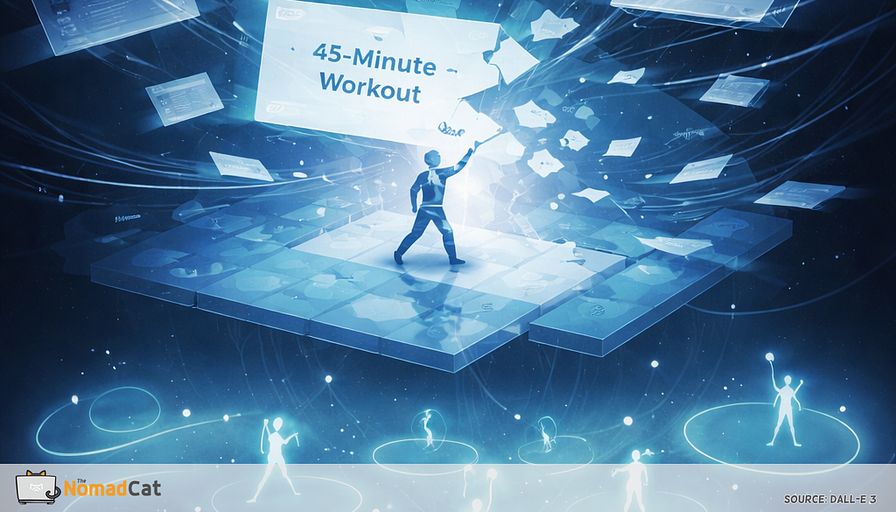
Mine, for a while, was a simple plan: a 45‑minute gym session after work, four days a week. It looked reasonable on Sunday. Then the real week showed up. Meetings multiplied. Slack kept blinking. A “quick sync” ate the only usable gap. Lunch became a keyboard event. The plan didn’t fail because I suddenly lost motivation. It failed because it was built with hidden dependencies my calendar doesn’t actually respect.
That is the quiet premise this article is here to challenge.
Instead of treating consistency like a personality trait, it treats it like a system problem. A routine is more like software than a moral contract. It runs in certain conditions, it crashes in others, and the fix is usually not “try harder” but “change the setup”.
Here’s what you’ll get in the sections ahead.
- Why so many fitness and food plans only work on calm weeks, and what they assume you control
- How to read any routine like a dependency list: time blocks, privacy, transitions, shower access, and “permission” to be briefly offline
- A quick test to spot plans that break in production, especially for desk workers who do not own the scheduler
- A blameless way to audit misses, without turning it into guilt accounting
- A simple ladder for habits that degrade gracefully, so a day can get noisy without going to zero
There’s a small personal note in here too, from someone who has spent most of adult life at a desk in Beijing, then Berlin, and now Lisbon, often past midnight. It is weirdly easy to confuse stillness with competence. The body files the ticket later, usually when the calendar is even worse.
The goal is not a perfect week. It is a plan that still runs when your time gets stolen mid-hour. Somehow, that already feels like relief.
The quiet premise behind most health advice
Most plans are built for calm weeks
On Sunday, the week looks almost reasonable. A few clean calendar tiles, a 45-minute slot for a workout, a quick lunch that will be a salad, maybe even a walk between 2 calls. Then Monday arrives with back-to-back meetings, Slack pings that feel urgent for no good reason, and the kind of context switching where your brain keeps 12 tabs open but none of them loads. Lunch becomes a keyboard event. The workout block gets eaten by a surprise invite with a scary title.
In that situation, the plan didn’t really fail. Opportunity collapsed. Not “time” in the abstract—usable time. Plus a place to change. Plus a shower. Plus the ability to be briefly unreachable without paying for it socially.
If you want one name for the idea, COM-B calls this the opportunity part of behavior (Michie et al., 2011).
Once you notice the runtime, it becomes easier to see what the plan quietly needs.
Read any routine like a dependency list
Most simple routines assume you control a bunch of inputs, even if nobody writes them down. A useful way to read a plan is like a setup guide: what resources, setting, and dose does it require.
A lot of research exists for a boring reason: outcomes depend on the “unsexy” details—where, when, with what equipment, and under what constraints (Hoffmann et al., 2014; Loudon et al., 2015). Monday-morning translation: don’t just ask “is it a good plan?” Ask “does it run in my environment?”
Common hidden inputs
- A clean 45 to 60 minute block plus transition time
- Uninterrupted attention for that whole block
- A private-ish space to move without feeling observed
- Shower access or at least not disgusting recovery conditions
- Predictable end-of-day energy
- A stable food environment with groceries and options you control
- Low meeting volatility
- Permission to be offline long enough to finish something
For many desk workers, these inputs are basically rented. And the lease can be revoked mid-hour, with a calendar invite as the eviction notice.
Motivation is not the missing ingredient
COM-B is blunt in a helpful way. Behavior depends on motivation, but also opportunity and capability (Michie et al., 2011). So a person can be highly motivated and still lose the battle when opportunity collapses.
Plans over-index on motivation because motivation is easy to sell, and kind of easy to measure. Schedule authority and social norms are harder. Also, self-control tends to work less through heroic effort than through habits and environment structuring, according to a meta-analysis by de Ridder and colleagues (2012). Discipline is not fake. It’s just that discipline mostly wins when the system makes the disciplined choice the default.
So the practical question becomes how to tell when a plan requires protected inputs you don’t actually have.
A quick test for plans that will break in production
If it only works on calm weeks, it probably depends on protected inputs. Like software that passed in staging and crashes in production, the spec is wrong for the real environment.
Two questions help
- Does this routine require a stable time and place to trigger automatically
- When the day gets noisy, does it degrade gracefully, or does it go to zero
Here’s the test on my “45 minutes after work” gym plan. Tuesday shows a clean 30-minute gap before the workout window, so it looks safe. In reality it becomes 6 minutes to decompress, 7 minutes to answer the “quick thing” in chat, and 5 minutes to join early because joining late is now a personality flaw. Now you have 12 minutes and a brain full of residue. The plan needs a clean handoff, not a shredded one—so it goes to zero.
That second part matters because habits are cue-driven. When the context is stable, habits can run with low mental effort (Wood & Neal, 2007). When the context changes, habit expression gets disrupted and you fall back to intention and effort, which are limited resources on busy days (Wood, Tam & Witt, 2005).
When you do not own the scheduler
Calendar time that looks free but is not
In desk jobs, the calendar mutates in real time. A meeting appears with 12 minutes notice, grows from 15 minutes to 30, then drags a quick follow-up behind it. Microsoft’s Work Trend Index (2022) reported that around 50% of meetings are scheduled within 0 to 8 hours—which is another way of saying: your “free time” is often provisional.
This is how you get phantom gaps. There is a 30-minute slot on paper. In reality it is 6 minutes to decompress, 7 minutes to answer the quick question in chat, and 5 minutes to join early because joining late is now a personality flaw. That leaves 12 minutes. Not enough to change clothes, move, shower, and return to normal human state. The plan doesn’t run, not because there is zero time, but because the fragments are not usable.
The restart tax makes transitions feel expensive
Interruptions are not only annoying. They change what a small action costs. When work is sliced into tiny chunks, any health behavior with setup steps becomes the first thing to drop, because it is the easiest to postpone without anyone noticing.
Altmann and Trafton’s resumption lag model describes how, after an interruption, the brain has to reconstruct the goal and context before continuing (Altmann & Trafton, 2002). Task-switching research shows a measurable performance cost when shifting between tasks (Monsell, 2003). So a 5-minute interruption is rarely just 5 minutes.
Practical implication: prefer actions that are pause-safe—things that survive being cut in half without becoming pointless.
Social optics are part of opportunity too
Even if you could carve time, visibility norms can make behavior costly. Standing up mid-call, turning the camera off to stretch, or doing a few squats in an open-plan zone can read as disengagement.
Video calls add a specific tax. Bailenson describes self-presentation demands as one mechanism behind video-call fatigue (Bailenson, 2021). And in many workplaces, being busy signals status, so visible breaks can feel like a reputational risk (Bellezza et al., 2017). Open-plan spaces can amplify impression management and reduce comfortable behavior (Bernstein & Turban, 2018). Sometimes the missing input is not time. It is permission.
A small personal note on stillness looking like competence
I have spent most of my adult life at a desk, in Beijing, then Berlin, and now Lisbon, often past midnight. It is weirdly easy to treat skipping food, water, and movement as a work skill. It is not.
I am not in pain, but I know the early signal for me: tightness in the upper back that builds quietly until it forces movement. My wife, who is a fitness trainer and nutritionist, reminds me to sit straight. I usually manage about 3 minutes.
Desk stillness can look like performance for a long time, and then the body opens a support ticket later, when the calendar is even worse.
A failure autopsy you can reuse
A blameless incident review for habits
Treat a missed workout or a week of desk-lunches like a blameless incident review. The goal is not to find who is guilty. It is to find which dependency keeps breaking so the system can be redesigned.
COM-B gives a clean frame. Something failed in capability, opportunity, or motivation (Michie et al., 2011). And to say it plainly, shame is not a diagnostic tool. It just adds noise to the log.
The input ownership checklist
Many tools accidentally hide the real story because they score you like every day had the same inputs. A better template takes 5 minutes and asks the boring questions.
The attempt
What was the plan, and what did “done” mean in 1 sentence?Required inputs
Time block, place, equipment, shower, food options, social permissionInput ownership
For each input, who controlled it that day: you, your calendar, your partner, the office?What failed first
The first missing dependency, not the last excuseRe-entry cost after the miss
What got heavier the next day: packing again, decision fatigue, soreness anxiety, “now I need 90 minutes to make it worth it”
That last one is a quiet killer. If restarting feels expensive, missing once makes the next miss more likely. Not because you became lazy overnight, but because the system added friction.
Measurement note: habit trackers often measure effort, but end up mostly measuring availability and schedule stability. So you learn the wrong lesson—“I’m inconsistent”—when the real lesson was “this plan only runs when opportunity is stable.” There is also a well-known intention–behavior gap in physical activity (Rhodes & Dickau, 2012).
Consistency that survives stolen inputs
The input control ladder
A more useful model than “be flexible” is a ladder based on opportunity load and cue portability. In COM-B terms, this is mostly opportunity (Michie et al., 2011). In habit terms, cues matter because habits fire when a familiar cue shows up, not when life is calm (Wood & Neal, 2007).
A simple rubric is to score any habit on time needed, privacy needed, interruption tolerance, and optics safety. Then sort it into 3 tiers. Not as virtue levels. As environment levels.
Tier 1 is fragile by design. It needs protected blocks, clean transitions, and a predictable cue like after work at 7. It is not bad. It’s just a nice-to-have feature that only works when the context stays stable. When circumstances change, habit expression gets disrupted and intention has to do more work (Wood, Tam & Witt, 2005). Making Tier 1 the baseline contract is what creates the guilt loop.
Tier 2 is buffered. It prefers structure, but carries fallbacks so the day can wobble without collapsing.
- Shorter minimum viable sessions that still count as done
- Split doses that can be scattered across gaps without feeling pointless
- Minimal equipment and low setup so transitions are cheap
- A pre-decided fallback with an if-then rule
This works because it moves decisions earlier, when the brain is less fried. Implementation intentions—planning “if situation X happens, then I do Y”—improve goal attainment across studies (Gollwitzer & Sheeran, 2006).
Tier 3 is the core. Input agnostic.
Here are a few Tier 3 options with a clear done state:
- Camera-safe posture break (2–3 minutes): during a call, sit tall and do 10 slow shoulder rolls + 10 gentle neck turns (5 each side). Done when you’ve completed both sets once. No floor, no sweat, interruption-proof.
- Hallway loop (3 minutes): stand up, walk to the far end of your home/office, back, repeat until 3 minutes passes. Done when the timer ends. Works even if you get interrupted—you can stop mid-loop without “ruining” it.
- Kitchen-counter set (about 2 minutes): 10 counter push-ups + 10 bodyweight squats. Done when you hit 20 total reps. If interrupted at rep 7, you can finish later without needing a warmup or a shower.
This is not fake exercise. The US Physical Activity Guidelines note that moderate to vigorous activity does not need to come in 10-minute minimum bouts anymore; the dose can accumulate across the day (Physical Activity Guidelines for Americans, 2018). Older trials also found accumulated bouts can improve fitness and risk factors in a similar direction to longer continuous sessions when total dose is comparable (DeBusk et al., 1990; Murphy & Hardman, 1998).
Tier 3 is basically admitting what desk weeks are: choppy, observed, constantly edited. Then building a plan that degrades gracefully instead of going to zero.
Selection filters that prevent future faceplants
Before debating motivation, run tactics through runnability questions.
- Can this be paused mid-way without wasting the effort?
- If interrupted at minute 3, is there still a valid “done” state?
- Does it require a shower or a full change of clothes to be socially usable after?
- Does it rely on a single time window that other people can steal?
- Can it be done in a small space without feeling watched?
- Is it camera-safe or at least camera-neutral on meeting days?
- How much setup/admin does it create?
- packing, laundry, logging, charging devices, cleaning gear
- packing, laundry, logging, charging devices, cleaning gear
- Will skipping 1 day create a big re-entry cost the next day?
- If the cue changes—commute, office day, travel—does the habit still have a trigger?
Food needs its own filter because the environment often owns the decision. Structural defaults are often more reliable than asking for more agency, and can be more equitable too (Adams et al., 2016). Cafeteria choice architecture studies show that changing labels and placement can shift purchases without requiring deep motivation in the moment (Thorndike et al., 2012).
- Is it silent and 1-hand edible at a keyboard without becoming a mess?
- Can it be stored safely, or does it require perfect fridge access?
- Is there a default order that is good enough when the brain is tired?
- Can it survive meeting drift—still fine if eaten 45 minutes later?
One nuance, so this doesn’t become another willpower lecture: systems beat brute-force effort, but self-control still has a job—mostly upfront—building habits and structuring environments rather than fighting each day (de Ridder et al., 2012).
The classic ego depletion story is not a solid foundation anymore. A large multi-lab replication found near-zero effect (Hagger et al., 2016). The practical replacement is boring but useful: remove decisions from the day by pre-deciding the smallest “done” versions that fit your real constraints.
If the same plan fails in the same way 4 times, it is probably not a personality mystery. It is a repeatable bug report about stolen inputs: the calendar, the setting, the optics, the transitions. COM-B would call it an opportunity constraint, not a motivation defect (Michie et al., 2011). And if a lapse triggers shame, it can escalate into a bigger relapse cycle—the abstinence violation effect (Marlatt & Gordon, 1985).
Most plans don’t fail because you “fell off”. They fail because they assume calm-week inputs you rarely control: a clean time block, low meeting drift, a place to move, shower access, and the social permission to be briefly offline. If the runtime is chaotic, the fix is not more guilt, it’s a different spec.
The useful shift is treating missed days like a blameless incident review. What dependency broke first. What made re-entry feel expensive. Then building a ladder that degrades gracefully: a fragile Tier 1 when the day behaves, buffered Tier 2 fallbacks, and a Tier 3 core that still works in 3 stolen minutes and doesn’t require a full costume change.
Small, pause-safe movement (like a 3-minute hallway loop) and boring food defaults (like a pre-decided “desk lunch” you can eat one-handed) won’t look heroic, but they do help with stiffness, energy, and sleep when work keeps bleeding into the evening.
Most of the time, the problem is not you. It’s the hidden dependencies.
You might be interested by these articles:


When your habits fail it is usually executive function not laziness

Build health habits that work when your workday never ends

Build a health plan that stays online during deadline weeks

Your health plan needs glue code for meeting-to-meeting days

Pause-safe movement for meeting-heavy desk days

Silence is not the problem your brain still thinks it is on call at 02:40

Clumsiness debt when the first stair feels wrong after 10 hours on screen