Abstract:
The article argues that when a planned 15‑minute “walk” or stretch break keeps disappearing under meeting overruns, chat pings, and last‑minute invites, the problem is usually not personal motivation but a predictable systems failure in modern desk work, where calendars function as shared infrastructure and constant reachability is treated as competence. Using a vivid mid-morning example—10:30 blocked for a walk, but the prior meeting runs long, a “quick question” arrives, an invite lands, and suddenly there are 18 tabs open again—it explains how a “veto cascade” turns small breaks into zero, especially because “later” has no error-handling rule for interruptions. It highlights the social “optics tax” (camera norms, green-dot theater, monitoring, interdependence) and telepressure that make even 1–3 minutes of movement feel costly to explain, then proposes a practical reset: keep a brief, blameless “interruption ledger” that logs what preempted the break (channel, urgency, implied rules) to reveal repeatable patterns, and implement lightweight team-friendly protocols—like channel-based response expectations, simple away signals with return times, hard meeting stops and buffers, and a clear escalation path—so microbreaks become legitimate and survivable in messy days, supported by evidence that even very short walking breaks and modest daily steps can still meaningfully improve health markers.
That 15-minute “walk” block on your calendar looks so reasonable. Then the meeting runs long, the chat pings stack up, someone drops a last-minute invite, and somehow the only thing that gets cut is the thing that doesn’t shout back. By mid-afternoon you have 18 tabs open, lunch happened near the keyboard (maybe) — I’ve done that for years, from Beijing offices to Berlin remote weeks on bad chairs, and now in Lisbon it’s the same story — and the plan to move “later” becomes a small fiction you keep repeating.
This is for that kind of day. Not the calm-day version of you.
If breaks keep failing, it is often not a motivation issue. It is a system problem. Desk work is built on interruptions, coordination, and visibility. Your calendar is not private property, it is shared infrastructure.
What you will get is a more usable way to think about health breaks in a schedule that gets preempted all the time, plus a few small tactics that don’t require a personality change or a company-wide initiative. We will cover
- Why “private time” on a work calendar is fragile by default
- The veto cascade that turns 15 minutes into 0 without anyone doing anything “wrong”
- How reachability and optics make tiny breaks feel socially expensive
- A simple interruption ledger that logs the veto, not the guilt
- Small team-friendly protocols that make 1 to 3 minute movement actually legal in real life
Nothing here relies on perfect mornings or heroic discipline. The goal is more boring and more realistic. Configure work so small movement survives meetings, pings, and weird endings.
The private time myth
A day that looks owned on paper
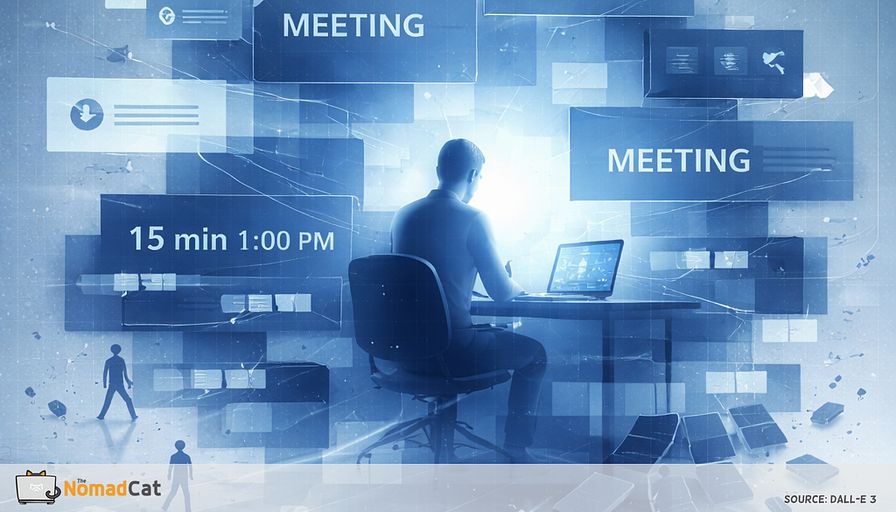
At 10:30, there is a clean little block on the calendar. 15 minutes, labeled “walk” or “stretch”. At 10:27, the meeting before is still going. Someone is screen sharing the last slide. The “quick question” arrives in chat, quick for the sender. At 10:31, a last-minute invite lands for 10:30 with 6 people on it, and declining feels like creating friction for no reason. By 10:36, there are 18 tabs open again, and the body part of the day goes back to “later”.
This fragility is not about motivation. Desk work naturally breaks into short bursts with setup time, meetings tend to run long, and remote coordination adds another layer of interruption load (González & Mark, 2004; Rogelberg, 2019; Yang et al., 2022).
Your calendar is a shared system
A calendar in desk work is less a private plan and more a shared interface. Other people and systems can “write into it” through meetings, pings, and implied urgency. Anything that assumes exclusive access gets overwritten under normal load. Protected time usually works better when it is a team agreement, not a personal wish (Perlow, 1999).
Having 15 minutes on paper is not the same thing as having the authority to use them.
- Can you turn camera off without raising questions
- Can you answer a message 20 minutes later without apologizing
- Can you disappear briefly and come back without needing to explain the gap
Many desk roles quietly reward being reachable, which creates pressure to be always available (Mazmanian, Orlikowski & Yates, 2013). Even email can become visible proof of responsiveness (Barley, Meyerson & Grodal, 2011).
A lot of desk-friendly health tips assume a permission set they never mention. Start on time. Stay uninterrupted. Predictable ending. Those are not personality traits. They are organizational permissions. When those permissions are missing, the “small break” becomes the first thing traded for coordination.
When work preempts your plan
The veto cascade
You block 15 minutes for movement. Then the meeting before shifts by 5 minutes. Then it starts late. Then it runs over. Then someone pings “quick thing”. You answer because it is easier than resisting. The 15 minutes becomes 6. Then it becomes “later”. Then it evaporates into the next block. Then somehow the story turns into you being inconsistent.
A more accurate label is simpler. This is a predictable scheduling collision in a day made of short work bursts, not long quiet stretches (González & Mark, 2004). And every collision has a cost, even when it looks tiny (Mark, Gudith, Klocke, 2008). If the collapse sequence is predictable, it is system behavior. Not a personality mystery.
“I’ll do it later” is uniquely fragile because “later” has no defined shape. The plan had no specified behavior under interruption. No fallback. No safe restart point. No clear re-entry.
In ops language, the routine has no error handling. If you get interrupted at minute 4 of a 12-minute walk, what happens next. Resume for the remaining 8 minutes, restart, or switch to a 90-second option. Without a rule, your brain has to keep the goal alive while context switches happen. That is exactly where goals fade and restarts get messy (Altmann & Trafton, 2002; Trafton et al., 2003).
One honest note: there is no clean universal percentage for “how many planned health actions get displaced by work events”. Anyone who gives you a crisp number is guessing.
The mechanism is boring: intentions don’t reliably turn into behavior on their own, and interruptions make follow-through and restarts worse (Sheeran, 2002; Altmann & Trafton, 2002). So you don’t need a statistic to stop blaming your personality.
Health breaks in multiplayer time
Preemption is not noise
A lot of “interruptions” are not random. Preemption is when a live request arrives with implied priority, because the channel itself pushes you into now. A call beats an email before you even know what it’s about. A chat pop-up with an @mention carries a soft social command even if the content is “can you send me that link”. Channel choice matters because immediate channels inflate urgency by accident (Daft & Lengel, 1986). A “can you…” in chat feels like a fire drill; the same request in email feels like a queue. Add the stress and cognitive overhead of task switching, and the little break loses the fight before it starts (Mark, Gudith, Klocke, 2008).
Telepressure is the feeling underneath. The internal buzz that says answer fast because fast looks safe. Breaks get sacrificed not because they are unimportant, but because they are the only thing in the day that does not complain back. Telepressure is also linked to worse recovery (Barber & Santuzzi, 2015), and the autonomy promise of modern tools often flips into pressure to stay reachable everywhere (Mazmanian, Orlikowski & Yates, 2013).
A useful filter is to separate real emergencies from urgency style.
- Does waiting 30 minutes change the outcome in a material way
- Will a choice become irreversible if it is not handled right now
If both answers are no, it is probably coordination, not an emergency.
The optics tax makes tiny actions feel expensive
In a lot of workplaces, being seen and being instantly reachable are treated as competence signals. Presence can get read as commitment, even when output is the real job (Elsbach, Cable & Sherman, 2010). “Ideal worker” norms add the expectation that a serious person is always available and unencumbered (Williams, Blair-Loy & Berdahl, 2013). The safest posture becomes stillness.
Under monitoring, 2 minutes can be expensive because the cost is not the clock. It is the story. Presence indicators, read receipts, activity dashboards, or just a watchful culture can push people toward defensive responsiveness (Aiello & Kolb, 1995; Moore, Upchurch & Whittaker, 2018). So you get green dot theater. I’ve done it too: moving the mouse like it’s part of the job.
Interdependence adds another cost. When work is tightly coupled, delays propagate. If someone is waiting on a handoff to finish a deck, and another person is waiting on that deck for a client email, a 5-minute “away” is not experienced as private time. It is experienced as future cleanup work. Responsiveness matters more when tasks are linked (Gittell, 2002).
A habit survives shared time when it is legitimate, interruptible, and cheap to explain. If it fails 1 of the 3, it gets preempted, then you blame yourself, then the habit becomes “something I do on quiet days”, which are, funny enough, not on the roadmap.
The interruption ledger
Log the veto not the guilt
The point is not to track your life. It is to capture 5–10 missed moments, like a small bug report. 1 week is usually enough to spot repeats. Keep it blameless on purpose. Messy notes are fine. Perfection is how this turns into another task.
I already track workouts with a Polar H10 and a basic Decathlon watch; the ledger is the same idea, but for interruptions.
A tiny template that fits in 20 seconds
- Intended break or habit
- What preempted it
- Source type: external vs self interruption (Mark et al., 2005)
- Channel and whether it was immediate or negotiated in practice (McFarlane, 2002)
- Deferrable: yes or no
- Implied rule you felt you had to obey:
- reply instantly
- never be away
- camera on
- stillness
- reply instantly
After a few entries, patterns usually appear. It is often 1 meeting that always runs over, 1 time zone that eats your buffers, 1 stakeholder who escalates everything through chat, or 1 block of back-to-back calls that makes any micro break unrealistic. Meeting overruns become a norm when late starts and weak endings are tolerated — no clear last item, no hard stop, no clean close (Rogelberg, 2019). Time famine dynamics help explain why the fix is often collective, not personal (Perlow, 1999).
A pattern is design input, not a verdict.
If the ledger starts to feel like surveillance you are doing to yourself, stop. If it increases anxiety, stop. It is a short diagnostic sprint, not a lifestyle.
Microbreaks have evidence behind them for fatigue and performance, and they do not need heroics to matter (Kim, Park & Niu, 2017).
Small protocols that make breaks legal
Minimum viable coordination beats intention
Desk health fails less on physiology than on permissions. Minimum viable coordination is the smallest shared set of expectations that makes a 1 to 3 minute action socially safe, without starting a culture war or launching a “wellbeing initiative”. It can be local and almost invisible, like a norm inside a team of 6.
It also matches what major guidance keeps repeating in a dry way. Work design and organizational choices shape health outcomes, not just individual effort (WHO, 2022).
Micro protocols that lower the coordination tax
The easiest protocols are not grand rules. They are defaults that remove guesswork about responsiveness.
- Response latency by channel, like chat within 30 to 90 minutes, email same day, calls only for truly time-critical items (Barber & Jenkins, 2014)
- A simple away signal with a return time like “back at 14:10”
- Meeting end-time discipline, including hard stops and clearer closings (Rogelberg, 2019)
- Buffers between meetings treated as real time, not optional overflow (Rogelberg, 2019)
- 1 explicit escalation path for urgent items so everything else stays non-urgent by default (Perlow, 1999)
These reduce the daily tax of explaining yourself. When expectations are explicit, a 2-minute walk stops being a social negotiation repeated 8 times a day.
Small movement is not a rounding error
This is not about winning at fitness during office hours. It is about making small movement doable often enough that it adds up.
Evidence is fairly kind here. Interrupting sitting with very short walking breaks can improve post-meal glucose and insulin responses in controlled settings, even with 2-minute bouts (Dunstan et al., 2012). Reviews also find consistent benefits from breaking up sitting with light activity (Benatti & Ried-Larsen, 2015). Step benefits start showing up at the low end too, with risk reductions beginning around about 4,000 steps per day in large reviews (Paluch et al., 2021).
The trap is making the plan brittle again. A perfect 30-minute block that only works on calm days is not a plan, it is a mood. A better target is a setup that survives overruns, pings, and weird endings.
A boring but honest success test is this. The approach is working if it stays doable under preemption, optics, and unpredictable endings. That is a configuration test, not a motivation test.
The next step can stay small. 1 protocol that reduces ambiguity, and 1 tiny action that fits inside it. Use the interruption ledger as feedback, not as a new boss.
If your 15-minute break keeps getting eaten by overruns, pings, and “quick” asks, it is probably not a character flaw. It is how shared calendars and high-reachability workdays behave. The useful shift is to treat movement like anything else that needs some runtime protection, not like a nice idea that survives only on calm days.
The day is messy. Design for that.
You might be interested by these articles:


Stop losing breaks to the shared calendar

Your breaks keep getting deleted by the calendar

Stop treating breaks like optional when your calendar is shared

Why your 3-minute break still needs permission at work

The green dot trap why empty calendar time still is not yours

Week 2 broke your health plan because it has too much overhead

The Future of Genomic Advances