Abstract:
The article explains “phantom hunger” as a common desk-work bug where a perfectly adequate lunch still fails to feel finished, so around 15:30 you find yourself “reopening the ticket” by orbiting the fridge as if it might contain “new information” since midday, getting brief relief from a small snack and then feeling the urge return. Instead of blaming willpower or assuming you simply need more food, it argues the key clue is specificity: real hunger is broad and comes with clear body signals, while phantom hunger is picky (crunchy/salty, sweet, “something else”) because soft, fast, beige desk lunches eaten with screens on reduce chewing, attention, and meal memory—weakening the brain’s “done flag” for eating and making snacking the easiest mode switch during cognitively demanding, ping-filled work. To avoid fixing the wrong problem, it offers a 30‑second check (“Would a hot, savory, crunchy thing cut this by ~50%?”) and then a simple, desk-compatible intervention: add one “satisfaction anchor” (a single chew/crunch item like carrots or crispbread, a brightness cue like diluted vinegar, savory depth like broth or mushrooms, or a soup/temperature element) in the first three bites to help the meal register as complete, without turning lunch into a project or accidentally increasing intake via too much variety. The recommended approach is a boring 5‑day, one‑variable test—keep lunch the same, add the same anchor, track kitchen laps and afternoon snack episodes—then escalate only if needed to stronger physiology levers like more protein and viscous fiber, while recognizing that fogginess may be circadian dip or sleep debt and that concerning symptoms warrant medical evaluation.
Phantom hunger at the desk
Lunch was fine. A real lunch. You even felt done.
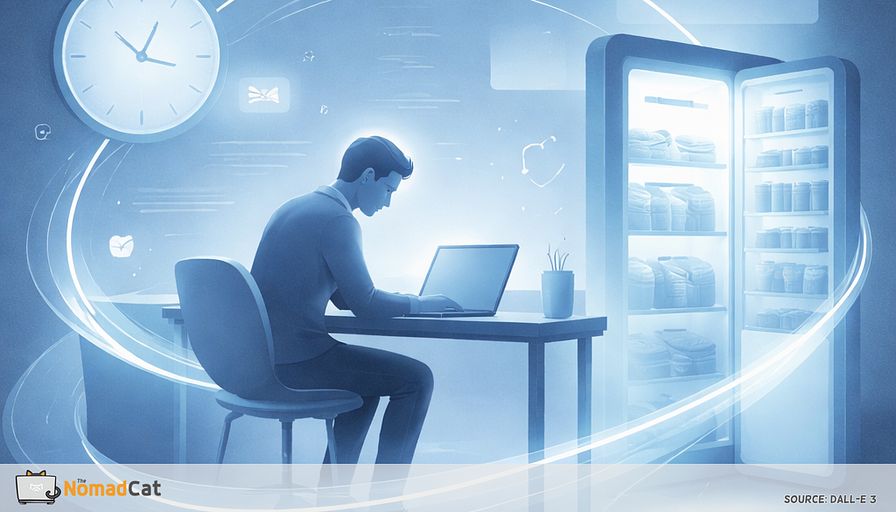
Then 15:30 hits and your brain opens a new ticket anyway. Suddenly you are in front of the fridge like it might contain new information since 12:45. You eat something small, feel better for 8 minutes, then the urge comes back. Not dramatic. Just annoying. And weirdly specific.
This article is for that loop.
I’ve had versions of it across years of desk days in Beijing, Berlin, and now Lisbon. And my wife (fitness trainer + nutritionist) notices the same pattern in people who “eat fine” but keep getting pulled into that mid-afternoon snack orbit.
Not the serious medical stuff. Not the “just have more willpower” stuff either. More like a systems bug that shows up when desk work messes with the signals that normally end an eating moment. The result looks like hunger, but it does not behave like classic hunger. It is picky. It has no clean shutdown.
What you will get here is a practical way to debug the 15:30 pull without turning your day into a food project.
We will cover
- How phantom hunger is different from real under-fueling, and why the specificity is the tell
- Why desk-compatible lunches tend to be soft, fast, and forgettable, and how that weakens satiety signals
- A 30-second check to avoid fixing the wrong problem
- The satisfaction anchor idea, adding 1 signal to make lunch land as complete
- A simple 5-day test with 1 variable so you can see what actually changes, not what should change
If this has been showing up alongside stiff neck, tight shoulders, lower back grumbling, and that post-lunch energy drop that makes everything feel 10% harder, good. Not good like “yay”, good like “ok, this pattern is real.” The goal here is less kitchen-lapping and fewer afternoon snack loops, using changes that fit inside a 10-hour desk day. Perfection not required. A working patch is enough.
The mid afternoon scavenger loop
Lunch was normal. Not a tragic desk salad. A real lunch that should buy a few hours of peace. And yet around 15:30, something shows up anyway. You are back at the laptop, Slack is doing its thing, and you stand up “just to refill water”… and somehow you’re scanning the pantry shelf like it’s a new feed.
You eat something. Relief. Then the urge comes back.
This is the tell: the pull can feel urgent even when the fuel situation is not. If lunch happened with email open and attention split, later snacking tends to rise—treat the screen as part of the input, not as background.
Classic hunger has closure. Phantom hunger often does not. It feels less like body hunger and more like a system that never wrote the done flag.
A practical non-clinical label is phantom hunger. It is often a mismatch between how much you ate and the signals that tell the brain the meal is complete. It shows up when satiety signals are weak, attention is split, and the memory of the meal is fuzzy. Meal memory matters because it can influence later eating.
What to watch for
- Low closure after eating
- A specific pull for something else rather than broad hunger
Why it is not automatically you need more food
The specificity is the tell.
Real hunger is usually broad. Any decent meal sounds good. You get stomach cues, maybe a drop in energy.
Phantom hunger is picky. It wants a specific hit, like something crunchy and salty, or something sweet right after a perfectly fine lunch. That fits what researchers call sensory-specific satiety and variety effects (plain version: your brain still wants a new taste even if you’re basically full).
Desk work also selects for low-signal meals. A lunch can be calorie-adequate and still feel incomplete if the signals are weak.
Evidence-backed levers that often matter
- Protein is one of the more reliable satiety levers in controlled studies
- Viscous fiber (the gel-forming kind—think oats or chia) has stronger satiety effects than fiber as a generic label
- Lower energy density and more volume tends to increase fullness for fewer calories
- Oral processing matters because fast, soft meals reduce chewing time and can weaken satiation signals
- Attention and meal memory matter because distraction can reduce recall of what was eaten and increase later intake
Put that next to a desk lunch eaten in 12 minutes with email open and the bug starts to look less mysterious.
Desk work deletes satiety signals
Desk compatible food gets beige by design
Desk food is selected by the toolchain, not by your nutrition knowledge.
Keyboard hands. Camera on. A meeting that starts 3 minutes after you sit down. No loud crunching. No garlic smell. No real plate because the sink is a negotiation. A microwave that is either missing or socially risky. A lunch that must survive being paused mid-bite when Slack pings.
So the menu skews soft and fast. Yogurt. Hummus. Pasta leftovers. Wraps that behave like edible packing material. Often lukewarm, eaten straight from a container, with just enough flavor to be fine.
That format is easy to consume while barely noticing it, especially with a screen running. With distraction, the bigger problem often shows up later: you don’t register lunch properly, and then the afternoon snack loop gets louder.
Chewing is not a cute detail. It is data.
Less chewing means less oral processing time. That time is one of the inputs that helps shut down eating. Slower eating tends to reduce intake on average. Crunchy is not magic, but longer mouth-time helps the meal count.
Screens reward the fastest mode switch
Desk work keeps the brain in scan mode. Tabs. Tickets. Pings. Mini incident loops.
In that state, food becomes the quickest internal mode switch that does not require leaving the chair. When work is cognitively demanding, later intake tends to drift up—especially if the break is “eat something while still working” rather than “eat, then stop.” Add stress and it is not hard to see how the pattern sticks.
So the point is not screens cause cravings. The point is constrained options.
If a snack reliably rescues the 15:30 slump, the time window becomes a trigger. Even when lunch calories were fine, the brain remembers the pattern more than the macro math. Distracted eating also weakens the memory trace of the meal, and meal memory can influence later snacking.
Quick debug before you fix the wrong thing
A 30 second check
When the 15:30 pull hits, try 1 quick hypothetical.
If a hot, savory, crunchy thing existed right now, would that cut the urge?
Quick rule of thumb
- If it drops a lot (say ~70–80%): it’s probably a sensory gap → try an anchor first.
- If it drops a little (say ~20–40%): could be part sensory, part habit/stress → still try an anchor, but keep debugging.
- If it doesn’t drop at all: start with meal memory and adequacy checks.
If it does not drop, check meal memory.
Can you actually recall lunch. Not macros, the actual meal. If lunch was screen-first and autopilot, it often does not register. With weak recall, later snacking is more likely—so don’t only blame “willpower”; fix the inputs.
If lunch is clear in memory, check for simple under-fueling signs.
If the urge is non-specific and comes with real stomach hunger, shakiness, lightheadedness, or the anything-edible-sounds-good feeling, lunch might simply have been too small. Protein and viscous fiber are common upgrades with decent evidence. If symptoms are strong or you have a condition that affects glucose regulation, this stops being a desk puzzle and becomes a medical question.
Match the fix to the failure mode
- Sensory gap → add 1 contrast element
- Meal memory gap → less screen and slower first bites
- Drift pattern → anchors and a consistent sequence
- Caffeine timing → protect the afternoon window
A fix only works when it matches the mechanism.
The rest focuses on the sensory gap lever because it is small and desk-compatible.
Variety is the trapdoor. Variety tends to increase intake during a meal, especially with energy-dense buffet-style options. So the goal is not adding 4 fun upgrades. It is patching 1 missing signal, then stopping.
The satisfaction anchor that ends the loop
What it is
A satisfaction anchor is 1 deliberate sensory or oral-processing element added to the lunch you already eat, so the meal lands as complete instead of pending.
Not a meal plan. Not a new identity. Not a snack board.
The 1-anchor rule is a safety rail. Too many upgrades becomes variety with better branding, and variety tends to push intake up.
Mental model
Lunch is a background process that should write a done flag. When lunch is rushed, beige, and screen-splitted, the flag sometimes never gets written. So the process keeps running and pings you again at 15:30. Anchors are just completion cues that help the event commit.
Anchor options that survive desks and meetings
If lunch is soft, adding chew is often the simplest missing signal to test.
Crunch and chew anchors
- Raw carrots
- Cherry tomatoes
- Cucumber sticks
- Apples or pears
- Crispbread
- Roasted chickpeas
Boring guideline: low odor, low crumbs, no sticky fingers.
If crunch is socially risky, brightness can work. Vinegar has some evidence for modest post-meal blood sugar blunting with carb-heavy meals, but appetite effects are mixed and sometimes tangled with nausea. Better framing is this makes the meal feel finished, not this suppresses hunger. Dilute it and skip it if it irritates your stomach.
Savory depth is another anchor. Umami can improve how satisfying food feels, while effects on intake are mixed and context-dependent. Practical options that do not turn into a recipe include mushrooms, tomatoes, a small cup of broth, aged cheese, or yeast extract.
Temperature can help mostly through volume and lower energy density, not heat magic. A small soup-first or broth-alongside move can work if it replaces the random snack later.
A 5 day anchor test with 1 variable
Keep lunch stable and change 1 signal
To make this work on real days, keep the experiment boring.
Run a 5-day test where lunch stays the same and you add the same anchor daily. Change 1 variable, observe, decide. Interpret results across the week, not day by day.
Low-friction tracking
- 15:30 status label: steady, snacky, coffee-urgent, foggy
- Kitchen laps: 0, 1, 2+
- Unplanned snack episodes in the afternoon window
- Optional craving intensity 0 to 10 at the same time
- Lunch recall check: can you name what you ate in 1 sentence, yes or no
Placement and timing
Placement solves access. Timing solves signal quality.
Put the anchor where it cannot be accidentally not available at lunch, desk drawer, laptop bag pocket, shelf next to the coffee mug. Defaults and proximity beat good intentions.
Add the anchor in the first 3 bites so it shapes pacing and helps the meal register. Degraded mode note: if lunch gets interrupted, resume with the anchor first, then continue.
Read the results without turning it into a project
When the loop fades
If kitchen laps drop and the craving gets less specific, that is pretty clean evidence the pull was missing sensory or oral-processing signals, not a discipline bug. Keep it boring.
If it works but gets stale, rotate between 2 anchors. Rotation keeps the completion cue fresh without stacking variety.
If it helps but does not end it, move to the reliable physiology levers. Increase lunch protein and viscous fiber. Add solid protein and a viscous-fiber source rather than trying to drink your way out with liquid calories that signal weakly.
When nothing changes
If the pull stays broad and relentless, treat it as adequacy first, not “try harder.” Lunch may be low on basics that reliably reduce later eating—especially when the food has to be portable, low-odor, and meeting-proof.
A useful framing is add, not subtract
- Add a protein portion you can eat quickly between calls (eggs, Greek yogurt, tofu, tinned fish if your office culture allows it)
- Add a high-volume side that doesn’t need reheating (a bagged salad, cut veg, a piece of fruit)
- Add a viscous-fiber item that survives a desk drawer (oats, chia pudding, or a psyllium-fiber add-in if you tolerate it)
If the main symptom is fog and sleepiness, food may not be the primary driver. The normal circadian dip plus sleep debt plus workload can get blamed on lunch because lunch is the easiest knob to touch.
Hydration is a low-risk check, and mild dehydration can worsen mood and fatigue. But “thirst is always disguised hunger” is often overstated.
If symptoms feel off or risky, the correct move is medical evaluation, not more desk experiments. This is about predictable desk-day loops under normal constraints and the goal is fewer repeat loops, not perfect eating under a microscope.
If the 15:30 fridge orbit keeps happening, it is probably not a character flaw. It is a desk-day bug. Soft, fast lunches plus screens can blur meal memory and weaken the “done” signal, so the brain keeps reopening the ticket with a very specific request. The fix does not need a new meal plan: start with the 30-second check so you stop solving the wrong problem, then try the 1-anchor rule—one cue, first three bites, five days, one variable, and keep the patch that actually holds.
You might be interested by these articles:


Your lunch is too fast to count in your brain

Your lunch did not close the loop and the 15:30 snack hunt begins

Your 15:30 snack urge is usually a boredom bug not hunger

Why your lunch feels like background noise in back to back meetings

When stress turns lunch into a 16:30 invoice

Securing the Web's Future

Unlocking EU Market Success: A Startup's Guide to Compliance