Abstract:
The article explains how many people’s 15:00 energy crash isn’t about willpower but about “ambient sugar”—small, unplanned calories that slip in because food is free, visible, and socially permitted, like a meeting-room biscuit, a few bites of someone’s chocolate during a call, or a cappuccino that quietly counts as food, leaving you feeling like you’ve eaten without ever having a real meal. It argues that this fragmented, distracted nibbling creates micro-spikes without a clear “done” boundary, weakens meal memory, and can lead to brain fog, irritability, compulsive coffee, unsatisfying snack loops, and an “18:00 dinner cliff,” especially when liquid or soft calories add energy without making you feel fed. Framed as “debugging” rather than self-blame, it proposes a simple 3-day “exposure audit” that doesn’t count calories—just tracking whether food was visible within ~2 meters for hours, whether you ate something free/left out, and whether you ate without stopping work, then labeling your 16:30 state as steady/foggy/snacky/edgy—to reveal whether the environment is driving the problem. From there, it recommends treating changes like A/B tests by choosing one small lever for five days—put snacks out of sight in an opaque container, enforce a one-location rule so eating doesn’t happen at the desk, or use a tiny “one-plate” step to turn bites into visible units—while noting guardrails for people where timing changes may be risky (e.g., insulin use, pregnancy/gestational diabetes, eating-disorder history) and reminding readers that some fatigue warrants medical attention beyond snack tweaking.
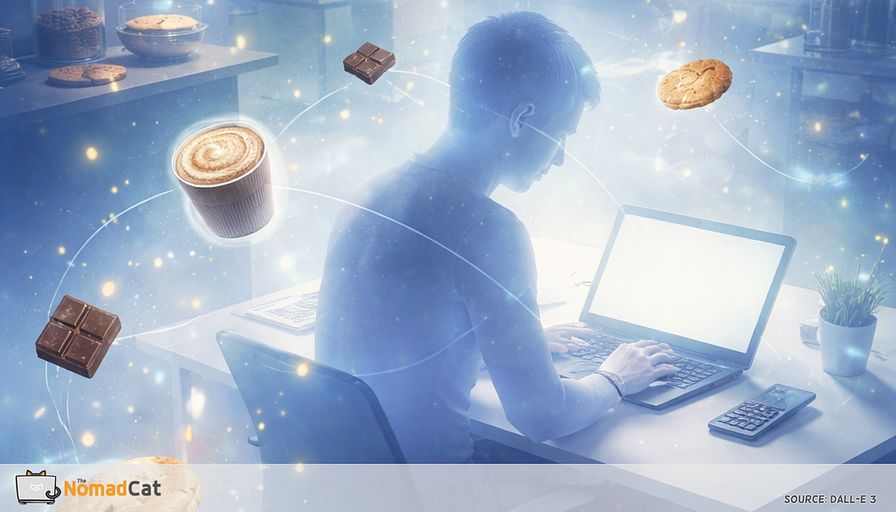
It starts as “nothing.” A biscuit that was just sitting there. 3 bites of someone’s chocolate during a call. A cappuccino that quietly counts as food. By 14:00 you’ve eaten, but you haven’t really had a meal, and the afternoon still shows up with low battery warnings.
This article is about that pattern. Not willpower. Not “being good.” More like background noise, calories slipping into the day because they are visible, free, and socially allowed. The idea is to make the hidden inputs easier to spot, so the 15:00 crash stops feeling random.
This lens comes from years of desk-heavy work across different setups—offices in Beijing, then Berlin, and now Lisbon—where the furniture changes and the snack physics stay weirdly consistent.
You’ll see:
- What “ambient sugar” looks like on office days, home office days, and hybrid commute days
- Why free and visible food overrides hunger for a few predictable reasons
- How distracted nibbling creates micro-spikes that don’t land as a proper “done” boundary
- A simple 3-day exposure audit that doesn’t require counting anything
- 3 small environment levers that reduce the loop without banning snacks
- Quick guardrails for situations where timing experiments are not harmless
If the desk day keeps throwing errors and nobody can find the log, this is the log. Debugging beats guilt. Small changes, inside the schedule, with results you can actually notice by 16:30.
The ambient sugar trap at your desk
Calories you did not schedule
It is 10:30, the day is going fine, tabs under control. By 14:00, without any official “snack break,” there has been 1 biscuit from a meeting room, 3 bites of someone’s chocolate, maybe a cappuccino that quietly counts as food. And still, the body feels oddly under-fueled.
That pattern is less a decision and more background input. Desk cues do a lot of the driving: if food is right there, and it’s normal to take it, your hand can “vote yes” before your brain has an opinion. The meeting-room biscuit isn’t low character. It’s a predictable cue-response loop. (Wood & Neal, 2007)
Ambient sugar (or ambient food) is calories entering the day through proximity, visibility, and social permission, not through hunger or a planned eating moment. It shows up in predictable places.
- Office days: biscuits in meeting rooms, birthday cake, leftover catering, the free snack shelf
- Home office days: kid snacks in open view, cereal on the counter, delivery add-ons you didn’t want, treats parked near the coffee machine
- Hybrid commute days: pastries at the station, lobby carts, coffee queues where the default is snack-plus-drink
This isn’t dramatic. The environment sets it up. Put food in reach and people take more of it; put it in sight and it pulls attention. (Refs: Boswell & Kober, 2016; Bucher et al., 2016; Hollands/Marteau group reviews)
Presence + permission.
It stays invisible because small bites are socially normal, happen mid-task, and attention is elsewhere. And when eating is backgrounded, it doesn’t land in memory as “I ate,” so the day still feels under-fueled later. (Refs: Robinson et al., 2013; Higgs, 2015)
It is like warnings that never make it into the incident log, then acting surprised when the system is unstable.
When free and visible beats hungry
The default wins for 3 predictable reasons
Free changes the category. When the price hits zero, the brain treats it differently than “cheap,” and the snack table wins arguments hunger didn’t even start.
“Help yourself” is a norm. In offices, it’s a tiny social contract. Declining can feel like making a statement, so a lot of people comply on autopilot to avoid 4 seconds of awkwardness.
Friction is asymmetric. A biscuit takes 5 seconds and no cleanup. A real lunch takes time, setup, dishes, and the visibility of “this person is eating now.” When snacks are easier than meals, people predictably take the easy thing more often—then everyone calls it “choice,” like the system was neutral.
Refs: Shampanier, Mazar & Ariely, 2007; Herman, Roth & Polivy, 2003; Robinson et al., 2014; Maas et al., 2012.
Why the crash keeps repeating
Micro-spikes that never become a meal
Small sweet or starchy bites are fast, pleasant, and socially frictionless, so they repeat. But fragmented intake rarely creates the clean “done” boundary of an actual meal. Snacking can fit many patterns and isn’t automatically a problem, but outcomes depend a lot on how it’s done. What the snack is matters too: higher-protein snacks tend to hold better than crackers or chocolate in controlled comparisons. (Refs: Bellisle, 2014; Douglas et al., 2013)
Reducing these bites does not always create a clean deficit, because later meals may increase. Compensation is variable and often incomplete, depending on timing and what the snack was. Practical implication: totals can drift up quietly when the day is a drip feed, even if dinner feels “normal.” (Refs: Almiron-Roig et al., 2013; Bellisle, 2014)
The slipperiest version is liquid and soft calories. A sweetened latte or coffee drink that’s basically dessert can add energy with weaker compensation than the same sugar eaten as solid food. Neutral fact, no moral. It just explains the “I consumed stuff all day and still feel oddly hungry” bug report. (Ref: DiMeglio & Mattes, 2000)
A typical desk day looks like this.
- 10:30 is 1 biscuit (free + visible, often also without stopping work)
- 12:30 lunch is delayed because there was also a latte and 2 bites of something during a call (distracted, sometimes free/left out)
- 14:30 attention is smeared and the body asks for fuel all at once (often after a morning of high exposure)
Distraction makes this worse because the episodes are poorly encoded, so later intake can rise. (Ref: Robinson et al., 2013)
When hunger signals turn into noise
Frequent, small, distracted intake can scramble the signal. Hunger doesn’t build cleanly. Fullness doesn’t arrive cleanly. The result is “snacky-but-unsatisfied,” or “not hungry but still checking the kitchen.” Meal memory is part of appetite regulation, so when eating is backgrounded, later appetite can get louder and less specific. Less willpower, more bad logging. (Refs: Higgs, 2015; Robinson et al., 2013)
The recognition map tends to be consistent.
- 14:30–16:30 brain fog and rereading the same paragraph
- Sharper tone in messages, more impatience in meetings
- Coffee feels required, not optional
And somehow you’re still hovering over the send button, rereading one Slack line like it’s written in legal code. - “I could eat” but nothing sounds satisfying
- Random snacking patches that don’t fix it
- 18:00 dinner cliff, too hungry to decide calmly
Correct diagnosis matters because this pattern responds best to environment tweaks, not pep talks.
A 3-day exposure audit that does not count anything
If afternoons keep going weird, it can help to treat it like debugging. The goal is not perfect behavior. It is to find the silent input channel. This takes under 1 minute per day for 3 normal workdays.
Just tick the flags.
- Visible food within ~2 m for 2+ hours (Y/N)
- Ate something free or left out (Y/N)
- Ate without stopping work (Y/N)
At 16:30, pick 1 label.
- Steady
- Foggy
- Snacky
- Edgy
This format works because exposure recall is easier than amount recall. It points at conditions instead of “being good.” Also, there is no magic validated threshold for “2 m for 2+ hours.” Treat it as a quick diagnostic, not a verdict.
Interpretation can stay simple.
- If foggy or snacky clusters on high-exposure days, the environment is probably driving afternoons.
- If it doesn’t, other levers like sleep debt or caffeine timing may dominate, and there is no need to keep poking the snack shelf.
During the 3 days, the cleanest signal comes from not turning it into an intervention. No aggressive restriction. No compensating by skipping meals.
Make food less ambient without banning it
Pick 1 lever only
Treat it like A/B testing, not discipline. For 5 workdays, pick 1 lever and change nothing else, so the result is interpretable. Small placement and proximity changes shift what people take in the moment, and habits are welded to stable cues more than good intentions. (Refs: Hollands/Marteau group reviews; Wood & Neal, 2007)
Option 1, out of sight. Snacks can stay allowed, just not visually on stage. Put them in a cabinet or an opaque box. Less visibility reduces cue-triggered wanting. (Ref: Boswell & Kober, 2016)
Option 2, one location rule. If you eat it, it happens in 1 spot, not at the desk. Kitchen counter, break area, whatever creates a boundary. This targets distracted intake and weak meal memory, which are linked to higher eating during and later. (Refs: Robinson et al., 2013; Higgs, 2015)
Concrete version: if you’re in back-to-back Zoom, park the snack in the kitchen and only stand up during the calendar gap, not mid-call.
Option 3, one-plate rule, tiny version. Ambient food goes on a napkin or plate first. Yes, even the 1 biscuit. The point is not manners. It is units. People treat a “unit” as the right amount more than they admit, and portion size effects are among the more robust findings in this area. (Refs: Geier, Rozin & Doros, 2006; Hollands et al., 2015)
What success looks like when it works
Success is not “zero snacks.” It is fewer loops and less urgency, especially in the 15:00–17:00 zone.
- Fewer “I need something” checks that end in random bites
- Coffee 2 feels optional again
- Dinner becomes a decision, not a cliff
Light signals, no scoring.
- Fewer kitchen laps
- Fewer “just 1” bites while reading a thread
- A more stable 16:30 label across days
Expect it to feel small day to day. Think packet loss, not a new processor.
Guardrails
If someone uses insulin or sulfonylureas, delaying food isn’t a harmless experiment. Low blood sugar is a real risk, and timing changes should be aligned with a clinician first (NHS/CDC hypoglycaemia guidance).
Pregnancy is a similar category in a different way. With gestational diabetes, meal and snack timing can be part of the treatment plan (ACOG Practice Bulletin 190; ADA Standards of Care; NICE NG3).
And if there is an eating-disorder history, hard rules can quietly become forbidden zones. A safer pattern is a time-limited experiment with gentle language, and stopping if anxiety or rule-thinking spikes (Fairburn, 2008; Tribole & Resch, 2020).
Also, sometimes the afternoon crash is not a biscuit problem. New or severe fatigue, persistent appetite loss, unintentional weight loss, fainting, or rapidly worsening symptoms deserve medical attention first (Merck Manual; Mayo Clinic fatigue guidance). Debugging the desk setup is useful, but it shouldn’t override safety.
If your desk days keep ending in a 15:00 crash, it’s probably not a character flaw. It’s background input: free, visible, socially normal food that slips past hunger and past memory, then shows up later as fog, edgy messages, and the dinner cliff. When you make that channel visible, the fix is usually low-drama—one small boundary that shows up in the 16:30 label within a week.
You might be interested by these articles:


Leftover meeting snacks are breaking your appetite signal

Why your inbox makes you snack and how to break the loop

When stress turns lunch into a 16:30 invoice

Too many micro decisions is why 16:00 snacks get weird

Your lunch is too fast to count in your brain

At 03:00 your brain starts doing reputation management

A productive day can still break your sleep fix the missing downshift signal