Abstract:
The article explains how desk-based, always-on work scrambles body signals and trains many people into “dopamine snacking”: reaching for coffee or something sweet right after a vague, urgent Slack/email ping or during micro-transitions (waiting for a page to load, between meetings, after a tense call) not because of real hunger but because a quick reward briefly relieves stress and uncertainty. It argues this is a predictable response to open loops, social-evaluative pressure, and the heavy switching tax of knowledge work—not a discipline problem—and notes that while sugar or caffeine can feel like an instant “start button,” it often backfires later with dips, delayed meals, louder evening hunger, irritability, and more “rescue coffee.” Instead of prescribing strict food rules, it offers a light-touch “system fix”: run a 3-day, in-the-moment debug log (rating hunger and stress and asking if you’d still want the snack if stress were zero) to identify whether triggers are inbox pressure, conflict, boredom/avoidance, or transitions, then “keep the reward but change the default” by adding about 60 seconds of friction before sweets and choosing a “non-spike” treat first (e.g., sparkling water with something crunchy, protein-forward snacks, nuts, or fruit paired with protein/fat), plus small environment tweaks like putting sweets in an opaque container or farther away. Success, it emphasizes, looks like weaker coupling—fewer phantom cravings after messages and steadier mid-afternoon mood—rather than perfect adherence, with a reminder that on high-telepressure days sleep and stability may matter more, and that anyone at risk of rigidity or eating-disorder distress should stop and seek qualified help.
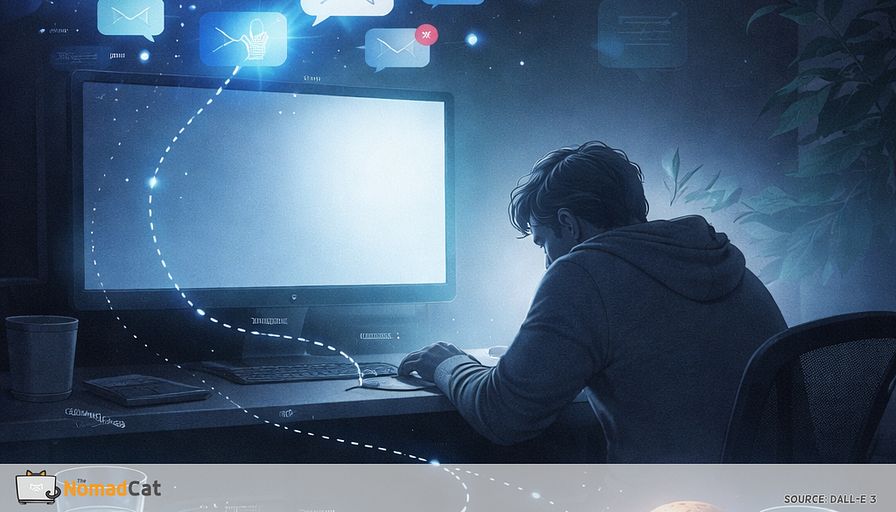
The desk-day has a special talent for scrambling basic signals. You sit down “just for 10 minutes,” then it is meetings, tabs, pings, and a lunch that happens somewhere between 2 calendar invites. By mid‑afternoon your shoulders are up near your ears, your neck is stiff, and you are weirdly tired even though you have barely moved.
I’ve been in Lisbon since 2023, and the remote-work setup changes week to week: different chairs, different desk heights, different “temporary” setups. The pattern stays the same though: upper‑back tightness first, then the weird wired‑tired thing, then the urge for something small and fast.
Then it happens. You check Slack or email. Something vague lands. Slightly urgent, slightly unclear. And before you can even name what you feel, your hand is already doing the familiar thing. Coffee. Something sweet. A quick bite while the page loads. Not because you are hungry, exactly. More like you need a small win to get through the moment.
This article puts a simple name on that loop: “dopamine snacking.” Not in a cheesy brain‑chemistry way, just shorthand for a reward-seeking pattern that shows up when work is built on uncertainty, interruptions, and constant checking. The goal here is not food rules or willpower speeches. It is to make the pattern visible, then adjust the system so it stops pulling the same lever 20 times a day.
A quick roadmap, nothing fancy:
- Name the loop (so it stops feeling like “random lack of discipline”)
- Catch your triggers while they happen (not later, when your brain rewrites the day)
- Keep the reward, but change the default so the afternoon stops wobbling
If any of this sounds uncomfortably familiar, good. That usually means the problem is not you. It is a normal human response to an always-on system. And small configuration changes can matter more than trying to be a different person at 15:40.
The dopamine snack loop at the desk
What dopamine snacking looks like in real time
It starts like this. The cursor hovers over the inbox count. You refresh and there is a new message, vague, urgent, slightly unclear. That “I should answer quickly” pressure is stressful, even if the message is polite (Barber & Santuzzi, 2015). So your hand drifts to coffee or something to eat right after uncertainty lands, not when hunger shows up.
Common tells
- The urge arrives after opening Slack or email, not after noticing an empty stomach.
- It feels like needing a restart more than needing food.
- Coffee is for irritation, not sleepiness.
- Something sweet sounds perfect right after a tense thread, even if lunch was recent.
- You snack while a page loads, then realize you barely tasted it.
- Visibility does the work. A jar on the desk, a delivery app tab, the office kitchen 12 steps away.
“Dopamine snacking” is just shorthand. Nobody is measuring neurotransmitters at a standing desk. It is a way to name a reward-seeking loop that shows up under uncertainty and variable rewards, the same basic learning logic behind a lot of “keep checking” behavior (Schultz et al., 1997).
This is not a character flaw. Put a human in a system that flashes needs attention all day and they will patch tiny stress gaps with the fastest available reward. Environment tweaks often beat willpower speeches (Hollands et al., 2015).
Why the inbox hits so hard
Open loops plus being judged
A Slack ping is rarely just information. Even a polite “quick question when you have 2 min” can feel like a test of speed, competence, and status. That “someone is evaluating me” layer reliably raises stress responses (Dickerson & Kemeny, 2004). Add reply pressure (Barber & Santuzzi, 2015) and your body goes alert while nothing physical is happening.
The switching tax is not subtle
Knowledge work is built from mini-reboots. People switch tasks often in field studies (Mark, González & Harris, 2005). The desk version is not abstract: you reopen the doc, reread the same paragraph three times, then scroll up because you forgot what you were doing.
Even if your own numbers differ, the feeling is familiar. Re-orienting takes effort. Snacks and coffee start to look like the cheapest “start” button.
Snacks latch onto transitions
This is why snacking sticks to boundaries, not every second of the day.
- before opening the inbox
- right after sending a hard email
- while waiting for a build or dashboard to load
- between meetings
- after a tense call
- when a thread goes quiet and you are stuck in “did I mess that up” mode
Transitions are predictable cues, which is why simple if–then rules can work here (Gollwitzer & Sheeran, 2006).
When it works and still backfires
Relief now, volatility later
Sugar or caffeine can feel like a clean patch in the moment. Relief is a powerful teacher. If relief keeps following inbox stress, the brain learns the pairing and starts predicting a reward as soon as the cue appears (Bouton, 2002/2004). Then the snack starts to feel necessary even when it is clearly not hunger.
The cost is often not “more food.” It is later, louder hunger. Small snacks can delay a real meal and then create a more impatient appetite later, because compensation is often imperfect (de Graaf, 2012).
People also report the boost-then-dip pattern. At the desk it looks like this: you feel better for a bit, then an hour or two later you are foggy again, rereading the same paragraph, and suddenly the idea of “something small” sounds perfect again.
A plausible mechanism is blood sugar swinging after a higher-GI snack for some people, with a slump window that often lands 1–3 hours later (Hoyland, Dye & Lawton, 2009). You do not need the mechanism to be perfect for the pattern to be useful: if your 15:30 sweet snack predicts 17:00 irritability + a second snack, that’s a trackable desk fact.
Caffeine is the parallel loop with its own invoice. The cleanest desk-life rule I’ve found is to treat late caffeine like a sleep decision, not an energy decision: caffeine taken 6 hours before bed still disrupted sleep in a controlled study (Drake et al., 2013). If the 16:00 rescue coffee is your habit, you are often borrowing from tonight to fund this meeting.
What the late day looks like
The pattern is usually not dramatic. Lunch at the desk is low-interest. Then 14:00–17:00 becomes polite nibbling between pings. By 20:00 hunger is suddenly loud and impatient, with mild irritability that mysteriously improves after something sweet.
It also shows up as work symptoms. Rereading the same paragraph 4 times. A slightly sharper tone in messages. A micro-error in a spreadsheet. Not one cause, just a common cluster when stress, sleep debt, and unstable fueling stack up (Lanaj, Johnson & Barnes, 2014).
One reason guilt does not help is that mental work can increase intake even though it does not burn many calories. Lab work suggests a small effect with lots of variability (Chaput et al., 2008/2011). Low calorie burn, higher appetite. Annoying, but explainable.
A 3-day debug log for snack impulses
A tiny check that beats end-of-day storytelling
At 18:00, the brain writes a clean story. It edits out the weird moment at 15:40 when the inbox spiked, your shoulders went up, and your hand went to sugar. Real-time logging catches the trigger before memory smooths it into narrative (Shiffman, Stone & Hufford, 2008). Think small bug report, not life audit.
For 3 days only, and only when the coffee or snack impulse hits, log these 3 questions:
- Hunger right now (0–10)
- Stress or upset right now (0–10)
- If stress was 0, would you still want it (Yes / Not sure / No)
Notes app, sticky note, whatever is fastest. Time plus 1 label is enough. Example: “15:40, inbox, hunger 2/10.”
If you’re a metrics person, keep it simple: I sometimes glance at sleep/HRV trends from a chest strap (Polar H10). When sleep tanks, this loop gets louder the next day. That’s not a moral issue, it’s just input → output.
4 useful buckets
-
Inbox trigger
- Urge follows checking tools, unread counts, refreshes, that need to answer now pressure.
- Related to telepressure (Barber & Santuzzi, 2015).
-
Conflict trigger
- Urge appears after socially risky or ambiguous messages, irritation or dread rises first.
- Fits social-evaluative threat research (Dickerson & Kemeny, 2004).
-
Boredom or avoidance trigger
- Grazing when stimulation is low or starting feels annoying and you hover between tabs.
-
Transition trigger
- Urge appears at boundaries between modes. Meeting to deep work, deep work to inbox, just sent the email to waiting.
- A good fit for small if–then rules because the cue is predictable (Gollwitzer & Sheeran, 2006).
A small loop change that still feels like a treat
Keep the reward, change the default
The principle is boring but effective. Keep a reward, just do not make it the same edible spike every time the cue hits.
A simple rule: during any communication-trigger moment, default to a non-spike reward first, and add 60 seconds of friction before sweets or rescue coffee. Small frictions and defaults can shift behavior without needing motivation exactly when your brain is already busy (Hollands et al., 2015).
What counts as a non-spike reward
Non-spike here means still satisfying, but less likely to kick off the rebound cycle.
- water or sparkling water plus something crunchy and neutral
- a protein-forward snack like Greek yogurt, cottage cheese, eggs, jerky
- nuts, small handful
- fruit paired with something fattier or protein-ish
The point is not purity. It is keeping the “ah good, a small reward” feeling with less volatility.
Friction that protects future you
Friction is not punishment. It just gives the default a chance to win.
- Put sweets in an opaque container, not a clear jar.
- Move the fun stuff to another room or at least a high shelf.
- Keep the non-spike option closer than the spike option.
- For coffee or sweets, require finishing the next 10-minute work block first.
Proximity and visibility matter, usually with modest impact, not magic (Bucher et al., 2016).
Desk-life signals that the coupling is weakening
What to notice, not what to track
When this works, it often looks like work outcomes, not nutrition perfection.
- fewer phantom cravings right after messages
- less late-day rescue coffee
- steadier mood and patience in the 14:00–17:00 window
- fewer snack-driven delayed meals and then loud hunger later
If sweets still happen sometimes, fine. The goal is weaker coupling, not zero treats.
Expect the loop to return on hard days
Conflict-heavy days can bring the old pattern back. Learning relapse is context-dependent (Bouton, 2002/2004). The win is noticing earlier, inserting the 60 seconds, and giving the default reward a chance.
When the safe move is boring stability
If your role is high-urgency and telepressure is basically the job, sleep is often the main leverage point, not perfect snack timing (Lanaj, Johnson & Barnes, 2014). If your sleep metrics are sliding, treat that as a leading indicator: tomorrow’s “mysterious cravings” are often already booked.
Also, if blood sugar regulation, pregnancy, or meds are in the mix, predictable intake and cautious caffeine use within safety guidance (EFSA/FDA/Health Canada) tends to be a safer priority.
If any of these tools increases rigidity, food preoccupation, compensatory behaviors, or distress, that is a signal to stop. NICE NG69 and the APA (2023) eating disorders guideline are solid references, and SCOFF is a common screening pointer (Morgan et al., 1999), but qualified help beats DIY rules here.
Desk work is weirdly physical. A day of pings, open loops, and constant switching can leave you stiff, wired, and tired, even if you barely stood up. In that state, “dopamine snacking” is not a lack of discipline. It is a predictable loop where uncertainty lands, stress spikes, and the fastest reward nearby does its job.
The useful shift is simple: make the pattern visible, then change the defaults. A 3-day debug log can show whether the urge is hunger or inbox pressure. Then small frictions and a non-spike reward first can keep the treat feeling without the late-day dip, loud hunger, and extra rescue coffee.
Most days it is not hunger first. It is the inbox. Once you see that, the day gets easier to steer.
You might be interested by these articles:


Your lunch did not close the loop and the 15:30 snack hunt begins

Lunch happened but your body stays online

The 3 minute exit handshake that stops the dinner cliff after deep work

Your desk is drip feeding carbs and the 16:00 crash is the error message

The 90 second gap after calls that sends you to the fridge

Revolutionizing Industries with 3D Printing

Satellite Communication Advancements