Abstract:
The article explains a common, non-dramatic pattern where mentally noisy workdays—full of Slack pings, stacked meetings “like Tetris,” and the feeling of having 12 browser tabs open—quietly derail eating, not through lack of care but through depleted decision capacity; it names this “decision-heavy drift,” marked by mid-to-late afternoon restlessness (often 15:00–17:30) where you wander to the kitchen like opening a new tab, snack cravings don’t “close the loop,” and “now” beats “real food in 10 minutes.” It argues lunch can technically happen yet barely register when eaten under load, because speed and convenience drive choices toward low-chew, low-fiber, low-protein meals (the sandwich becomes mostly bread, salad becomes decoration, protein feels optional—like clicking “accept all cookies” just to make the pop-up go away), which sets up the predictable 16:00 crash, sharper tone, more errors, and extra caffeine pull (“No, Slack is not cardio”). Rather than relying on willpower, hydration hacks, or idealized meal prep, it frames the problem as a systems bug to debug: change upstream defaults by using a “1 decision lunch rule” (a simple template of protein anchor + fiber anchor + carbs as needed) and a pre-decided “spillway snack” (protein-forward with some fiber/volume, like yogurt/skyr, edamame, hummus and veg, tuna and crackers, or fruit and cheese) so there’s less in-the-moment negotiation. It also offers a minimalist 3-day diagnostic—label decision density, 16:00 state (clear/drag/crave), and whether lunch was one decision or many, with optional hunger/sleepiness checks—to distinguish decision load from sleep debt, while emphasizing flexibility, avoiding moral language, and pausing for support or medical advice if tracking becomes rigid or symptoms are concerning.
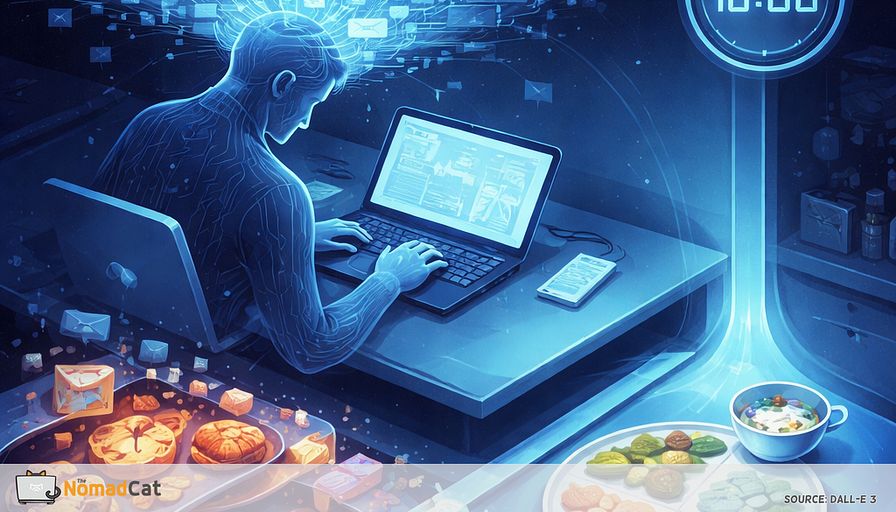
Nothing is melting down, but somehow the day still feels like it is. Slack pings, meetings stacked like Tetris, and that weird mental sensation of having 12 tabs open even when you are staring at 1. You are not doing “big” work. You are doing 70 tiny decisions on repeat. And somewhere around 16:00, food starts getting… messy.
This article is for that exact kind of day. Not the dramatic “i had a crisis so i ate chips” story. The quieter pattern where lunch technically happened, but it barely registered. Then the snack loop starts. Not because you don’t care, but because your brain is already at 90% CPU and keeps choosing the easiest option available.
For context: i’ve spent most of my working life in desk-heavy tech roles (Berlin 2017–2023, now Lisbon since 2023/2024), so this is written for the calendar-packed, screen-heavy version of “normal.” I’m also annoyingly physics-brained about it, and my wife (fitness trainer + nutritionist) is the reason you’ll see me keep pointing to the boring stabilizers.
Here’s what you’ll get from the rest of the piece
- A simple name for the pattern, decision heavy drift, and the quick signals that separate it from normal hunger
- Why lunch can feel like it never happened when you eat under load, plus what tends to go missing (usually the boring stabilizers)
- How cognitive load makes fast, sweet, salty options feel like the only reasonable choice in the moment
- A small failure map for the 16:00 crash so it stops feeling random or “personal”
- Practical defaults that reduce decisions instead of demanding more willpower, including a 1 decision lunch rule and a pre decided spillway snack
- A 3 day diagnostic that gives useful signal without turning your week into a spreadsheet
- Safety guardrails if tracking backfires
The vibe here is not perfection. It is debugging. When the workday is loud, food decisions become a systems problem, not a character test. And systems, at least, can be configured.
When micro-decisions push you off track
A normal day that is still mentally loud
You are not doing “big” work, just constant small work. Approve this, clarify that, pick the order, reword the sentence, decide if you answer now or later, re-prioritize again.
On days like this, food choices don’t fall apart because you “don’t care.” They fall apart because your attention is already spent on other stuff. If you want a quick check, a simple “how heavy did today feel” rating is often enough.
The pattern behind the urge to graze
Call it decision-heavy drift. It is when a high-choice day quietly degrades food decisions, so the afternoon gets unstable even if lunch happened.
Lunch can be on the calendar and still barely count. You eat while reading emails. You build something fast. It’s light on what keeps you steady. Then the body asks for “something” at 16:00, and the brain picks whatever is closest.
To keep it usable, here are quick tells that separate this from ordinary hunger.
The 10-second signals that this is capacity, not hunger
This shows up a lot in the mid-to-late afternoon window, often around 15:00–17:30.
- You go to the kitchen like you open a new tab. Not because you chose a snack, but because you lost the thread.
- You eat a thing, then 10 minutes later you want another thing. The loop does not close.
- The urge feels like restlessness or itch, not clear stomach hunger.
- The pull spikes around 15:30–17:00, when attention is fragmented and the day starts to feel long.
- Stress can be there, but the main signature is cumulative micro-decisions and constant switching.
What decision-heavy drift is not
- Not just a timing problem. Lunch can happen and drift still happens.
- Not classic stress snacking from 1 bad moment. This one is more like a slow CPU tax.
- Not a hydration trick. Water can reduce noise, but it does not fix the decision surface — the pile of tiny choices you have to make to get food.
- Not always hunger. Sometimes it is sleepiness wearing a hunger mask.
Also, if lunch was distracted, later intake often goes up. Not magic. More like the meal didn’t fully register.
Why lunch can feel like it never happened
Speed wins when attention is scarce
Under load, lunch becomes a meal signal problem. The brain picks food that is fast to get, fast to eat, and fast to feel. That often means less chewing and fewer “ok i’m full” cues.
A concrete check: if lunch took under 7 minutes and you never stopped typing, assume it didn’t “register” and plan the spillway snack.
Decision load also pushes people into whatever default is easiest. The sandwich becomes mostly bread because it’s simple. Salad becomes decoration. Protein becomes optional because each extra “what should i add” is one more tiny decision. It’s like clicking “accept all cookies” just to make the popup go away.
Then 15:30 arrives and you see the bug report. A low-chew, low-fiber, low-protein lunch tends to bring hunger back sooner and make cravings louder. Stability usually comes from boring structure like enough protein, fiber, and volume, not from heroic discipline.
Why fast food wins under load
Bandwidth depletion looks like hunger
When the day is overloaded, the “i need something” signal gets noisy. After the 4th context switch and the last-minute calendar reshuffle, hunger, boredom, tiredness, and low focus can all land as the same itch: something, now. Like getting a generic error message, the brain reaches for the fastest fix. Often sweet, salty, or caffeinated.
Under load, the future is less convincing. “Real food in 10 minutes” loses to “something now in 30 seconds.” This is not a character flaw. It’s a normal shift toward immediate relief when your brain is busy.
Mental work can increase opportunistic eating
There is a slightly annoying effect where the body behaves as if you “earned” extra food, even when you didn’t move. No, Slack is not cardio.
Still, your brain invoices you.
Some people call this “willpower ran out.” A safer framing is reduced capacity in the moment. And it’s not evenly distributed. If attention slips are already common, the drift can hit harder.
One more thing. If food rules get rigid, the loop can get worse, not better. So it helps to avoid moral language and avoid turning meals into a test.
A simple failure map for the 16:00 crash
The chain that creates the 16:00 signal
On decision-dense days, the chain is boring and repeatable.
- Decision density rises
- “Now” wins more often under load
- Food choice drifts toward the tasty default when attention is busy
- Satiety drops and volatility rises around 15:30–17:00
- The 16:00 crash appears and the snack loop starts
The reliable leverage point is earlier than cravings. Change defaults upstream, not negotiate with your brain at 16:07.
The fiber-and-satiety/">satiety node that stops endless snacking
The most useful breakpoint is simple. Satiety fails when lunch is too light on boring stabilizers, mainly protein and fiber.
Concrete example. Keep the sandwich, just add a side protein like yogurt, eggs, or tuna. Boring but effective.
The hidden bill you pay at work and at night
By late afternoon, the cost is rarely “extra calories” on paper. It shows up as shorter tone in messages, lower patience, more small errors, and a stronger pull for caffeine.
Sleepiness can look like hunger, so a quick sleepiness check can help separate the 2. Add stress and the pull toward very palatable food gets easier to trigger.
Why the usual fixes miss on high decision days
Symptom tweaks are not the same as changing defaults
The leverage point is not more effort. It is fewer decisions at the exact moments your brain is overloaded. Water can reduce some noise. Caffeine timing can help. But neither changes the choice mess when the day is packed.
Meal prep also gets oversold as the hero. In real life, a lot of people have 0 time, 0 kitchen, or 0 desire to spend Sunday building lunch boxes like it’s an Ikea project.
The lighter move is pre-deciding. You remove the in-the-moment pull by deciding earlier. Habits run on cues and defaults when attention is thin.
With guardrails. The goal is adequacy and ease, with flexibility, and zero moral language around food.
2 defaults that shrink the choice surface
The 1 decision lunch rule
Workday lunch gets 1 decision. Everything else is a template. The point is not to eat “perfect.” It is to stop lunch becoming another micro-decision cluster when your brain already has max tabs.
A simple template
- Protein anchor + fiber anchor + carbs as needed
No macro math required. Just a constraint that prevents composition drift.
Office-real defaults that usually survive cafeterias, delivery apps, and corner stores
- Sushi plus edamame or a side of tofu
- Grain bowl with double protein, and extra veg
- Sandwich plus a protein side like yogurt, eggs, cottage cheese, or tuna
- Salad plus a real protein add-on
- Soup plus a side protein, or soup and a cheese or yogurt
- Convenience store combo. Skyr or yogurt plus fruit plus nuts
- Vegetarian option. Hummus or beans plus whole grain bread plus veg
These are boring on purpose. Like good infrastructure.
The decision spillway snack
On high-decision days, a useful move is a spillway snack, something pre-decided that you eat for stabilization, not as a reward decision.
The rubric
Boring work-compatible examples
- Greek yogurt or skyr, optionally with berries
- Cottage cheese plus fruit or tomatoes
- Edamame
- Hummus plus crunchy veg
- Tuna plus crackers plus veg
- Apple or pear plus cheese
- Roasted chickpeas or lentils
If 3 to 5 options are approved in advance, the brain does not need to negotiate when it is already running hot.
A 3-day diagnostic
The tiny log that shows what really drives 16:00
Keep it to 3 workdays and track 2 labels plus 1 checkbox. This is debugging, not food tracking.
Copy-paste version
-
Decision density today. low / med / high
-
16:00 state. clear / drag / crave
-
Lunch choices. ☐ 1 decision ☐ many decisions
Two optional controls so you do not blame lunch for sleep debt
Optional means optional.
-
Hunger 0–10 at 16:00
-
Sleepiness 1–9 using a quick check
After 3 days, look for the simple pattern. If high decision density lines up with crave at 16:00 even when lunch timing is similar, defaults and pre-decisions are probably the right lever. If sleepiness dominates, the lever is more likely sleep, schedule, or sometimes a medical check if fatigue is extreme or persistent.
Safety note (once, and only once): if you have an ED history, or if any tracking makes you rigid or compulsive, skip the log and stick to the 2 defaults. If you notice dizziness, fainting, or severe daytime sleepiness, pause experiments and get medical advice.
What success looks like on high decision days
Templates are tools, not rules. Practical wins look like
- 0 to 1 snack loop, not the infinite tab refresh
- No urgent 2nd coffee after 14:00–15:00
- Less sharp tone in late messages
- Dinner appetite normal, not explosive
Some days are just high load and the best result is “less damage,” not a perfect plate.
Decision-heavy drift is not you being “bad at food”. It is a predictable bug that shows up when your brain is spending all day on micro-choices. Lunch can happen and still not land, especially if it is low on the boring stabilizers like protein, fiber, and volume. Then 16:00 arrives, attention is fragmented, “now” wins, and the snack loop starts like a browser tab you didn’t mean to open.
The fix is not more discipline. It is fewer decisions at the exact moment capacity is low. A 1 decision lunch template and a pre-decided spillway snack reduce negotiation, lower volatility, and usually makes the rest of the day less sharp, less caffeine-y, and less chaotic.
You might be interested by these articles:


Your lunch did not close the loop and the 15:30 snack hunt begins

Your desk lunch is not registering and your 15:00 brain pays for it

Your 15:30 fridge loop is a missing done signal from lunch

When stress turns lunch into a 16:30 invoice

The 11:00 desk dip behind your typos and tab pinball

Find your real risk dna for a tech career that fits you

AI and Innovation: Unlocking Opportunities in Europe's Energy Puzzle