Abstract:
The article explains why many people drift into a “post-call fridge loop” in the brief gap right after a meeting ends—when the red dot disappears and the calendar looks free, but the body is still stuck in “perform and defend” mode—leading to automatic, standing-at-the-fridge grazing that feels less like eating and more like checking an inbox: open, scan, close, repeat, resulting in five micro-bites, barely noticed taste (texture stands out), and a lingering unsatisfied feeling. It argues this isn’t a discipline failure or even always true hunger, but a transition problem driven by powerful endpoint cues, stress timing, and autopilot “cached scripts,” compounded by the fact that distracted nibbling is memory-poor so people undercount it and can’t fix it by perfect tracking. The main leverage point is the first 90 seconds after the call, where the author proposes a deliberately “boring,” optics-safe buffer—no new input, a few sips of water, two slow breaths with longer exhales, and a 10-second far gaze—to interrupt the automatic branch toward the kitchen without adding another complicated plan; if you do eat in that trigger window, a simple one-constraint rule (one protein/legume/dairy anchor plus one fruit/veg/whole grain) helps the snack actually “land” rather than reopening cravings. Progress is measured with practical signals (no rapid second snack, less coffee urgency, fewer kitchen laps, dinner feeling like a decision again) and an optional 10-second neutral “debug log,” while noting that sometimes it really is delayed hunger or a chaotic schedule, and that persistent appetite or weight issues warrant clinician support.
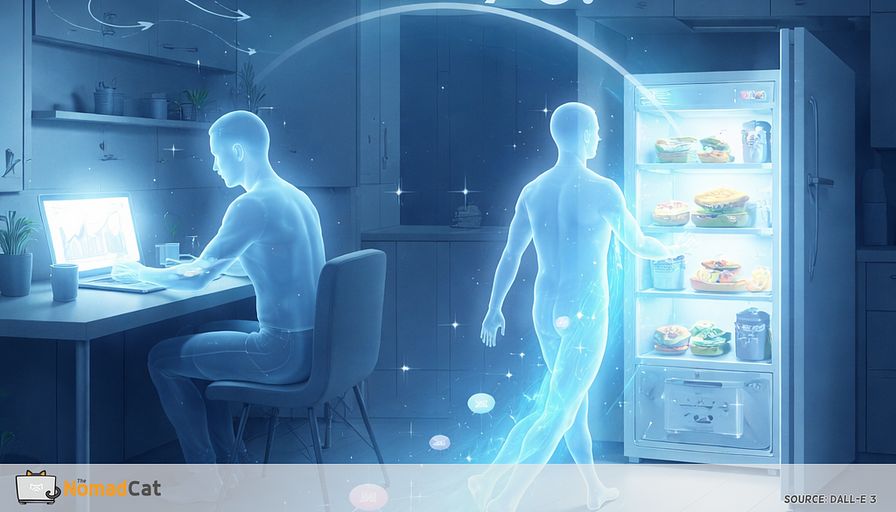
The call ends. The red dot disappears. Your calendar has this tiny, suspicious gap that looks like freedom.
But your body doesn’t switch modes that fast.
So you stand up, still half in “perform and defend” mode, and somehow you’re at the fridge before you’ve even decided you’re hungry. Not a real snack, not a proper break. More like refreshing a feed. Open, scan, close. Repeat. I’ve spent most of my adult life at a desk, and the remote years made that fridge door feel even closer than the coffee machine ever was. You walk away with 5 micro-bites and the same vague unfinished feeling.
This article is for that exact 30-second window.
Not to add another plan, or another app, or another thing to be good at. The goal is simpler. Understand why this specific kind of snacking shows up right after meetings, why your brain barely logs it, and where the small leverage point actually is.
Here’s the map, in plain terms:
- A clear picture of the “post-call fridge loop” and why it doesn’t behave like normal hunger
- The difference between real delayed hunger and urgency that’s really a downshift request
- Why endpoints and transitions are such strong cues, even when intentions are solid
- A boring-on-purpose 90-second buffer that blocks autopilot without making your day weird
- A 1-constraint snack rule for the moments you do eat in that trigger window
- Simple ways to tell it’s working without turning life into a tracking project
If the pattern feels familiar, good. It’s not a character flaw. It’s a transition problem with decent odds of improvement using small, schedulable fixes.
The mode switch you never notice
That 30 seconds after the last call
The meeting ends, the Zoom window closes, and the calendar suddenly looks empty. You close the laptop, Slack still blinks, and your shoulders stay up near your ears like they didn’t get the memo.
There’s a tiny gap where your brain says “free” but your body is still in perform-defend mode. And in that gap, your feet start moving before you decide. One moment you’re scanning the last thread, the next you’re pulling the fridge door with the same precision as clicking “leave call”.
This is less about discipline and more about transitions. It’s the same mistake as opening the wrong app because your fingers start the sequence before your brain votes yes (an “action slip”) (Norman, 1981). Endpoints are messy, so the brain grabs a default script. Repetition turns “call done” into a cue for “kitchen” (Wood & Neal, 2007).
The loop that hides in plain sight
What makes it different from a normal snack
This has a specific shape. It looks like eating, but it behaves like checking something.
- You eat standing up. No plate, no chair, no meal mode
- It’s not 1 snack. It’s 5 micro-snacks
- The fridge opens like an inbox. Quick check. Close. Repeat
- You don’t pick a food. You pick a feeling
- Taste barely registers. Texture does, weirdly
- You walk away slightly confused. Still not satisfied
That last part matters. If it doesn’t close the loop, it’s often not hunger. It’s more like trying to change state.
Why your brain undercounts it
Distracted standing intake is memory-poor. It leaves weak traces, like logs written to the wrong file. That’s not dishonesty, it’s just how attention works. The worst part is the story after: “I wasn’t even hungry, what is wrong with me.”
People tend to underreport everyday intake, especially small, easy-to-forget bites (Livingstone & Black, 2003). In-the-moment sampling also catches more of those tiny episodes than end-of-day recall (Shiffman, Stone & Hufford, 2008). So if your brain fails to log it, any fix has to work without perfect logging.
When urgency pretends to be hunger
The urge is often a downshift request
During the task you might feel no hunger at all. You’re in camera-on, brain-on mode, running on tension and attention.
Then the endpoint lands, the pressure drops, and suddenly the body wants something now. Not because you got weak in the last 3 seconds. More because the system wants to shift gears fast, and food is a very available lever.
Stress can do that. Under acute stress, attention and control can get less reliable, especially right around the stressor (Arnsten, 2009). Other work suggests stress can also affect executive functions depending on timing and task demands (Shields, Sazma & Yonelinas, 2016). Translation, your brain isn’t always at its best right after effort.
The first 90 seconds choose the branch
The urgency concentrates in a small window. Often the next behavior gets picked before you even put words on it.
That’s why big intentions lose to small cues. Habits can run even when intentions disagree, like a background process that doesn’t ask permission (Neal, Wood & Quinn, 2006). Endpoints are powerful cues because they’re consistent and clean.
One quick sanity check before you treat this as a pattern. Sometimes it really is delayed hunger because lunch was basically coffee plus vibes. But if the pull is immediate, sharp, and oddly mechanical, the leverage is usually in the first minute, not in the pep talk after the fridge is already open.
Quick checks before blaming hunger
3 lookalikes
Not every snack after work is “whiplash”. These 3 situations can look similar.
Calendar compression
You’re not reacting to an endpoint. You’re paying a debt. Lunch never happened, and the next meeting starts in 4 minutes. On those days, “the gap” isn’t a gap. It’s a trapdoor to the next thing.Stress-muted appetite
Some people get the opposite of cravings during the task. Appetite goes quiet, even water feels annoying, then the body comes back online later (Greeno & Wing, 1994). A simple diagnostic is timing.
- Did the urge start because the meeting ended
- Or because it’s been 4 to 6 hours since food
-
Decision fatigue stories
The classic “willpower battery” idea took hits in big replications (Hagger et al., 2016). A safer framing is that sustained demands shift attention and motivation toward easier rewards (Inzlicht & Schmeichel, 2012). Practically, you don’t need a grand theory. You need a precise trigger and a small patch at the seam.
Transitions run cached scripts
Why fast reward suddenly looks logical
Work stress is not just thinking. It’s being evaluated, even when nobody says it out loud.
After intense focus, the brain tends to overweight what gives relief right now, and undervalue what only pays off later. Under load, “sweet, salty, crunchy, caffeine” doesn’t show up as a bad decision. It shows up as a quick tool for a fast state change.
You can think of it like workplace priority inversion. The tiny urgent ticket “make me feel normal in 15 seconds” jumps ahead of the important ticket “eat in a way that helps at 6pm”.
Also, not everyone reacts the same way. Some people eat less when stressed, others reach for more palatable foods after stress, and performance-pressure stress can pull harder than quiet work. If the meeting felt like a performance review in disguise, the post-meeting fridge pull is not random hunger. It’s timing plus context.
A 90 second protocol that is boring on purpose
The 90 second downshift that blocks autopilot
If you work in camera-on culture, the downshift has to be optics-safe and not “now everyone watch me do breathing exercises”.
This is a 90-second buffer right after an endpoint. It’s meant to block the auto-launch of the kitchen script, not to make you calm or enlightened.
- No new input for 90 seconds. No Slack, no email, no news, no “just quickly”
- Sip water. 3 to 6 sips
- 2 slow breaths. Longer exhale than inhale if possible
- Look far for 10 seconds. Out a window, across the room, anywhere that is not your screen
Micro-breaks can help with well-being and performance (Kim et al., 2017). Even small breaks between meetings reduce stress signatures compared to back-to-backs (Microsoft Research, 2021). That’s the point here: you’re not “resting,” you’re preventing the next tab your body opens from being the fridge. And video calls keep you “on” through nonverbal load and self-view (Bailenson, 2021).
The bar is low. If the only win is “did not end up at the fridge on autopilot,” it counts.
Versions that survive real days
Good
Stay seated. Feet on the floor. Do the window-stare version.Better
If it’s socially possible, go camera-off for 30 seconds at the end of the call, or ask for 30 seconds of silent note-taking.Worst-case
Ugly day mode is 20 seconds. 2 long exhales, sip water, done. Not elegant, but it works. And honestly, some days I take what I can get.
A protocol that only works on perfect days is not a protocol.
The 1-constraint snack rule
If you eat in the trigger window, make it 2 components.
1 protein or legume or dairy anchor plus 1 fruit or veg or whole grain.
This is a constraint, not a diet. It’s not trying to ban treats. It’s trying to avoid pure patch calories that spike relief fast and then reopen the loop.
Protein snacks often improve fullness compared to lower-protein options (Leidy et al., 2011). Fiber helps with satiety (Howarth et al., 2001). Higher-volume lower energy density foods can make portions feel like they actually land (Rolls, 2010).
Fast examples
- Greek yogurt + berries
- Cottage cheese + cherry tomatoes
- Cheese + apple
- Hummus + carrots
- Edamame + orange
- Tuna pouch + cucumber
- Hard-boiled eggs + grapes
- Kefir or milk + banana
Quiet, fast, and low-drama beats ideal.
How to tell it’s working without turning into a tracking app
Calories are hard to recall and easy to argue with. The loop is not.
Watch for simple outputs that say the seam is getting less sticky.
- No immediate 2nd snack within 10 to 15 minutes
- No coffee urgency within 1 hour
- Dinner feels like a decision again, not a rescue mission
- Fewer autopilot kitchen laps
Very light self-monitoring can help behavior change even when imperfect (Harkin et al., 2016). In-the-moment prompts catch the tiny episodes memory deletes later (Shiffman, Stone & Hufford, 2008).
A 10-second debug log
Not a food diary. More like logging errors while the stack trace still exists.
What ended
What I ate or drank in the next 5 minutes
Did the loop close yes/no
Keep the tone neutral. No guilt language. Just data.
The map you can keep in your head
The loop in 7 steps
- Hard call ends
- Nervous system still elevated
- Control is briefly less reliable (Arnsten, 2009)
- Brain seeks fastest state change
- Sugar, caffeine, salty crunch look efficient
- Brief relief reinforces the choice
- Rebound craving and late-day crash
The seam lever that changes the next branch
Insert a boundary at the seam. Not a life plan. A small guardrail between “task ended” and “kitchen script”. That’s what the 90-second buffer is doing.
Small credibility note because otherwise it sounds too clean. Some days it will still be hunger. Some days it’s poor sleep. Some days the calendar is a trash fire and the buffer gets deleted. Direct “camera-on call ends then snacking” studies are limited, so treat this as a testable model, not courtroom proof.
If appetite loss is persistent, weight changes are unintentional, or eating starts to feel rigid or genuinely distressing, stop running DIY protocols and talk to a qualified clinician. This should feel lighter over time, not heavier.
That post-call gap is real. Your calendar says “free,” but your nervous system is still in perform-defend mode, so the brain grabs the nearest cached script. For a lot of people, that script is the fridge loop. Not real hunger, more like a fast downshift request with 5 micro-bites and zero satisfaction.
The good news is you don’t need another plan. You need a seam. A boring 90-second buffer with no new input, a few sips of water, 2 slow breaths, and a far look can interrupt autopilot without making your day weird. And if you do eat in that window, the 1-constraint rule helps it actually land. Protein plus fruit or veg or whole grain.
Small signals matter. Fewer kitchen laps. Dinner feels like a choice again. If the seam gets calmer, the rest of the afternoon stops feeling like damage control.
You might be interested by these articles:


The 3 minute exit handshake that stops the dinner cliff after deep work

When stress turns lunch into a 16:30 invoice

Lunch happened but your body stays online

Ambient sugar is why your afternoon feels underfueled anyway

Why your inbox makes you snack and how to break the loop

Next-Gen Satellite Tech Trends

Your workday ended but your brain is still on duty at 23:40