Abstract:
The article explains that on meeting-packed, camera-on workdays, coffee becomes the “only runnable breakfast” because sipping looks like you’re still working while chewing requires time, two hands, cleanup, and a socially visible boundary that back-to-back calls don’t allow, so the calendar effectively “edits” appetite and prices lunch out until hunger finally hits hard around 17:30 and dinner turns into a recovery event. It describes a common loop—coffee as the boot sequence, then a token bite (banana, plain yogurt, nuts), then coffee #2 as the most reliable “module” to bridge an early-to-mid afternoon energy valley that’s often circadian (“post-lunch dip” isn’t always caused by eating), which can escalate into later caffeine that disrupts sleep (e.g., research noting 400 mg can impair sleep even 6 hours before bed), leading to a mechanical-feeling day of rereading the same line three times, sharper tone, and “packet loss” before hunger feels real. Instead of moralizing or prescribing idealized 20-minute lunches, it argues for low-friction guardrails that work under load—simple if-then rules like “coffee #2 requires a chewable co-pilot” or “no coffee after the first meeting block unless something chewable happened,” with degraded modes like delaying coffee #2 by 20 minutes or switching to half-caf—paired with “desk-legal” micro-fuels that take 2–4 quiet minutes (Greek yogurt/skyr, fruit, nuts, cheese stick, boiled eggs, hummus and veggies, bread with peanut butter, small leftovers off camera). The core message is to protect one small, repeatable eating boundary your schedule can’t delete so coffee stays a useful tool rather than a stealth meal replacement, improving mood, focus, and sleep without turning eating into a rigid nutrition project, while noting that anxiety, compulsiveness, or relevant medical histories are cues to stop DIY experimenting and seek qualified support.
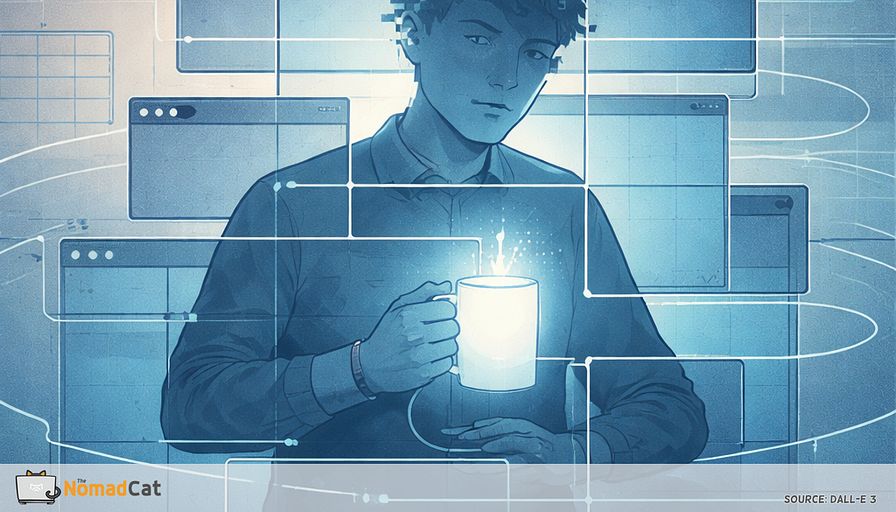
Coffee works because it’s the only breakfast that doesn’t require permission.
On a day stacked with back-to-back calls, food needs a boundary. A plate needs 2 hands. Chewing needs you to be “away” for 6 minutes. Meanwhile, sipping looks like you’re still working. So coffee becomes the easiest module to run. Not because you’re weak or “bad at mornings,” but because the calendar edits your appetite in real time. I did this for years between Beijing, Berlin, and now Lisbon: calls first, appetite later.
This article is for that very specific loop. The one where lunch gets pushed out, coffee #2 becomes more reliable than food, and the 1st real hunger shows up at 17:30 like an alert you ignored all day. The goal isn’t perfect eating. It’s keeping coffee useful without letting it quietly replace meals.
The map
- Why meetings make chewing feel more expensive than sipping (especially on camera)
- The coffee + delayed food loop, and why mood and focus can go sideways before hunger feels “real”
- A few guardrails that work under load: simple if-then rules, plus “degraded mode” for messy days
If lunch has been downgraded to “maybe later” and dinner has become the recovery event, you’re not alone. The fix is usually less about discipline and more about adding 1 small boundary where the calendar can’t delete it.
When coffee becomes the only runnable breakfast
You wake up and the calendar is already running the day. 9:00 stand-up, 9:30 client call, 10:00 internal sync. Camera on, mute ready, 1 hand on the trackpad. I can defend a roadmap for 30 minutes, but I can’t defend 6 minutes of chewing. Coffee fits because it’s one-handed, pause-safe, and socially invisible in a way that chewing is not. Food needs a minute that can’t be interrupted. Meetings don’t offer one.
Coffee #1 becomes the boot sequence. Not an addiction claim. Just the fastest “brain on” input that still looks like you are working on video. Sipping looks neutral. Chewing looks like a break, and breaks are weirdly more punishable than they should be.
Then comes the middle state. Coffee plus a token bite that never becomes a meal. The maximum chew allowed without declaring “i am now offline.” Typical token bites
- 1 banana
- a plain yogurt
- a small handful of nuts
They work because they’re interruption-friendly. You can take them at a task boundary without paying a big restart cost.
A useful reframe is that appetite signals get rescheduled by what the calendar permits. Part caffeine, part stress, part momentum. Hard to prove cleanly in workplaces. But the pattern is familiar. Your internal scheduler gets edited by the external one.
Why lunch gets priced out
Chewing has a bigger social cost than sipping. On camera it’s the crunch, mic pickup, wrapper noise, mess risk. Even off camera it can read as “away” or slow to reply. Meetings are basically little performances with rules, and small violations get corrected fast—the moment someone hears wrapper noise, you get the “are you multitasking?” look. Coffee rarely triggers the same reaction.
This is also where screen breaks and meal breaks get confused. Breaks cluster at task boundaries because resuming work is cheaper when the pause happens at a clean stopping point, not mid-thread (Bailey and Konstan, 2006). Back-to-back meetings remove those boundaries and build a wall of “not now.” What survives inside the wall is coffee #2.
You can often spot the pattern without tracking anything
- Lunch starts to feel optional, like a nice-to-have
- Dinner starts to feel urgent, like the 1st real slot
- Coffee #2 feels non-negotiable, more stable than food
- Tone gets a bit sharp before hunger is obvious
- Small cognitive slips show up first, like rereading the same line 3 times
Coffee as the only runnable module
Coffee survives the calendar because it is low effort. Portable, camera-safe, low mess, no setup. Food needs time, 2 hands, chewing, cleanup, and a small social boundary that sometimes requires explanation. That mismatch is why a lot of nutrition advice fails when work gets intense.
Most “eat better at work” tips quietly assume a clean 20-minute lunch and a day with edges. Meeting-heavy days don’t ship with that. So it becomes an adherence problem, not a motivation problem. Work-as-imagined has a lunch slot. Work-as-done has a chain of calls.
Also, the mid-afternoon dip is not only lunch. Many people hit an early-to-mid afternoon alertness valley that’s basically scheduled (Lavie, 1986). So the dip is not proof you “ate wrong.” Sometimes it’s just timing. That’s why the fix can be a 3-minute bite at 11:30, not a perfect lunch at 13:00.
On a 2-coffee day, that valley meets an under-fueled, high-load state and coffee becomes the bridge. That stacking looks like
- circadian dip
- cognitive load
- delayed food
- no boundary available
Late bridging has a cost. Drake et al. (2013) found 400 mg of caffeine could worsen sleep even when taken 6 hours before bed—so if coffee #2 slides to 16:30, it can still reach into your night. This can happen even if daily total looks reasonable, because timing is a different constraint than dosage, and sensitivity varies.
Late coffee, lighter sleep, harder morning, more coffee. Not a moral failing. Just a loop.
The flywheel you can spot
- Lunch gets delayed because chewing needs a boundary the calendar won’t give
- Coffee becomes the patch that keeps you in meeting mode
- Coffee makes it easier to keep delaying chewable food
- Hunger gets pushed later and dinner starts to feel urgent
- Later caffeine gets more likely, sleep can take a hit, setting up tomorrow under-fueled
Causality is not clean for every link. The sleep piece is the most solid.
The internal feel is often mechanical. You reread the same line 3 times. Small errors slip in. Replies get sharper. Hunger still isn’t obvious, but the day starts to feel like it has packet loss.
When the 1st real hunger arrives late, decision space shrinks. You are tired, time is short, and convenience wins. Many people notice dinner becomes a recovery event.
Before you try to “fix” it, a quick sanity check.
Guardrails before trying rules
If timing rules increase rigidity or anxiety, stop.
If there is an eating disorder history, pregnancy or lower caffeine limits, diabetes or hypoglycemia risk, persistent appetite loss, or unintentional weight loss, this is not a DIY problem. Qualified support beats experiments.
1 boundary for coffee
On a 10-hour day of calls and tabs, motivation is a weak runtime. A boundary works better because it removes negotiation when the brain is already tired.
Pick 1 rule that fits your calendar
- Coffee #2 requires a chewable co-pilot
- No coffee after the 1st meeting block unless something chewable happened
This is an if-then plan with fewer feelings. Implementation intentions have decent evidence for turning intention into action across many behaviors (Gollwitzer and Sheeran, 2006; Adriaanse et al., 2011; Bélanger-Gravel et al., 2013).
Reality breaks rules, so add a degraded mode
- If there is no moment to eat now, delay coffee #2 by 20 minutes and eat 1 chewable thing first
- Or downgrade to half-caf and treat full coffee as available only after the co-pilot happens
If it starts to feel compulsive, drop it. A rule that makes you tense is not discipline, it’s just another bug.
The micro fuel that fits between calls
Micro-fuel is not lunch, and it is not a nutrition project. It is chewable, low mess, 2 to 4 minutes, quiet enough not to create a meeting scene. The purpose is simple. Add a small food input early enough that coffee stays a tool, not a meal substitute.
A short menu helps because planning is usually the missing resource, not knowledge. Availability often beats willpower in workplace food interventions. When my sleep numbers look bad, late coffee is usually in the logs.
Desk-legal options that tend to be low friction
- Greek yogurt or skyr
- 1 banana or 1 apple
- a handful of nuts
- 1 cheese stick
- 2 boiled eggs
- hummus with carrots or cucumber
- 1 slice of bread with peanut butter
- leftover rice or potatoes in a small container if you can eat off camera
Keep it boring so it repeats. Repetition in the same context is what makes it more automatic over time (Lally et al., 2010; Gardner et al., 2012). If it becomes a new spreadsheet hobby, the calendar will win.
If someone wants proof without obsession, keep the measurement dumb for 5 workdays
- Coffee #2 felt optional yes or no
- Hunger arrived before 16:30 in a calmer way yes or no
- Optional note 0 to 10 urgent hunger rating around 15:00
Make it fit the calendar you actually have
Most behaviors that repeat do so at boundaries. So pick a boundary your calendar cannot delete. After the 1st long meeting block. After sending the deck. Before reopening Slack.
Templates that run under load
- If the 1st meeting block ends, then take 1 micro-fuel bite before opening Slack again
- If coffee #2 is being made, then add a chewable co-pilot first
- If a doc is sent or a ticket is closed, then stand up and eat 1 quiet thing in 2 minutes
Success is boring outputs, not perfection
- Coffee #2 becomes smaller or sometimes optional
- Hunger arrives earlier and calmer, not as a 16:00 emergency
- Fewer sugar rescue moments late afternoon
- Dinner feels less like an emergency response and more like dinner
The circadian dip can still exist. This just reduces the need to patch it with late caffeine and chaotic eating. Some days will still be messy because constraints are real.
If appetite stays low for weeks, weight drops without trying, or the rules start to feel rigid or anxiety-ish, stop the experiment and get proper support.
If your days are wall-to-wall calls, it makes sense that coffee becomes the only thing that fits. Sipping is “still working.” Chewing looks like leaving. That is the real problem, not laziness, not a character flaw, not “being bad at mornings”.
The useful shift is treating food like a small system input, not a perfect lunch performance. A simple if-then guardrail can keep coffee as a tool instead of a quiet meal replacement. Add 1 chewable co-pilot before coffee #2, or tie a 2 to 4 minute micro-fuel to a boundary your schedule can’t erase. The payoff is boring, which is good: earlier, calmer hunger; less sharpness and packet loss; fewer late caffeine patches that mess with sleep.
The smallest boundary is usually enough to protect 1 real bite, and that’s often enough to keep coffee in its lane.
You might be interested by these articles:


Your calendar is giving you jetlag and lunch keeps missing the handoff

When lunch turns into a drink and your afternoon still crashes

The 3 to 6 minute food commit that stops desk day grazing

Second-order hunger and the next-day crash on meeting-wall days

The friction tax that turns lunch into coffee and a 16:00 crash

Augmented Reality: Revolutionizing Retail and Reducing Returns

Next-Gen Satellite Tech Trends