Abstract:
The article names and explains “calendar-compressed eating,” a subtle workday pattern where meeting walls and on-camera etiquette make food breaks feel too costly, so you end up living on quiet fragments—heroic morning coffee, a “free” meeting-room biscuit, a few bites of banana with the camera on, a bar “opened like an email attachment”—and then finally eat a real dinner late because the schedule at last loosens its grip. It argues this isn’t dramatic lunch skipping but a two-loop trap: under-fueling shows up as cognitive drag (buffering brain, rereading messages, sharper tone, micro-errors), which then gets patched with caffeine and quick sweets that can mute hunger temporarily, push urgency to the evening, and even disrupt sleep if coffee runs late—setting up more dependence tomorrow. Instead of demanding a new personality or perfect schedule, it proposes a small “configuration change”: place a 3–5 minute, low-visibility “anchor intake” (roughly a protein-and-fiber minimum, like yogurt with fruit and nuts, tuna and crackers, hummus and veggies, or a smoothie) before or right after the first long meeting block, supported by practical tactics like defaulting to 25/50-minute meetings to create buffers and keeping a shelf-stable mini kit at your desk. The piece emphasizes treating the process like debugging a system rather than policing yourself—using simple signals (mid-afternoon sleepiness, late-day hunger, dinner timing, reduced 16:00–18:00 snack urgency) to confirm the fix is working—while noting special cases where timing should be individualized (hypoglycemia risk, reflux, eating-disorder history).
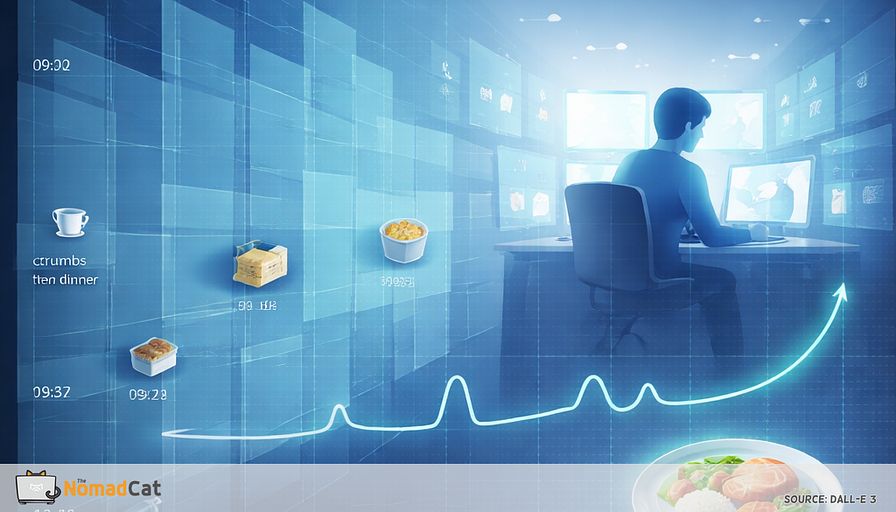
9:02 coffee. 9:37 a biscuit that was “free” because it came from the meeting room. 11:26 half a banana, 3 bites, camera on. And suddenly, it’s already 19:42 and dinner arrives like the first real sentence of the day.
This article is about that pattern, the one that looks normal on a busy calendar and still feels a bit off. Calendar-compressed eating is not dramatic lunch skipping. It’s the quiet version. Tiny inputs between calls, then a rebound meal when the schedule finally lets go. If you’ve ever thought “i ate something” and later realized it was mostly coffee plus fragments, this will feel familiar.
What you’ll get here is a clean way to see what’s happening and a few small, schedule-proof fixes that don’t depend on having a perfect day. We’ll cover
- Why meeting walls create the crumbs-then-dinner shape, including the on-camera friction that makes food breaks feel expensive
- The two-loop trap where under-fueling shows up as mental drag, then gets patched with caffeine and late-day urgency
- The moment coffee stops being a helpful tool and starts quietly substituting for lunch
- A practical “anchor intake” that fits into 3–5 minutes and survives back-to-back calls
- Simple signals to track so it feels like debugging a system, not policing yourself
The goal is not a new personality or a new schedule. It’s a small configuration change that keeps the day from splitting into partial packets and one big correction at night.
Calendar-compressed eating has a shape
What a calendar-heavy day looks like on paper
9:02 coffee, hot and heroic.
9:37 2 biscuits from the meeting room.
10:11 “quick call”, no water.
11:26 half a banana, 3 bites only, camera on.
12:05 lunch slot becomes a meeting again, of course.
14:18 another coffee, because thinking is needed.
16:47 a bar, opened like an email attachment.
19:42 first real plate of food, eaten like the day just ended.
Once the pattern is visible, it becomes easier to name it without blame. It’s Phase 1 from 9:00–17:00 fragments, then Phase 2 the first complete meal in the evening.
Calendar-compressed eating is when a meeting-dense day pushes most daytime food into tiny pieces, then forces a proper meal later when the calendar finally releases you. It’s not dramatic lunch skipping. It’s micro-intake during work hours plus a rebound meal at night, because earlier inputs never looked like a clean stop.
It stays invisible because coffee counts as “something”, and a bar counts as “i ate”, and 4 bites while listening counts as “fine”. The body ticks the checkbox, even if the system never got a complete input. It’s like sending partial packets all day and wondering why the transaction never completes.
The meeting wall that creates it
A meeting wall is that stretch of 3 hours with no air gaps where leaving the screen feels impossible. On those days, eating stops being planned and becomes opportunistic, meaning coffee and whatever is closest.
Time pressure is only half the story. The other half is social friction on camera. People often avoid a 3-minute food break on video because it feels awkward, or it feels like it will be noticed. Video calls make you feel watched. Self-view doesn’t help (Bailenson).
And the norms are status-shaped. If you are senior, you can eat on the call and it reads as efficient. If you are not, you may feel you need to look maximally available and never messy. So any fix has to be calendar-proof and low-visibility, not dependent on breaking meeting etiquette.
The two-loop energy trap
Loop 1 under-fuel and cognitive drag
Late morning, it rarely announces itself as hunger. It looks more like rereading the same Slack message 3 times, then sending a reply with a slightly sharp edge. Or postponing a small decision because it feels weirdly heavy, like the brain is buffering.
The annoying part is that the sensors get muted. Back-to-back video calls are high attention, high self-monitoring, low movement. It’s like running production without monitoring. The system degrades, you just don’t see the alert.
When under-fuel drag hits, it shows up where a calendar person cares. Not on a scale. More like
- Micro-errors in writing and small misses in recall
- A more reactive tone on calls that didn’t deserve it
- Afternoon sleepiness that makes everything feel harder than it should be
Then performance dips, and the system compensates. That compensation is Loop 2.
Loop 2 the compensation spiral at night
The patch is usually reasonable. A coffee to stay present. Something sweet because it’s quick and quiet. A bit of grazing while the next call loads. Caffeine does reliably improve alertness and can help vigilance (McLellan et al., 2016). But it is not the same as being well-fueled for complex work.
Caffeine may also blunt hunger for a short window in some studies (Greenberg, 2005). If you drink coffee at 14:30 and suddenly “forget” lunch until 18:00, that’s the blunting effect in real life.
There is also evidence that when earlier intake is missing, later-day intake tends to rise. In a randomized crossover, breakfast omission led to greater energy intake later in the day (Clayton et al., 2016). In real desk-day terms, that’s the big dinner plus the “extras” you barely register: a second helping, a handful of crackers while cooking, something sweet “just to finish”, then wondering why you feel both stuffed and unsatisfied.
Late intake plus late caffeine has one more downstream effect worth naming. Sleep disruption. Caffeine taken even 6 hours before bed can reduce sleep time (Drake et al., 2013). Tomorrow starts with lower patience and higher coffee dependence. Not exactly the upgrade anyone ordered.
When coffee stops being helpful
Coffee as a substitute, not a tool
The reason it feels confusing is that feeling awake and thinking well can separate. In tool mode, coffee is a small bump. In substitute mode, it quietly fills the eating window you didn’t get. It feels like it works, until it suddenly doesn’t.
It is like turning screen brightness to max when the battery is already at 4%. Things look clearer, but the system is still running low.
So the fix is not quit coffee. It is stop using it as lunch. Also worth remembering that caffeine can still affect sleep even 6 hours before bed (Drake et al., 2013). Late coffee is basically a loan. It often gets repaid the next morning.
The anchor intake patch
A minimum that survives the meeting wall
To keep it practical, it helps to define what counts and what doesn’t. An anchor intake is a calendar-proof minimum you place early, before the day splits into crumbs plus late correction. It is not a meal plan, and it is not a moral promise about “being good”. Think of it like 1 small line of code that prevents the worst crash.
Useful criteria
- Portable and reachable with 1 hand
- Low-friction in 3–5 minutes, no kitchen required
- Low-visibility on camera, low mess, low noise
- Real intake, not just sugar dust and a second coffee
A “good enough” floor might be around 15–20 g protein plus some fiber. No tracking required. Just a minimum that feels like actual input.
Timing rule. Place the anchor before the first long block or immediately after it ends, not when hunger finally gets loud. For example 10:30 right before the meeting wall, or 13:10 right after it ends, before email refills the slot.
Options that don’t need a perfect day
To reduce decision load, treat it like packing for unreliable conditions.
- Greek yogurt or skyr plus fruit and nuts (quiet, no prep, can be done in the 2-minute gap)
- Cottage cheese plus crackers
- Tuna packet plus crackers and carrots (silent, no microwave, 2 minutes between calls)
- Eggs plus fruit
- Hummus plus pita and veggies (works as “camera-off transition food”, not a full lunch ritual)
- Smoothie with milk or soy yogurt plus fruit plus chia
- Edamame plus fruit
- A “bento” box version of any of the above
Repeat is fine. The goal is not culinary achievement, it is uptime.
Mini kit to stash where work happens
- 1 tuna or salmon packet
- whole-grain crackers
- nuts or chia packet
- shelf-stable fruit
If any of these apply, keep it clinician-guided:
- Diabetes meds / hypoglycemia risk → timing and carbs need to be individualized.
- Reflux → late food can backfire; avoid eating close to bedtime.
- Eating disorder history/risk → rigid timing rules can ramp anxiety; keep it flexible.
Make it stick
Protect 5 minutes like it is a meeting
Even with food ready, etiquette still runs the room. So treat the anchor like an interface change, not a “health break”. Identify the meeting wall, then insert a protected 5-minute buffer the same way people protect a call.
A concrete rule that often works is defaulting to 25- and 50-minute meetings so there is always a small gap, and using tools like “shorten meetings” settings so it is system-supported.
Camera norms are the main friction. Some meetings are chew-friendly, some are not, and pretending otherwise just creates guilt. Self-view and the sense of being watched raise self-monitoring (Bailenson, 2021). So the anchor often works best between calls or in the 2-minute off-camera transition.
A simple instability detector helps before the day gets away from you. If it is already 2 coffees and still no substantial intake, treat that as your flag and place the anchor at the next gap. This is not a moral score.
Track signals that matter
Skeptical brains deserve a quick verification loop, not a spreadsheet life. Signs the anchor is working tend to look like this
- Less 16:00–18:00 snack urgency
- A steadier tone in late meetings
- Dinner becomes normal-sized instead of a correction
- Coffee shifts back toward optional tool, not emergency patch
For a 1-week debug log, keep it small
- Mid-afternoon sleepiness, 1 number using the Karolinska Sleepiness Scale (Åkerstedt & Gillberg, 1990)
- Late-day hunger, 1 number using an appetite VAS style rating (Flint et al., 2000)
- Dinner time, just the clock time
Common failure modes are boring, and that is good news
- Forgetting → If–then plan tied to a meeting end “If the 12:30 ends, then I eat before opening email”
- Not hungry → Treat low hunger as ambiguous data, not a green light
- Can’t eat on calls → Move the anchor to the first 3-minute gap and use stable cues
- No food available → Keep a shelf-stable backup kit where work happens
This is still a calendar effect, not a character trait.
Calendar-compressed eating is not a personal failure. It is what happens when the day is built out of meeting walls and camera etiquette. The pattern is simple. Crumbs plus coffee to stay sharp, then a late dinner that has to pay the bill. The cost shows up where work already hurts, more drag, more irritability, more “why is this email hard”. The worst part is pretending it’s fine all day, then feeling weirdly out of control at dinner.
The useful fix is also simple. Put in one anchor intake early enough to stop the split day. Make it 3 to 5 minutes, low mess, real food, and repeatable. Then treat it like debugging, not self-policing. Track 1 or 2 signals, see if dinner gets calmer and coffee goes back to being a tool.
If your day starts with coffee at 9:02 and ends with dinner at 19:42, the “problem” is probably the calendar, not you.
You might be interested by these articles:


Coffee #2 should not be lunch

Second-order hunger and the next-day crash on meeting-wall days

Performance-proof fueling and the predictable 15:00 crash

Fixing the 15:00 crash with a 10 minute buffer before the dip

The 3 to 6 minute food commit that stops desk day grazing

Cultural Diversity: The Secret Sauce of European Tech Innovation

Elevating Training with VR Tech