Abstract:
The article explains why many desk workers snap awake in a recurring 01:30–03:30 window—often around 02:40—despite a silent room, with an “instant orientation” feeling (tight shoulders, jaw awake, the urge to check) that’s less about being “bad at sleep” and more about a trained loop: naturally lighter late-night sleep combined with telepressure, open loops, and a blurry definition of “urgent” teaches the nervous system to run a nightly status check even when nothing happens. Framing it as a systems-level debug rather than sleep-hygiene moralizing, it distinguishes normal brief awakenings from insomnia (and flags medical red signs like sleep apnea symptoms) and argues that common tips fail when urgency still feels credible. Using an SRE/ITIL-like lens, it recommends upstream operational fixes—explicitly splitting issues into true urgent vs “momentum-protecting” vs reputation/ambiguity, creating a single hard-to-abuse urgent channel (call/SMS only), and “removing the night due date” by converting dependencies into a simple statement (Owner / Next touch time / Reopen trigger) to reduce uncertainty. If you wake anyway, the key is to keep it unrewarding—no clock or inbox checks, maybe write one dull line on paper (“If thinking about X, next touch tomorrow at Y”), use stimulus control if fully awake—and track progress only in blunt weekly signals so sleep doesn’t become another 03:07 dashboard.
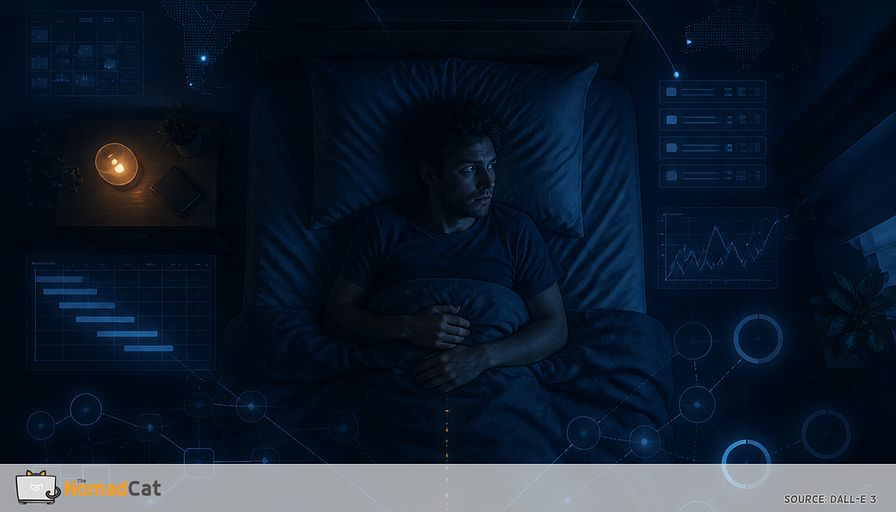
It’s 02:40. The room is quiet. No buzz, no Slack ping, no email. And still, your brain boots like a pager just went off.
If that feels familiar, it’s probably not because you’re “bad at sleep” or because you missed the one magic rule about screens or magnesium or whatever is trending this week. For a lot of desk workers, this wake-up has a pattern. It shows up in the same window. It comes with tight shoulders, a stiff neck, and that weird sense that something needs checking, even when nothing happened.
This article is a systems-level debug of that pattern. Not a pep talk. The goal is to explain why silence still “pages you,” and what actually helps when the problem is learned urgency and uncertainty, not just generic stress.
Here’s what will be covered:
- What the “midnight pager” wake-up looks like, and why the 01:30 to 03:30 window keeps repeating
- The mismatch that matters, a ready-to-respond body in a quiet room
- Telepressure, monitoring, and the small safety checks that accidentally train the loop
- A quick sanity check on normal night awakenings vs insomnia, plus red flags that should be screened first
- Why common sleep tips often don’t stick when urgency still feels credible
- Practical fixes that reduce uncertainty upstream, including a simple severity split and a single urgent channel
- What to do if you wake anyway, without rewarding the habit with “just one check”
If your days are already full of meetings, tabs, and half-owned dependencies, sleep shouldn’t become another dashboard to babysit at 03:07. (I’m writing this as someone who did the remote desk-worker thing in Berlin for years, and has been Lisbon-based since 2023.) This is about making nighttime genuinely non-urgent again, operationally, not emotionally.
The midnight pager pattern
When a normal weeknight suddenly isn’t
A quiet weeknight can start fine. You go to bed, the room is dark, and sleep lands without negotiation. Then, in that very specific 01:30 to 03:30-ish window, you snap awake like someone tapped your shoulder. Except nobody did.
It’s not a slow, confused wake-up. It’s instant orientation: what time is it, what day is it, what did I miss. Shoulders slightly high. Jaw awake before the rest of you. And the weird part is what’s missing.
No big panic story. No obvious worry. More like a silent status check.
That timing also isn’t random. The second half of the night is naturally lighter and easier to interrupt because sleep pressure is lower, so brief awakenings can show up there without meaning something is “wrong.” The detail that matters is the mismatch.
The mismatch that gives it away
There’s no buzz. No email ping. No Slack sound you forgot to mute. Still, your system behaves like an interrupt landed and it needs certainty right now.
Quiet room, ready-to-respond body.
What gives it away is the “safety checking.” The same way you might check Slack “just once” to feel settled, your brain does a silent version: check the time, scan for any signal, try to confirm nothing needs you.
Plenty of people wake briefly and roll back over. This is different. It comes with an extra boot sequence.
Why it keeps landing in the same time window
These wake-ups often cluster. Not every night, but enough that you start to predict it.
If you live a desk-worker life, time zones, deploys, leadership habits, your brain doesn’t need an actual message to learn the schedule. A few drivers that often line up with that 01:30 to 03:30 band:
- overlap with a team several time zones away starting their day
- routine deploy windows or batch jobs that sometimes need attention
- a leader who clears inbox at odd hours
- a standing on-call rotation, even if you’re not officially on-call
- a culture where “urgent” has no agreed definition
A useful label here is telepressure: the internal urgency to respond quickly, even without a new message arriving. Combine that with naturally lighter late-night sleep and your body can learn a recurring pager window.
Not your average anxiety or scrolling problem
This pattern is easy to file as generic anxiety, generic screens, or moralized sleep hygiene (“no caffeine, no fun, no life”). Sometimes those factors matter. But the midnight pager pattern is often rumination-second, not rumination-first.
It’s closer to learned anticipation plus uncertainty. Like your nervous system created a recurring calendar invite titled “check if everything is on fire.” Work contact after hours is linked to worse detachment and sleep outcomes, and the Spielman 3P model is one way to explain how it gets stuck: something can predispose you (light sleeper, high responsibility), something precipitates it (a few late incidents), and then something perpetuates it (the “just one check” that rewards the wake-up).
None of this is a label. It’s just useful data.
Red flags that should come first
If any of the below are in the mix, treat this as screening first, not a Slack-boundary puzzle:
- loud snoring, choking, or gasping (possible sleep apnea)
- severe daytime sleepiness or dozing unintentionally
- panic-like episodes at night that feel intense or unsafe
- frequent bathroom trips that are new or escalating
- significant breathing issues, chest pain, or other concerning symptoms
- persistent insomnia with major distress or impairment
Obstructive sleep apnea is a common, underdiagnosed source of fragmented sleep. For chronic insomnia patterns, clinical guidelines put CBT-I as the first-line treatment.
A quick sanity check on night awakenings
Brief awakenings happen to a lot of adults. Sleep isn’t a perfect continuous block. The line gets crossed when awakenings become frequent or long, flip you into “awake and online” mode, and start showing up as distress or rough days.
Population stats separate insomnia symptoms (common) from insomnia disorder (less common): roughly 1 in 3 adults report insomnia symptoms, while around 6 to 10% meet criteria for chronic insomnia disorder when you include persistence and daytime impairment. In plain terms: if this is happening most weeks for months and your daytime is getting hit, it’s no longer “annoying but normal”—it’s worth treating properly.
If you want simple terms that make this less fuzzy:
- Time awake after you first fall asleep (total minutes you’re awake in the night)
- Number of awakenings (how often sleep breaks)
- Sleep efficiency (time asleep divided by time in bed)
Be careful with turning sleep into a dashboard you refresh at 03:07. That tends to feed the problem you’re trying to measure.
Why silence still pages you
Uncertainty is a real trigger in interdependent work
“Something could happen” is not irrational when work is built from dependency chains. If an approval is pending, a build is queued, or a partner team is waiting on your answer, silence can feel less like calm and more like an unstable state.
Telepressure fits better than personality labels. It’s the belief that response time matters, even before anything arrives. Once that belief exists, the clock can become the trigger.
The clock becomes a trigger after a few real incidents
If a few late-night approvals or incidents happened in the same window, the body can learn it like a schedule. Not dramatic. Just pattern matching with consequences.
Later, even on a quiet night, the system runs the same “check” because it remembers that this is when problems used to appear. Once awake, monitoring can keep the loop alive: checking the time, checking the phone, doing “just one” reassurance action.
A reliability strategy that went slightly feral
Teams schedule standups because uncertainty is expensive. Your brain does something similar, except it schedules a silent standup at 02:40 and calls it “risk management.”
In SRE language, paging is supposed to be rare and reserved for urgent, actionable, user-impacting events. In ITIL terms, it’s the same idea: prioritize by impact × urgency, not vibes. The pager wake-up is what happens when the severity system gets blurry.
Open loops make the night feel like the last chance to prevent tomorrow
Modern desk work leaves a lot of tabs open, even when the laptop is closed. Async across time zones creates more “pending” states than anyone admits.
Common open loops that follow people into bed:
- a thread where the last message sounds urgent but isn’t clear
- a review or approval sitting with your name on it
- a doc that needs “one last pass” before someone important sees it
- a calendar tomorrow with no slack if anything shifts
- a decision blocked on someone else
Interruptions are costly in knowledge work, even when they look small.
In this article’s terms, “more schedule control” just means fewer surprise lanes: one urgent channel, a clear definition of urgent, and fewer loose dependencies that can suddenly become yours at 02:40.
Why the usual sleep tips don’t stick
The earlier bedtime trap
When wake-ups are time-locked and conditioned, “go to bed earlier” often disappoints. Expanding time in bed can create more surface area for being awake in bed, drag down sleep efficiency, and teach the brain that bed equals monitoring.
CBT-I’s logic is basically the opposite: tighten the sleep window to consolidate sleep and reduce wake time in bed, then expand again as efficiency improves.
Calm loses to credible urgency
Relaxation helps you downshift. But if a part of the brain still believes “a response might be required,” it will pop back up the moment sleep gets light.
Calm loses to credible urgency. The checking itself can become the loop.
Upstream fixes beat perfect nights
When the trigger is uncertainty, the useful lever is not a fancier bedtime routine. It’s changing what counts as urgent, and making “nothing is due tonight” operationally true.
It’s not very poetic, but it works.
The 2 minute mapping that avoids a new tracking habit
A one off debug not a nightly log
Treat this like a quick debug pass.
On the next wake-up, note the rough window only, like “between 02:00 and 03:30,” then stop. No exact minute, and ideally no clock-checking. Time-checking can become a safety behavior.
Name the expected event not the most dramatic one
Ask a boring question: what work event could plausibly happen then. Pick the most plausible, not the most dramatic. Pick 1 from the list above.
The counterfactual that reveals the imagined SLA
Ask what would really happen if the reply lands 8 hours later, at normal morning time.
A lot of middle-of-the-night urgency is genuine ambiguity plus social discomfort, not actual impact. “Customer is blocked” is different from “someone feels ignored until 09:30.” Both can be unpleasant. Only one is truly urgent.
A simple severity split for nighttime interruptions
When everything can wake you, recovery becomes impossible. Use 3 buckets, and only the first one should have an actual interrupt path.
- True urgent: user-impacting and actionable now (rare)
- Momentum-protecting: helpful, but safe to handle in the morning (common)
- Reputation and ambiguity: mainly about looking responsive or avoiding uncertainty (very common)
Remove the night due date
The dependency clock statement
Open loops are the real problem. Not “stress” in the abstract, but waiting-on items with no owner, no next touch time, and no clear rule for when they become urgent.
Convert each dependency into a simple line that says who owns it, when it gets touched again, and what rare condition would justify reopening it tonight. I studied fundamental physics in Paris, so I treat this more like a config change than a mindset speech.
Owner:
Next touch time:
Reopen trigger:
Examples:
Approval waiting on legal
Owner: Legal. Next touch time: tomorrow 10:30. Reopen trigger: signed contract must be sent before 08:00.PR review sitting with you
Owner: You. Next touch time: tomorrow 09:15. Reopen trigger: release blocked for a customer outage.Exec sign-off on a deck
Owner: You. Next touch time: tomorrow 08:45. Reopen trigger: meeting moved to before 09:00.
These look small, but they reduce uncertainty. That matters because monitoring briefly reduces uncertainty, which rewards the checking and keeps it alive.
One urgent channel boring enough to trust
Escalation works best when it is rare, single-lane, and defined. When urgency arrives via email, Slack, WhatsApp, calendar notes, and “just calling quickly,” the brain learns it must monitor everything, even in silence.
Define the urgent lane as call or SMS only, with a tight list that’s hard to abuse:
- production outage with clear user impact
- security incident with active risk
- confirmed data loss or corruption in progress
- hard deadline inside the next 6 to 8 hours with real external impact
- safety or legal issue that cannot wait until morning
Everything else can wait.
If you wake anyway
Keep it unrewarding.
The no reward protocol
If the mind insists on doing a status check, give it the smallest possible response plan and cut the feed.
- no clock checking
- no message intake
Time and inbox both pay the wake-up with certainty, which is exactly how the loop gets trained.
One exception: write a single line on paper, then stop.
“If thinking about X, next touch tomorrow at Y.”
Keep lights dim. Keep it boring. If you feel clearly awake for a while, use stimulus control: get out of bed, do something quiet in low light, and return only when sleepy. No need to measure 15 minutes precisely.
Define success correctly: fewer full boot sequences, less urge to orient, shorter awakenings, easier slide back to sleep.
Progress signals and stop rules
Boring metrics that matter
If data helps, keep it weekly and blunt:
- fewer instant orientation wake-ups
- less urge to reach for the phone or “just check”
- faster return to sleep
- mornings that feel like a clean start
If a minimal log helps, keep it low-resolution. One line per week: number of nights with a pager wake-up, plus a rough duration band (30).
Screening triggers
Escalate to a clinician or sleep specialist if you see:
- loud snoring, gasping, or witnessed breathing pauses
- dangerous daytime sleepiness
- panic-like episodes at night, chest symptoms, or anything that feels unsafe
- new or worsening depression symptoms
- insomnia that stays frequent and impairing
If the bug still reproduces after work-side changes, it deserves its own triage path. CBT-I remains the first-line treatment for chronic insomnia.
Waking up at 02:40 in a silent room isn’t a character flaw. For a lot of desk workers, it’s a trained loop: lighter late-night sleep plus telepressure, open loops, and a blurry definition of “urgent” equals a body that keeps booting into incident mode.
The useful fix is mostly upstream. Make nighttime non-urgent in a way your nervous system can actually believe. Split true urgent from “nice to be fast,” convert loose dependencies into a simple owner and next-touch plan, and keep one boring urgent channel so you don’t have to monitor everything. And if you do wake, don’t pay the habit with “just one check.” Keep it dull, write one line, go back offline.
Once “urgent” has a real lane and most open loops have an owner and a next touch time, the quiet room starts to feel quiet again.
You might be interested by these articles:


The 02:17 reboot after a 10-hour desk day and how to make it boring again

Your 1st 45 minutes are training your 02:00 brain so change the input order

Your brain never clocks out when work can still ping you at night in Beijing Berlin or Lisbon

Why your brain starts work at 05:00 and how to stop rewarding it

After dinner no more invisible work so your sleep can actually power down

Revolutionizing Global Connectivity with Satellites

why perfect posture is overrated for minimalist tech workers