Abstract:
The article explains why you can have a “clean” evening—dinner done, laptop shut, normal bedtime, no doomscrolling—yet still wake up feeling like “sleep didn’t apply”: the real culprit is often invisible maintenance work after 18:00 that doesn’t look like overtime but keeps your brain in daytime performance mode. This quiet, self-assigned coordination and reputation-protection—rewriting status updates to preempt questions, pre-writing messages to seem instantly responsive, adding extra context so nobody pings you, doing “one last check” for landmines, or scanning threads for anything that could be misinterpreted—creates immediate relief by reducing uncertainty, which reinforces the habit, but also sustains mental activation and “on-stage” vigilance that can produce thin, nonrestorative sleep even if you fall asleep quickly. The article points to a common sleep signature (fast sleep onset but early-morning “boot-ups” with an urge to scan and reprioritize, plus low tolerance for uncertainty after late messages) and argues the fix isn’t “sleeping harder” or blaming screens, but shrinking nighttime background tasks. Practically, it recommends a category boundary—“after dinner, no new protection” (no new preemptive explanations, tone-polishing for defensibility, contingency-planning-as-anxiety-insurance, or starting new threads that expand what you feel responsible to monitor)—paired with an earlier 15-minute “friction shield” slot to offload just a minimal transfer packet for tomorrow (one status line, one unblock message, one definition-of-ready note). Progress is measured with deliberately boring diagnostics like the “relief test” (calmer-and-sleepier vs calmer-but-sharper) and a simple yes/no log for “new protection after dinner” and “morning urgency-scan impulse,” with a reminder that persistent thin sleep alongside symptoms like loud snoring, gasping, restless legs, or dangerous daytime sleepiness warrants proper medical screening.
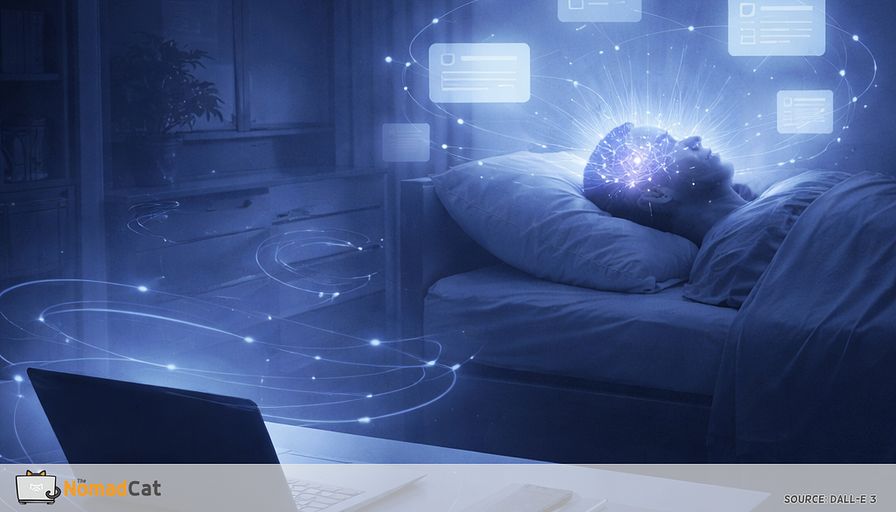
Dinner is done. The laptop is technically closed. You even went to bed at a normal hour. And still, the next morning feels like sleep didn’t apply. Not tired exactly. More like the system booted too fast, with a weird urgency in the background.
I’m 52, and after years of remote work (Berlin 2017–2023, Lisbon since 2023), sleep is still the variable i have not solved. And what keeps tripping it up is not the obvious stuff.
This article is here to name the real culprit in a lot of “clean” evenings that still produce thin sleep. Not doomscrolling. Not notifications. Not a lack of discipline. It is the quiet work you do after 18:00 that doesn’t look like work, because it’s mostly coordination, context packing, and reputation protection.
You’ll see how invisible maintenance keeps the brain in daytime mode, why the relief is so immediate it trains the habit, and what the sleep signature can look like when this pattern is running. Then it gets practical without turning into a bootcamp. A simple rule that cuts the late-night spin-up, a small “friction shield” slot that catches the impulse earlier, and 2 quick diagnostics to tell if the change is working.
If your evenings feel calm but your sleep feels oddly flat, this is a useful bug report. The fix is not sleeping harder. It’s reducing the background tasks.
the work you do after 18:00 without calling it work
a normal evening that still breaks your sleep
Dinner is done, the kitchen is more or less clean, and on paper the evening looks fine. Lights off at a decent hour. Sleep comes fast. No doomscroll tunnel.
And yet the next morning has that weird bug. You wake up and it feels like sleep did not apply.
This shows up a lot in desk jobs where evenings are the only quiet slot left for high-agency brain work, even if nobody would call it overtime. It is not about being weak or addicted to screens. It is more like the system never stopped running background tasks.
One useful idea here is being mentally off the clock—not just done with work, but your head is not still “at work.” When that detachment doesn’t happen, sleep can look fine on paper and still feel nonrestorative (Sonnentag & Fritz, 2007).
The mismatch makes more sense once you name what the evening work actually was.
invisible maintenance work is still real work
Call it invisible maintenance. Not because it is noble. Not because it is shameful. Just because it is work that keeps tomorrow from becoming annoying.
It is the self-generated coordination layer. The part where you package context so people don’t ask. You shape status so it doesn’t trigger follow-ups. You try to prevent confusion before it lands at 09:12. You smooth stakeholder edges so nobody escalates.
None of this looks like output. No feature shipped, no deck finished. But it reduces uncertainty and social friction, so it is real work in practice. It is close to what Star and Strauss call articulation work, the invisible coordination that makes work doable for others (Star & Strauss, 1999).
the calmer but sharper checklist
Invisible maintenance is easy to misread as notifications or “bad habits”. Typical examples
- Rewriting a status update 3 times so it answers questions before they are asked
- Pre-writing tomorrow’s messages so you look instantly responsive
- Adding screenshots and links so nobody pings you for details
- Re-ordering tasks so the morning feels controllable
- Checking a doc one last time because maybe there is a landmine
- Scanning threads for anything that could later be interpreted as “you didn’t say that”
It’s quiet work, but it still counts as mental activation. Pre-sleep worry and repetitive problem-focused thinking can keep arousal up and mess with sleep quality (Harvey, 2002).
The tell is the state change. You feel less uncertain, but more mentally sharp. That is the opposite of bedtime drift.
what it is not
To debug the right thing, it helps to separate the look-alikes.
It is not your boss actively messaging you. It is not notifications dragging you back. It is not doomscrolling. It is not generic “busy day residue”.
It is self-assigned coordination and reputation-protection, even when nobody is asking right now.
Devices matter, but the mechanism matters more. If you open a device at night to do high-agency, reputation-sensitive work, you’re basically asking the brain to stay in “monitoring” mode.
why the pattern keeps coming back
the relief loop that trains the habit
Invisible maintenance pays immediately. Uncertainty drops. Tomorrow looks less dangerous. You get a small hit of control that makes the day feel “closed”.
So the loop trains fast
Trigger → maintenance task → relief → repeat
This is the brain replaying work problems on a loop (sometimes called perseverative cognition). It’s not a character flaw. It’s closer to a reinforcement bug.
quiet work can keep you in daytime mode
The brain does not care that the room is quiet. High-agency choice-making is still performance mode.
Some insomnia research points to a simple idea: once your brain is “on,” it can stay on, even without an obvious crisis. Checking, rehearsing, and trying to prevent imagined problems can keep arousal going, because it signals “risk” to the brain (Harvey, 2002).
A “productive morning” can be just an early boot. The system is up fast because it never fully powered down.
why normal bedtimes still produce thin sleep
Invisible maintenance is not “a bit of email”. It mixes 3 modes that keep you online
- Agency mode: micro-decisions and micro-risk management. Like a service you just deployed, everything stays warmed up.
- On-stage mode: the work is written to be judged. Tone, defensibility, polish, who might forward it. Rewriting the same line 6 times so it sounds “neutral” but also “decisive”.
- Open-loop creation: you start threads, stage messages, drop docs “for tomorrow”. Notifications can be off and part of the brain still checks for a callback.
Most office-work studies don’t measure “evening context packing” as its own clean variable, so I’m not trying to win an academic argument here. The practical point is: if the evening keeps your brain in performance mode, sleep can be long enough and still feel thin.
the sleep signature it creates
Sleep can look clean on paper. You fall asleep fast. Lights off at a reasonable time. Still, the next day feels flat, like you got hours but not recovery.
2 markers I’d watch for
- Early-morning boot-ups: the brain starts executing immediately, with an urge to scan messages or reprioritize before standing up.
- Low tolerance for uncertainty after any late message: even a small after-hours expectation can spike the feeling that you must respond fast.
This is pattern recognition, not diagnosis. If tracking helps, keep it boring. A simple morning 0–10 sleep continuity rating plus a yes or no for “urgency-scan impulse” is often enough.
why desk work pushes it into your evening
Some of this is just displacement. Meeting-heavy days leave documentation, planning, and context packaging for the only quiet slot left after dinner.
Ambiguity makes it worse. When ownership is unclear, coordination becomes risk control. That usually means more checking, more clarifying, more friction.
Async tools also have a cost. You have to rebuild shared context in writing, and if you don’t have templates, you end up doing it from scratch. Often at night, when nobody interrupts.
a small switch that stops the evening spin up
no new protection after dinner
Protection tasks are anything you do mainly to prevent future social friction, not to move the work forward
- Pre-emptive explanations to stop questions tomorrow
- Polishing tone so nobody can misread you
- Contingency planning that is really anxiety insurance
- Staging messages to look instantly responsive
- Extra context dumps just in case
- Rewriting status so it is defensible, not clearer
- Starting a new thread to reduce uncertainty tonight
A category rule can work better than a clock rule because detachment is mental, not technical (Sonnentag & Fritz, 2007).
After dinner, no new protection.
Notice what it does not say. It does not say stop working at 18:00. It does not say be disciplined. It says don’t expand the social surface area at night.
Closure-only tasks can be fine. Filing notes is ok. Finishing a small edit already started is ok. Starting a new thread or rewriting a message “to be safer” is a no. In insomnia models, monitoring and safety behaviors can keep the brain in threat-management mode (Harvey, 2002).
It also helps to have an emergency hatch. One break-glass channel, everything else waits. Example script
“If this is blocking production or a client launch, call me. Otherwise I will pick it up tomorrow morning.”
a 15 minute friction shield slot
To make the rule easier, give the impulse a container earlier. 15 minutes right after the last meeting or before dinner.
The job is a minimal transfer packet for tomorrow, not cleaning up the universe. Getting the plan out of your head and onto a page can help reduce mental churn (Scullin et al., 2018).
A tiny checklist keeps it from expanding
- 1 status line if someone needs it tomorrow
- 1 unblock message that removes a dependency or queues it clearly
- 1 definition-of-ready note for tomorrow’s first task, so starting is cheap
Then stop. Stopping is part of the spec.
2 quick diagnostics and boring success signals
2 fast tests
Relief test. After the evening cleanup, do you feel calmer and sleepier, or calmer but sharper. Calm but sharp is the red flag.
Surface-area test. Did tonight’s quick thing create new surface area you now feel responsible to monitor. New Slack messages that invite replies, adding CCs, sending doc requests that now need responses.
If proof helps, run a 3-day binary log. Yes or no for “new protection after dinner”. Yes or no for “morning urgency-scan impulse”. Stop at 3 days so it doesn’t become a new project.
what success looks like
If it works, it looks unsexy
- Fewer mornings with the instant urgency-scan impulse
- Less compulsion to pre-explain or pre-defend something at 22:00
- More continuous-feeling weekday sleep even if total duration barely changes
The point is not blaming screens or trying to sleep harder. It is naming the real trigger. Self-assigned coordination keeps systems and people aligned (Star & Strauss, 1999), but it also keeps the mind online.
If sleep still feels thin after cleaning up evening work patterns, don’t force-fit everything into workflow. Loud snoring or gasping, restless legs sensations, or dangerous daytime sleepiness deserve proper screening.
If your evenings look “clean” but your sleep still feels thin, it is probably not a discipline problem. It is the invisible maintenance that keeps the brain in daytime mode. The coordination, the context packing, the reputation protection. It gives fast relief, so the loop trains itself, and the next morning you wake up like the system never fully powered down.
The fix is not sleeping harder. It is shrinking the background tasks. A simple boundary like “after dinner, no new protection” reduces the late-night surface area. A 15 minute friction shield slot earlier gives the impulse somewhere to go without leaking into bedtime. Then keep the diagnostics boring. Fewer urgency-scan mornings is a real win.
Most people have one default: tone polishing, the last check, or the pre-emptive explanation. Once you can name yours, you can spot it earlier.
You might be interested by these articles:


Thin sleep is leftover context from a chopped up desk day

Your sleep is thin because your brain is still on standby

At 03:00 your brain starts doing reputation management

Your workday ended but your brain is still on duty at 23:40

A productive day can still break your sleep fix the missing downshift signal

making solo tech wins count

Unlocking Innovation: How Europe's Cultural Diversity Fuels Startup Success