Abstract:
The article addresses a specific kind of bedtime insomnia where, around lights-out (like 23:40), your “work role” stays mentally active even though the day is objectively finished—so your brain quietly simulates tomorrow, rechecks calendars and Slack threads, drafts email replies in your head, and runs low-grade monitoring fueled more by responsibility than fear; the author frames this as a “shutdown problem, not a volume problem,” distinct from sleep fragmentation (waking repeatedly) and decision residue (a lingering choice), and proposes diagnosing it with a quick self-test (notably, whether a tiny written plan immediately reduces the mental noise) while also flagging medical red signs like loud snoring, gasping, restless legs, or dangerous daytime sleepiness. Drawing on research about cognitive arousal, telepressure, and the loss of natural role transitions in remote/hybrid work (the missing commute “exit ramp”), and grounded in the author’s own desk-heavy life after studying fundamental physics across Beijing, Berlin, and Lisbon, the piece argues the brain keeps “overnight watch” because it never received a credible end-of-day handoff. The practical fix is intentionally boring: a 90-second, three-line “shift end log” that acts as a resume pointer (done today / parked until tomorrow / first move tomorrow), a clear one-sentence availability rule that replaces implicit always-on responsiveness with defined channels for true urgency, and small “handoff tokens” (one next action plus one line of context placed where the work lives) so open threads stop living in your head—plus reducing after-dinner notification pings to prevent re-triggering checking loops. Implemented for a few nights, these steps aim to lower bedtime replay, cut re-check cycles, reduce “reload cost” in the morning, and make sleep onset feel less like you’re still on duty, with the caveat that persistent problems may reflect broader hyperarousal or another sleep disorder rather than a workflow gap.
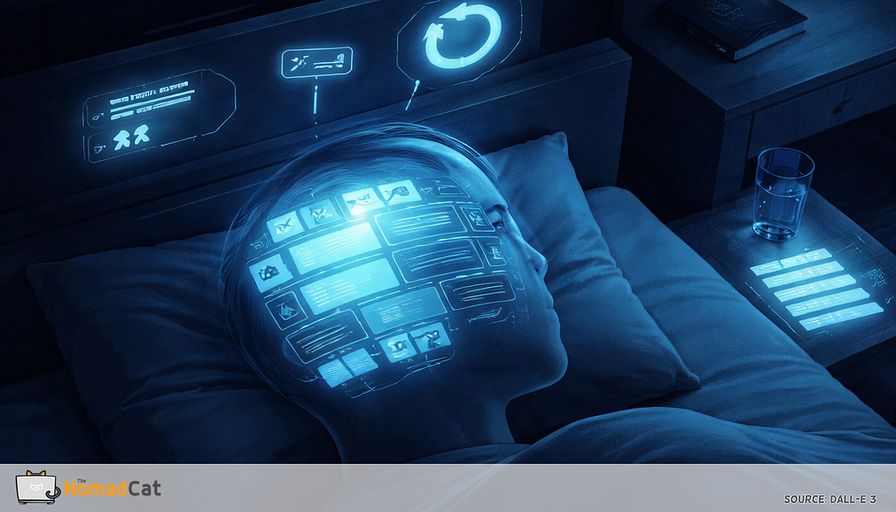
It is 23:40. Everything is technically done. Laptop closed, lights low, teeth brushed. And then the brain opens a second laptop inside your skull and starts running tomorrow. Not loudly. More like a quiet background scan. Calendar. Emails that nobody is asking about tonight. A meeting you already survived. One more check “just to be sure”, and somehow it is 00:10.
This article is for that specific problem. Not waking up 5 times a night. Not a giant unfinished to-do list. It is the “work role is still on” feeling at lights out. A shutdown problem, not a volume problem.
The goal here is simple. Get a credible end-of-day handoff so the mind stops doing overnight monitoring. Not perfect calm. Just less “still on duty.”
What will be covered
- How to tell apart 3 similar patterns that get mixed up a lot
sleep fragmentation, decision residue, and the missing handoff loop - A quick self-test to check if this is really what is happening
- A short medical exclusion check, because sometimes this is not a workflow issue
- A small closure system that fits inside a demanding desk day
a 90-second shift end log, a clear availability rule, and tiny handoff tokens so open threads stop living in your head - Why these small moves can feel strangely real the next day
fewer re-check loops, lower “reload cost” in the morning, and less cognitive noise at bedtime
If the evening brain-spin is fueled by responsibility more than fear, that is a good sign. It means the system is trying to help. It is just missing a stop condition. This is about adding one that your brain actually trusts.
No shutdown signal
When it hits around 23:40
Same pattern: lights out, and the brain starts a quiet scan of tomorrow. Your body is tired, but your mind stays in “work mode,” running checks anyway (Harvey, 2002).
Common signs
- opening the calendar “just to be sure” and suddenly reading the whole day like a thriller
- drafting replies in the head to an email that nobody asked for tonight
- reordering a slide deck mentally, including fonts, because of course
- rehearsing answers to questions that might not even be asked
- re-running a Slack thread and spotting a “risk” that is mostly theoretical
- checking the phone for new pings, then checking again 3 minutes later (Exelmans & Van den Bulck, 2016)
- doing “safety behaviors” like planning extra contingencies, which keeps the monitoring loop alive (Harvey, 2002)
What is sneaky is the fuel. Often it is not fear. It is responsibility. The brain is trying to protect the morning from surprises, like a background process that refuses to quit. That is basically the opposite of psychological detachment, which is a big part of how people recover after work (Sonnentag & Fritz, 2007).
And it is not always “i have too much work.” Even if the inbox is calm. Even if tomorrow is routine meetings. The problem is that the work role never reaches a clean end state, especially when work and home boundaries are porous and the stop button is mostly imaginary (Allen, Golden, & Shockley, 2015). This is a shutdown problem, not a volume problem.
Not fragmentation, not a to-do list
A quick sort so you do not fix the wrong thing
First, separate this from sleep fragmentation. Fragmentation is repeated awakenings and thin blocks of sleep. Here the complaint is usually sleep onset: falling asleep is the hard part because your mind ramps up right at lights out (Harvey, 2002). The nervous system can stay on alert in both patterns, but timing matters (Bonnet & Arand, 2010).
Next, separate it from decision residue. Decision residue feels like an unresolved choice, with criteria still floating around. In a missing handoff pattern, even when no decision is pending, the mind still runs tomorrow because availability is implicit and the work role stays active by default. Again, the opposite of detachment (Sonnentag & Fritz, 2007).
A simple 3-line diagnostic
- Fragmentation means you fall asleep, but the night keeps interrupting you
- Decision residue means 1 or 2 choices stay open, so the brain keeps evaluating
- Missing handoff means the shift never ended, so low bandwidth work keeps running until you force a role transition (Ashforth, Kreiner, & Fugate, 2000)
A 60 second self test for the missing handoff pattern
Before trying to “discipline” bedtime, check if this is actually a handoff failure. Also, if sleep is seriously impaired, it is not a fun side project.
Quick yes-no check
- Rehearsal starts even when inbox is quiet
- You open the calendar without a specific fear
- A tiny written plan makes the noise drop
- You are not waking repeatedly at fixed hours
That #3 matters. Externalizing a to-do list can reduce sleep onset latency in lab conditions, and more specific lists seem to help more (Scullin et al., 2018). Plan-making also reduces how “mentally sticky” unfinished goals stay (Masicampo & Baumeister, 2011).
A brief medical exclusion check
If there is loud snoring, gasping, restless legs sensations, or severe daytime sleepiness, this is the part where I stop pretending it is a workflow issue. Treat it as medical territory. Strong daytime sleepiness is also a safety issue for driving and work errors (Åkerstedt, 2003). Talk to a clinician.
Green flag for this article is sleep onset plus the work role still being “on.”
The missing stop condition that keeps you on duty
A lot of modern desk work has no real “end of day” state. No box to tick that means you are done. So the brain keeps a small watch process running, just in case. It is not weakness. It is what happens when role transitions are vague and the exit door is more symbolic than real (Ashforth, Kreiner, & Fugate, 2000). And without detachment, recovery does not really start (Sonnentag & Fritz, 2007).
That watch process protects tomorrow. It replays scenarios to reduce surprise. It looks like planning, but it never lands because there is no final state to reach. So at 23:40 you get the loop.
Modern tools keep the work identity alive even when volume is low. Responsiveness becomes a proxy for competence, not officially, just culturally. So you answer at 22:10 because you do not want to be “the slow one” tomorrow. That creates telepressure, the internal urge to respond quickly, and it tends to erode detachment (Barber & Santuzzi, 2015).
Remote and hybrid work removes an old separator. The commute used to be a forced role transition, a small exit ramp. Without it, the work role can leak into dinner and then into bed.
Trying harder at bedtime often makes it worse. “Forcing relaxation” becomes another task, another performance goal, another thing to monitor. In insomnia models, effortful control and monitoring can maintain the problem (Harvey, 2002). The practical goal is not perfect calm. It is a credible handoff.
I studied fundamental physics, and I have spent most of my adult life at a desk, in Beijing, Berlin, and now Lisbon, often past midnight. So this framing is not self improvement. It is debugging an interface.
Build a small closure contract that your brain trusts
The shift end log in 90 seconds
Treat the shutdown note as a closure contract, not planning. The point is to create an explicit end state that says “closed and safely queued,” so prospective memory can stop nagging. Writing a simple to-do list has been shown to reduce objective sleep onset latency, likely because planning reduces the mental interference of unfinished goals (Scullin et al., 2018; Masicampo & Baumeister, 2011).
Use a fixed 3-line format and keep it specific
- Done today ship deck v2 draft
- Parked until tomorrow reply to X is safe to wait
- First move tomorrow 09:10 open doc and write 5 bullets for slide 4
Think “resume pointer,” not “project plan.”
Hard rule. If it does not fit in 3 lines, it is not a log, it is continuation. The constraint is the feature. Offloading works when it reduces internal maintenance load, not when it adds a second workday (Risko & Gilbert, 2016).
Put the note where tomorrow-you will see it first
- sticky note on the laptop
- first line of the daily doc
- top of the notebook page
- pinned
handoff.txt
Tool wars are optional. Reliability is not (Risko & Gilbert, 2016).
Replace implicit availability with a visible rule
A 1-sentence availability rule is operational clarity, not boundary theatre. When expectations are vague, telepressure increases and detachment gets worse, which is one pathway to worse sleep (Barber & Santuzzi, 2015). If the brain has to guess, it will keep monitoring.
Templates that usually sound normal in real teams
- “Offline after 20:30, back 08:30. If launch is blocked, ping #urgent.”
- “I check messages 2 times after dinner max. Anything else tomorrow morning.”
- “For urgent only use SMS. Slack can wait.”
For global teams, strict personal rules can just push the burden to someone else. A fair version is designed around coordination
- define “urgent” narrowly
- pick 1 emergency channel
- agree overlap windows for decisions
- rotate coverage when it is truly needed
Install a handoff token for open threads
A handoff token is 1 breadcrumb placed where the work lives, so the thread has a home and does not require bedtime reconstruction (Risko & Gilbert, 2016; Starmer et al., 2014).
Examples
- email draft saved with first line “TODO: confirm pricing table and add 2 bullets”
- Slack message scheduled for morning with 1 context line plus the question
- calendar invite note with “first question: what is the decision needed by end of meeting”
Constraint. The token is not the task. It is the next 1 action plus 1 line of context. If paragraphs appear, congrats, you are back on shift.
Calendar deflation so bedtime gets fewer shocks
Late meeting pings are new inputs, and new inputs restart monitoring. The issue is often interactive checking loops, not “screens” as a moral category (Exelmans & Van den Bulck, 2016).
One-time change. Silence or hide meeting notifications after dinner. After-hours work tech use is linked with worse recovery and sleep, so fewer pings means fewer re-entries (Derks et al., 2014).
If checking is unavoidable, constrain the query to avoid branching
- only check the first meeting
- only check the first deliverable
Example. “09:00 exec sync, need 3 bullets.”
What changes the next day and why it feels real
With a shift end log plus 1 or 2 handoff tokens, the morning starts with a lower reload cost. Instead of scanning Slack, email, and calendar to reconstruct state, there is already a next action parked outside the head (Risko & Gilbert, 2016; Masicampo & Baumeister, 2011).
The tells are boring
- fewer tabs opened “for later”
- fewer Slack loops to re-find the same thread
- less rereading yesterday’s last messages
- faster first useful output, even if focus is still average
At night, the brain throws 1 last error message, like “did you forget something,” then it starts monitoring (Harvey, 2002). A closure contract makes deferment explicit, so perseverative thinking has less fuel (Brosschot, Gerin, & Thayer, 2006). Sleep does not need to be perfect. Just less “still on duty.”
If it still does not improve after clean handoffs and reduced checking, it may be broader insomnia-style “always on” arousal or another sleep issue, not a boundary issue (Bonnet & Arand, 2010). And if daytime sleepiness is strong, treat it as a safety signal, not a productivity problem (Åkerstedt, 2003).
If your brain spins at 23:40, it is often not because you are dramatic or “bad at relaxing.” It is because the work role never got a clean end state, so it keeps doing quiet overnight monitoring. The fix is boring on purpose. A 90-second shift end log that leaves a resume pointer. A visible availability rule so your mind stops guessing. And 1 small handoff token per open thread so nothing has to live in your head.
These are tiny moves, but they change the system: less checking, fewer replay loops, lower reload cost in the morning, and a better chance that sleep starts without negotiations. Most of the time, it is not motivation. It is the missing handoff.
You might be interested by these articles:


Your 1st 45 minutes are training your 02:00 brain so change the input order

After dinner no more invisible work so your sleep can actually power down

At 03:00 your brain starts doing reputation management

Your sleep is thin because your brain is still on standby

Thin sleep is leftover context from a chopped up desk day

AI Transforming Industrial Operations

Quantum Computing Impact