Abstract:
The article explains why sleep can still feel “thin” after a seemingly perfect, disciplined workday—10 hours at a desk with back-to-back meetings, lunch at the keyboard, a caffeine-patched slump, and one last “quick” reply—because the real culprit often isn’t unfinished tasks but “role vigilance,” a subtle on-call state where your brain stays in standby like a server waiting for pings, leaving you to wake “instantly competent” and compelled to do a morning status scan. Drawing on the author’s experience working late across time zones from Beijing to Berlin to Lisbon and research on hyperarousal, low detachment, and on-call sleep fragmentation, it distinguishes task vigilance (specific open loops that can close with a plan) from role vigilance (an identity-level sense of being the safety net that doesn’t resolve with a to-do list), then offers a fast self-check to tell which is driving tonight’s restlessness. The piece argues that modern work systems—async teams, reachability pressure, invisible labor, and especially blurry ownership where “someone should” becomes you—mechanically keep people in standby, so the fix is to bound responsibility rather than optimize bedtime: write a constrained 2-minute “coverage handoff note” before evening depletion (define overnight scope, escalation thresholds, and who/what covers), push ownership clarity into daytime artifacts like templates and decision logs, and adopt one protective rule (“no new guardianship after dinner”). It also notes when to look beyond work boundaries (conditioned arousal, circadian timing, or medical red flags like snoring/gasping or restless legs) and defines progress as boring but meaningful: fewer wake-ups with an “ok what broke” boot sequence, less compulsive scanning, and more tolerance for ambiguity—without turning sleep tracking into another form of vigilance.
You did the “good” day. The 10-hour desk day with meetings stacked back to back, lunch that happens near the keyboard, a mid-afternoon slump you solve with caffeine and denial, then a late laptop close because one more reply is “quick.” You go to bed on time-ish. Notifications off. To-do list made. And still, sleep feels thin.
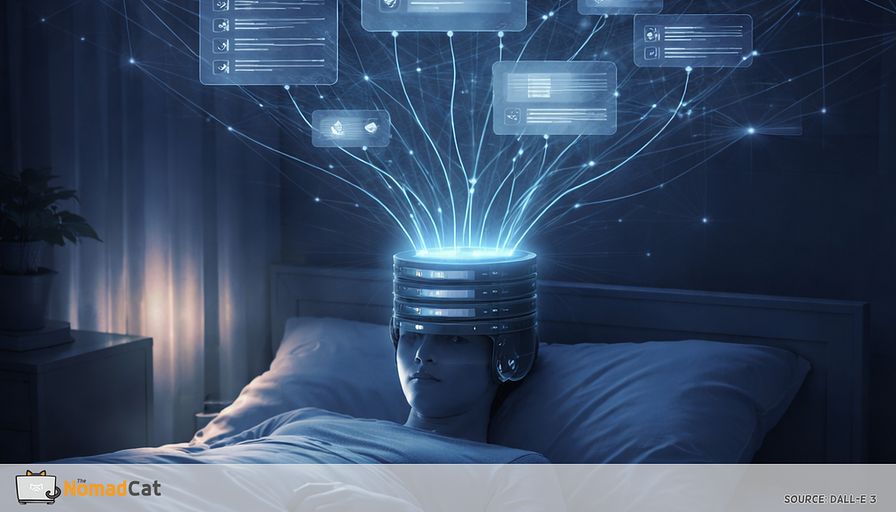
Not because you forgot magnesium or because your bedtime isn’t aesthetic enough. It’s often because part of your brain is still on standby. Like a server running in a reduced mode, not doing heavy compute, just waiting for pings. You wake up not panicked, just instantly competent. A quick status scan runs before your feet hit the floor.
This article is for that specific problem. The kind where productivity hygiene can be perfect and sleep still doesn’t land.
Here’s what you’ll get, without turning your evenings into another project plan
- A clear distinction between task vigilance and role vigilance, and why only one of them closes with a list
- A quick check to figure out what’s running tonight, in about 10 seconds
- The work-system reasons this happens in the first place, especially in async teams and blurry ownership setups
- A small, practical boundary move that helps your brain stop doing unpaid night shift, plus what to do if it doesn’t
The goal is not to become less responsible. It’s to make responsibility bounded enough that your nervous system can stop acting like you’re on call, even when nobody is calling.
Role vigilance is a different kind of sleep thief
When you never stop being the responsible one
You close the laptop late, after the last meeting stack and the last “quick” reply. Sleep happens, technically. But part of you stays online. You wake up fine, but instantly operational, like you never fully left the shift. A status report seems to be waiting for you.
This is common, especially in desk work that leaks across time zones and into evenings. I have spent years at a desk between Beijing, Berlin, and now Lisbon, often past midnight, and sleep is still the variable I haven’t solved.
The useful move is noticing what’s actually running. This is not only replaying 1 email thread. It’s a readiness stance.
Thought content is what you’re thinking about. System state is whether you’re on standby. Sometimes your thoughts are quiet, but your system stays revved anyway, like you’re waiting for the next interrupt (Riemann et al., 2015). And in work settings, low evening detachment predicts poorer sleep that same night (Sonnentag, Binnewies & Mojza, 2008).
Here’s the usual signature. Falling asleep can be fine. The problem is what kind of sleep you get, and how you come out of it.
- Light depth you sleep, but it feels thin, easily punctured
- Instant competence on waking eyes open and you’re already solving
- Morning scan reflex urge to check status before you’ve fully stood up
It can happen with notifications off and a neat to-do list. That’s the point. It’s not only about loose tasks. It’s about being “on call” in your own identity.
On-call research is a clean analogue. Being on standby alone can fragment sleep and lighten it, even without being called in (Torsvall & Åkerstedt, 1988; Wuyts et al., 2012). And if sleep problems persist or start to sprawl into daily functioning, it’s worth treating them as a real health topic, not just a personal discipline project (Sateia et al., 2017).
Two kinds of vigilance that look the same at 01:00
Task vigilance closes with a plan and role vigilance does not
This is why good productivity hygiene sometimes does nothing for sleep.
Task vigilance is a few open loops that feel specific. Did I send the invoice. Did I reply to X. It often calms down with a plan, or even a 5-minute list that offloads tomorrow (Carney et al., 2016).
Role vigilance is a standing internal contract. I catch what others miss. You can close every task and still feel assigned. The common mistake is making better lists and nothing changes.
Sleep hygiene can be perfectly true and still irrelevant. Sleep hygiene education on its own tends to be weak as a standalone fix for chronic insomnia patterns (Irish et al., 2015), which is why CBT-I components are the benchmark in studies when sleep problems persist (Trauer et al., 2015).
Quick boundary check without overthinking it
You don’t need a new bedtime system. You need to pick the likely driver tonight.
- Reachability uncertainty the pull to stay available fast (Barber & Santuzzi, 2015)
- Micro-checking novelty tiny “just to be sure” loops that spike attention
- Decision residue unfinished choices that keep reopening
- 03:00 reputation rehearsal imaginary performance review, but with your own voice
- Early anticipation waking eyes open because calendar exists
Role vigilance’s marker is simpler.
Even if nothing is pending, you still feel assigned.
A quick mechanism check that takes 10 seconds
Two questions to separate role from tasks
- If I knew every task was handled, would my body still feel on standby
- Is my mind stuck on 1 concrete loop, or doing a broad scan of tomorrow
Role vigilance often feels like posture. A subtle readiness in the chest, jaw, shoulders. Not dramatic panic. More like available for interrupts.
Debug first, not introspect
Think debugging, not therapy. The goal is to pick the dominant driver tonight, not to produce a perfect label. Drivers stack in real life, which fits the 3P model where predisposing, precipitating, and perpetuating factors can all be active (Spielman et al., 1987). Mechanism matters because the useful levers are different, and guidelines don’t treat insomnia as “just do better hygiene” for a reason (Sateia et al., 2017).
Why work systems keep your brain on standby
Ownership ambiguity makes you the safety net
Detachment gets mechanically difficult when ownership is blurry. A handoff lands with someone should follow up. A doc has 12 editors but no accountable owner. A deploy has a soft gate where everyone can approve and nobody really does.
So the dependable person becomes the glue. Conscientiousness is an asset here, until it becomes an identity.
Role ambiguity and role conflict have long been linked to strain (Jackson & Schuler, 1985). Over time, role stressors also map to burnout patterns (Lee & Ashforth, 1996). The body reads this as 24-hour duty, even if the calendar says done.
A second accelerant is invisible labor that gets rewarded but never bounded. If the next state is undefined, the brain keeps running a quiet coverage simulation. Low psychological detachment in the evening predicts more sleep complaints, even when researchers control for job stressors and demands (Sonnentag, Kuttler & Fritz, 2010; Wendsche & Lohmann-Haislah, 2017).
Async work creates latent responsibility
In async teams, while you sleep, decisions still move. Requirements shift. Stakeholders reply. Incidents resolve badly. Definition of done quietly changes. Even if nobody expects an answer at 02:00, the system can mutate while you’re offline.
If you’ve done the Beijing → Berlin → Lisbon desk shuffle (sometimes on bad chairs and worse desks), you know the feeling: you log off and the thread keeps evolving without you.
That is enough to trigger the responsiveness reflex in people who carry responsibility. Telepressure captures this urge to reply fast and be seen as reliable (Barber & Santuzzi, 2015). After-hours email demands also link to worse recovery pathways (Lanaj, Johnson & Barnes, 2014).
On-call and standby nights show lighter, more fragmented sleep even when nothing happens, measured objectively (Torsvall & Åkerstedt, 1988; Wuyts et al., 2012). Not identical to your job, but close enough as a model.
Fix the boundary, not your bedtime
The 2-minute coverage handoff note
A contrarian idea that often helps more than another perfect bedtime plan is to write a coverage note, not a journal. It’s a boundary artifact that tells your brain 1 thing.
Coverage exists.
Keep it brutally constrained. 2 minutes, same format, written before evening depletion, so end-of-work or pre-dinner. Not a new ritual. Just a tiny handoff.
A note only works if it matches reality. Otherwise your brain will ignore it.
Use 3 prompts.
1) Scope
“Overnight I am responsible for X, not responsible for Y.”
Vague scope turns into infinite scope, and infinite scope keeps you scanning.
2) Urgency threshold
“Escalate only if A, B, or C happens.”
Clear if-then triggers reduce mental rehearsal and create closure.
3) Coverage
“If it trips the threshold, who or what covers it and how.”
Naming an owner, timer, or rule converts identity-duty into an escalation ladder you can trust.
If there is no coverage, write no coverage and shrink the scope instead. Offloading only buys calm when you trust the external system (Risko & Gilbert, 2016).
Shrink responsibility during the day
Move recurring responsibility out of your head and into the work surface itself.
When “someone should” lands on you, a low-drama script helps.
- “Who is the owner for this, and what’s the deadline we’re committing to.”
That’s coordination hygiene, not being difficult. Reducing ambiguity reduces strain (Jackson & Schuler, 1985), and clarity makes detachment more likely later, which supports sleep (Sonnentag, Binnewies & Mojza, 2008).
Turn being responsible into bounded artifacts where the work lives, not in your memory.
- A checklist inside the ticket template
- A PR template with risk, rollback, owner
- A tiny decision log with who decided what and why
- A runbook snippet for the top 3 incidents
Point-of-action means the prompt appears exactly where the action happens, so you don’t have to carry it around.
Even with those, evenings need 1 simple rule.
No new guardianship after dinner.
Closing loops is fine. Adopting new ones is not. It protects sleep without demanding screen perfection, and it prevents the classic quick thing that somehow breeds 6 more quick things.
When the handoff note still fails
Stack the mechanisms before blaming yourself
Some nights it’s not work brain, or not only that. If you get sleepy on the couch but become weirdly alert in bed, think conditioned arousal and stimulus control first: bed starts to mean “work-alert” instead of “sleep” (Bootzin, 1972). If you sleep great on free days but at shifted hours, that’s often timing and circadian framing (AASM, 2014). Boundaries still help, just not always as the main fix.
Fast red flags worth screening
If things don’t budge after a few weeks of cleaner boundaries, it’s reasonable to stop debugging Slack at midnight and check the boring basics (Sateia et al., 2017).
Non-dramatic reasons to get proper advice include
- Loud snoring or gasping pauses
- Restless legs sensations at night
- Medication or substance effects including alcohol, nicotine, stimulants
- Dangerous daytime sleepiness
What progress looks like for desk workers
The boring signs your system is powering down
Judge this over weeks, not nights. The best indicators are not duration or a score. It’s whether role vigilance is loosening its grip.
- Fewer wake-ups with immediate work readiness, the ok what broke boot sequence
- Less morning compulsive scanning
- More tolerance for ambiguity the next day
Detachment predicts better sleep in diary studies (Sonnentag, Binnewies & Mojza, 2008). Rumination and perseverative thinking tends to push the other way (Querstret & Cropley, 2012; Wendsche & Lohmann-Haislah, 2017).
One caution. Measuring can become another form of vigilance. Treat sleep like a noisy signal. Look for a small downward drift in standby mode, not a perfect streak. If tracking makes bedtime feel like an exam, drop trackers for a week and reduce it to 1 or 2 morning questions.
You don’t need to become less conscientious. You need a handoff your brain can trust, so it stops running unpaid night shift (Risko & Gilbert, 2016).
You might be interested by these articles:


After dinner no more invisible work so your sleep can actually power down

8 hours in bed and still tired debug your fragmented sleep

Your 1st 45 minutes are training your 02:00 brain so change the input order

Work is over but your body is still in competence mode at midnight

Your workday ended but your brain is still on duty at 23:40

Driving Innovation and Growth: DEI Strategies in European Tech Startups

A health plan that still works in 3 stolen minutes