Abstract:
The article argues that many “tired-but-wired” nights (thin sleep, early wake-ups with instant planning, a brain that keeps polling for updates after the laptop closes) are trained during the day—especially in remote work where the commute and other buffers disappeared—because starting the morning by immediately absorbing Slack/email/calendar demands teaches the brain to stay on “watch,” a 24-hour hyperarousal pattern that shows up at 02:00. It distinguishes two lookalike midnight problems that need different fixes: availability vigilance (sleeping with one ear open for pings) versus unfinished-work replay (mentally drafting emails and rearranging tasks), and explains how constant checking becomes an “operating system” when priorities reshuffle all day (“priority volatility”), making “done” feel unstable and keeping obligations running in the background. The practical core is a simple, non-precious change to the first 45 minutes: a two-phase protocol where Phase A (10–20 minutes) is “no intake” (no messages/news/dashboards) to write a three-line “priority anchor” on paper—what matters most, what still gets done if the day explodes, and a small first move—followed by Phase B (15–30 minutes) as a bounded intake window that triages each message into do-now (≤2 minutes), park with a specific next-touch time, or route to the right person, using “closure cue” scripts like “Seen. Parked. Next touch at 14:00.” Alongside a narrow exception rule (true emergencies use call/text), a guilt-free “repair” if you slip, and signs of success measured by reduced bedtime checking urges rather than sleep apps, the piece frames the issue not as a character flaw or a perfect-morning quest but as reducing background mental tabs; it even nods to the author’s own desk-heavy, spreadsheet-and-wearables lifestyle across Beijing, Berlin, and Lisbon as proof that the lever is inputs and boundaries, not motivation—while noting that persistent insomnia merits CBT-I rather than tweaks.
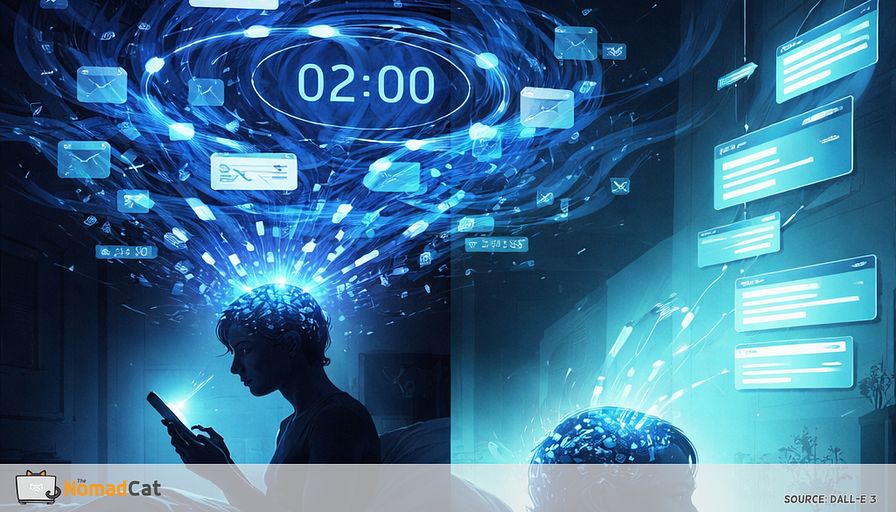
You wake up and your phone is already doing customer support. A Slack preview. An email subject line that is basically a new requirement. A calendar that looks like it was scheduled by someone who hates you personally. Before your feet hit the floor, you are already reacting.
Then it’s a 10-hour desk day. Meetings that drain your battery. Lunch at the desk “just this once” again. You tell yourself you’ll move later, then later turns into tomorrow. Meanwhile, your brain keeps scanning for what’s next.
And it feels normal, because it kind of is now. Remote work removed the buffers. No commute. No hallway. No “i left the building” moment. Just a clean jump cut from bed to inbox. The problem is that this early intake doesn’t stay in the morning. It teaches your brain “we are on watch,” and that posture leaks into the night: at 02:00 your body is tired but your mind is still refreshing.
This article is here for a simple purpose. Not to sell a perfect morning. Not to add another system to manage. Just to change the first 45 minutes so your day stops training the exact mental mode that keeps sleep thin and wired later.
You’ll get two things, plus a small protocol. First, a clear way to tell apart two midnight problems that feel identical (ping-vigilance vs unfinished-work replay). Second, why constant checking becomes the default when priorities reshuffle all day. Then a 2-phase morning sequence: a short no-intake boot, followed by a bounded intake window that routes messages without swallowing your whole brain.
There’s a bit of evidence in the background, but the focus is practical. The goal is not to be less responsible. It is to keep fewer things running in the background when the lights go out.
The 45 minutes that set your whole day
When your morning already feels like support duty
You wake up and the phone is already warm. The screen glow is the first light in the room. Your thumb does its usual thing and checks a notification preview that is basically someone else’s priority, compressed into 2 lines. Before you even stand up, you are in Slack, email, or a calendar that looks like Tetris played by an enemy. You are not choosing anything yet. You are just responding.
That early intake is easy to dismiss. But sleep research has a boring, useful point. Insomnia and sleep disruption are often linked to 24-hour hyperarousal (your system stays in “alert mode” all day), not only something that starts at night (Bonnet & Arand, 1997). So the first 45 minutes can shape tonight’s sleep more than another bedtime rule you will follow for 3 days.
The tired-but-wired signature
If you recognize this, it usually looks like:
- light sleep that feels thin
- early wake-up with instant competence (awake and planning in 3 seconds)
- evenings where the body is done but the head keeps doing status checks
- closing the laptop, but the mind still polling for updates
Harvey (2002) points to pre-sleep cognitive activity and monitoring as a key piece that keeps sleep problems going. Researchers call it cognitive arousal (basically: the brain stuck in thinking mode when it should power down).
The point is not to diagnose yourself. It is to stop treating this as a personality defect.
Remote work removed the buffers
Remote work killed a lot of accidental downshifts. You used to get tiny “loading screens” between contexts. Now the phone follows you from bed to desk, and there’s no transition where your brain gets the hint: we’re done.
Knowledge work is fragmented by default, and constant switching + interruptions reliably increases stress and strain (Mark, Gudith & Klocke, 2008). Put that next to a device that can mint new obligations in 2 seconds, and bedtime habits end up trying to compensate for a day that never downshifted. (Other related work: González & Mark, 2004.)
2 problems that feel identical at 02:00
You can stare at the ceiling for the same reason, but the fix differs.
Availability vigilance
Even if you are not truly on-call, the possibility keeps part of the brain on a low-grade watch shift. It shows up as tiny behaviors: keeping the phone face-up, volume on, checking “just in case,” even when you told yourself you wouldn’t. Harvey (2002) describes threat monitoring as part of the loop.
Unfinished work that keeps running
The other driver is unfinished work that stays mentally “running.” You stop working, but your mind keeps drafting the explanation you might need tomorrow.
On days with more unfinished tasks, people ruminate more and report poorer sleep quality (Syrek et al., 2017). A broader mechanism is perseverative cognition (your brain chewing the same thing again and again) keeping stress activation going after the trigger is gone (Brosschot, Gerin & Thayer, 2006).
A practical distinction:
- A feels like sleeping with 1 ear open for a ping
- B feels like rearranging tasks and writing emails in your head
Detachment is one of the main recovery mechanisms from work demands (Sonnentag & Fritz, 2007), and it is linked with better sleep outcomes across studies (Wendsche & Lohmann-Haislah, 2017).
When checking becomes the operating system
High sampling rate becomes your default
A “high sampling rate” is when check, refresh, reopen, reread becomes how you feel in control. It starts with a quick scan in the morning and becomes the regulation tool for the whole day.
The hidden lesson is simple. Your brain learns that safety comes from constant updates.
- Checking email less frequently reduces daily stress (Kushlev & Dunn, 2015)
- Notifications disrupt attention even when you do not respond (Stothart, Mitchum & Yehnert, 2015)
And that lingering attentional pull is the same “monitoring posture” your brain brings to bed.
If the day trains “alert and scanning” as the default mode, bedtime inherits it. Insomnia models describe this as a 24-hour issue, not a nighttime glitch (Perlis et al., 2001; Riemann et al., 2010).
Priority volatility is the real fuel
Priority volatility is not “too much work.” It is the queue reshuffling all day, so “done” never feels stable. One “quick” message becomes: a new meeting invite, a reshuffled calendar block, one dependency you have to chase, and suddenly your clean 2-hour block turns into 6 micro-decisions and 3 half-finished threads. Everything becomes almost done.
This matters because:
- unfinished tasks spill into rumination and poorer sleep quality (Syrek et al., 2017)
- keeping priorities in your head makes your head keep tracking them
- offloading priorities reduces internal load (Risko & Gilbert, 2016)
And here’s the non-poetic version of “outsized impact”: if the day starts with a Slack preview + an email subject line + a calendar reshuffle, don’t be surprised when at 02:00 your brain does the same three-step refresh loop, just without the screen.
A small author note from the desk side
The fix here is not motivation. It is a small protocol that changes the first inputs of the day.
The author has spent most of adult life at a desk, from Beijing to Berlin to Lisbon, often past midnight, with a metrics-brained approach to health (HRV, sleep tracking, the whole spreadsheet vibe). And still, sleep stays stubborn when the day keeps teaching the brain to monitor and reshuffle. I can see it in the sleep graph, but more in the feeling: 7 hours that behave like 4. It is not very glamour.
A 2-phase morning that keeps you responsive
This is meant to fit an overloaded schedule. It is not a precious routine. It is a sequence change.
Phase A with no intake
Take 10-20 minutes to boot up without letting new inputs mint new obligations.
Options (boring on purpose):
- no Slack, no email, no news, no dashboards, no “quick scan”
- if you can, airplane mode. if not, at least kill notifications for 20 minutes
- allowed: water, coffee, shower, basic breakfast
- allowed: glance at calendar for blocks only, not meeting details
- i use 1 paper sheet (a plain note works too)
- if something feels urgent, write it down. do not open it yet
Then write a priority anchor in 3 lines:
1) Today matters most ______
2) If the day explodes, still do ______
3) First move (5-15 min) ______
Why it helps:
- unfinished goals intrude less once a concrete plan exists (Masicampo & Baumeister, 2011)
- writing it down is cognitive offloading (Risko & Gilbert, 2016)
The first move is small on purpose. You want early closure, not a heroic plan.
Phase B with a bounded intake window
Now you can open inputs, but keep them in a timebox, usually 15-30 minutes. The goal is routing decisions, not solving. The sleep win is that each message gets a closure cue, so it stops replaying at 02:00.
Give each message 1 of 3 outcomes (think “close tabs,” not “be efficient”):
1) Close now (≤2 min)
2) Container (with next-touch time)
3) Hand off (so your brain releases it)
Use an intake ledger:
- Container 11:00 ask finance about invoice status
- Hand off to Ana bug report with logs attached
- Container 16:30 reply to recruiter with availability
Task listing can help people fall asleep faster, likely by reducing bedtime intrusion (Scullin et al., 2018).
Keeping responsibility out of your bed
Knowing is not the same as doing
Desk work has a bug. The moment you see something, your brain treats it as partially owned. It feels responsible and competent, so it gets rewarded. It also keeps obligations running in the background, which is exactly the kind of perseverative cognition that extends stress activation (Brosschot, Gerin & Thayer, 2006).
If you detach less, recovery gets worse (Sonnentag & Fritz, 2007). So the goal is tiny closure cues.
Small scripts that close the loop
- “Seen. Parked. Next touch at 14:00.”
- “Not deciding now. Reopening at 11:30.”
- “Got it. If it is still urgent after my intake window, I’ll handle it at 09:40.”
The time is not a productivity flex. It is a closure cue. It turns a floating obligation into an if-then plan (Gollwitzer, 1999), which reduces intrusive thoughts from unfinished goals (Masicampo & Baumeister, 2011). (More on implementation intentions: Gollwitzer & Sheeran, 2006.)
Parking without a time is not parking
If “park it” has no next touch, it becomes suppression. Suppression tends to rebound as cognitive intrusion (Harvey, 2002). Even “tomorrow morning” is a container.
Keep it realistic
The protocol starts at your first work moment
Some mornings are chaos. Meetings at 08:30, kids yelling, global team mid-thread. This is not about waking up at 05:45 to win at life.
Phase A happens at the first moment you can choose inputs. Even if that moment is 11:10 between 2 calls.
One narrow exception channel
To make it workable, keep 1 boring exception rule.
True fires use call or text. Everything else can wait 20 minutes.
That gives you a single channel to trust, so you stop treating every app like a fire alarm.
Degraded mode and the 90-second repair
If you open Slack first, do not do the guilt spiral. Run the repair.
- close Slack
- write the 3-line anchor anyway
- run a shortened Phase B
Slightly dumb. Effective, like restarting an app.
Signs it is working without staring at a sleep app
You are looking for less monitoring behavior:
- fewer urges to do a quick check after lights out
- less replaying threads and drafting replies in your head
- fewer early wake-ups where the brain boots into planning mode
- less bedtime scanning for “did i forget something”
Not bliss. Just fewer 02:00 check impulses.
That is basically a reduction in pre-sleep cognitive activity (Harvey, 2002).
What this article is not
This is not a supplement stack, a new app workflow, a sleep hygiene lecture, or a wearables requirement.
If sleep is persistently impaired, evidence-based clinical help matters more than tweaks. Sleep hygiene alone is often insufficient for chronic insomnia, and CBT-I is recommended as first-line treatment in guidelines (Qaseem et al., 2016; Riemann et al., 2017).
For everyone else, the goal is plain.
Stop training the brain to monitor. Stabilize importance early. Contain obligations with a next touch. You do not need to be less responsive. You need fewer things running in the background when the lights go out.
If your day starts with Slack triage and ends with your brain refreshing at 02:00, it is not a character flaw. It is a loop you trained all day.
The first notification isn’t “information.” It’s a training stimulus.
You might be interested by these articles:


After dinner no more invisible work so your sleep can actually power down

A productive day can still break your sleep fix the missing downshift signal

Sleep looks fine but your brain never downshifted

Stop feeding Slack at 07:40 a simple morning intake gate for thin sleep

8 hours in bed and still tired debug your fragmented sleep

Java's Impact on Tech Leadership Roles

Collaborative pricing made simple for freelancers and clients