Abstract:
The article explains why you can do everything “right” for sleep—get 7–8 hours and go to bed on time—yet still wake up tense and mentally on-call, with your jaw tight, your brain drafting replies, and your hand reflexively reaching for the phone: the real problem is often upstream, where a modern, interruption-heavy workday never truly downshifts, leaving bedtime as the first quiet moment and forcing sleep to do two jobs at once (physical recovery plus mental decompression). Framed as hyperarousal fueled by constant context switching, open loops, rumination, and telepressure to respond, the piece argues that “go to bed earlier” can backfire by creating more time to replay the day. It offers a pragmatic “recovery sandwich” that fits real calendars rather than demanding a purity lifestyle: a 10-second self-check (“when was my first no-input moment today?”), repeated 2–4 minute no-input/no-output micro-downshifts between meetings (e.g., staring out a window, washing a mug in silence, a slow hallway loop with the phone face down), a short late-afternoon capture to contain unfinished tasks using a tiny template (Done/Waiting on/Tomorrow first move/Optional unblock message), and a binary hard stop after a set time to prevent the “just checking” spiral, supported by simple deferral scripts and an explicit emergency channel. Progress is defined as boring but measurable—less bedtime scanning, fewer imaginary replies, more sleep in one block, fewer early wake-ups that trigger instant planning—and the author grounds it with personal modern-work details like accidentally working past midnight in Lisbon or going all day without eating, drinking, or moving, while also noting when to stop DIY and seek proper evaluation or CBT-I for chronic, impairing insomnia or other red flags.
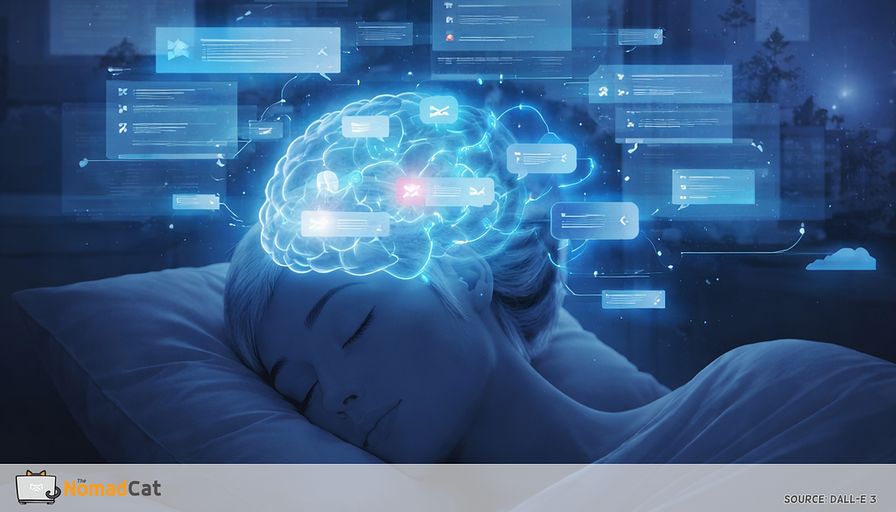
You did the “right” thing. You got 7–8 hours. You went to bed on time-ish. And still you wake up like the incident already started. Jaw a bit tight. Brain already writing replies. Hand doing that small automatic move toward the phone, like it’s not even a decision.
This is the annoying gap between time in bed and felt recovery. For a lot of people, the problem is not classic insomnia and not a single obvious villain like screens or coffee. It is simpler and more modern. The day never really downshifts, so sleep gets assigned 2 jobs at once.
- recover the body
- decompress the mind
When the mind stays in “check status, scan for risk, run the next scenario” mode, bedtime turns into a performance review. You as employee and manager. Great system.
This article is here to make that system less stupid, with small changes that fit inside real calendars. You’ll get a quick 10-second check to spot whether bedtime has become your first quiet moment, a clear explanation of why sleep can’t clear a full day’s backlog by itself, and a pragmatic setup called the recovery sandwich.
Three seams, not a new system:
- a 2–4 minute no-input downshift between blocks
- a short late-afternoon capture to park open loops
- a hard stop that protects the night from “just checking”
No purity, no extra dashboard to manage. Just a few punctuation marks in the day, so the night can do its real job.
The day that never powers down
Sleep that looks fine and still feels useless
You get 7–8 hours. You fall asleep fast. No drama. And still, the morning starts like you are already on-call—brain already scanning, body already braced, the day arriving at full volume.
On paper, it should work. In real life, focus is brittle and patience is… limited. This gap between time in bed and felt recovery is common. Stress is linked with worse sleep quality and continuity (Åkerstedt, 2012).
It’s not always classic insomnia. Not automatically “screens”. Not just caffeine. Often it’s simpler and more annoying: the day never really downshifts, so night sleep gets the impossible job of doing recovery and decompression at the same time.
A useful way to see it: your brain stays on patrol. It keeps running “check status, scan for risk, run the next scenario.” Bedtime becomes a performance review, with you as both employee and manager. Great system.
Left alone, I work past midnight in Lisbon. Sleep is still the variable I haven’t solved. Not heroic. Just… very modern.
A 10-second check without apps
A quick self-check: when was the first moment today with no input.
No Slack. No email. No podcast. No meeting. No “quick scroll”. Just 2 minutes where nothing was asked from you and you didn’t ask anything from the world.
If the honest answer is “late evening”, bedtime has been doing double duty as the first decompression window. Like running garbage collection only when the server is already overheating. In recovery research this maps to detachment, meaning being off the job mentally, not only away from the laptop (Sonnentag & Fritz, 2007).
A workday without transitions
Calls end and Slack opens instantly. You close 1 tab and another blinks. Lunch happens at the keyboard. Bathroom breaks feel negotiated.
Knowledge work is naturally fragmented. Research has documented short activity episodes and real resumption costs from interruptions (González & Mark, 2004). That constant context switching keeps the mind in interrupt-handling mode. Then you expect 7–8 hours to clean it all up.
No punctuation, no reset.
Why sleep cannot clear the backlog
If your system runs at 70–90% capacity from 09:00 to 19:00, sleep doesn’t get a fair maintenance window. When the backlog is too big, nights get lighter, more fragmented, or end early with the brain already online.
This load isn’t always 1 big crisis. It’s normal desk-day stuff stacked together, with no downshift.
A big part of the problem is replay. You close the laptop, but your head keeps running—drafting the message you should have sent, re-litigating the meeting, pre-solving tomorrow.
Desk culture quietly pushes that:
- Meetings carry subtle evaluation. Even friendly ones can leave you “performing” for the rest of the day.
- Context switching creates unfinished loops. Tiny “I’ll come back to this” promises that your brain keeps in RAM.
- Unclear ownership creates background vigilance. The “don’t drop the ball” watcher never shuts up.
- Always-available comms becomes monitoring. Telepressure (the felt need to respond fast) is linked with reduced detachment and sleep problems (Barber & Santuzzi, 2015).
So when quiet finally arrives, the brain starts processing what it couldn’t process while reacting. If silence only happens at night, “go to bed earlier” often fails. You just create more time for the replay channel.
Also: if sleep problems are persistent, severe, or impairing, it can be worth escalating. CBT-I is recommended as first-line treatment for chronic insomnia (Qaseem et al., 2016). This is not a failure. It’s the right tool.
Recovery sandwich
The idea is boring: move some recovery earlier, in small pieces, in a way that survives real calendars.
Downshift that ends the mode
This is not “relaxation”. It’s a marker that the performance block is finished.
Constraint: 2–4 minutes, no input and no output. No learning, no replying, no catching up.
Examples (pick anything that doesn’t feed you new information):
- Stand by a window and look far
- Wash a mug in silence
- 1 hallway loop, slow pace
- Refill water, no phone
- Sit, eyes closed, 10 breaths
- Step outside, feel the air
Rule: phone stays face down. The activity matters less than the “no new info enters” rule.
Make it reliable by attaching it to something stable:
- the moment you click Leave
- before opening inbox after a meeting
- right after sending the last message before lunch
If you catch yourself scrolling anyway, treat it like a slip, not a moral crisis. Repair: 90 seconds of no-input standing or walking (no phone), then continue. The goal is not purity. It’s to end the mode.
I can do a full day without eating, drinking, or moving. It’s not a superpower. So yeah—boring breaks are not a luxury. They are the missing punctuation, voilà.
Downshift that contains the open loops
This is less rest and more containment.
Keep it 6–10 minutes in late afternoon. Goal: write what is still open in a way that makes it less urgent for your brain.
Use a tiny template so it doesn’t become another work session:
Done:
Waiting on:
Tomorrow first move at:
Optional unblock message:
Write 1–3 lines max. Then stop.
Failure mode is predictable: you start “just clarifying” and now it’s a spreadsheet at 18:47. Fix: capture only next touch time + first move, then exit.
If your day is wall-to-wall, do a degraded version in 3 minutes: 3 bullets (done, waiting, tomorrow first move at 09:30).
Hard stop that protects the night
Make a simple rule: after time X (often after dinner), close loops if needed, but don’t open new ones. No new tasks, no new threads, no “quick check” that creates something else to monitor.
Late-evening work on the phone is linked with less sleep and lower next-morning vigor (Lanaj et al., 2014). Telepressure makes checking feel necessary even when nothing is urgent (Barber & Santuzzi, 2015).
Short scripts help because they remove ambiguity without drama:
- “Seen. Parking for tomorrow 10:00.”
- “Not deciding tonight. Reopening after 1st block tomorrow.”
If real emergencies exist, define a channel: call or SMS, not “scan Slack forever just in case”. A channel is explicit. Scanning is endless.
Signals that the system is calming down
Skip the fantasy of perfect nights. Early wins are usually smaller and more realistic: less replay, fewer scan urges, fewer mental drafts.
Look for boring, observable signs:
- less phone-reaching at 23:10
- fewer imaginary replies in bed
- sleep feels more like 1 block
- fewer early wake-ups with instant planning
- mornings feel less like incident response
- lower irritability from small pings
Even “2 nights per week are less noisy” counts.
If you want measurement, keep it tiny. A 10-second morning note for 5 days:
- [ ] Scan urge on wake yes/no
- [ ] Sleep felt like 1 block yes/no
Direction matters more than purity. Sleep diaries are a real clinical tool (Carney et al., 2012), but tracking can also become another input stream. If you use wearables, consider watching 1 trend only for a few weeks.
When work tweaks are not enough
DIY setups shouldn’t route around medical issues.
Red flags worth proper evaluation:
- loud snoring or witnessed breathing pauses
- restless legs sensations
- severe mood symptoms
- parasomnias with injury risk
- medication or substance triggers (including alcohol as “sleep aid”)
- dangerous daytime sleepiness, especially while driving
If insomnia is chronic and impairing, CBT-I is first-line in guidance (Qaseem et al., 2016) and improves key sleep outcomes in meta-analysis (Trauer et al., 2015).
Most things fail because the calendar eats them. The point here is smaller: install a few punctuation marks so your system stops running hot into midnight. If a day collapses, don’t restart a whole plan. Just re-install 1 seam after 1 meeting.
If sleep looks fine on paper but mornings still feel like incident response, the problem is often upstream. A day with no downshift leaves the brain “online” until the first quiet moment, which is usually bedtime. Then sleep gets 2 jobs at once and does neither perfectly.
The fix is not a new system to manage. It is a few small seams in the day: a 10-second check for your first no-input moment, a 2–4 minute downshift between blocks, a short late-afternoon capture to park open loops, and a hard stop that blocks the “just checking” spiral.
Early progress is boring and that is good: less replay, fewer phone reaches, sleep that stays in 1 block more often. If it stays severe or chronic, getting proper help like CBT-I is not defeat, it’s correct tooling.
You might be interested by these articles:


Your 1st 45 minutes are training your 02:00 brain so change the input order

8 hours in bed and still tired debug your fragmented sleep

After dinner no more invisible work so your sleep can actually power down

Your brain needs an off duty signal not an earlier bedtime

Work is over but your body is still in competence mode at midnight

Minimalist branding for tech professionals building trust through simplicity

Eco-Friendly Building Innovations