Abstract:
The article explains why, after an intense work “crunch” or major deadline, you can sleep longer yet still wake up foggy, stiff, irritable, and oddly wired—like an old laptop forcing surprise updates—and argues that this common mismatch is often **nonrestorative sleep** driven by “recovery debt” rather than laziness or simple burnout: weeks of sustained cognitive load, context-switching, and low-grade vigilance can keep the body’s stress systems partially activated (allostatic load), while rumination and “just in case” mental checking (perseverative cognition) keep the brain scanning even after Slack goes quiet. Instead of chasing a “hero sleep” night, the piece recommends **sequencing recovery**: decompression while awake first, then sleep, because extra time in bed can backfire if arousal is still high. It describes how this shows up at a desk as “focus that’s actually control” (rereading, sloppy approvals, too many mental tabs) and advises “decision hygiene” like a **deploy freeze**—delay irreversible decisions for 24–72 hours and avoid creating “new surface area.” It warns about the “first free evening” trap of rebound stimulation (doomscrolling, competitive gaming, inbox-clearing, high-input social catch-ups) and offers low-cognitive alternatives (paper fiction, one familiar episode, light chores, a short walk, optional warm shower 1–2 hours before bed), plus concrete guardrails such as 60–90 minutes the next morning with no email/Slack/news and a bounded writing practice (a 12-minute mini postmortem and a 5-minute next-day to-do list to stop bedtime replay). Finally, it suggests simple recovery signals (less morning “sandbag” feeling, fewer urges to re-check, more continuous sleep) and flags when to seek screening instead of more bedtime rules (dangerous sleepiness, snoring/gasping, high ESS or STOP-Bang risk, symptoms lasting weeks, or depression indicators).
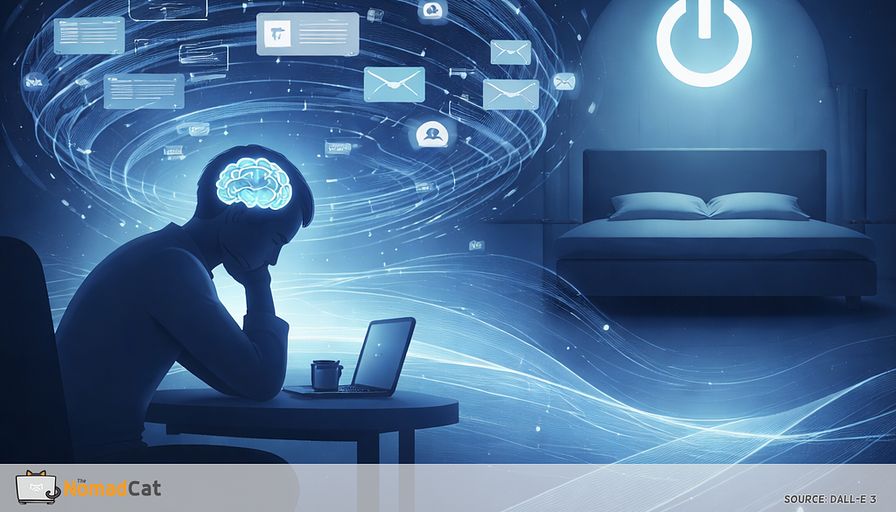
The day after the big push is supposed to feel like relief. Calendar suddenly empty, Slack suspiciously quiet, no one asking for “just 1 more thing.” So why does your body still feel like it is on-call.
You slept longer. You still wake up with the heavy head, dry mouth, and that cottony behind-the-eyes feeling. Your brain starts like an old laptop that insists on installing updates right now. And the annoying part is the guilt loop. You got the hours, so you “should” feel fine. But you don’t.
This article is for that exact mismatch.
It puts a useful label on what is happening, nonrestorative sleep, and explains why it often shows up right after a crunch. Not as a dramatic diagnosis, more like a systems problem. Too much load for too long, not enough real off-switch, and sleep gets asked to do all the repair work by itself. Spoiler, it rarely can.
No grand plan here. Just a way to name what’s happening, stop feeding it on the first free evening, and give your system a simpler path back to baseline. Three things matter most:
- why the crash can linger even when the deadline is over
- decompression first, sleep second
- quick red flags that deserve screening, not more bedtime rules
If your work life is heavy on meetings, tabs, and context switching, this is not about perfection. It is about getting your system back to baseline with small inputs that fit inside real weeks. The kind where lunch happens at your desk and “rest” is mostly switching to a different screen.
The crash sleep cannot fix
The morning after looks familiar
It is the morning after the launch, the incident, the big client thing that ate 3 weeks of your calendar. Slack is quiet. Meetings are gone. You sleep longer. Still you wake up and it’s the same cotton-eyes, same slow boot, plus that low-grade neck-and-shoulder stiffness that makes no sense for “just desk work.”
I did 6 years in Berlin, the last 4 mostly remote on bad chairs and worse desks, and the day after a push is when my upper back likes to file a complaint.
That mismatch has a name in research. Not a diagnosis, just a useful label.
Researchers call it nonrestorative sleep (NRS). Sleep that feels unrefreshing and does not bring you back to normal functioning, even when the hours in bed look fine. The key point is how it feels plus the daytime impact, not a perfect night on paper. Research usually measures it with questionnaires that capture “sleep felt bad” plus “daytime functioning got worse.” The label matters because it points to the right problem.
Often the first instinct is to call it burnout. Sometimes it is. Often it is closer to recovery debt. Demands stayed high, the off switch did not really happen, and the body did not return to baseline yet (Effort-Recovery model, Meijman & Mulder). Another common trap is the “1 perfect night” fantasy, like you can pay back 3 weeks of strain with 1 long sleep. With cumulative stress activation, the system can stay partly on for a while. That is basically allostatic load in plain language (McEwen).
A quick self-check helps, like reading logs, not grading yourself. In the last 24 hours, notice if you have
- Slept longer but woke up with worse clarity than usual
- Felt tired and wired at the same time
- Reached for coffee early, then still felt slow
- Had a strong urge to re-check work just in case
- Kept replaying decisions or conversations
- Made small mistakes you normally don’t make
That “just in case” loop fits perseverative cognition (Brosschot). Rumination and mental monitoring can keep stress activation running, even when nothing is happening right now. If you recognize yourself here, the outcome is normal. It just means recovery will likely need sequencing, not hero sleep.
The costs you notice at a desk
It looks like focus, but it is actually control
This does not always look like falling asleep at your keyboard. It looks like quiet executive friction.
- You reread the same paragraph 4 times
- You task-switch like a browser with 27 windows
- You approve a slightly sloppy change because your brain wants to close a tab
Sleep restriction makes attention more fragile and executive functions weaker (Durmer & Dinges, 2005; Lowe, Safati & Hall, 2017). In knowledge work that often turns into more rework, weaker review, and less ability to hold the full shape of a problem in your head.
The emotional signature is loud in meetings
Meetings feel louder than usual. A neutral email reads as passive-aggressive. You get impatient with slow talkers, including the slow talker that is you today.
Mood tends to worsen with sleep loss (Pilcher & Huffcutt, 1996). One practical translation is simple. The same conversation takes more effort, and conflict risk goes up.
Decision hygiene after a crunch
Stress chemistry and sleep quality do not obey calendar invites. Under stress, regulation and flexible thinking can get harder (Arnsten, 2009). Then you see it at work: more shortcuts, less patience, more “whatever, ship it” energy.
A useful work analogy is a deploy freeze. Not because disaster is guaranteed, but because the system is in a known-risk state and you add friction until it stabilizes.
- Clean up reversible items
- Delay irreversible decisions for 24–72 hours when possible
Rule of thumb
- If it is hard to undo, do not decide it on a nonrestorative-sleep day
The brain keeps scanning after the deadline
The postmortem loop does not stop on command
After a crunch, the brain can act like an error-checking script that keeps running after the deploy. You close the laptop, but part of you is still scanning for what was missed, what could break, what email might arrive. Monitoring and threat-checking can keep arousal up and make sleep harder to start or less satisfying (Harvey, 2002; Riemann et al., 2015).
Rumination keeps the body online even in a quiet room
You can lie in bed, room calm, nothing on fire, and still feel wired. Perseverative cognition is a plain explanation. When the mind keeps rehearsing, predicting, or scanning, stress activation can extend past the real demand, and sleep can feel thin even if the clock says you got enough hours (Brosschot). Pre-sleep stress links with more disrupted sleep and longer time to fall asleep (Hall et al., 2004).
The social residue is still open in your head
Tasks are done, but judgment feels pending. You wait for the client reply. You replay how you sounded on the call. Workplace recovery research puts weight on detachment for a reason. Work is finished is not the same as my brain believes we are safe now (Sonnentag & Fritz, 2007). Telepressure makes it worse. The felt need to respond fast keeps part of the brain half-dressed for work all evening (Barber & Santuzzi, 2015).
Decompression comes before sleep
2 different phases, and order matters
Recovery often has 2 phases, and yes, the order matters.
- Phase A is decompression while awake, where the system gets safety cues and stops scanning
- Phase B is sleep, where deeper restoration can happen
The deadline ending removes demands, but it does not automatically create detachment. Unwinding and sleep work together, but they are not interchangeable (Sonnentag, 2018).
Why more time in bed can feel like more not-sleep
If arousal stays high, just sleeping more can backfire. You spend longer in bed but the night feels lighter, more interrupted, and you wake up equally unimpressed. Stress is consistent at messing with sleep continuity and the subjective sense of being restored (Meerlo, Sgoifo & Suchecki, 2008). Hyperarousal models describe the same pattern. The system stays too on for sleep to do its full job (Riemann et al., 2015).
Treat recovery like a cool-down sequence. After an incident, nobody fixes reliability by extending uptime. You cool down, reduce noise, then restart.
The first free evening trap
Rebound stimulation makes sense
The first free evening is where people accidentally keep the machine hot. You finally have permission to be a human again, so you relax by doing high-input stuff that still requires monitoring and evaluation.
- catching up on Slack and personal messages
- long social catch-ups that turn into mini therapy sessions
- competitive gaming
- scrolling short videos until your thumb goes numb
- “quickly” organizing tomorrow, next week, next quarter
- reading hot takes, replying, then regretting it
- online shopping with 14 tabs and 0 decisions
- cleaning the inbox because it feels like control
It is not only screens. It is novelty and branching. Late switching can leave attention residue, meaning part of your brain stays logged in (Leroy, 2009). Negative news is basically portable vigilance. Even short exposure can increase anxiety and catastrophizing (Johnston & Davey, 1997).
A blunt rule for crash nights
A useful policy is
- Do not spend your freedom on cognition
No planning that multiplies tasks. No debates. No fix-my-life sprint. If it creates a new tab in your head, it is not for tonight.
Low-cognitive leisure tends to work better. Print can beat glowing reading. eReaders in the evening can delay circadian timing and reduce next-morning alertness compared with print (Chang et al., 2015).
Options that usually fit
- comfort fiction on paper
- 1 low-stakes episode of a familiar show, then stop
- simple puzzle games without competition
- light stretching while listening to something calm
- hands-busy tasks like folding laundry or basic tidying with a 15–30 minute timer
- very easy cooking, nothing that becomes a project
- a short walk with no calls
If you want 1 physiology nudge, a warm shower or bath 1–2 hours before bed can help sleep onset and efficiency (Haghayegh et al., 2019). Optional is the whole point.
The next 48 hours
A quiet morning block that lets your system drop
A practical guardrail is 60–90 minutes the next morning with no inbox, no Slack, no news. The goal is not productivity. It is letting arousal fall back toward baseline before reactive inputs restart the monitoring loop. Batching email checks has been shown to reduce stress (Kushlev & Dunn, 2015).
To make it doable, give the block a replacement plan.
- 10–15 minutes of light movement, no timer, no goals
- breakfast with the phone in another room
- a short walk outside, even 8–12 minutes
- 1 offline task that closes a loop
There is no definitive RCT that says first hour no Slack is the magic key. The mechanism still matches what we know about interruptions and unfinished attention pulling you back.
A 24-hour freeze on new surface area
For 24 hours after a crunch, a useful rule is no new surface area.
- no new projects
- no major decisions
- no big reorganizations
Only closure and light admin. If it opens new tabs in your head, it is probably not for today. For jobs where decisions keep arriving, use the deploy-freeze gate.
- Reversible decisions can proceed
- Irreversible ones wait 24–72 hours
This is sequencing, not avoidance. My physics brain wants a dashboard. But right after a crunch, the dashboard mostly measures noise, not signal.
A small written postmortem that stops the replay
If the mind keeps replaying, give it a bounded place to land. Set a timer for 12 minutes and write 3 headings.
- what happened
- what i learned
- what i am not solving today
Stop when the timer ends. The stop time matters more than the quality.
If bedtime is still noisy, a second writing tool is surprisingly evidence-friendly. Spend 5 minutes writing a boring to-do list for tomorrow. In a polysomnography study, this shortened sleep onset latency compared with writing about completed tasks (Scullin et al., 2018). It works because it externalizes intentions, so the brain does not keep rehearsing them.
How to know you are recovering
Signals that show up before the perfect night
Skip the dashboard. Use 1 tiny check-in. Over 2–4 nights, progress often shows up as less morning friction, not instantly longer sleep. NRS is subjective by definition, so subjective restedness is a valid signal.
Look for
- mornings feel less sandbagged
- less irritability in normal conversations
- fewer micro-urges to check Slack, email, analytics
- sleep feels more continuous, fewer random wake-ups
- the heavy-head dry-mouth cotton-eyes combo fades earlier
A 2-question check-in that does not become a new project
Ask 2 questions for 2–4 mornings.
- On waking did my sleep feel restorative today, yes or no
- At noon is my mind clearer than yesterday at the same time, yes or no
Partial improvement still counts. Often the first win is daytime steadiness rather than extra hours.
Scope and red flags
This is not an insomnia treatment plan. Not a circadian deep dive. Not a supplement stack. It is a sequencing fix for the recovery mismatch that shows up after heavy desk-work load, when decompression got skipped and sleep was asked to do everything.
If you can’t fall asleep for hours most nights, that’s a different problem than “I slept, but it didn’t work.”
Some patterns deserve screening instead of more evening rules.
- Dangerous daytime sleepiness, near-miss while driving, or dozing unintentionally
- Loud snoring, gasping, or witnessed breathing pauses at night
- Excessive sleepiness on ESS > 10 (Johns, 1991/1992)
- Elevated apnea risk on STOP-Bang ≥ 3
- Severe fatigue or unrefreshing sleep that persists for weeks, not just 2–4 nights post-crunch
- Depression flags, including persistent low mood or loss of interest, with optional screening via PHQ-9 and urgent attention for any suicidal thoughts (Kroenke et al., 2001)
Obstructive sleep apnea is common, with moderate to severe prevalence estimates around 13% in men and 6% in women ages 30–70 (Peppard et al., 2013).
The takeaway
Desk work does not only steal hours. It also changes what sleep is asked to do. After weeks of cognitive load and low-grade vigilance, the system can stay activated. The Effort-Recovery point is blunt. Recovery happens when demands stop, including the internal ones like scanning and replay. So after a deadline, it often works better to treat recovery like staged system stabilization.
Decompression first, sleep second. Not collapse in bed and hope for a miracle, even if hope is, admittedly, the lowest-effort plan.
If you slept 9 hours and still woke up like an old laptop doing surprise updates, you are not broken. You are seeing the normal lag between “the deadline is over” and “the system is actually off.” Nonrestorative sleep is often a recovery-debt problem, not a motivation problem. The fix is rarely hero sleep. It is sequencing.
Decompression first, sleep second. Less cognitive noise on the first free evening. A small deploy-freeze on big decisions for 24 to 72 hours. Tiny guardrails that stop the scanning loop, so sleep can finally do its real job. Then the early signs show up, fewer re-check urges, less morning sandbag, less meeting irritability.
If this keeps going for weeks, or there are red flags like dangerous daytime sleepiness or loud snoring, it deserves proper screening.
Usually it’s not the work. It’s the last 5% of uncertainty that keeps running in the background.
You might be interested by these articles:


A productive day can still break your sleep fix the missing downshift signal

Thin sleep is a workday monitoring bug not a bedtime failure

Monday tired after 9 hours is usually recovery debt not sleep debt

Your 1st 45 minutes are training your 02:00 brain so change the input order

Your sleep is thin because your brain is still on standby

Debugging self-doubt after big tech with structured journaling

Your workday ended but your brain is still on duty at 23:40