Abstract:
The article argues that “Monday night insomnia” is often a predictable timing-and-stress feedback loop rather than a personal failing: small weekend schedule drift (especially sleeping in) creates “social jetlag,” Sunday catch-up sleep and late/long naps quietly reduce sleep pressure, and extra evening light delays circadian timing, so when Monday forces an early alarm you feel exhausted in the late afternoon yet “tired-but-wired” at bedtime—opening “23 tabs,” replaying conversations, and sometimes fast-booting awake between 02:00–05:00 as work-brain re-entry, rumination, and telepressure kick in. Instead of turning sleep into a second job, it recommends a quick three-question audit (weekend wake-time shift, Sunday nap timing/length, whether Monday is reliably worse), ultra-minimal tracking with one line per day on paper, and a low-effort two-week experiment using three levers: keep a “soft anchor” on wake time (or at least out-of-bed time) within about ±30–60 minutes, cap Sunday naps to ~20–30 minutes and keep them earlier (before mid-afternoon), and do a five-minute “closure packet” before dinner—writing 1–2 priorities, one unblock message, and what you’re not touching tonight—to give the brain a credible queue so it stops thrashing at night. It closes with guardrails that if the pattern persists or there are red flags (dangerous sleepiness, apnea signs), the next step is proper screening and evidence-based treatment like CBT-I, not escalating hacks or obsessive tracking.
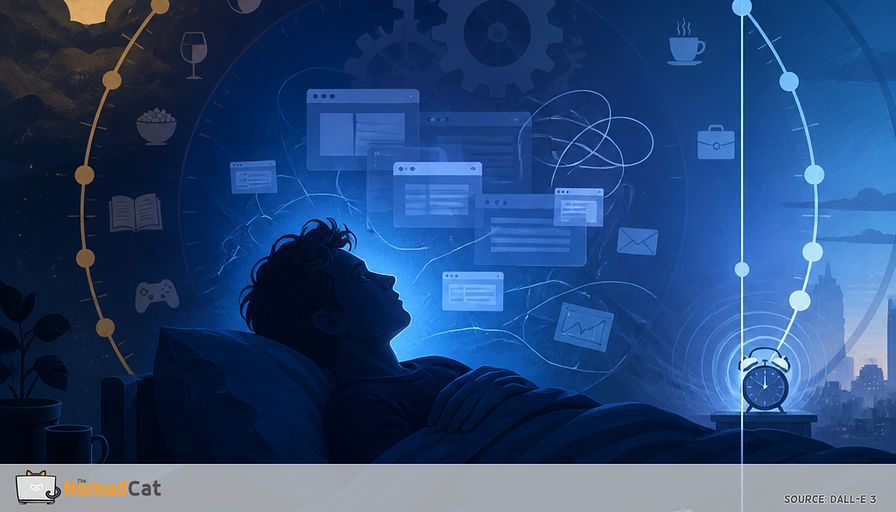
Monday night has a specific kind of nonsense energy. You spend all day moving through mud, then bedtime shows up and your brain suddenly decides it’s time to open 23 tabs, replay 4 conversations, and draft a fresh plan for the week at 02:30. It can feel like insomnia, or like you’re doing something wrong. But a lot of the time it’s a pretty predictable system problem. I’m a French exec living in Lisbon (after years in Beijing and Berlin), and even with a desk-heavy job you can’t “willpower” your way out of a timing mismatch.
The issue usually starts earlier than Monday. Weekend schedules drift in small, almost invisible steps. Friday runs late because it feels like reclaimed time. Saturday slides a bit more. Sunday becomes “catch up” day with a sleep-in, maybe a long nap, and extra screen light at night. None of that is dramatic by itself. Together, it shifts timing, reduces sleep pressure, and sets up the classic Monday snapback when the alarm goes back to work-mode.
This breaks the pattern down without turning sleep into a second job: what’s drifting, why Monday night flares up, and a couple of small constraints that reduce the Monday penalty while keeping the weekend feeling like a weekend.
It covers:
- why weekend drift happens and why wake time often matters more than bedtime
- the Sunday catch-up trap (including naps that quietly make Monday worse)
- a low-effort check + a small test, plus guardrails for when it’s worth proper screening
No perfect routine required. Just a clearer read on cause and effect.
Why Monday night feels like a system bug
Weekend drift is a timing shift not a single late night
Friday ends, but the tools don’t. The laptop stays open on the same desk. Leisure happens on the same screen, in the same chair. Pushing bedtime later can feel like reclaimed time, not a mistake. That rebound is normal, especially after a packed week. Sleep research calls the mismatch between workdays and free days social jetlag (Wittmann et al., 2006; Roenneberg, 2012).
The key detail is that a later Friday rarely stays isolated. Drift usually happens in 2 small steps. Saturday slides later, then Sunday slides again. Nobody notices because it feels fine in the moment. Then Monday hits and the body clock is still on weekend time.
A simple self-check without apps is to look at wake time, not bedtime.
-
≥1 hour later than workdays is often meaningful
- ≥2 hours later is often “high” social jetlag in many discussions of the research (Wittmann et al., 2006; Roenneberg, 2012)
Different papers use different calculations, so this is not a diagnosis. It is just a quick reality check.
The Sunday catch-up that pays you back on Monday
Sunday has a trap that looks logical. Sleep in, maybe add a nap, and it feels like paying down debt. Mechanically, it can do the opposite for Monday night.
Sleeping in reduces sleep pressure, the drive that builds across the day (Borbély’s two-process model, 1982). Less pressure in the evening often means it is harder to fall asleep early enough for a Monday alarm. So you can get “9 hours on Sunday” and still have a Monday night that feels weirdly thin.
Naps add another lever. The issue is not naps as a moral failing. It’s mostly timing and duration. Reviews tend to show the risk of messing with nighttime sleep goes up when naps are later and longer, often described as over 20–30 minutes, especially late afternoon (Milner & Cote, 2009). Shorter naps around 10–20 minutes earlier in the day are usually the safer profile (Brooks & Lack, 2006; Lovato & Lack, 2010).
Then light timing piles on quietly. Weekend evenings often mean brighter indoor lighting and more screen-light close to the face—plus the desk-work version of “just 20 minutes”: laptop open to clear Sunday-night email or tweak Monday slides. Evening light tends to delay circadian timing, while morning light tends to pull it earlier (Khalsa et al., 2003). eReader-style evening light has been shown to delay melatonin timing and increase how long it takes to fall asleep (Chang et al., 2015). Drift plus a long late nap plus late light is a standard recipe for a Monday snapback.
Monday snapback and the tired but wired night
The snapback is simple. Monday’s alarm is early again, but the body clock is still closer to weekend time. A lot of people get a predictable pattern.
-
15:00–20:00 feels like walking through mud
- bedtime arrives and the brain is oddly alert
Social jetlag explains one half of it. The other half is cognitive re-entry. Monday reopens a judged environment and your brain starts scorekeeping again. The triggers are boring on paper but loud at 23:30.
- open loops that were paused Friday
- evaluation pressure and being back “on the record”
- a backlog that now has deadlines
There’s also a line of research on worry loops—how rumination can keep stress systems switched on longer than you’d expect (Brosschot et al., 2006). Add “telepressure”, the feeling of needing to be reachable, and recovery gets thinner (Barber & Santuzzi, 2015).
Put it together and the sleep pattern is familiar. Lighter sleep, easy awakenings, or a 02:00–05:00 window where the brain fast boots and starts planning. This can look like insomnia, but it can also be the combined output of reduced sleep pressure (Borbély, 1982), delayed timing, and Monday re-entry arousal.
A 3 question audit before you label it insomnia
The 60 second weekend audit
1) Was weekend wake time later than workdays by ≥1 hour or ≥2 hours (Wittmann et al., 2006; Roenneberg, 2012)
2) Did you nap on Sunday after 15:00–16:00 or for >20–30 min (Milner & Cote, 2009)
3) Is Monday night usually worse even when Sunday evening was fairly normal
If 2 or 3 are “yes”, it is often schedule drift, not a personal failure.
Why wake time is the useful anchor
Direct trials that randomize people to “anchor wake time” versus “anchor bedtime” are basically missing, so treat this as practical inference, not a grand claim. The rationale is simpler: wake time pins the whole day (light, meals, movement, meetings), while bedtime is often a lagging output of how that day went. CBT-I stimulus control also tends to push a consistent wake time and keeps bedtime tied to sleepiness, not the clock (Trauer et al., 2015; ACP, 2016). In practice, wake time is the cleanest log line because it stabilizes the work clock that Monday will enforce anyway.
Minimal tracking that does not become another job
The one line per day note
Use paper. 7 lines. Done in 30 seconds. Track only.
- weekend wake time
- Sunday nap time and duration
- Monday night thinness 0–10
This is intentionally blunt. High-resolution tracking can become its own arousal loop.
Guardrails for when it is more than drift
If symptoms are persistent and not explained by timing, or there is risky daytime sleepiness like nodding off while driving, proper screening and evidence-based treatment matters. Guidelines put CBT-I as first-line (ACP, 2016; Sateia et al., 2017). Clinicians often use screeners like ISI, ESS, and STOP-Bang to sort insomnia from other sleep problems.
The soft anchor that keeps weekends yours
A soft anchor is one timing variable kept steady across all 7 days, while everything else stays flexible. It is not about perfect sleep. It is about fewer Monday penalties.
Two workable anchors cover most situations.
- keep wake time consistent
- or, if the night was messy, keep out-of-bed time consistent even if sleep was imperfect
Wake time is usually the highest-leverage pick because it stabilizes the work clock that Monday will enforce anyway. A ±30 minutes target is common in CBT-I style constraints. Variability around ±45–60 minutes is often where regularity starts looking costly in research discussions (Phillips et al., 2017).
If waking early after a bad night sounds cruel, the compromise is out-of-bed time. The point is to avoid the oscillation of “wrecked night” followed by “sleep in half the morning” followed by “why am I awake at midnight”.
Monday re-entry without bedtime theatre
A 5 minute closure packet before dinner
A lot of Monday-night spinning is not stress in the abstract. It is your brain refusing to drop 23 tabs because it doesn’t trust they will still be open tomorrow.
Writing things down helps. Planning can reduce intrusive thoughts (Masicampo & Baumeister, 2011). A 5-minute to-do list has been shown to reduce sleep onset latency measured in a sleep lab in a randomized trial (Scullin et al., 2018). Keep it simple, before dinner, on paper.
- 1–2 priorities for tomorrow
- 1 unblock message to send tomorrow
- what is explicitly not being touched tonight
This is not catching up. It is giving the brain a credible “queued for tomorrow” receipt. Like moving work from RAM into a queue so the system stops thrashing.
Guardrails so it stays small.
- cap it at 5 minutes, stop mid-sentence if needed
- stop when it starts branching into subprojects
- do not do it in bed, stimulus control logic keeps the bed for sleep, not planning
A small two-step test that stays boring
For one week, do the 1-line note. Don’t fix anything yet—just see whether weekend wake drift and Sunday naps predict “Monday thinness” for you.
If the pattern is obvious, change only one thing first for the next week:
-
Wake time or out-of-bed time within ±30–60 min all week
or, if that’s already tight, keep wake time and change the nap instead: -
Sunday nap capped at 20–30 min, and keep it before 15:00–16:00 when possible (Milner & Cote, 2009)
- and if the problem is clearly re-entry rumination: the 5 min closure packet before dinner (Scullin et al., 2018)
Success is not sleeping like a monk. It is fewer error symptoms.
- Monday thinness trends lower
- fewer 02:00–05:00 fast-boot wake-ups
- smaller Monday vs Tue–Thu gap
If it fails, the data is still useful. If kids, shifts, or life make a consistent wake time impossible, anchor out-of-bed time instead. If naps are non-negotiable, trade the long late nap for a short earlier one or a non-sleep horizontal break. If rumination dominates or impairment is chronic, the next step is not more tricks. It is proper evaluation and CBT-I, which guidelines still put first-line (ACP, 2016; Sateia et al., 2017).
Guardrails so this does not become a sleep hobby
Sleep debugging is useful until it becomes an endless sprint of tweaks. If sleep is persistently impaired, or there is loud snoring with gasping, or dangerous daytime sleepiness, getting evaluated is not overreacting—those are “don’t wait” signals because the risk is bigger than a groggy Tuesday. Insomnia and other sleep problems often show up together, so the right move can be screening rather than more schedule gymnastics (Ohayon, 2002; Morin et al., 2006; Roth, 2007). And sleep apnea is worth ruling in or out with proper testing when it fits, because treating the wrong problem wastes months (Kapur et al., 2017; Yeghiazarians et al., 2021).
Scope stays narrow on purpose. No wearables required. No supplement stack. Just 1 schedule constraint plus a small Monday re-entry containment step, measured with low-effort notes when needed.
If Monday night keeps turning into “tired all day, wide awake at 02:30,” it is not a character flaw. It is often a predictable feedback loop. Weekend wake times drift, Sunday sleep-ins and late naps quietly drain sleep pressure, and a bit of extra evening laptop light pushes timing later. Then Monday forces an early alarm, and the brain responds by reopening every work tab you thought was closed.
The fix does not need a perfect routine or a new sleep hobby. A soft anchor on wake time or out-of-bed time, a shorter earlier Sunday nap, and a 5-minute Monday closure note can reduce the snapback without stealing your weekend. And if the pattern does not budge, that is useful data too. It may be time for proper screening and CBT-I.
Most weeks, the “bug” isn’t you; it’s the handoff between weekend time and desk-work time.
You might be interested by these articles:


Stop rehearsing monday at 01:00 close the work loops on friday

Monday tired after 9 hours is usually recovery debt not sleep debt

Thin sleep is a workday monitoring bug not a bedtime failure

Why your brain starts work at 05:00 and how to stop rewarding it

At 03:00 your brain starts doing reputation management

Unlocking cybersecurity potential through strategic partnerships

Optical Fiber: The Startup Game-Changer for Growth and Success