 Gilles Crofils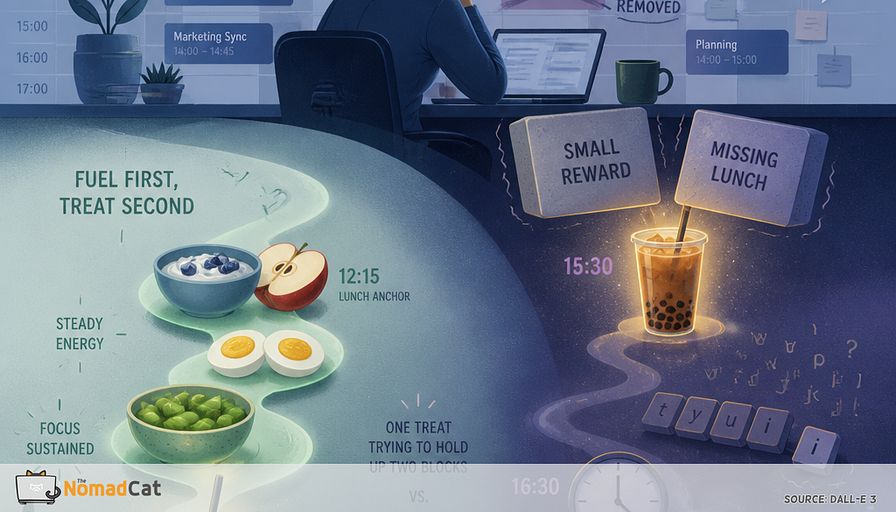
You had lunch “planned.” Then the calendar ate it.
Back-to-back meetings, a Slack thread that won’t die, and suddenly it’s 15:30. Your 1st real pause all day is a premium coffee, boba, or a bakery run that feels weirdly like a work benefit. It’s not even chaotic. It’s clean. You paid, you stepped outside, you got a mood lift, you’re back at the desk. Break achieved.
This article is about the quiet bug hiding inside that moment. Not “snacking is bad.” Not “have more willpower.” It’s a sequencing problem.
Treat substitution is when 1 deliberate reward ends up doing 2 jobs at once:
- Job 1 is the obvious one: a treat, a small morale patch
- Job 2 is the sneaky one: it replaces the meal boundary you didn’t get to have
The result is often lunch-sized calories with snack-level staying power, so the day keeps wobbling. You get the lift, then the 60–120 minute whiplash, then dinner shows up like an overdue invoice.
What you’ll get here is a practical way to debug it without turning food into another project. We’ll cover:
- How to tell treat substitution apart from free-snack grazing, caffeine drift, and the ping-snack loop
- Why desk work makes “premium treats” the default break format
- Why liquid calories rarely close the meal loop, even when they’re basically lunch
- A simple fix that keeps the treat, but changes the order
- A tiny 5-day log to see if it actually moves your 16:30 state
No perfection, no moral lecture. Just a small change that makes the workday feel less like it’s held together by oat milk and vibes.
Treat substitution is the quiet desk day upgrade
The little treat trap, in normal desk language
Treat substitution is what happens when a single “break treat” quietly becomes your missing lunch boundary.
Treat substitution is the pattern: 1 deliberate reward chosen under pressure when you’re under-fueled that ends up doing 2 jobs in 1 item.
- Job 1 is obvious: a reward, a mood lift.
- Job 2 is sneakier: it replaces the meal boundary you didn’t get to have.
It’s usually a single, nameable event. Not all-day grazing. Not “i blacked out in front of the snack drawer.” More like: “I went out and got my thing.”
The trap gets stronger because it feels “worth it.” It’s paid, it’s special, and it counts as your break. A flavored latte can land around 250–450 kcal. Boba can hit 300–600+ kcal. That’s lunch territory. But protein is often 2–12 g (depending on milk and add-ins), while a typical lunch is often closer to 20–50 g.
So you get lunch-sized energy with snack-level staying power.
A quick check so you pick the right bug
Not the free snacks problem
There’s a difference between drifting past the kitchen and eating 6 mini-cookies, and doing 1 deliberate café run that costs real money and becomes the only clean pause in the day.
A simple test:
- Did you pay for this and call it your break?
If yes, it’s probably treat substitution.
Not the caffeine drift problem
Also separate it from pure caffeine patterns. Treat substitution is often 1 larger episode late-ish that mixes sugar or fat (and sometimes caffeine) and tries to do the job of lunch. Caffeine drift is more like a stream.
One useful reality check: latte size ≠ caffeine dose. Milk volume is mostly vibes. Caffeine tracks espresso shots.
Common safety anchors: FDA and EFSA both cite about 400 mg/day as generally safe for most healthy adults, and EFSA notes up to about 200 mg in a single dose as generally safe.
Not the ping snack loop
Don’t confuse it with the notification-trigger micro-reward loop. Those are frequent and automatic. Treat substitution is more deliberate and “earned,” often after “I shipped something.”
Why desk work makes premium treats the default
Lunch has the highest restart cost
A “real” lunch has hidden fees. Not money fees. Restart fees.
You need setup, chewing time, maybe a fork, cleanup, and the awkwardness of being visibly offline.
Then the big one: re-entry. You come back to 27 pings and your brain needs a warm-up again.
When things are busy, lunch is the easiest thing to delete.
I can do a full day without eating, drinking, or moving, especially when i’m remote on bad chairs and worse desks across europe. So yes: the restart tax is the real bug here, not lack of will.
Treats are portable and socially safe breaks
Premium treats win because they match office logistics and office scripts.
- A drink is walk-and-talk friendly
- A pastry can be carried one-handed and eaten between keyboard gaps
- “Coffee run?” is already socially approved
It signals “normal human moment,” not “i’m offline for 30 minutes.”
The timing is effort and stress, not random craving
The timeline is often boring:
After a tense meeting or long focus block, then your body wants a downshift, so your brain okays a reward that also patches the missed meal boundary.
Short breaks can reduce fatigue. But desk life selects the easiest break format, not the best one.
Liquid calories do not close the meal loop
Why a drink rarely feels like a full stop
A sweet latte or boba can feel like “ok i ate something” and still not work like a real meal boundary. Not because it’s a “bad choice,” but because format matters.
Liquids and soft sweets tend to go down fast, without the same stop signal you get from chewing. And in controlled feeding/lab studies comparing liquid vs solid calories, people often compensate less for drink calories later (the size of the effect varies).
In practice at a desk: if it doesn’t register as a stop, it won’t protect the next 2 hours.
Lunch calories with snack runway
Even when calories are basically lunch-sized, the runway is missing. Many premium treats are sugar plus fat, with low protein and low fiber.
Protein and fiber are the boring parts. They are also the parts that keep the system stable.
The 60 to 120 minute whiplash signature
The failure mode is usually not dramatic. It’s a small lift, then a predictable wobble.
After a high-sugar hit, controlled work often shows more fatigue and less alertness around 30–60 minutes, and hunger rebound in the 60–120 minute window.
At a desk, it can show up as:
- rereading the same paragraph 3 times
- typo spikes
- craving something very specific (salty, crunchy, “real food”)
- the thought “ok i need coffee now”
The downstream loop
When there was no clear “fed checkpoint” earlier, dinner arrives like an overdue invoice. So dinner becomes heavier and faster. Evening grazing gets easier, because the day never had a clean stop signal.
Next morning can feel off even if nothing is “wrong”: big dinner, later bedtime, lighter sleep, then appetite is weirdly muted or chaotic, so it becomes coffee-first.
Also: “safe” caffeine and “sleep-neutral” caffeine are not the same thing. In controlled experiments, 400 mg taken 6 hours before bedtime can still disrupt sleep.
With a desk-heavy life across beijing, berlin, and now lisbon, often past midnight, it feels more honest to treat this as inputs and outputs than as a discipline test. When work runs late, the schedule is the boss.
Keep the treat and fix the sequence
The decoupling rule for brutal calendar days
Keep the treat. Just don’t let it be the 1st real fuel.
Rule: have a chewable anchor earlier in the day, or within 30 minutes before the treat, then enjoy the latte boba muffin situation as the reward.
This is sequencing, not restriction. It’s for days where lunch is basically a rumor.
A simple anchor target is 15–25 g protein + 3–6+ g fiber. No macro app required.
Desk-legal chewable anchors
Pick anything you can chew and forget.
- Skyr or Greek yogurt (or soy)
- 2 eggs (boiled, prepacked)
- Edamame (microwave bag)
- Roasted chickpeas (or lentils)
- Tuna pouch plus crackers
- Apple plus peanut butter
- Cottage cheese plus berries
Why this works without becoming another food rule:
- Physiology layer: chewing + protein (often fiber) gives a clearer stop signal
- Psychology layer: the treat stays a treat, so you’re less likely to rebound later
You stop asking 1 item to do 2 jobs.
A 5-day log that does not become homework
Run this for 5 workdays with 2 checkboxes. Paper is fine.
1) Anchor before treat Y/N
2) At ~16:30: steady / foggy / snacky / edgy
If sequencing changes your 16:30 state, you found a lever.
If nothing changes, that is still useful data. Common suspects are sleep debt, late caffeine, total under-eating, or stress plus 0 real breaks. A non-food lever can be making lunch more restful by not working through it, or adding tiny microbreaks.
Stop signs that mean this is not a snack problem
If fatigue is persistent or worsening for 2–4+ weeks, or comes with unintentional weight loss, fever or night sweats, shortness of breath, chest pain, or new neurologic symptoms, treat it like a medical evaluation problem.
For dizziness, get urgent help if there is fainting, chest pain, shortness of breath, sudden severe headache, numbness or weakness, vision change, or trouble speaking.
Also a stop sign: if any “rule” starts creating anxiety, guilt, avoidance, or restriction escalation.
Keep the treat. Just don’t ask it to do 2 jobs. On brutal calendar days, sequence is the only lever you still control.


