Abstract:
The article argues that what many people call a “post-lunch crash” is often less about food or willpower and more about a rough handoff back into work: jumping straight from a real break into Slack, email, and meetings creates ambiguity, social evaluation, time pressure, and constant interruptions that amplify normal midday sluggishness into a “buffered” desk fog marked by rereading messages, abandoning drafts, tab sprawl, edgy tone, and low-stakes busywork. Rather than prescribing a major lifestyle overhaul, it frames the problem as a workflow bug and recommends a simple 3-day “debug log” that tracks only what you do in the first 20 minutes after lunch and how foggy you feel 30–60 minutes later, to see whether comms-heavy re-entry predicts the slump. The practical fix is a 10-minute re-entry protocol that delays reactive channels (notifications off; Slack/email later, with an emergency exception if needed) and replaces them with a boring ramp—opening one document and taking one concrete under-two-minute step, or doing a two-minute meeting micro-prep—so the brain “boots” before it has to triage. “Success” is intentionally measurable and unglamorous (fewer rereads, fewer false starts, less need for a second coffee, fewer sharp replies), and the piece adds a personal note from the author’s multi-city desk life (Beijing, Berlin, Lisbon) about how easy it is to sit all day without eating, drinking, or moving, while also warning not to mislabel extreme or unsafe daytime sleepiness as a sequencing issue since sleep debt and medical causes like sleep apnea may require professional attention.
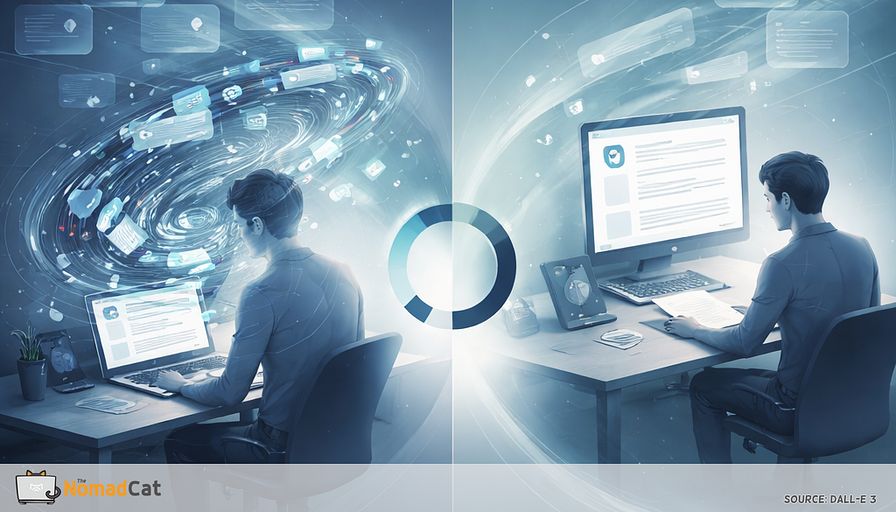
Lunch ends. Laptop opens. And somehow the next 20–60 minutes feel worse than the morning. Not fully sleepy. Just… buffered. You reread the same message, open 12 tabs, start 3 replies and abandon all of them. Then you blame lunch, motivation, age, discipline, whatever is closest.
This article makes a narrower (and more useful) claim. The “post-lunch crash” is often not mainly food or willpower. It is the handoff. An abrupt drop straight into Slack, email, and meetings can turn normal post-meal sluggishness into desk-level fog. Think of it like rebooting your laptop and immediately opening every app, then acting surprised it runs slow.
You will get a practical way to debug it without adding a new life-management project. We will cover:
- What the fog actually looks like in desk work, beyond “sleepy”
- Why reactive channels create attention residue and make everything feel urgent and unclear
- Why the first 20 minutes back are a multiplier, especially in interruption-heavy days
- A simple 3-day log to spot the pattern without turning it into a lifestyle audit
- A 10-minute re-entry protocol that fits even a hostile calendar
- When it is not a workflow issue and persistent daytime sleepiness deserves real attention
The goal is not perfection. It is a small sequencing change that lets lunch be a real boundary again, instead of an interruption that you pay for all afternoon.
The hard reboot after lunch
The 20 minute trap
You sit back down after lunch and the screen is already loud. Slack pops. Email refresh. Calendar reminder. A quick tab switch to “just check something.” Maybe a meeting link, camera on, brain off.
Then, 20–60 minutes later, the weird part. Not fully sleepy, but buffered. Reactive. A bit fragile, like everything is urgent and nothing is clear.
This is the desk version of a context-switch crash. Midday is already a vulnerable window because circadian timing and post-meal effects overlap (Monk, 2005). But the claim here is narrower and more useful.
The narrower claim
This is not:
- a full circadian dip explainer
- a macro debate
- a claim lunch was perfect
The point is simpler. An abrupt re-entry into reactive channels can amplify normal post-meal physiology into a perceived crash. What matters is how the first minutes back are sequenced.
Why it feels like lunch did it when it was actually the inbox
Lunch feels like a break. So when the first hour back feels bad, people blame the obvious variable: food, age, motivation, “bad discipline.”
But the benefit of the break gets overwritten when the first task is both ambiguous and socially evaluative. Inbox triage. Slack threads. Replies where tone matters. Questions where “done” is unclear. It is a rough handoff into performance mode with no ramp.
And when the work is unclear, restarting costs more. The classic version: you open a half-written reply to a sensitive thread, reread it three times to rehydrate the context, rewrite one sentence to make it “sound right,” then freeze because you’re not sure what the other person will infer. Meanwhile a defined task—fixing a paragraph in a doc with a clear “before/after”—would move with less friction. That pressure to respond quickly is linked to telepressure and strain (Barber & Santuzzi, 2015).
What the fog looks like at the desk
It rarely announces itself as “sleepiness.” It shows up as small interface-level glitches.
Common ones:
- You reread the same paragraph or message 3 times and it still doesn’t land
- You draft a reply, delete it, rewrite it, then leave it as unread
- Eyelids heavy, brain wired enough to scroll
- You get blunt in short messages, then regret the tone 2 minutes later
- You avoid anything that requires judgment and pick low-risk busywork
- You open “a quick check” and end up with 15 tabs of half-started threads
- You make small mistakes you don’t usually make
These signals get worse in interruption-heavy work, which correlates with higher stress and time pressure in real office settings (Mark, Gudith & Klocke, 2008). That’s useful. It points to conditions, not character.
Why reactive triage creates residue
Notifications matter even if you do not respond. Seeing alerts can degrade sustained attention (Stothart, Mitchum & Yehnert, 2015). Then you switch tasks, and part of your attention stays stuck on the previous thread for a while—basically attention residue.
If the first post-lunch block is pings plus meeting carryover plus “quick checks,” tab sprawl is not a personal failure. It is the expected output.
A quick split test
Watch day-to-day covariance.
- If the fog is worse on days when the first 30–60 minutes back are meeting-heavy or comms-heavy, re-entry sequencing is likely the amplifier.
- If it hits just as hard on low-message days with a clean calendar, circadian timing, meal effects, and sleep debt may be doing more of the work, and these contributors can stack (Monk, 2005).
Also, extreme or unsafe daytime sleepiness should not be treated as “just lunch.”
Why the first 20 minutes are the multiplier
Task switching has a setup cost. After lunch you are already changing gears, then you stack switches: Slack → email → calendar → doc → Slack. The per-switch hit can be small on paper, but the real cost is the pile-up when you pay it 30 times in a row.
Real offices make it messier. Work doesn’t pause and resume cleanly; it fragments. When you get interrupted, you don’t just lose the minute you spent on the interruption. You also spend extra time reloading what you were doing and why, and that “reload” repeats all afternoon.
And unfinished threads create residue. Leaving a task half-done can drag on the next task, so one “quick check” can make the next paragraph feel muddy even after you close Slack.
Lunch only helps if it creates a clean break
If lunch ends and the first thing you reopen is the same high-stakes thread, lunch gets coded as an interruption, not a boundary.
Recovery research calls the key ingredient detachment. In practice it just means: you actually left, and you actually came back.
A systems-minded framing helps here. This is a workflow bug, not a nutrition failure. Reactive work right after lunch stacks three drivers at once:
- ambiguity
- social evaluation
- time pressure
Add interruptions, and stress rises in field settings (Mark, Gudith & Klocke, 2008).
The author bio has a blunt detail that fits this: after desks in Beijing, Berlin, and now Lisbon—often on bad chairs and worse desks—it is clearly possible to work a full day without eating, drinking, or moving, and that is not a superpower. Small configuration changes beat more willpower.
A 3 day debug log for the post lunch fog
Keep it usable. For 3 workdays, write down only 2 things:
1. What you did for the first 20 minutes back at the desk
2. How foggy you felt 30–60 minutes later
Make it a bug report, not a lifestyle audit.
Use simple labels for the first 20 minutes:
- Reactive: Slack/email triage, clicking whatever is loudest
- Socially evaluative: a sensitive reply where tone and judgment matter
- Deep: a task with real complexity, not just “feels serious”
- Meeting to meeting: leaving 1 call and joining another with no buffer
A filled-in example (two lines, that’s it):
- Day 1: first 20 min = Reactive (Slack triage + “quick check” on email). Fog 45 min later = 7/10 (reread messages, tab sprawl).
- Day 2: first 20 min = Deep (one doc, outline + fix one paragraph). Fog 45 min later = 3/10 (reading feels normal).
Then pick 1 lever. If reactive or socially evaluative first blocks predict fog, treat it as sequencing. If fog shows up even with a clean deep block, inputs like sleep, meal size, and hydration become more likely levers.
Micro-breaks can help, and results vary depending on what the break is and whether it feels self-directed (Kim, Park & Niu, 2017). Annoying, but also freeing. You do not need the perfect break.
The 10 minute re entry protocol
Delay reactive channels on purpose
For the first 10 minutes after lunch:
- no Slack
- no email
- notifications off
Treat it like a config setting for a vulnerable window, not a moral stance.
Alerts alone can tax attention (Stothart, Mitchum & Yehnert, 2015). Checking less frequently can reduce stress (Kushlev & Dunn, 2015).
If your role has real urgency constraints, use a compromise:
- keep 1 emergency channel (for example, phone calls from 1 person)
- let everything else wait 10 minutes
- or do this only 2–3 days per week
Telepressure makes the objection feel real, because the urge to respond fast is its own strain mechanism (Barber & Santuzzi, 2015), not a character flaw.
Use a boring ramp that starts motion
You need something unglamorous to do instead of comms.
Option 1 is a one-tab ramp:
1. Open 1 document only. Hide or close the rest.
2. Do 1 concrete action under 2 minutes. Title, 3 bullets, fix 1 obvious sentence.
3. Keep a tiny if-then for tomorrow: “If lunch ends and I sit down, then I open this doc and add 1 bullet.”
If you are forced into a meeting right after lunch, create a mini boundary.
Option 2 is meeting micro-prep. Arrive 2 minutes early, skim the agenda, write 3 bullets:
- what “good outcome” means
- 1 question you can ask if you are fading
- the update you might give in 20 seconds
It is small, but it shifts you out of passive time-pressure mode.
Make the ramp survive a hostile calendar
If you cannot block time, control sequencing of the first tools you open. Even 5 minutes is a buffer.
A simple order:
- open 1 doc and do 1 concrete step
- then open the project board or task list
- email and Slack last
This is not deep-work theater. It is reducing early ambiguity and reducing residue.
Messaging norms also matter. A boring status line can lower background urgency:
- “Focus block. Replies at 13:45.”
- “Heads down until 14:10. If urgent, call.”
For high-pressure roles, use delay instead of abstinence. Make it “1 check at minute 10, not minute 0.” Think of it like letting the system boot before opening 12 tabs.
What success looks like and where to stop
Success looks boring and observable:
- less urge for the emergency 2nd coffee
- smoother reading within 30 minutes, fewer rereads
- writing is less fragile, fewer false starts
- fewer sharp replies right after lunch
- less tab sprawl when you open the laptop again
Keep the thesis simple. Lunch didn’t fail; re-entry did. Change the default first 10 minutes and the afternoon often stops leaking energy.
But do not treat extreme, persistent, or unsafe sleepiness as a workflow bug. If you are nodding off in meetings, struggling to stay awake while driving, or having sleepiness that scares you (or people around you), treat that as a real signal. Professional evaluation is the responsible route when it is beyond “annoying.”
Also, do not miss the most common desk-worker confounder: sleep. The author bio is blunt here too: left alone, I work through the night, so sleep is the variable not solved. The re-entry buffer can help, but it should not become a permission slip for chronic short nights.
Three common re-entry modes show up again and again: reactive comms, meeting-to-meeting churn, or a clean ramp into one defined task. The buffer is just choosing the third more often than defaulting into the first.
You might be interested by these articles:


The 3 minute exit handshake that stops the dinner cliff after deep work

How pingy workdays keep your sleep on watch

The 11:00 desk dip behind your typos and tab pinball

Your 1st 45 minutes are training your 02:00 brain so change the input order

Stop letting Slack eat breakfast fuel before feed for desk days

why every minimalist needs a buffer for creativity and calm

Smoothing freelance income with rolling-average models