Abstract:
The article explains why remote workdays can feel strangely exhausting even when the workload is reasonable: without the small “exits” of office life—standing up, walking through doors, entering public space—there are no scene changes to help the brain segment time, so attention and memory run in one long, monotonous mode until you end up “wired and tired” by mid‑afternoon, rereading the same paragraph like it’s “written in sand.” Framing this as a systems/environment problem rather than a discipline failure, it argues that a workout at 19:00 can’t replace missing transitions at 11:00, and introduces a low-maintenance “replacement principle” to rebuild chapter breaks using tiny “third-place” switches (not a cute café, but a deli line, package pickup hello, library slot, or even checking the mail) that provide anonymity, a role shift, and different sensory input. The practical fix is a 2–7 minute, no-tracking, no-streak, between-meetings boundary loop—like a 90-second doorstep step-out with far gaze and slow breaths, a 4–6 minute boring errand loop with a deliberate re-entry cue (wash hands, close the door, open the next tab), or a window “micro exposure” break—anchored to reliable moments such as clicking “Leave meeting” or pressing “Send.” Done consistently, these small event boundaries don’t aim to boost energy so much as reduce friction: cleaner task starts, less tab-hopping and rereading, fewer sharp replies around 16:00, and a day that feels like distinct chapters instead of one continuous scroll.
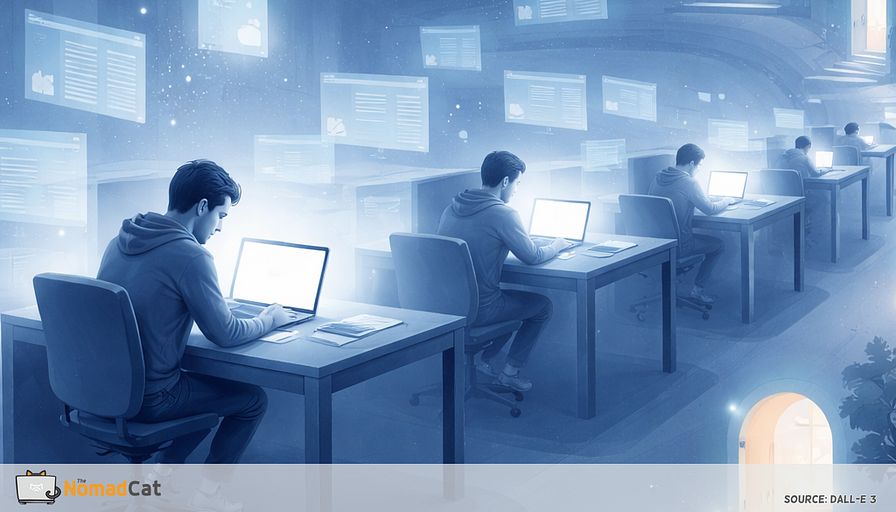
A remote workday can look perfectly productive and still feel weirdly exhausting. Not because the workload is insane. Because nothing ever ends. You click Leave meeting and you are still in the same chair, under the same light, with the same tab open. The next call starts before your brain has filed the last one away. Different topics, different urgency, same scene. By 16:00, it’s not rare to feel wired and tired at the same time, rereading the same paragraph like it’s written in sand. I’ve been in Lisbon since 2023 and I often work past midnight, and that “everything blurs into one long block” feeling shows up even on days that look calm on paper.
This article treats that feeling as a systems problem, not a discipline problem. When remote work removes the little exits and transitions that used to break the day into chapters, attention and memory take a hit. The brain uses changes in scene to file one thing as “done” and start the next (Zacks et al., 2007). Without those boundaries, it runs one long mode until it starts throwing errors.
You’ll get a practical way to put those chapter breaks back without turning your calendar into another thing to maintain.
What we’ll cover
- Why a day without scene changes feels heavier than it “should,” even when you barely moved
- The boring version of “third places,” tiny low-stakes stops that create real context switches
- The invisible cost of staying inside all day, and why a workout at 19:00 doesn’t fix missing transitions at 11:00
- The replacement principle, small interruptions that survive back-to-back meetings
- Simple third-place proxies that fit in 2 to 7 minutes, plus anchors and re-entry cues so the break actually sticks
- Why blended spaces drain some people faster, and how high focus can hide the warning signs
No tracking. No streaks. Just a few small boundary loops that make the day feel like separate chapters again, instead of 1 continuous scroll.
The day without scene changes
What vanished was not steps
Slack pings, camera stays on, and the next call starts before the previous one has even finished evaporating. Different topics, different urgency, yet the day feels like 1 long unbroken block.
It’s tempting to call that laziness or bad discipline. It looks more like a missing system feature. The chapter breaks disappeared.
In a physical office, breaks came from boring exits into public space. Stand up, walk, open a door, see a different wall, hear different noise. And monotony has real costs in sustained attention and fatigue (Warm, Parasuraman & Matthews, 2008). When the scene never changes, the brain keeps running the same mode for hours, then acts surprised when it starts throwing errors.
Third places as tiny nervous system gear shifts
The boring version of third places
A “third place” does not have to be a charming café. In the boring version, it is just a low-stakes stop that is not home and not work.
- The 4-minute coffee run
- The deli line
- The lobby hello when picking up a package
- The library return slot
- The quick pharmacy errand
- Even the walk to the building entrance to check the mail
What matters is leaving the home stimulus field and stepping into a different one where nobody expects performance, output, or a coherent sentence.
Role is the software layer. The hardware layer is sensory input, and remote work makes it too uniform. A 2-minute switch from worker to customer or citizen sounds trivial, but it forces a script change.
Outside also changes the input stream in a way “a different room” often doesn’t. Vision goes long instead of near. The acoustics get messy. Temperature shifts. The ground is slightly uneven. Being somewhere else for a minute gives directed attention a break (Kaplan, 1995). This is not a promise that nature fixes your life. It does not require a forest.
There’s also a quiet relief many people miss only after it’s gone: public anonymity. You are around people but not responsible for them. Around people is not the same thing as available to people. Tools that make you flexible can also make you feel always available (Mazmanian, Orlikowski & Yates, 2013). A short errand flips that. You are present without being on duty.
The invisible cost of staying inside all day
Monotony fatigue is not the same as too much work
This is why a workout at night doesn’t fully repair what broke at 11:00. The signature feeling is oddly specific.
- Irritable, but not about anything important
- Restless, but also glued to the chair
- Scattered, but still “busy”
- Wired and tired at the same time
- The simplest email feels like sand in the gears
Nothing dramatic happened. It’s more like the attention system has been running in low-variety mode for hours and starts dropping packets.
Human factors research has been describing this for a long time. Mackworth’s clock test showed that staring at a slow signal for long periods produces a vigilance drop (Mackworth, 1948). The broader vigilance literature is blunt that low event-rate monitoring reliably produces fatigue and performance decline over time (Warm, Parasuraman & Matthews, 2008). So when a remote day feels exhausting without being physically demanding, it’s not automatically a motivation problem. It can be an input problem.
Timing matters. Steps at 19:00 don’t replace missing transitions at 11:00, 14:00, and 16:30. Those are the hours where work stacks without clean edges. And there’s a physical tax too: that quiet upper-back tightness can build all day until it finally forces you to move, not because you planned it, but because your body files a ticket you can’t ignore anymore. Short breaks tend to reduce fatigue and increase vigor, even when they are brief (Kim, Park & Niu, 2017).
And yes, movement matters. So does light. Outdoor daylight is usually far brighter than indoor lighting, and light influences alertness-related biology (Cajochen et al., 2005). Field studies link more daylight exposure with better sleep and well-being outcomes (Boubekri et al., 2014). The cautious part matters too. The “dose” and timing vary, and there’s no clean universal rule (Zeitzer et al., 2011). Treat daylight as one plausible reason a short step outside can feel like a restart, not as a guaranteed trick.
Work rest blur is an environment bug
Mixing versus separating is a real preference
Some people can mix roles without much friction. Same table, same mug, same laptop, still fine. Others need separation, even if it’s small and slightly silly. Different clothes, different keys, a different room, a different pen.
Neither is morally better. But if blended spaces drain you fast, it usually means exposure is high and markers are weak, not that you failed a discipline test.
High focus can mute the logs until they get loud
Some people can suppress signals for absurdly long. You can work a full day without eating, drinking, or moving, and it looks like focus from the outside. It is not a superpower. It is more like ignoring system logs until the alerts become impossible to miss. I did that for years; it looked like focus. It was just delayed consequences.
So the fix is rarely a big habit program. It’s usually a replacement principle: add back small interruptions and re-entry cues so perception is not the only safety system under load.
The replacement principle
Constraints that survive messy calendars
The goal is a context switch, not cardio, and not another thing that needs motivation. The break has to work between calls, without setup, and without belief in streaks.
Engineering spec version
- 2 to 7 minutes total
- No special clothes and no shower math
- No phone required
- No tracking and no streaks
- Works even if the calendar is back-to-back
- Binary execution, either it happened or it didn’t
Think of it like clearing a stuck process, not training for something. When the day is 1 long scene, the brain treats it as 1 long event (Zacks et al., 2007). A short interruption is a deliberate boundary you insert back into the day. The output you want is the slightly stupid feeling of ok, new chapter when you sit down again.
A small ladder that prevents all or nothing
-
Outside for 2 to 7 minutes doorway, sidewalk, tiny errand, no destination needed
-
Window and far gaze stand up, look far, let the eyes stop clenching around 50 cm depth
-
Different room or different spot change the stimulus field, even if it’s kitchen vs desk
If outside is not available, distance viewing still has a practical justification. Breaks from sustained screen and near work are a standard lever for computer vision syndrome discomfort (Rosenfield, 2011). Smaller scene change done often beats the perfect break that only happens on Tuesdays.
Three third place proxies that fit between calls
Proxy 1 The doorstep switch
-
Step outside for 90 seconds doorstep, hallway window, building entrance
-
Look far for 20 to 30 seconds sustained near focus is a common driver in computer vision strain (Rosenfield, 2011)
-
Add 6 slow breaths slow breathing is often used to shift arousal and can change HRV-related physiology (Lehrer & Gevirtz, 2014)
I like HRV data (I use a Polar H10 sometimes), but for this break I don’t measure anything.
The point is not calm as a personality trait. It’s giving the next task a cleaner start signal.
Proxy 2 The errand loop
Keep it at 4 to 6 minutes. Pick 1 and make it boring.
- Take out trash or recycling
- Check mail or packages
- Refill water from the farthest tap
- Walk 1 lap of the building corridor or stairwell
- Buy 1 small thing from the nearest shop, no browsing
- Do a quick keys in pocket walk outside and back like a tiny fake commute
End with a clear re-entry cue so work doesn’t ooze back in. Wash hands. Close the door. Sit. Open the next tab.
Proxy 3 The micro exposure break
Open a window. Let the soundscape change. Give your eyes 30 to 60 seconds of far focus. Digital eye strain is strongly linked to sustained near work, and breaks are one of the most consistently recommended levers (Sheppard & Wolffsohn, 2018). Use it after high-friction screen work like debugging, writing, spreadsheets.
Anchors and re-entry cues
Anchors that actually happen
Pick 1 reliable moment and use it as a temporal boundary.
- After you click Leave meeting
- After you press Send on a high stakes message
- Before opening email the first time
- After lunch ends even if lunch was small
- After you close a doc you were stuck in
- After the last call of the day ends
A useful constraint is 1 anchor for 5 workdays. Less decision overhead. More reliability. Concrete if then style plans can reduce intrusive thoughts compared with vague intent (Masicampo & Baumeister, 2011).
A 90 second micro shutdown for open loops
If evenings are the pain point, close the open loops. Detachment is being psychologically off work, not just near the laptop (Sonnentag & Fritz, 2007). Planning helps reduce intrusive thoughts about unfinished goals (Masicampo & Baumeister, 2011), and bedtime to-do list writing has been linked to falling asleep faster (Scullin et al., 2018).
3 line template
- Done today
- Parked
- First move tomorrow
What success looks like when you’re not counting steps
Most people notice less friction, not a burst of energy.
- Starting the next task feels cleaner
- Fewer loops of rereading the same paragraph or Slack thread
- Less urge to tab-hop when something is slightly hard
- Fewer accidental sharp replies around 16:00
- The day feels more like chapters, not 1 continuous scroll
If remote work broke anything, it wasn’t only movement. It broke being elsewhere and the automatic boundaries that come with it. Rebuilding doesn’t need a program. It’s a small boundary loop, a tiny exit plus a clean re-entry, repeated often enough that the day stops being 1 unbroken work scene.
Remote work didn’t just remove commuting. It removed endings. Every meeting ends where the next one begins, so nothing gets a clean “done” label before the next thing piles on.
The fix doesn’t need a program or a streak. Put small boundaries back into the day: a 2 to 7 minute third-place proxy, a boring errand loop, even a doorstep switch plus a clear re-entry cue. Treat it like clearing a stuck process, not chasing motivation.
Over time, the payoff is simple: cleaner starts, less rereading, fewer sharp edges late afternoon, and a day that feels like chapters again. Most days, the difference is one small exit you repeat, not a plan you maintain.
You might be interested by these articles:


Bring back the out tray so remote work can feel done

Micro-exits for remote days that keep your body from timing out

Your remote day needs friction to make movement normal again

Your remote day needs scene changes not a longer walk

Remote work stole your hallway breaks and your neck feels it

Harnessing Nature for Energy Innovation

Exploring Quantum Computing's Future