
Abstract:
The article argues that remote work didn’t just increase sitting time—it erased the “hallway moments” of office life (printer trips, water refills, walking to meeting rooms) that quietly forced posture changes and made movement feel socially normal, then replaced them with video-call dynamics where even a 20‑second stand or glance away can seem like impatience or multitasking, amplified by “telepressure” to appear constantly responsive. Because movement at home becomes highly visible and interpretable, the author says typical fixes like Pomodoro timers and reminder apps often fail on meeting-packed days (they start to feel like spam), and the resulting strain shows up as “quiet body errors” like tight shoulders, stiff neck, lower-back complaints, poor sleep, and the post-lunch crash “even when lunch was basically coffee”—a pattern the writer notes after years of desk work across Beijing, Berlin, and Lisbon. Instead of more willpower, the piece recommends “permission by design”: make movement visually boring on camera by widening your frame (raising the laptop on a few books or using a farther webcam), use neutral one-line scripts (“I’m going to stand for this one, still here”), adopt simple rules that survive calendar chaos (stand in the first two minutes, stand during listening segments), and recreate “home hallway” transitions by placing work-adjacent destinations (water, notebook, charger) around the space and doing a brief 30–60 second walk-to-a-threshold-and-back after calls—small, repeatable motions that require no tracking, guilt, or perfect streaks, but reduce the physical “bill” you pay at night.
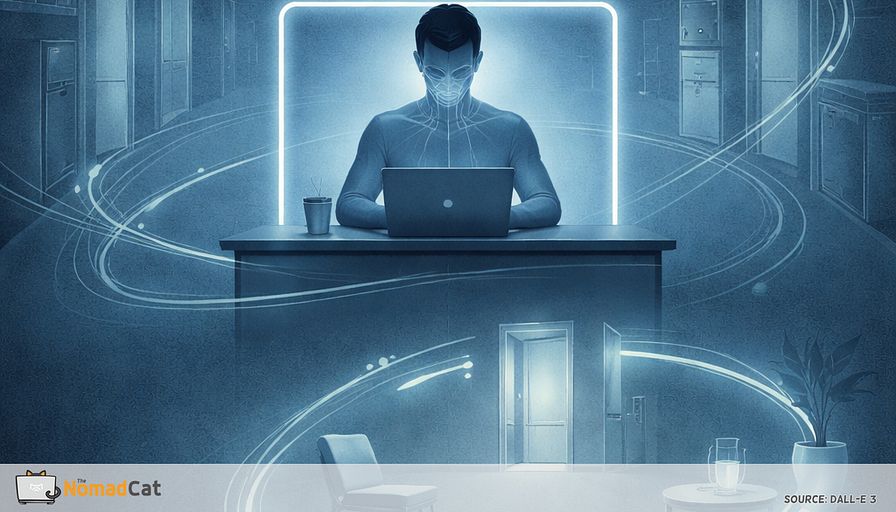
Remote work did not just move the desk. It removed the tiny “hallway moments” that used to keep your body from freezing in place.
In an office, you stood up without thinking. Printer. Water. Meeting room. Whiteboard detour. All those little transitions gave movement social cover. At home, movement becomes… interpretable. Standing up mid-call can look like impatience. Looking away for 3 seconds can look like multitasking. And when the calendar is a solid block of video calls, even a 20-second stretch starts to feel like something you need to justify.
So the usual advice falls flat. Timers. Pomodoro. Apps that buzz. They work until they collide with real meetings, real urgency, and the weird pressure of being “available” as a dot. If you’ve tried reminders and still end most days with tight shoulders, a stiff neck, lower back complaints, and that post-lunch energy drop (even when lunch was basically coffee), it’s not a discipline problem. It’s a setup problem.
This article is about making movement unremarkable again. Not heroic. Not a new project to manage.
You’ll get a practical way to rebuild the missing defaults of office life, without needing extra time or perfect consistency, including
- why movement feels socially risky on video
- why prompts turn into spam on meeting-wall days
- a simple “home hallway” loop that brings back breaks you used to get for free
The aim is simple. Fewer quiet body errors during the day, and less paying for it at night.
What the hallway used to do for you
The office made movement feel unremarkable
In the office, movement happened without meaning.
You badged in, dropped the laptop, then walked to the printer. You refilled water. You hovered near the kettle. You took the long way to a meeting room, detoured past a whiteboard, went back to your desk. Little transitions were baked into the floor plan. Your body changed posture without you scheduling it.
That was the real feature. Not the step count. The social cover.
Walking to the printer did not look like “taking a break.” It looked like work, because it was work-adjacent. Nobody had to interpret it. The office layout forced you to break up long sitting without thinking (Owen et al., 2010).
Remote work removes those defaults. Then people are told to “build habits,” which is like being told to manually run background processes your operating system used to handle.
When movement becomes interpretable at home
When your body becomes a signal
Mid-call, the legs start doing that bounce under the desk. Shoulders creep upward. The neck gets stiff. You want to stand for 20 seconds, but you stay frozen anyway.
A big part of the problem is that video calls turn you into your own camera operator. You self-monitor more. You manage the frame, not just the meeting. The easiest way to avoid sending the “wrong signal” is to move less (Bailenson, 2021).
Then there is the status layer. Presence indicators and fast-response norms turn “available” into a dot and a timestamp. A 12-minute delay can feel like a small reputational event. The pressure is not imaginary.
This is why “stand every 30 minutes” can feel weirdly hard. Remote work did not remove face-time norms. It relocated them onto your chair and your webcam.
Why reminders feel like a bad product feature
Prompts do not fail because you are weak
You already know the usual advice. Timers. Apps. Pomodoro. Watches that vibrate like a polite mosquito.
Sometimes it works for 2 days. Then the calendar happens.
On meeting-wall days, the prompt arrives mid-sentence, mid-screen-share, mid “quick one before you go.” Your brain files it under not now. After 6 or 7 of those, it feels less like support and more like spam.
The simplest takeaway from the research is also the simplest takeaway from real life: changing the environment beats piling on reminders. Prompts alone rarely hold up long term; setups that make breaks easier tend to work better (Shrestha et al., 2018; Chu et al., 2016). It is not a character flaw. It is a context problem wearing a “habit” mask.
When standing looks like a statement
The hidden cost is not physical. It is social.
I keep hearing the same thing: standing at work feels awkward, obvious, and easy to misread as not working, especially when nobody else does it. Remote work amplifies this because movement is framed and highlighted. A small adjustment becomes a visible event.
So the practical goal shifts from building discipline to removing the need for a story. If standing looks like a statement, most people will keep sitting, because sitting requires no explanation.
After years of long desk work across Beijing, Berlin, and now Lisbon, one pattern is hard to ignore. Remote stillness can feel like “focus” while the environment quietly wins. Left to myself, I’ll keep going past midnight, and the bill shows up later in sleep that doesn’t really reset anything.
Tight shoulders. A stiff neck. Lower back complaining. Poor sleep after a day that looked “productive.” That post-lunch energy drop even when lunch was basically coffee.
The physical bill
Not just more sitting but longer sitting blocks
Remote days turn calendars into flat lines. Back-to-back calls erase the tiny transition minutes you used to get for free. The walk back from a room. The refill. The drift between meetings—especially on the nights when “one more thing” turns into working through the night.
Now, standing up can require a visible act. A camera adjustment. A “brb.” A micro-explanation. So you stay.
Research on microbreaks is boring in the best way. Short breaks tend to reduce discomfort and fatigue, and performance usually does not drop (Wendsche & Lohmann-Haislah, 2017). Reviews of very short breaks land similarly (Kim et al., 2017). The blocker is often legitimacy. If breaks feel slightly illegal, they get skipped.
And home setups shrink movement variety before you notice. Everything is within arm’s reach, charger, water, notebook, headphones. The environment stops forcing posture changes. Immobility becomes the path of least resistance.
There are numeric anchors, like guidance suggesting about 2 hours a day of standing and light activity at work, progressing toward 4 hours (Buckley et al., 2015/2016). Useful as a reference—and it’s more reachable than it sounds when your rule is “stand during listening segments” across several meetings. Those minutes accumulate without needing a dedicated “exercise block.”
Permission by design
The goal is to make movement boring again. Not heroic. Not a new project.
Micro transitions that bring back the missing hallway
Remote work made meetings denser and gaps rarer. So create a tiny corridor after each call.
Before opening the next tab, walk to one fixed point and back. 30–60 seconds is enough to start. Treat it as context closeout, not a break.
If your home is tiny, the threshold can be tiny too.
- A doorway
- The kitchen edge
- The line between desk area and bed area
Step through it, step back. The cue matters more than distance.
Replace office excuses with home equivalents
The printer walk worked because it looked like work.
You can recreate that by building 2–3 believable destinations so standing up is attached to something work-adjacent.
- Water in one corner
- Notebook or reference shelf in another
- Charger placed so “plug in” requires standing
Even one deliberate placement helps. Small placement changes shift behavior without motivation speeches.
A simple loop
1) Trigger: hit send, close a ticket, push a PR
2) Destination: refill water, grab notebook, plug in device
3) Return: sit back down and open the next tab
The slightly silly vibe is part of why it works. It removes the internal debate about whether you “deserve” to move. It is framed as keeping the system running.
Also helpful (when the camera makes you freeze)
If a posture change keeps pulling focus on video, widen the frame so small movement doesn’t read as an event. And if you need it, one neutral line removes guesswork: “I’m going to stand for this one, still here.”
If your days are 10 hours of tabs and back-to-back calls, it makes sense that your body starts throwing quiet errors. Remote work didn’t just add sitting. It removed the tiny transitions that used to interrupt it for free—and on camera, even normal movement can look like a message.
When movement stops looking like a statement, it starts happening again.
You might be interested by these articles:


Make movement non-narrative on video calls

Micro-exits for remote days that keep your body from timing out

Audio first gives your body permission to move on remote days

Stop relying on break reminders and steal movement from meeting transitions

Build an interruption ecology for remote work so your body stops billing you at 18:30

Transforming Customer Experiences with Computer Vision Technology

Generative AI Revolutionizing Content Creation




