Abstract:
The article argues that feeling stiff and “invoiced by your body” at 18:30 after a perfectly productive remote-work day isn’t a motivation or fitness failure but an environment problem: working on screens removed the office’s hidden “interruption ecology” of socially imposed micro-pauses—tiny, unavoidable movements like swiveling to answer a question, half-standing to point at a screen, walking to a whiteboard, or briefly dropping “typing posture”—that used to inject constant posture variability for free. Remote work makes coordination frictionless (silent messages, one-click meetings), which optimizes away those movement moments and can leave you with tight neck and upper back, stiff hips, heavy legs, jaw tension, or low-grade headaches even when nothing “went wrong.” Because timers often fail at the worst moments and can feel like random preemption (plus camera “optics” and telepressure reward stillness), the article recommends rebuilding variability without heroic discipline by tying micro-movements to work events (stand before replying to Slack/Teams, stand to answer calls, walk to a doorway or threshold before longer replies) and using brief, professional scripts (“brb 1 min,” “still with you, standing 30 sec”) to reduce ambiguity. It also suggests “coworker proxies” that force small trips—placing the charger, headset, notebook, printed docs, or even the trash bin out of reach—or creating a second mini station for reading/reviewing so walking becomes the payload. To validate the idea without turning life into a tracking project, run a boring 7-day test logging a single 0–10 score at 18:00 (“did my body feel rescued?”), optionally counting interruptions you didn’t choose or checking wearables for longest sedentary bout/sit-to-stand transitions, while noting that severe or persistent pain or symptoms like numbness or swelling need medical assessment.
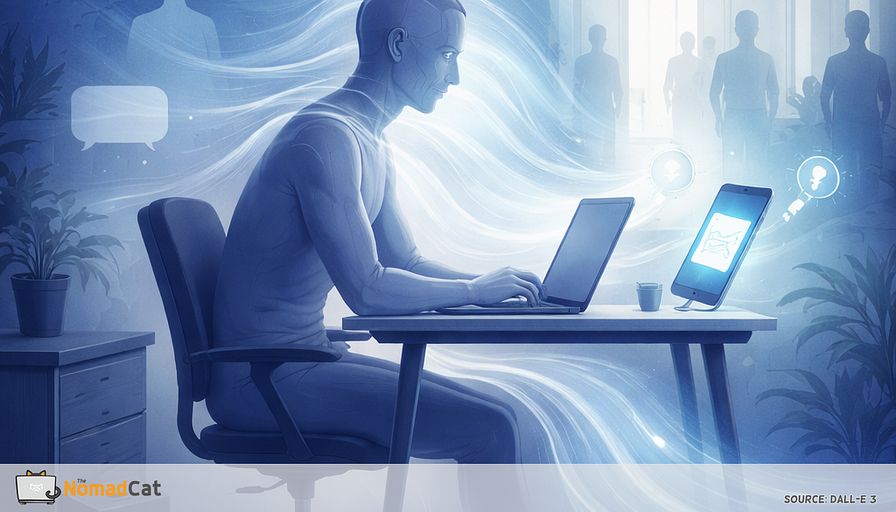
You can do everything “right” at work and still stand up at 18:30 feeling like your neck got welded to your shoulders. I’m French (born 1974) and I’ve spent most of my adult life at a desk—from Beijing to Berlin to Lisbon—so I know that specific upper-back signal.
The annoying part is the mismatch. The day looks clean on paper. Tasks shipped. Meetings done. No drama. And yet your upper back is tight, your hips complain, your legs feel weirdly heavy. That gap can create this low-grade guilt, like you failed at some basic adulting setting.
A useful reframe is that this is often not a motivation problem. It’s an environment problem.
When work moved onto screens, it quietly removed a whole layer of tiny, forced interruptions that used to break up stillness for free. Not “work-life” anything. Just micro-stops caused by other humans being in the same space. Someone walks up, you swivel, you half-stand, you point at a line, you step to a whiteboard, you sit back down in a slightly different shape. Small movements, but frequent. Less time spent frozen.
This article calls that missing layer an interruption ecology and shows how to rebuild a version of it at home without relying on heroic discipline. You’ll see
- why the office interrupted your stillness in ways remote work doesn’t
- why timers feel smart and still fail the moment real work gets messy
- how to use work events as triggers for tiny posture changes that actually stick
- a few simple “coworker proxies” you can place in your room so movement happens almost by accident
- a boring 7-day test to check if the change is real without turning your day into a tracking project
The goal is not a new personality or a perfect setup. It’s fewer end-of-day invoices from your body, using small, practical inputs that fit inside a packed schedule.
The interruption ecology you did not notice
The productive day that still charges your body
At 18:30 you stand up and do a tiny inventory. Neck stiff. Upper back tight. Legs weirdly heavy. The annoying part is that the day was good on paper. Tasks shipped, meetings done, no drama.
What changed is often not motivation, or even “lack of exercise.” It is the disappearance of small, externally forced interruptions. Not the big stuff. Just the quiet pattern of micro-stops that used to break up stillness without asking for discipline.
You already know the principle; the missing piece is that the office used to enforce it for you.
This framing helps because it moves the problem from character flaw to missing input. Once the input is named, it stops being a vague guilt cloud.
Socially imposed micro pauses
“Socially imposed micro-pauses” are tiny, unavoidable posture and attention changes triggered by other humans during the workday. They were not wellness breaks. They were just coordination showing up in the schedule.
Micro-pause = external interruption → stand, turn, reach, speak, re-orient → back to task.
In practice it looked like:
- someone asks a 10-second clarification, you swivel, gesture, half-stand
- you lean over to point at a screen, then sit back differently
- you get pulled into a quick sync and your hands leave the keyboard long enough for your shoulders to drop
The mechanism is not magic. It’s variability: less time loading the exact same tissues in the exact same position.
Remote days can be missing this variability. Not because anyone did something wrong. Because the environment stopped injecting it for free.
Office interruptions were a physical feature
Walk up work created movement for free
In the office, coordination had a physical cost. Someone appears at your desk. You swivel. You half-stand. You point at a line. You step to a whiteboard. You come back. You sit, but not in the same shape.
None of that counted as exercise. It was just the default workflow of being in the same room. And it mattered because discomfort is often time-based. The longer you hold a position, the more it starts to feel bad. The office injected variability before anyone had to be disciplined about it.
Same story for the “boring” building stuff: the 3‑minute walk to meeting room B, the stairs, the coffee run, leaving the building for lunch. That was 3 minutes of spine rotation and leg load you don’t get from a calendar link.
The tiny mechanical edits that slowed discomfort
Those walk-ups caused a lot of small mechanical changes:
- you unload the chair for 10 seconds
- you rotate your spine instead of staying glued forward
- you shift weight, reach at a different height, change eye line
- your hands open, grip relaxes, jaw unclenches
- your shoulders drop when you stop “typing posture”
A common ergonomics line is “the best posture is the next posture.” Slightly poster-like, still useful.
Attention shifts also gave short recovery moments
A person in the room also changes your attention. Your gaze moves off the rectangle. Your face softens. Breathing becomes less held. You speak, you listen, you pause.
Even brief breaks can reduce fatigue and strain, and performance often doesn’t collapse when breaks are short and reasonable.
The office was not healthier it was harder to stay perfectly still
The office was not automatically better ergonomics. Chairs were often bad, screens too low, laptops everywhere, people eating at desks like it’s a sport. But it was harder to sit frozen for 3 hours straight when humans kept needing things.
Blunt version. The office interrupted your stillness whether you wanted it or not. Remote work removed that enforcement. Next comes the awkward part. The tools made stillness the default setting.
Remote work optimized away the rescue
Remote work removed the physical transaction costs from coordination. Messages arrive silently. Clarifications happen in-thread. A meeting is a click, not a walk. You can route an entire day through the shortest path and never leave the chair, like a smooth pipeline with zero friction and suspiciously low latency.
That’s the win, and also the trap. Posture changes stop being baked into the process.
So “unbroken stillness” is less a personal failure than a default configuration. Deep work blocks get longer because nobody walks up, nobody leans over your screen, and side chats don’t slice the day into smaller pieces.
Not a discipline issue, a context issue. The body rarely throws an error message at 11:12. It logs it quietly and prints the invoice after 18:00.
Also: my wife is a fitness trainer, and she still has to tell me to sit straight—and I manage it for about three minutes, then I’m back to my little desk shrimp position. So yes, “just be disciplined” is not a plan.
Common end-of-day logs:
- tight upper back, like your shoulder blades got glued a bit too high
- stiff hips when you finally stand up, with a few “old door hinge” steps
- heavy legs or a subtle swelling feeling
- low back stiffness that is not sharp, just… present
- tension headache or jaw tension that arrived without a clear trigger
- restless body with a tired brain
None of that proves you “sat wrong.” It fits sustained loading plus low movement.
A careful note. Many people report more neck/shoulder/low-back discomfort at home; it’s hard to isolate why. Workstation quality, workload, stress, sleep, and response expectations all mix in. Still, the lever here is pretty adjustable: how long you stay seated without a break. You don’t need perfect certainty to test reducing uninterrupted sitting blocks.
Why timers feel smart and still fail
Scheduled breaks lose to real work
A timer is cute until it fires at the exact worst moment. You dismiss it on instinct, same gesture as closing a cookie banner.
And it’s not only annoyance. There is a real mental cost to stopping and restarting. Resuming takes time because you rebuild the goal and the state you had in your head. Then you pay the usual task-switching cost.
In an office, many interruptions had shared meaning. A colleague is physically there. The question relates to what’s on your screen. You restart with context still warm. A timer is more like random preemption with no story attached, so restarting feels like a cache miss (meaning: your brain has to reload the whole problem again).
Now add a remote-specific issue: optics.
In the office, standing up looked normal because everybody stood up. At home, movement can feel noticeable on camera, like you are “not fully here.” Telepressure makes it worse, that subtle expectation to be responsive and visibly available. When psychological safety is low or unclear, people default to the safest-looking behavior, which is often stillness.
So if timers fail and optics matter, the fix is not more self-discipline. It’s better triggers.
Your brain is not the right trigger
Using your attention as the reminder system is like asking the app to also run the pager. When load spikes, the pager mysteriously goes offline. That’s predictable architecture, not a character flaw.
Habit research is pretty blunt. Behavior runs on cues and context, not continuous self-monitoring. Changing the environment is often a stronger lever than adding more intention on top of an already full day.
A more reliable pattern is event-triggered prompting. Attach micro-movement to things that already happen. Not “every 30 minutes,” but:
- after you hit send
- when you join a call
- when the meeting ends
- when you finish a short voice note
It recreates coworker-driven variability without asking memory to behave perfectly.
Rebuilding interruptions without willpower
Movement rules triggered by work events
Don’t schedule movement. Attach it to events that already hit you. That is how the office worked.
A few rules that are almost too small to fail:
When a Slack or Teams message requires a reply, stand first, then answer. Yes, 10 seconds counts. The point is not exercise. It’s a posture change and a short unload.
When the phone rings, stand to answer. Sit again if you need the keyboard. The ring already feels urgent, so it’s harder to ignore than a polite timer.
If a message needs more than 1 line, walk to a threshold before replying. Doorframe, balcony door, kitchen entrance, hallway line where lighting changes. The walk is the payload. The threshold shifts eye line and hand position without turning it into a big “break.”
If camera optics are a worry, stepping slightly off-camera is often enough.
Scripts that keep it boring and professional
Remote strips context. With fewer cues, small things get misread. Silence becomes “checked out,” standing becomes “walking away.” A 1-sentence status line is often enough.
Useful scripts stay work-native:
- Chat: “one sec, grabbing water”
- “brb 1 min”
- “back in 2”
- “here, just standing a moment”
- Call: “i’m still with you, standing 30 sec”
- “keep going, i’m taking notes standing”
One guardrail. Scripts should not become a new promise of speed. Telepressure is real. Teams generally work better when norms reduce coordination ambiguity. A simple norm like “non-urgent chat gets a reply by EOD” creates space for thinking and small movement.
Walking calls can fit for low-stakes coordination, but “optional” matters. Psychological safety drops when a norm becomes a test. Also, constraints exist. Mobility limits, captions and access needs, safety outside, weather, privacy, confidentiality rules. Walking is not “better.” It is just one way to recreate the old coworker-style interruptions.
Coworker proxies you can place in a room
The most reliable trigger is the one you can’t snooze because the work depends on it. Change the setup, not your motivation. Add a tiny hassle cost to staying glued to the chair.
Small-apartment friendly options:
- put your laptop charger in the next room
- store your headset 2–5 meters away
- keep your notebook on a shelf behind you
- place printed docs on a side table
- move the trash bin away from arm’s reach
This is built-environment logic applied at home. Make the easy option slightly less easy.
A simple second station can also work. A shelf, counter, windowsill. The only job is reading longer messages or reviewing a doc before replying. Standing is optional. The walk is the payload.
In a small Lisbon apartment (or on those workations around Europe with bad chairs and worse desks), laptop-only days make these silly friction tricks even more valuable, because you don’t have many ergonomic levers left.
A boring 7 day test that proves the idea
If you want to validate the “missing interruption ecology” idea, measure something that matches the mechanism.
At 18:00, log 1 number. Did my body feel rescued at all today (0–10). A single number is crude, but it’s consistent enough to spot change.
Optional companion metric. Count interruptions you didn’t choose. Any moment where work forced you to stand or walk, even briefly. You are not farming Pokémon. You are checking whether the room is injecting variability again.
If you wear a watch, the most useful view is usually not total steps. Look for fragmentation signals like your longest sedentary bout and, if available, sit to stand transitions. Treat wrist numbers as fuzzy. (I use a cheap Decathlon sport watch for exactly this kind of “rough signal,” and I keep the Polar H10 for workouts—not for pretending my desk has lab-grade telemetry.)
Success looks boring. Slightly less end-of-day tightness, not a new personality. Some days will still spike. Sleep debt, laptop-only setups, high-telepressure weeks, and back-to-back meetings can overpower the signal.
If there is severe or persistent pain, new numbness or tingling, noticeable swelling, weakness, or a sudden change that feels wrong, that deserves medical assessment. This is an ecology tweak, not treatment. The target is simple. Fewer invoices at 18:00 because the day included a few small interruptions that made stillness harder to maintain.
Remote work made coordination frictionless; your body misses the friction more than your calendar does. The trigger that works is the one that piggybacks on work you already do, not the one that asks you to become a different person.
You might be interested by these articles:


Remote work stole your hallway breaks and your neck feels it

Your watch logged the workout but your shoulders still filed a bug report at 18:00

Stop relying on break reminders and steal movement from meeting transitions

Your remote day needs friction to make movement normal again

Your chair lost its queues so your body files tickets at 18:30

Harnessing IoT for Next-Gen Connectivity

Why your after work stretch keeps losing to your desk day inputs