Abstract:
The article argues that remote work can make long desk days look efficient while quietly increasing physical strain because it removes the “boring” built-in office frictions—badge scans, printer trips, elevator waits, small queues—that used to force brief, automatic posture changes; at home, coffee is two meters away, meetings are a click, and lunch happens at the keyboard, so sitting becomes one uninterrupted slab until around 18:30 when the body “files a bug report” (tight neck, raised shoulders, achy low back, outsized post-lunch fog). Rather than treating this as a motivation or workout issue, it reframes it as a defaults-and-environment problem: steps and gym time can coexist with hours-long sitting bouts, and reminders/timers often fail on the busiest days, so the practical fix is to deliberately rebuild “fake queues” using existing cues (kettle boiling, joining a call, sending a long email, exporting/uploading) to prompt 30–90 seconds of standing or subtle, camera-friendly micro-movements (weight shifts, heel-to-toe rocks, ankle pumps, a slow exhale), plus simple home tweaks that add small friction (keep water in the kitchen, charging cable in another room, notebook on a high shelf) and a consistent “landing spot” after calls to recreate transition buffers. It also offers social/Zoom ergonomics (stable camera, wider framing, hide self-view, and a one-line explanation like “I’m going to stand for this, still here”), cautions against rigid all-day standing in favor of alternating positions, and suggests judging success by boring signals—less end-of-day stiffness, fewer neck/back complaints after stacked meetings, smaller energy slumps, and easier switching out of work mode—while noting that alarming symptoms warrant medical advice.
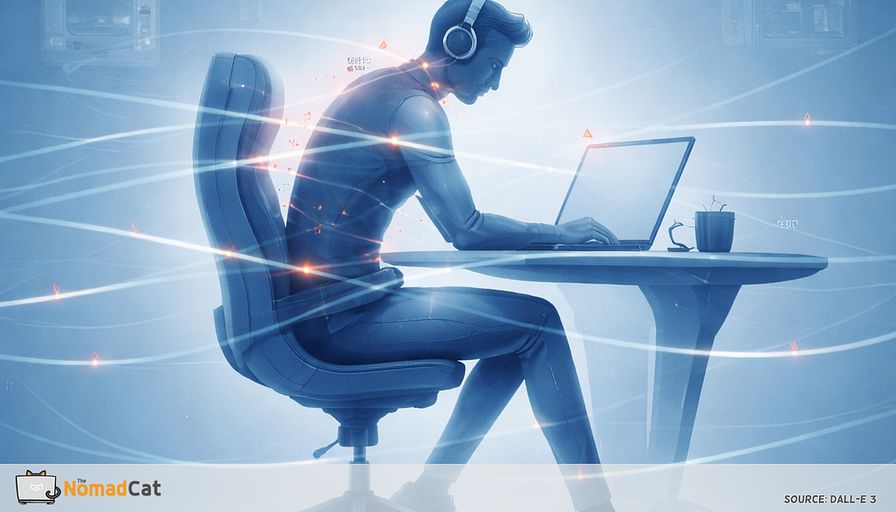
A 10-hour desk day can look weirdly “efficient” from the outside. Coffee is 2 meters away. Meetings are a click. Lunch happens at the keyboard. Then 18:30 arrives and the body sends the usual bug report. Tight neck. Shoulders up near the ears. Lower back complaining. That post-lunch fog that feels a bit too strong for the same sandwich. None of this is a personal failure. It is what happens when work removes the small, boring interruptions that used to break sitting without asking.
I’ve done this across Beijing offices, then Berlin, and now in Lisbon: the calendar wins, the spine loses.
- This is about rebuilding a few missing “queues” on purpose, without turning your flat into a gym.
- The target is simple: fewer long, uninterrupted sitting blocks.
- The method is even simpler: use cues already in your day, not timers and guilt.
The queue you forgot about
Queues were accidental posture variety
Badge scan, elevator, coffee machine, printer, microwave, reception desk. Nobody called any of this a break. Still, it inserted upright minutes into the day with zero motivation required. The office didn’t make anyone fit. It just made people less seated by default, which matters when “sedentary time” is basically any waking time spent sitting or lying, and a “break” is simply an interruption of that (Tremblay et al., 2017).
Standing in a queue isn’t heroic. It’s just physically different. Feet shift. Ankles move. Calves do a bit of work. Shoulders drop when the hands stop typing. It’s boring. And that’s the point. Short microbreaks in desk work consistently show boring wins: less discomfort, less fatigue, without tanking performance (Kim et al., 2017).
The systems part matters more than the posture trivia. In an office, friction happens to you. At home, everything is tuned for throughput. Coffee is 2 meters away. Meetings are a click. Food shows up like magic. Great for shipping work. Bad for movement variety. Defaults beat willpower because humans are lazy in a perfectly reasonable way. Workplace sitting research keeps landing on the same thing: environment changes tend to move behavior more than reminders alone (Shrestha et al., 2018). Your body does not care about throughput. It cares about changing positions.
When convenience makes sitting invisible
Speed wins and your legs lose
Remote work didn’t “make us sedentary” in one dramatic way. It just removed the tiny transitions.
Sometimes it’s as dumb as this: you used to walk to a meeting room, get there a bit early, wait 40 seconds, walk back. Now it’s click → talk → click → next call. Slack didn’t replace a walk; it replaced the shoulder tap and the little stand-up that came with it. Screen share didn’t replace collaboration; it replaced the small trip to someone’s desk. Each swap is a win in speed, and a loss in upright punctuation.
Long sitting bouts become the default
It is totally possible to train, hit steps, and still sit from 09:30 to 13:00 because the day is a wall of calls. Bout length matters, not only daily total. Prolonged sedentary patterns show up as a risk marker in device-based observational work (Diaz et al., 2017). WHO guidance stays intentionally plain: limit sedentary time and replace it with movement when possible (WHO, 2020). No magic interval. Just less unbroken stillness.
Reminders die on the days they are needed
Timers sound clean until the day gets heavy. Prompts start helpful, then feel like spam, then become background noise. If the system requires attention, it tends to fail exactly when attention is gone.
Also, personally: if I miss one day, I’m weirdly good at missing the next one too.
Steps are not the same as punctuation
Pattern beats totals more often than expected
Long uninterrupted sitting is like a server with a giant lock timeout. Nothing “breaks”, but everything gets sticky, slow, and weirdly fragile.
A break in sedentary time is any non-sitting interruption, even brief (Tremblay et al., 2017). That’s why the office queues mattered: they were tiny, frequent interrupts.
One common misread is thinking standing still equals moving a little. In controlled trials, frequent light-walking interruptions beat uninterrupted sitting for post-meal glucose and insulin. The typical protocol is unglamorous: about 2 minutes of easy walking every 20 to 30 minutes. That’s a lab schedule, not a life rule (Dunstan et al., 2012).
Standing still does help—especially as a delimiter. Alternating sit and stand tends to be friendlier for low-back discomfort than staying planted in one position forever. Standing marathons are not the assignment.
Exercise still matters, obviously. It just doesn’t reliably break the 3-hour sitting slab created by back-to-back calls. Workouts build capacity; fake queues break the blocks.
A win condition for desk days that does not need a new identity
The real target is fewer long sitting slabs
The day doesn’t usually fail because of “not enough workouts”. It fails because sitting becomes one continuous default until the body starts throwing small errors.
Neck and upper-back tightness that ramps quietly. Hips that feel rusty on first steps. Post-lunch fog bigger than the lunch. This is a pretty normal output of long stillness blocks, not a sign you are broken. Microbreak research suggests short breaks can reduce discomfort without wrecking performance (Kim et al., 2017). Standing is not the workout. It’s the cheap delimiter between tasks, like adding commas so the paragraph can breathe.
The practical move is to rebuild fake queues at home, on purpose, with low friction.
Rules that recreate queues without an app
Fake load time that forces you upright
If something would have made you wait in an office, recreate a tiny wait at home. When the kettle starts, a meeting link opens, a file exports, a big email sends, a dashboard loads. Stand 30 to 90 seconds and let the cue do the work. The if-then setup is the point here (Gollwitzer & Sheeran, 2006).
Triggers that often work
- kettle or coffee machine
- joining a call
- export or upload
- send on a long email
- app login or dashboard refresh
No heroic stretching. Just upright.
Two anchor cues that survive calendar chaos
Join the meeting, then stand for the first 60 seconds. Camera optional. It breaks the sit-to-sit chain that can run all morning, and it still counts as a break in sedentary time (Tremblay et al., 2017).
When the meeting ends, take 20 to 40 seconds for a tiny room change. Close the tab, refill water, open a window. Not theatre. Just an upright transition that helps create a boundary when work wants to glue itself to the chair.
My wife is a trainer and nutritionist; she still has to remind me to sit straight, and I last about three minutes. So yes, external cues do help.
Optional extras (only if they feel natural)
- Passive time defaults to upright: listening on a call, waiting for others to join, reading a doc.
- Small movements that don’t look like a workout: weight shifts, heel-to-toe rocks, ankle pumps, one long exhale.
- Match posture to the meeting: stand for shallow status syncs; sit for messy decision calls (standing can change how people elaborate).
Movement that stays forgettable on camera
Keep it boring for everyone else
On a 6-person gallery view, motion steals attention even when nobody wants it to. Vision research is blunt: moving things pull the eye automatically (Franconeri & Simons, 2003). So big gestures and dramatic chair gymnastics become a meeting event. The goal is boring movement nobody remembers 10 seconds later. Subtlety is not weakness. It’s social ergonomics.
A few setup choices help
- stabilize the camera so it does not wobble when you touch the desk
- widen the framing so standing is less visually loud
- keep bigger adjustments for transitions like joining and leaving
- slow is better than twitchy
- consider hiding self-view if it increases self-monitoring (Bailenson, 2021)
If someone notices, one sentence saves you from a TED talk
“I’m going to stand for this, still here.”
Home queues without turning your flat into a gym
Small friction that pays you back
Don’t add new “movement tasks”. Move the stuff you already use so it costs 6 extra steps and buys 20 seconds upright. Defaults beat motivation, especially on heavy days. Evidence trends in workplace sitting are similar: environment changes tend to beat education-only nudges (Shrestha et al., 2018).
Simple swaps
- Water lives only in the kitchen so every refill is a tiny walk.
- Charging cable lives in another room so plugging in is a micro-trip.
- Notebook lives on a shelf you must stand to reach so writing 1 thing includes a sit-to-stand.
Guardrail. Replacing sitting with rigid standing all day can turn into locked knees and concrete feet. Alternation and movement matter more than racking up standing hours.
A landing spot that replaces the elevator wait
Pick 1 physical threshold and reuse it. A spot by the front door, or next to a window you can reach in 10 seconds. After a call, stand there for 60 seconds. Not for virtue. It’s the missing buffer offices forced between rooms, and it can help role transitions when work wants to smear into everything.
Keep the minute practical
- refill water
- open the window
- put the headset away
On the nights where work runs late (yes, past midnight happens), that one minute at the window is sometimes the only “commute” the day gets.
How to know it works without tracking your life
Boring signals that are actually progress
If the day is still a 10-hour chair festival, “working” won’t look like a new body. It looks like less stiffness debt and fewer energy cliffs. Microbreak studies mostly report boring wins like lower discomfort and fatigue, not miracles (Kim et al., 2017). Signals to watch for
- standing up at 18:30 feels less rusty
- fewer neck or low-back complaints after stacked meetings
- smaller post-lunch slump with the same lunch
- less end-of-day glued-to-chair feeling
- easier switch into non-work mode because transitions exist again
If you’re the kind of person who already wears a Polar H10 or a cheap Decathlon sport watch, you might notice it indirectly: fewer late-day stressy spikes, or sleep that feels a bit less “wired” after a call-heavy day. Not a requirement, just a quiet side effect.
Stop rules that keep this responsible
If there is progressive weakness, persistent numbness, severe pain, new bladder or bowel issues, or anything that feels alarming, this is not a missing-queue problem and it is worth medical advice. For the usual desk stiffness, the idea stays simple. Offices gave movement by accident. Home can rebuild a small part of it on purpose.
A 10-hour desk day is not a character flaw. Remote work just removed the tiny queues that used to force posture variety, so sitting turns into one long slab until 18:30 and the body files a ticket. The useful shift is to stop treating movement like a workout problem and start treating it like a default-setting problem.
Steps and gym time still matter, but they don’t always break the long sitting bouts that make necks cranky, backs grumpy, and lunch feel heavier than it was. Fake queues help because they ride on cues already in the day. And it’s mildly annoying, but true: “efficient” days are often the worst ones for your body, because nothing ever makes you stand up by accident.
Kettle on, meeting starts, meeting ends, file exports. Stand 30 to 90 seconds, do a boring micro-move, then sit again. No timer guilt.
You might be interested by these articles:


Your legs are timing out in remote work bring back the missing standing layer

Remote work stole your hallway breaks and your neck feels it

Make movement non-narrative on video calls

Micro-exits for remote days that keep your body from timing out

Build an interruption ecology for remote work so your body stops billing you at 18:30

Building digital trust through ethical leadership

How to spot blind spots before making your next big tech move