Abstract:
The article argues that remote work can feel disproportionately exhausting because it removes the constant “scene changes” a commute and office day used to provide—corridors, stairs, coffee queues, printer trips, even “wrong exit” detours—that quietly added up to meaningful incidental movement without requiring motivation or a workout mindset; when those fragments vanish, the day becomes “step-neutral,” long sitting blocks accumulate, and you only notice the cost when you finally stand up around 18:30 and your neck and lower back protest. Instead of recommending a heroic daily walk or timer-based reminders that collapse when meetings stack “like Jenga,” it proposes rebuilding baseline movement with an autopilot “commute proxy”: attach tiny, pre-decided micro-routes (60–120 second loops) to reliable cues that already survive chaos—like “laptop opens,” “meeting ended,” “big email sent,” or “water refilled”—so movement becomes the default again with no gear, tracking, guilt, or perfection rules. Practical examples include a short 3–8 minute out-and-back before opening email, a matching shutdown walk after the last call, socially invisible off-camera walking for the first seconds of a meeting, and repeatable indoor loops (touch the front door handle, walk to the far room and back, one stair landing up and down), all aimed at breaking up freeze-frame workdays into small resets that reduce stiffness and the flat afternoon dip by restoring the lost, effortless steps of commuting.
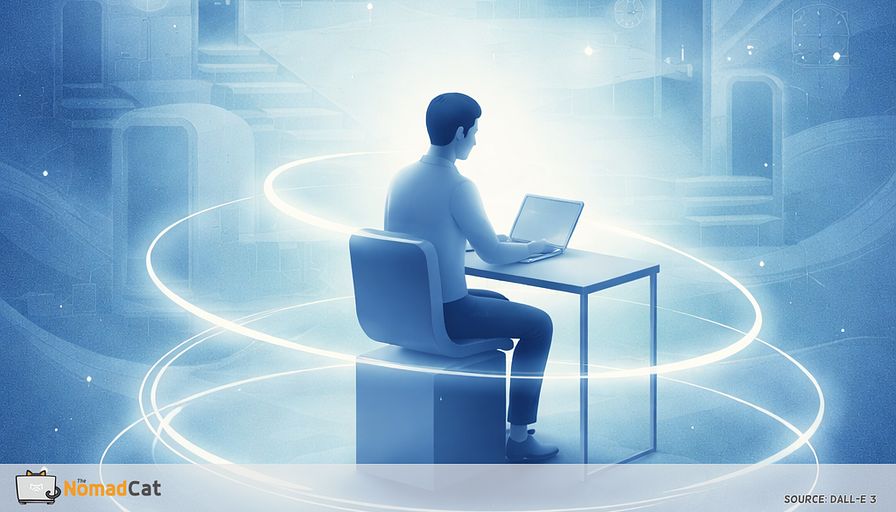
A 10-hour desk day can feel weirdly exhausting while also being… almost motionless. You sit through back-to-back calls, eat lunch at the keyboard, then stand up at 18:30 and your neck and lower back file a complaint. Not because you “did something wrong”. More because the day had no built-in scene changes. No corridors, no stairs, no “wrong exit” detours, no coffee run that forces you to stand up and queue.
That’s the quiet problem with remote work. The old commute wasn’t just transport. It was hundreds of tiny movement fragments that happened without motivation, without gym clothes, without negotiating with yourself. When those fragments disappear, step counts and energy tend to drop with them, and the body starts to feel like it’s been parked in one position too long.
I’ve been at a desk long enough—Beijing, Berlin, and now Lisbon—that I can tell when the “no scene changes” day is coming. The early signal, for me, is a tightness in the upper back that builds quietly until it forces me to move.
This article is about getting that baseline movement back without turning your calendar into another project. The focus is not a heroic daily walk that dies the first time meetings stack like Jenga. It’s a commute proxy that can run on autopilot.
Here’s what gets covered:
- The hidden math of “free steps” and why small transitions added up more than most people realize
- Why tiny walking never felt like exercise, and why long sitting blocks often feel worse than the workload
- What a step-neutral day looks like, and why timers usually fail on real schedules
- A simple model for movement that survives chaos: cues, micro-routes, and 60–120 second loops
- A practical menu of commute replacements for mornings, between meetings, lunch, and the afternoon dip
- How to make it stick without tracking, guilt, or perfection rules
The goal is modest and honest. Make movement the default again, in small pieces, so the day stops feeling like one long freeze-frame.
The hidden math of the commute
Where the free steps actually came from
The commute was never “a walk”. It was a bunch of tiny transitions, spread across the day. Transit users, for example, rack up a median of about 19 minutes a day of walking just to get somewhere (Besser & Dannenberg, 2005). And when restrictions hit, large-scale phone data showed step counts dropping fast, which fits with that quiet movement getting deleted (Tison et al., 2020). Once you see it as fragments, you can spot what disappeared.
It’s rarely 1 missing habit. It’s more like 10 defaults that used to trigger motion without any “exercise mode”. Typical fragments looked like
- Walk from home to car, bus stop, or station
- Parking-to-building walk
- Stairs, escalators, long corridors
- Platform transfers and “wrong exit” detours
- Coffee run that required standing up and queuing
- Printer trips
- Walking to meeting rooms
- Lunch pickup instead of eating at the desk
- Micro errands between tasks
- Walking back out at the end of the day
Add them up and the totals get bigger than you’d expect. As a rough rule, most people hit around 80–110 steps per minute at an easy indoor pace. So imagine a day that had just 18 minutes total of these fragments. That’s roughly 1,440–1,980 steps. In commute-proxy terms, that’s basically nine 2-minute loops, spread across the day (or 18 one-minute loops if your calendar is brutal). Caveat, step counters can get less accurate at very slow speeds, so don’t worship the last digit.
The bigger point is why those steps were so easy to keep doing. They were triggered by context. You stood up because you had to be somewhere else. In habit research terms, stable contexts trigger behavior more than intentions do (Wood & Neal, 2007), and when the context changes, the habit often breaks (Verplanken et al., 2008). Like background apps on a laptop, commute movement ran without asking for permission. Remote work removed the defaults.
Why tiny walking never felt like exercise
Small movement works like maintenance
After about 90 minutes in the same chair position, the first stand-up can feel rough. That “creaky” moment is often just what long stillness feels like. Research supports that stiffness sensations can come from how muscle behaves after being held still (Proske & Morgan, 2001). “Morning stiffness” is even a formal concept in clinical criteria, which tells you the sensation is common and recognized (Altman et al., 1986).
Most people notice this first as an energy and attention problem, not as a future risk chart. Breaking up sitting is basically a small “state change” for the body. Long sitting has its own downsides, even if you do a workout later. And in office settings, short activity breaks have been shown to reduce sleepiness and improve reported energy (Wennberg et al., 2016).
So the goal is not a new training plan. It’s restoring the old baseline that used to happen by accident. Long motionless blocks tend to make people feel sleepy and flat. If “productivity hack” language makes you roll your eyes, fair. Think of micro-walks as a way to change the feeling of the day, not a guaranteed brain upgrade.
The remote day that never switches scenes
When work has no built-in chapter breaks
You know the pattern. Bed-to-desk in 12 seconds. Slack, email, first call. Second call. Lunch appears at the keyboard. Another call. The only walking is to refill water, if luck. And if you’re the type (me, often) who keeps going past midnight, it gets even easier to do an entire day with basically no “chapters”, just one long screen.
A step-neutral day is a day where work is intense, even exhausting, but incidental walking is near zero because nothing in the schedule forces movement. The guidance is blunt: sit less, move more. In a remote calendar, the problem is you can’t “accidentally” do it—if you don’t insert transitions, nothing inserts them for you.
The cost often shows up late. You finally stand up and suddenly notice the neck, the back, the shoulders. Standing didn’t cause it, it just exposed it. For me it’s that upper-back tightness: I ignore it, ignore it, then I get up and it’s like my body sends the invoice all at once. Studies on supplementary or active breaks show discomfort can drop without productivity taking a hit (Galinsky et al., 2007; McLean et al., 2001).
Timers try to fix this, but they usually fail on real days. Back-to-back calls are the stress test. “Just walk more” sounds fine at 10:00, then 14:00 arrives with 6 calls stacked like Jenga and the plan becomes a negotiation you lose. If the schedule is wall-to-wall, “take a short break” isn’t a motivation problem. It’s a calendar problem. Ergonomics guidance has been saying this for years. Breaks and changes of activity should be planned into display screen work, not treated as optional decoration (HSE DSE guidance, OSHA computer workstation guidance).
So the replacement needs tighter constraints than most advice admits
- Triggered by a reliable cue like “call ends”
- Under 2 minutes
- No gear and no outfit change
- No streaks or identity upgrades required
Call it changing the setup so the easy option is the one that happens (Michie et al., 2011; Michie et al., 2013).
Build a commute proxy that runs on autopilot
Repeated walking beats one heroic walk
Research even tests this in absurdly small doses, which is good news for packed calendars. In lab-style protocols, 2 minutes of light walking every 20 minutes improved post-meal glucose and insulin compared with uninterrupted sitting (Dunstan et al., 2012). Meta-analysis results cluster around 2–5 minutes every 20–30 minutes (Saunders et al., 2018). Think of it like source control. Many tiny commits prevent one giant stiffness merge at 19:30.
The useful part isn’t the exact schedule. It’s the shape of it: small, frequent, easy to repeat.
Micro routes that remove daily negotiation
Counterintuitive truth, route beats intention. A pre-decided loop turns movement into a context cue, not a moral debate at 16:40 (Wood & Neal, 2007). Attach loops to boundaries that already exist.
Distance beats intensity, because 4 × 2 minutes beats 1 × 20 minutes on chaotic days. Small daily movement adds up as NEAT, even when nobody calls it exercise (Levine et al., 1999; Levine et al., 2005). And if-then hooks work because cue-action linking is the mechanism (Gollwitzer, 1999), with meta-analytic work showing these plans improve goal attainment on average (Gollwitzer & Sheeran, 2006).
Examples that don’t require planning meetings with yourself
- If a call ends, then walk the loop until the next one starts
- If a big email is sent, then do 1 loop before opening the next tab
- If water is refilled, then add the long way back
Make it socially invisible so it survives video-call culture. One concrete option is an off-camera loop for the first 30 seconds of a call, then sit once the meeting actually starts.
A menu of commute replacements that fit inside remote work
Bookends that rebuild the start and stop
Lock in a 3–8 minute out-and-back before opening email, with a fixed endpoint like “the corner then home”. It’s a boot sequence, not exercise, and putting it before urgency lands protects it. If weather is bad, swap to stairs. Small outdoor doses can still matter for mood, with research showing early gains around ~5 minutes of green exercise (Barton & Pretty, 2010; Pretty et al., 2005).
Use the same route after the last call as a shutdown signal, even if it’s just a loop to the same endpoint and back. That walk works as a delimiter between roles at the same address (Ashforth et al., 2000). Detachment supports recovery and functioning later (Sonnentag & Fritz, 2007). Some days are chaos. That’s why meeting transitions matter too.
Between meeting loops that survive calendar fires
A 60–120 second meeting-transition loop is a fixed mini-route you run between calls, using “meeting changed” as the cue instead of a timer. Short breaks can reduce sleepiness and improve reported energy (Wennberg et al., 2016), and brief activity breaks can have measurable effects in the broader sitting-interruption literature (Saunders et al., 2018). The route can be tiny and still count.
Small-space routes that work because they have a repeatable endpoint
- Hallway out-and-back to a mark on the wall
- Kitchen loop touching the counter then back
- Stair up to the next landing then down
- Balcony or patio loop, 1 lap only
- Touch the front door handle then return
- Walk to the farthest room, touch the window, return
- Walk to the bathroom, wash hands, return the long way
When calls are truly back-to-back, use a coping plan so 1 missed gap doesn’t break the whole system
- If you join 30 seconds early, then keep camera off and walk until the meeting actually starts
- If a call ends and chat explodes, then do 30–45 seconds of the loop before reading messages
Lunch and the afternoon dip triggers
A simple rule is 5 minutes out-and-back before lunch, not to burn calories but to interrupt what is often the longest sitting block of the day. Interrupting sitting with short walking breaks has shown post-meal improvements in controlled studies (Dunstan et al., 2012). Green space exposure is associated with better health outcomes in observational syntheses, best treated as a possible bonus (Twohig-Bennett & Jones, 2018).
If afternoons are where the system fails, use the dip as the trigger. Add an optional 2-minute indoor loop around 15:00, then see what changes. Treat it like a test. Energy often improves with short activity breaks (Wennberg et al., 2016), while cognitive test results are mixed, so watch how you feel and how the next hour goes (Wheeler et al., 2021). The point is avoiding the zero-transition day.
Make it stick without tracking
Cues and layout that feel inevitable
If leaving the house feels like a negotiation, keep it stupidly small. Put shoes or a jacket in the doorway on workdays so the default is a 60-second leave-and-return before sitting. Basically: put the stuff in your way so you trip over the habit. Visibility and context cues trigger action without a debate (Wood & Neal, 2007).
You can also force the day’s first edge by starting only the first meeting from a different spot. Take the call from the kitchen table, then walk back to the desk after. It’s a micro boundary with almost no effort.
And it needs a non-perfection rule, otherwise it becomes another performance metric. A simple one
- During work hours, every time you cross a doorway, take the long way back once
To keep it stable, aim for “default movement most days”, not perfect execution. Treat misses as missed deposits, not failure. Small wins matter for self-efficacy (Bandura, 1997), and modest reliable change tends to beat fragile plans (Conn et al., 2011).
A one week test with 1 tiny proxy
Success is not “a new routine”. It’s whether 1 small proxy happens with low drama for a week. Picking 1 behavior lowers the burden compared with trying to change everything at once (Spring et al., 2012). Define success by the worst day, not the best day.
- If the laptop opens, then do 1 out-and-back loop before email
- If a meeting ends, then walk 60 seconds before reading messages
That’s the whole idea: a commute proxy that shows up even when the calendar is on fire. The best cue isn’t the most virtuous one—it’s the one that still happens on the worst day, when you’re tired, late, and tempted to stay parked.
You might be interested by these articles:


Micro-exits for remote days that keep your body from timing out

Your remote day needs friction to make movement normal again

Your remote brain needs endings not more willpower

Your chair lost its queues so your body files tickets at 18:30

Remote work stole your hallway breaks and your neck feels it

Navigating AI's Impact on Future Careers

Advancing Networks with Mesh Technology