Abstract:
The article argues that remote work often turns the entire day into “one long seated interface,” where Slack, calls, and even thinking happen in the chair because the laptop feels like the room—removing the small, socially justified upright moments office life used to provide by default. It reframes late-day “leg tickets” (ankle heaviness around 18:00, sock dents, tight shoes, and the rusty “boot sequence” of the first steps after long sitting) as a configuration problem rather than a discipline failure, emphasizing that hitting a good step count can still coexist with 90–180 minute sitting blocks that leave the calf “pump” off and symptoms sneaking in; it also cautions that standing all day isn’t the solution and can carry its own risks. Because standing on video can feel performative or socially risky, the piece recommends making it boring and non-narrative—using a simple line like “I’m going to stand for a minute, still here”—and restoring “vertical conversation time” through work-attached if-then rules such as stand-to-speak (when you’ll talk >30 seconds), “waiting equals standing” during brief loads and joins, and “doorway delivery” for longer messages, paired with subtle micro-variation (weight shifts, staggered stance) rather than rigid stillness. Anchored by the author’s long desk-bound career across Beijing, Berlin, and Lisbon, the practical goal is modest—fewer predictable evening complaints and maybe better sleep—validated via a low-effort 7-day debug test that tracks one boring end-of-day 0–10 signal like leg heaviness at 18:00 or rusty first steps, instead of elaborate tracking or a new identity.
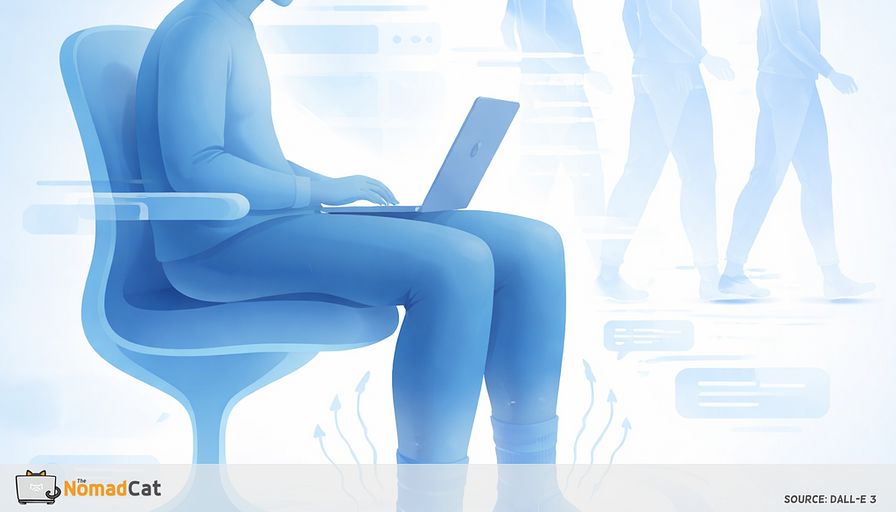
A remote workday can turn into 1 long seated interface. Slack in the chair. Calls in the chair. “Quick question?” also in the chair. Even thinking stays glued to the screen, because the laptop is the room and leaving the room feels like leaving work. So you wait, refresh, alt-tab, still seated. And yes, it’s a bit absurd, but voilà.
Then the body starts sending small tickets. Ankles feel a bit full at 18:00. Socks leave dents. First steps after a long sit feel rusty. Nothing dramatic, just repeatable enough to be annoying. And because you can still hit a decent step count, it creates this mild, pointless guilt loop. Like you “should” be fine.
This article is about the missing standing layer that office life used to give you for free, without motivation, without planning, without making it A Thing. Not standing all day. Not more workouts. Just the quiet upright minutes that used to happen at task boundaries and conversations.
Here’s what you’ll get in the next sections:
- Why remote work is a defaults problem, not a discipline problem
- Why steps and standing are different inputs, and why 90–180 minute sitting blocks can still cause leg weirdness
- The leg signals people actually notice, like heaviness, sock marks, and the “boot sequence” when you finally stand up
- Why standing on camera feels socially risky, and how to make it boring instead of performative
- Simple work-attached rules (not “take breaks”) that bring upright minutes back without rearranging your calendar
- A low-effort 7-day debug test using 1 boring end-of-day signal, not a spreadsheet
There’s also a small personal anchor later, because the author has spent most of adult life at a desk, from offices in Beijing to Berlin and now Lisbon, often past midnight. Not a dramatic injury story. More like noticing the early log line when the system drifts.
The goal here is modest and practical. Fewer late-day leg complaints, less stiffness, maybe better sleep. No new personality required.
The missing standing layer
When work becomes a single seated interface
The remote version of “task boundaries” is often invisible. Calendar goes back-to-back. Conversations become async waits. You don’t walk to a room or hover at someone’s desk; you just keep a tab open. And when responsiveness becomes the latency scoreboard, standing up can feel like you’re increasing ping.
Offices used to sneak in upright minutes without calling them breaks. A quick walk to a meeting room. Hovering at someone’s desk. Standing while talking because it made sense in the space.
If you work at home most days, this part often disappears without you noticing. Work still gets done. But the day loses those small posture changes that used to happen by default.
Vertical conversation time
Call it vertical conversation time. Socially justified standing that comes attached to communication, not to health. It worked because it had 3 features that survive busy days.
- It was tied to work, so it never felt like stopping
- It came in tiny fragments at task boundaries
- It let you shift weight and change posture without making a calendar event
Research on microbreaks is pretty consistent on the practical point: for desk workers, short, frequent interruptions tend to reduce discomfort and fatigue without hurting performance. The blunt takeaway is that you don’t need a 10-minute break—30 seconds repeated counts.
The bigger reason it worked, though, is simpler. The context was the cue.
A defaults problem, not a discipline problem
Remote work removed a default that injected upright minutes automatically, even for people who train and track steps. If the environment stops doing the work, motivation has to do impossible work and usually loses.
So if your legs feel weird late day, it can be a configuration loss, not a character flaw.
Standing is not steps
Different inputs, different systems
A morning run or a lunch walk is great. But it is not the same as the standing layer that used to sit quietly in the background of office life.
Steps are like a big data transfer once a day. Upright minutes with tiny weight shifts are more like background services keeping the ankles, calves, and feet online. When you sit, the “pump” is off and gravity wins, so fluid tends to hang out down there.
Long uninterrupted sitting bouts are where things get sneaky. In controlled studies, a few hours of uninterrupted sitting is enough to measurably worsen blood-vessel function behind the knee—basically, the system gets a bit worse at adapting to blood flow when you don’t move. Zooming out, breaking up sedentary time is associated with better metabolic markers even when total sedentary time is similar. That’s how someone can hit a “good” step count and still do 90–180 minute blocks of near-zero leg input: you did your big walk, then you went offline for three hours.
Standing all day is not the answer either. Prolonged occupational standing is associated with higher varicose veins risk in observational evidence. The useful target is alternation and dynamic standing. Small shifts, brief stepping, changing foot position. Not locking the knees and suffering.
Think distribution, not heroics. Reliability comes from redundancy, like backups that run all day instead of 1 giant backup that fails when you forget.
The leg signals people actually notice
Heaviness and the sock mark effect
Late afternoon, ankles feel a bit full. Socks leave deeper dents. Shoes feel tight for no clear reason. Calves feel lightly compressed, like someone wrapped them in soft tape. Easy to dismiss, but repeatable.
Office life used to interrupt this process many times per day by accident. When sitting stays uninterrupted, the calf pump is basically off and gravity is on. One plausible mechanism is that pressure in the leg veins rises and fluid tends to drift downward, so you can get “full” or tight sensations before anything looks dramatic. In plain language: nothing is broken, you just stayed still long enough for gravity to start winning.
Rusty first steps and standing intolerance
This is the boot sequence after a long sit. The first 10–30 steps feel awkward. Stairs make the calves complain. Even cooking can feel like work, because it is standing plus tiny steps.
Standing still in a meeting can also feel surprisingly unpleasant. Standing tolerance is its own axis. Fitness trains rhythmic contractions. Quiet standing removes that rhythm, so pooling can build and people feel worse even if they run or lift. The workaround is not “stand more.” It is dynamic standing with small shifts and brief contractions.
Some symptoms are not a desk pattern. The red flags are mostly about sudden changes, one-sided symptoms, or anything that suggests a circulation or nerve emergency. This isn’t to diagnose anything—just a reminder not to explain away the wrong kind of signal as “desk legs.”
Seek urgent help if there is
- 1-sided leg swelling, warmth, redness, or calf pain
- chest pain, sudden breathlessness, or coughing blood
- a cold pale limb, severe pain, or new numbness or weakness
- progressive weakness, new numbness in a saddle area, or bladder or bowel changes
Restless evenings and the tired but not exercised feeling
A weird one is the 21:30 paradox. Mentally cooked, but not in the satisfying way. You lie down and suddenly the legs want to move, like they are bored.
More sedentary time is linked with worse sleep markers, and it can go both ways anyway. One plain explanation is sensory monotony. For many people, the first real position changes happen late, when work finally stops. Then the system asks for movement input at exactly the wrong time. If your only real movement happens at 21:30, your legs will ask for it at 21:30.
So the aim is not perfect sleep metrics. It is fewer predictable evening symptoms by removing a predictable daytime exposure.
Standing on camera feels like a social risk
The legitimacy problem
In an office, standing mid-conversation reads as engaged. At home, the same standing can read as distracted, impatient, or weirdly performative. Video calls amplify that risk because you watch yourself being watched.
Movement becomes narratively loud on camera. The safest posture is the smallest one. Self-view adds a second task, monitoring how it looks, not just what is said.
Even outside calls, responsiveness becomes the scoreboard. When the job is reply fast, sitting reads like low latency. Standing can feel like a risk signal. So the fix has to make standing non-narrative, not heroic.
Make standing boring on calls
Choose moments where movement is least likely to steal attention. A neutral line removes the “is he leaving” ambiguity without the apology spiral.
“i’m going to stand for a minute, still here.”
Slightly awkward is fine. Clear beats smooth.
Low-drama windows
- while listening, not presenting
- camera off moments, or brief off while adjusting
- large calls where faces are not the main content
- screen share heavy meetings where the deck is the star
- muted moments if the chair or desk will make noise
Rule of thumb: 1 stand per call is enough.
Standing with a reason
Rules that survive calendar chaos
Don’t “take breaks.” Attach upright minutes to work events that already happen all day, like talking, waiting, and sending. This is basically if-then wiring.
Simple defaults
- Stand-to-speak rule. If you expect to talk for more than 30 seconds, stand up first.
- Doorway delivery. If a message is longer than 3 lines or needs thinking, walk to a fixed standing reply spot and type it standing.
- Waiting equals standing. Any 20–60 second wait becomes upright time. Joining meetings, uploads, builds, exports, screen share starting, audio connecting, calendar syncing.
Loading screens are free posture change slots. Take the free compute.
Micro-variation while upright
Standing still is not the hero here. The payload is micro-variation. Small shifts that keep the calf pump and load distribution alive, without turning the call into an exercise demo.
Micro-options that usually read as normal, even on camera
- shift weight at sentence boundaries, like punctuation for your ankles
- use a staggered stance while listening, then switch sides
- step 10 cm back, then forward, once in a while
- change foot angle in place, toes slightly in then out
- alternate 1 heel slightly lifted, then flat, no visible “calf raise” vibe
Protective constraint: if standing increases discomfort, shorten it. Stand for 1 sentence, then sit. Or stand for the summary part only. Small doses and frequent interruptions tend to work better than heroic blocks.
A 7-day debug test
Measure 1 boring signal
Tracking standing minutes turns into a second job, and the whole point is to reduce friction, not create a new spreadsheet to feel guilty about. 1 end-of-day signal is enough to tell if the missing standing layer is coming back online.
I’ve spent most of my adult life at a desk, from offices in Beijing to Berlin and now Lisbon, often past midnight. I’m not in pain, but I know the early log line when the system is drifting: upper-back tightness that builds quietly until it forces me to move. I can work a full day without eating, drinking, or moving, and it looks like focus; I know now it’s not a superpower. Sleep is also the variable I haven’t solved, and working through the night makes the “tiny defaults” matter more than I want to admit. If I’m checking my watch in the morning anyway, I don’t need more data—I just need one signal that tells me if the day was one long sit.
Use a simple 0–10 rating and keep the time constant.
- Leg heaviness at 18:00 rated 0–10
- Rusty first steps after a long sit rated 0–10
Aim for a gentle trend across 7 days. If the number drops from 6 to 5, that’s already a real signal in a noisy human system.
If nothing changes, it still tells you something useful. Either the standing inputs aren’t actually happening, or the cause isn’t mainly posture distribution.
Success here is just fewer late-day tickets from your legs, not a new personality.
Remote work didn’t make you lazy. It just removed a default. When the laptop becomes the room, the day turns into 1 long seated interface, and your legs start filing small tickets at 18:00. Sock dents, ankle heaviness, the rusty boot sequence after a long sit. Annoying, repeatable, easy to blame on yourself, even if you still hit your steps.
The fix here is not standing all day or adding workouts. It is restoring the missing standing layer with boring, work-attached rules. Stand-to-speak. Waiting equals standing. Doorway delivery. Tiny upright fragments, plus micro-variation so it doesn’t feel like punishment or performance on camera.
Most people have 1 reliable log line. Once you notice yours, the fix becomes boringly repeatable.
You might be interested by these articles:


Your chair lost its queues so your body files tickets at 18:30

The 6pm ankle reboot after a 2 hour statue block

Remote work made your day flat and your joints noticed

Micro-exits for remote days that keep your body from timing out

Your 18:00 stiffness is a config bug fix it with micro-variability

The Role of Ethics Review Boards in AI Development

Revolutionizing Medicine with Biotech