Abstract:
The article explains why a remote workday can be fully productive yet feel physically “flat”: not because you skipped workouts, but because you quietly lost the background “vertical life” that office routines used to supply—stairs to transit, slopes, curbs, standing while waiting, constant sit‑stand transitions, and messy little pivots around doors and meeting rooms that kept ankles, feet, and hips getting varied input. The author, who’s spent desk-heavy years working from Beijing to Berlin to Lisbon and admits they can accidentally work all day without eating, drinking, or moving, frames this as a systems problem rather than a motivation or wellness sermon: context changes erase automatic movement cues, remote work replaces state changes with clicks, and camera-on norms reward staying still as a form of social compliance. Because home “movement” often becomes repetitive hallway/kitchen loops, step counts can look fine while joints still miss the varied loading that helps spread stress; the result is non-dramatic signals like rusty first steps after sitting, tight calves on stairs, feet tired by late afternoon, or the second stair flight feeling easier than the first. The proposed fix is to treat stiffness like a debug log and rebuild the missing layer with small, low-drama “terrain minutes” (brief stair touches, threshold step-ups, turns, corner routes, surface changes, carrying objects between rooms), triggered by event-based cues like waiting to join a meeting or hitting “send,” kept deliberately tiny to avoid flare-ups, and guided by basic stop rules for pain, dizziness, swelling, giving-way, or other red flags.
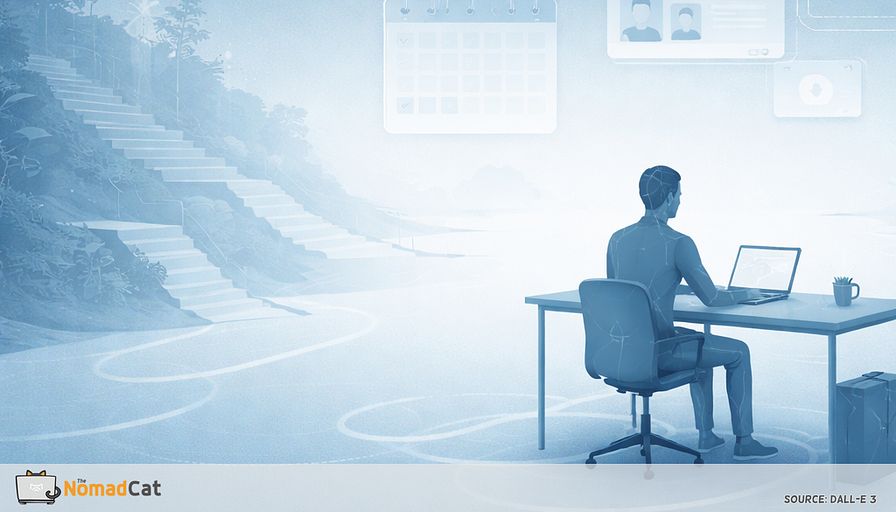
You can hit 7pm with a full day of real work behind you and still feel… weirdly unused. Not tired from moving. More like stiff from existing. The calendar was stacked, lunch happened next to the keyboard, and your “activity” was 12 tiny kitchen loops that somehow don’t count as anything your ankles or hips recognize.
This article is about the kind of movement you didn’t notice you lost when work went remote. Not workouts or step counts—the boring, constant “vertical life” that office days used to force into the background. Stairs to transit. Slopes and curbs. Standing while waiting. The endless sit-stand transitions and little turns that made your body deal with small, varied inputs all day.
If this sounds like wellness preaching, it’s not. The point here is systems, not motivation. Context changes delete habits without asking your opinion, and remote work replaced physical state changes with clicks. Add camera-on meetings, and stillness starts to look like social compliance.
Here’s what you’ll get as you keep reading
- Why your day can be productive and still be physically flat
- What “terrain” used to give your joints for free, especially ankles, feet, and hips
- Why flat indoor pacing doesn’t fully cover the gap, even if your step total looks fine
- Simple “terrain minutes” that fit between meetings without turning into a project
- A couple of low-drama self-checks, plus basic stop rules so this doesn’t get dumb
The goal isn’t to become a new person. It’s to put back a missing layer of the day, in small doses, using the same logic you already use at work. Treat the stiffness like a debug log, not a character flaw. Quiet improvements are still improvements.
The terrain you stopped touching
What used to count as vertical life
Calendar wall, meetings stacked, lunch at the laptop, then somehow it’s 7pm. There’s a weird illusion of “i moved” because you did 12 micro-loops to the kitchen. The missing category isn’t steps or workouts. It’s the terrain layer and the constant sit-stand transitions office life used to sneak into your day.
i’ve spent most of my adult life at a desk (Beijing to Berlin to Lisbon) and i can work a full day without eating, drinking, or moving, which is a bug, not a flex.
Vertical life wasn’t “more walking.” It was low-drama exposure, repeated all day:
- stairs to transit, stairs inside buildings
- ramps and slopes that change how your legs load
- curbs, thresholds, revolving doors
- waiting around standing up
Stairs also ask for more than flat walking, especially on the way down where you have to control the descent (McFadyen & Winter, 1988). And offices add little bits of chaos: turns around chairs, badge-scan pivots, stop-start walks to meeting rooms, carrying a laptop like a fragile tray. On my worst days in Lisbon, my Decathlon watch basically records a perfect flat line between 9am and dinner.
That mess is variability. In practice, it’s the difference between your ankles getting 200 slightly different reps, versus 2,000 identical ones. Repetition is its own kind of load, not just “hours worked” (NRC/IOM, 2001). Variability is one way the body can spread stress around instead of hammering one pattern all day (Latash, Scholz & Schöner, 2002). It’s so ordinary you only notice it when it’s gone.
Why you did not notice
The missing movement was baked into the old context
A lot of invisible movement wasn’t motivation. It was context glue: commute, badge-in, meeting rooms, lunch spots. When you repeat that in a stable setting, it becomes automatic (Lally et al., 2010). Change the setting and the loop falls apart quietly. Same hallway, same chair, same tabs—and nothing in that setup asks your body to stand up unless you force it. That’s a system failure, not a character flaw.
Remote work removed the state changes
Office life forced physical transitions. Remote work compresses them into clicks. You can be very productive and still get almost no movement initiation, because there are fewer event boundaries to attach it to.
Event-based cues often beat time-based reminders when attention is busy. If-then plans reduce the monitoring burden: if X happens, then Y (Gollwitzer, 1999). Timers can become background noise. Clicks don’t move ankles. Remote didn’t remove movement; it removed the prompts that used to start it.
Stillness is also social compliance
Camera-on norms reward staying centered, looking attentive, not drifting out of frame. Video calls are linked with higher fatigue (Bailenson, 2021). The plain-language version: you end calls with your jaw clenched because you tried to look “present” for 45 minutes. Treat it like a product requirement: movement becomes “loud,” so people default to stillness.
What your joints were getting for free
Ankles and feet prefer variety over motivation speeches
The ankle is a bottleneck. Steps and slopes ask it to bend more, then deal with different kinds of load. Up is push. Down is control (McFadyen & Winter, 1988). Ramps change the pattern again. Flatten the day and that exposure disappears.
That’s how you get the non-dramatic signals: calves that feel tight, feet that feel tired, a general “why is walking weird today” vibe. Not a diagnosis. Just the basic idea that tissues adapt to what they see.
Monotony is a classic setup for overuse patterns (Bahr, 2016). And yes, perfect experiments where everything is identical except “variability” are rare. Still, ergonomics has treated repetition as its own exposure risk for a long time (NRC/IOM, 2001).
Hips get stuck in the always-flexed default
Remote days tend to be long sitting blocks, then short indoor walks that barely open the hip. Office life used to sneak in longer walks, stairs, and more transitions. When that structure disappears, sitting-reduction efforts work less by willpower and more by rebuilding defaults.
This shows up as pattern recognition, not pathology: first steps after sitting feel rusty, knees feel busy on stairs, low back may “donate” motion when hips are not contributing much. If transitions feel worse than steady walking, it often points to missing daily movement options and load management issues, not that something is fundamentally broken (Bahr, 2016).
Why flat loops do not close the gap
Same inputs still give the same outputs
Most remote “movement” is a 30 to 90 second pattern: kitchen loop, pacing during calls, the same hallway, the same turns, same floor, same shoes or barefoot. It counts as steps. But step totals don’t tell you what kinds of loading you got (Troiano et al., 2008), and repetition is its own exposure dimension (NRC/IOM, 2001).
When the system keeps solving the same task, the same tissues get recruited in the same way. Same corridor + same speed + same slippers = same strain pattern. Under fatigue, the body often buys control with extra co-contraction, basically a stiffer strategy. “Tight” can mean “fewer options online,” not “you failed to stretch.”
This is also why it’s possible to train hard and still have weekday annoyance. A weekend hike is great, but it doesn’t fully replace 5 days where baseline inputs are flat. Sitting reductions tend to work better when they’re designed into the day, not left as a single heroic lever.
Signals that your day is too flat
Common boring signals:
- calves feel short on stairs
- feet tired by 5pm
- first steps feel rusty, like your feet are made of cheap plastic for the first 15 seconds
- stiffness despite “enough” steps
- second stair flight feels easier
A small measurement can anchor things: the knee-to-wall ankle test is simple and fairly reliable as a repeatable check (Powden, Hoch & Hoch, 2015). You’re looking for trend and asymmetry, not a perfect number.
A no-project self-check menu:
1. Notice the first 10 steps after sitting
2. Compare stair flight 1 vs 2
3. Once weekly, knee-to-wall each side (Powden, Hoch & Hoch, 2015)
This is not diagnosis. It’s a debug log. If there’s sharp pain, swelling, true giving-way, fever, chest symptoms, numbness or weakness, or you can’t bear weight, switch from experimenting to getting evaluated.
Terrain minutes that survive meeting days
Micro moves that do not read as exercise
Tiny doses of up and down, thresholds, turns, and surface change fit in the cracks of a calendar day. Think minimum effective dose. Stop before you get warm or sweaty. Short breaks like this can reduce discomfort without costing productivity in desk work (Galinsky et al., 2007; Dababneh et al., 2001).
If home is too flat, “fake” missing inputs with 20 to 90 second fragments:
- Touch stairs for 30 to 90 seconds. Up 1 flight, down 1. Descent asks for controlled braking (McFadyen & Winter, 1988).
- Step a threshold for 20 to 40 seconds. Use a doorstep or single step and do slow up-downs. Switch lead leg halfway.
- Do the elevator-lobby substitute for 30 to 60 seconds. Stand tall, shift weight left-right, then 3 slow turns each way.
- Walk corners, not corridors for 30 to 60 seconds. Pick a route with 2 to 3 turns and a couple of stops.
One caution that matters: down is harder than up. Use the handrail. Keep the descent slow. Cut the dose early if it gets sloppy.
Small environment tweaks that change input without adding time:
- Carry by default for 30 to 60 seconds. Put the laptop, water, or charger in another room so you get a carry plus a doorway.
- Swap surfaces on purpose for 2 to 10 minutes. Stand on a rug during a low-stakes call, or do a short shoes-on block if barefoot life has flattened your day.
To make it socially survivable, design around camera norms. Use the awkward 30 seconds early (join buffer) for threshold steps. If camera is on, widen framing so standing looks normal, and hide self-view to reduce the “performing a face” load.
Cues that survive calendar chaos
Timers fail on meeting days because they compete with attention and social context. Event-based cues behave more like a checklist: when X happens, Y runs automatically. That’s the point of if-then plans (Gollwitzer, 1999).
Make it plug into moments that already exist:
- When you hit “Join” and you’re waiting, do 20 to 40 seconds of threshold steps.
- When you press “Send” on a heavy email, do 1 quick stair flight (or 30 seconds of step-ups).
- When the kettle or coffee is brewing, do ankle rocks and 3 slow turns each way.
- When lunch ends before the laptop reopens, do 1 terrain minute first.
Keep adherence stupid-simple. Binary checks like “did i touch stairs today” work better than heroic plans. Automaticity grows from repetition, not intensity (Lally et al., 2010). If you’re like me and you track everything, log “terrain minutes” as a 1-line note—don’t try to turn it into a new dashboard.
Keep it safe and keep it boring
Start embarrassingly small
Start smaller than you think you need. For stairs, that can be 1 flight total, or even 3 to 5 steps and back. Use the handrail, good lighting, and a slow tempo. Descent is often the spicy part because it needs controlled braking (McFadyen & Winter, 1988).
The point is consistent terrain input without buying a 3-day flare. Load behaves better when it ramps gradually (Bahr, 2016).
Stop rules that keep this from getting dumb
Stop if any of this shows up, especially on stairs:
- sharp pain
- dizziness or near-fainting
- new swelling
- giving-way
- anything that feels unsafe or sloppy underfoot
Get evaluated if there is:
- inability to bear weight
- a hot, red, swollen joint with fever
- one-sided calf swelling or redness (DVT concern)
- progressive numbness, weakness, foot drop
- new bowel or bladder changes
For most desk-stiffness patterns, tiny terrain minutes are a reasonable, low-drama test. Progress usually looks like easier first steps and less late-day foot fatigue, not heroic numbers.
Remote work didn’t make you lazy. It just removed the tiny slopes and pauses that used to keep your joints awake.
Most people will find the “flat day” shows up first in the first 10 steps after a long call.
You might be interested by these articles:


Your first steps feel wrong because remote work killed the warm up layer

Your legs are timing out in remote work bring back the missing standing layer

Your 18:00 stiffness is a config bug fix it with micro-variability

Clumsiness debt when the first stair feels wrong after 10 hours on screen

The 6pm ankle reboot after a 2 hour statue block

Your lunch is too fast to count in your brain

A boring support stack for indie freedom that survives bad weeks