Abstract:
The article explains a common “desk-day exposure” pattern it calls the **2-hour statue block**, where long, uninterrupted sitting—stacked meetings with the camera on, lunch at the desk, and barely moving so you don’t look inattentive—leads to heavy calves, stiff ankles, tight shoes, dramatic sock marks, and those awkward first 5–10 “boot-up” steps when you finally stand, even if you exercise regularly. It argues this is often misnamed as tight hamstrings or generic stress because the real bottleneck is frequently lower, in the ankle-and-calf system that’s been parked toes-down and kept inactive; when that happens, the **calf pump** (basic circulation “plumbing” that helps move fluid back up the leg) essentially goes on pause, contributing to that end-of-day pressure and heaviness. Instead of prescribing big stretches or a lifestyle overhaul, it emphasizes “low-drama” micro-movements that fit invisibly into real workdays—tiny toe lifts, heel lifts, brief “un-tucks” that change ankle angle, and a slow exhale to drop bracing—ideally triggered by events like sending an email or joining/leaving a call, since reminders fail on meeting-heavy schedules. Progress is checked with one simple, boring metric (e.g., how normal the first 20 steps feel, whether stairs feel less like “calf boards,” or whether sock marks ease), while clearly warning that sudden one-sided swelling, warmth/redness with severe calf pain, chest pain/shortness of breath, coughing blood/fainting, or progressive numbness/weakness are red flags requiring urgent medical evaluation.
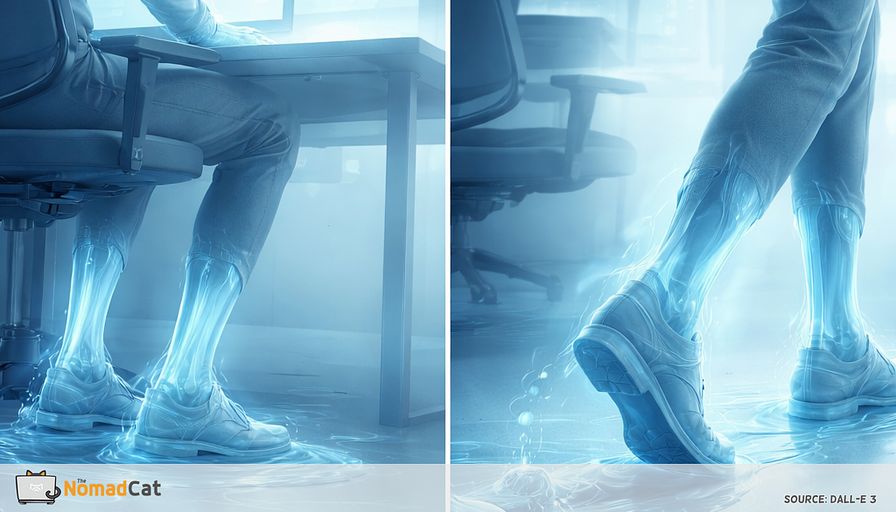
You sit down for “2 hours” to finish 1 thing. Then the calendar eats the rest of the day. Meetings stack. Camera on. You stay weirdly still because moving looks like you are not listening. Lunch happens at the desk. Water and bathroom breaks become optional. And work somehow leaks into the evening.
Then you stand up.
Your legs feel heavy. Ankles feel stiff in that delayed way, like the system was paused and is now trying to boot. The first 5–10 steps are a bit awkward and you catch yourself thinking ok… why am i walking like that.
This article is here to name that pattern and make it less mysterious. I’ve done this for years: Beijing offices, then Berlin remote days on bad chairs, and now in Lisbon I can still lose half a day without drinking or standing. It’s not a superpower. A lot of the time, it is not “aging overnight” or suddenly having bad flexibility. It is a predictable effect of long, uninterrupted sitting blocks, even for people who do exercise. Think of it as a desk-day exposure, not a character flaw.
What you will get in the next sections is practical and low-drama
- The early signals people tend to ignore, before it turns into real pain
- Why it gets misnamed as tight hamstrings or “just stress,” when the bottleneck is often lower in the ankle and calf
- The simple plumbing piece most desk days pause, the calf pump, and why that matters for heaviness and that tight-shoe feeling
- Micro movements that fit inside meetings and deep work without turning your day into a stretching performance
- A few boring checks to see if it is helping, plus clear red flags for when it is not a DIY situation
The goal is not to be perfect or to build a new lifestyle. It is to change the defaults a little, so the “2-hour statue block” stops billing you at 6pm.
Desk foot shutdown is a real pattern
When 2 hours turns you into a statue
This is not necessarily your body “aging overnight” or your flexibility disappearing. It’s often a normal desk-day effect from long, uninterrupted sitting. Research treats prolonged sitting as its own exposure pattern, not just “someone who didn’t exercise today” (Tremblay et al., 2017). You can lift or run and still get these little shutdown moments if the day is built on long blocks of stillness.
A useful label for it is the 2-hour statue block.
The not-quite-pain signals people ignore
These sensations usually show up before anything that deserves the word pain.
- Calves feel heavy when you stand, like they need a reboot
- Feet feel a bit cold-ish or “not fully online”
- Shoes feel tighter at night for no clear reason
- Sock marks look more serious than the sock deserved
- The first 5–10 steps feel sticky or awkward
- A brief toe-out walk because bending the ankle forward feels expensive
- A vague stiffness that fades after a minute
This is what you’d expect after prolonged sitting. Lower-leg volume can creep up over time with long sitting blocks (Belczak et al., 2014). And that “first movement cost” after being still is a known mechanics thing. Stiffness is higher right when you start moving, then it drops fast (Proske & Morgan, 1999).
The quiet habit stack that makes it happen
It fools people because the bill arrives later, in a different context.
Feet tucked under the chair. Chair a bit high so toes point down. Ankles parked toes-down for long stretches. Laptop pulled forward so the whole chain locks down. Calls where you try not to move at all, because moving looks like “not listening.” 1 more message. 1 more tab. 1 more hour.
None of this is a character flaw. It’s defaults.
Workplace guidance is boring but accurate. Break up sitting and vary posture, because the body doesn’t like 1 position held forever (Buckley et al., 2015/2016). Variation isn’t fancy. It’s just less time stuck in 1 ankle angle.
Why it gets misnamed as tightness somewhere else
You feel it later on stairs, or when you stand after dinner, so the brain grabs the nearest label it knows.
“Tight hamstrings.” “Bad flexibility.” Sometimes that’s true. But often the bottleneck is lower. Ankle and calf tissues that did nothing for hours. If the weirdness disappears after 60–90 seconds of walking, it’s usually a startup-cost problem. If it ramps up as you walk, that’s when I stop guessing and get it checked.
Prolonged muscular inactivity isn’t just the absence of exercise. It’s its own state with ripple effects (Hamilton et al., 2007). On the mechanics side, short-range stiffness helps explain why the first movements after stillness feel oddly resistant, then quickly improve once you’re moving (Campbell & Lakie, 1998).
It’s like getting a misleading error message. You keep patching the hamstring because it complains loudly, while the ankle system went idle at 11:00 and stayed idle until 13:00.
Early log files before it gets loud
Small signals that show up while you still feel fine
The goal is not to become hyper-aware or to turn your workday into a tracking experiment. It is just to catch 1 signal that reliably predicts the evening version, so the fix can be earlier and smaller.
This also matches the public-health message in plain language. Sit less, move more, and replace sedentary time with any movement you can actually fit in (Physical Activity Guidelines for Americans, 2018; WHO, 2020).
Six desk-time tells that predict the evening version
- Your feet haven’t changed position for 30–60 minutes
- Toes start gripping inside the shoe, without noticing
- Sliding the knee forward feels blocked, ankle wants to cheat
- Sock marks look deeper than usual by late afternoon
- Shoes feel slightly tighter, especially after long seated blocks
- First stairs feel weird, so you avoid ankle bend and toe-out
These are not pain scores and they don’t need a diagnosis label. They are inputs.
If someone likes numbers, a simple 0–10 scale is enough to notice “better vs same vs worse” over a week without turning it into a whole project (Farrar et al., 2001).
The first movement penalty is normal mechanics
A hinge that is perfectly fine but unused can feel sticky on the first open, then smooth again. Your ankle is similar.
After a long stretch parked at 1 angle, the first bit of movement costs more, then it eases quickly. That lines up with known muscle mechanics after stillness (Proske & Morgan, 1999). And because the ankle-foot complex plays a big role in getting you forward during walking, temporary reluctance there shows up immediately as cautious steps or small compensations (Leardini et al., 2007).
Not broken. Just idle too long, then asked to work instantly.
The calf pump you keep leaving on pause
Your calves are basic plumbing for sitting days
Your calves aren’t just “leg muscles.” When they contract and the ankle moves, they help push fluid and blood up from the feet, instead of letting it pool (Nicolaides, 2000). When you sit still for long blocks, that squeezing goes quiet. So the “tight shoe” feeling is often fluid + stillness, not you “getting stiff forever.”
This is why the sensations are predictable.
- Heaviness when you stand
- Sock marks that look dramatic
- A vague pressure
- That full-shoe feeling by evening
Studies measure this kind of buildup too: lower-leg volume can increase with prolonged sitting (Belczak et al., 2014). The practical point is simple: if you add tiny pulses during the day, the end-of-day “my shoes shrank” feeling is less likely to show up.
This also explains why evening stretching can feel great but still miss the main lever. Relief is real, but it doesn’t pay back 8–10 hours with minimal ankle movement. Breaks during the day matter because they interrupt the accumulation, not because they are magical (Dunstan et al., 2012).
Micro movements that survive meetings
Ankle variability per hour beats a perfect plan
The fix is small on purpose. Seconds, not sessions. Otherwise, honestly, it won’t happen on call days.
The goal is ankle variability per hour, not a routine, not a workout, not something that needs a calendar invite. You’re mainly trying to stop the monotony of 1 parked ankle angle, because monotony is what produces the shutdown.
If you do only 1 thing, change the ankle’s parked angle. It’s the cheapest win.
-
Heels heavy, toes light. Lift toes 2–3 times
-
Toes heavy, heels light. Lift heels 2–3 times
- 1 slow exhale. Let the ribs drop, unclench the legs
When you can’t visibly move, a micro pump still works and looks like thinking.
- Do a 2-second un-tuck. Slide 1 foot a bit forward so the ankle isn’t pinned toes-down for the whole call
- Next time, switch sides so you don’t create a new asymmetry
Seated ankle and calf movements can increase blood flow compared with quiet sitting (Hitos et al., 2007). Not a calorie story. More like the system needs small pulses, often.
Common mistakes that make it fail
- Making it too big, turning it into an obvious exercise moment
- Holding the breath and bracing, which breaks the easy background-process idea
Event triggers beat reminders on call days
Time-based reminders fail on meeting-heavy schedules. They either interrupt you mid-sentence or you swipe them away and feel mildly annoyed at your own phone.
Event triggers fit better. They are tiny commit points in a day that has no empty space.
- After Send → 3 brake-press calf pumps
- Join a call → toe lifts 2–3 reps
- Leave a call → heel lifts 2–3 reps
- Switch docs → 2-second un-tuck, alternate foot
- Waiting for export → ankle circles, 1 each direction
- Whenever you unmute → 1 slow exhale, drop bracing
Microbreak research in office settings suggests small breaks can reduce discomfort and fatigue without obvious performance harm in typical computer tasks (Galinsky et al., 2000). You don’t need to copy a lab protocol. Steal the principle and run it in the messy version of a workday.
If someone notices, it looks like you are adjusting your feet. A solution that fits social reality is worth more than a perfect plan that only works on a calm day.
Checks and red flags
Boring metrics that matter
If you want a number, keep it blunt.
Signs the micro-moves are doing their boring job
- The first 20 steps feel normal sooner after standing
- Stairs feel less like calf boards for the first flight
- Less end-of-day foot tightness in the same shoes
- Sock marks look less deep, less “why is this so intense”
- Less craving for aggressive evening stretching just to feel ok
Pick 1 signal only. A simple 0–10 rating is enough to track direction (Farrar et al., 2001).
A low-effort check that works on busy weeks is a tiny note like “leg heaviness at 18:00” on 0–10, for 5 workdays. You’re not building a spreadsheet. You’re checking if the line drifts down when you break sitting more often.
Guardrails and red flags
Some symptoms should not be debugged with ankle pumps, new shoes, or more stretching.
Red flag box
- Sudden one-sided swelling, especially with warmth, redness, or new severe calf pain (CDC DVT signs)
- Shortness of breath or chest pain, especially sudden or unexplained (CDC PE emergency signs)
- Coughing blood or fainting with the above symptoms (CDC PE signs)
- Progressive numbness or weakness in a leg or foot
These need urgent medical evaluation (NICE NG158, 2020; CDC VTE signs and symptoms).
Less urgent issues still deserve a check if they persist and trend worse. If symptoms are worsening week to week, or walking is getting more limited, it’s a good moment to get assessed.
For everyone else, keep the story boring. This is often a variability problem, not a broken-body story. The ankle-foot system goes a bit offline during long stillness, and the first steps feel like the boot sequence. It’s less about how long you sit, more about how long you sit without any ankle change at all. Treat it like maintenance, not rehab.
A 10-hour desk day can quietly turn you into a 2-hour statue block, even if you did a workout and ate “fine.” Meetings stack, lunch happens at the desk, and then the bill shows up at 6pm with heavy calves, stiff ankles, tight shoes, and those dramatic sock marks.
The useful reframe is simple. This is often a desk-day exposure, not a flexibility failure. When the ankle stays parked and the calf pump stays on pause, the first steps feel like the system booting.
The fix does not need a new lifestyle. Tiny pulses, often, beat 1 heroic stretch at night. A few toe lifts, heel lifts, and an un-tuck during calls can change the defaults. Track 1 boring signal, and keep the red flags non-negotiable.
For me, it’s usually the sock marks first, and I only notice once I’m already paying the 6pm bill.
You might be interested by these articles:


Remote work made your day flat and your joints noticed

Your feet are shrinking under the desk and your 18:00 steps notice

Your hips are booting up after sitting fix the first 60 seconds

Your 18:00 stiffness is a config bug fix it with micro-variability

Your feet went offline on camera days

How to spot quiet signs it’s time to leave your tech job

Why saying less online makes you stand out.