
Abstract:
The article explains that the familiar “weird first 10–30 steps” after sitting 60–120 minutes—front-of-hip pinching, a low-back “hey buddy,” and short, cautious walking that oddly fades within 2–5 minutes—is usually not a mysterious injury but a predictable transition cost: desk work keeps you in sustained hip flexion (often ~80–100°) with little movement variety, then you abruptly demand hip extension and coordinated gait, a mismatch made worse by remote work eliminating incidental walking. It describes how the stand-to-walk handoff exposes this immediately, why the pattern often normalizes quickly, and how the low back may “cover” for a sluggish hip by donating extension (which can make common lunge stretches misleading if they turn into rib flare and backbending). Instead of guilt-driven posture fixes or heroic stretching, it argues for frequent, tiny interruptions—often more effective than fewer long breaks—and offers a simple “missing hip extension” checklist (tight front hip crease when standing, short early steps, difficulty letting the leg go behind, quad-heavy stairs, glutes “absent” at first) plus three near-the-chair micro-movements: a subtle split-stance stand to bias hip extension, a gentle one-side-at-a-time “back pocket” glute squeeze for a few breaths, and deliberately longer “walk out” steps during the first moments after standing. To make this survivable in real workdays where timers get ignored and standing mid-meeting feels socially awkward, it recommends anchoring a 10–30 second movement to existing work events (after sending a message, a meeting ending, a build/export finishing, closing a ticket) for a week, tracking progress by how quickly walking feels normal again, while noting red-flag symptoms that warrant medical evaluation.
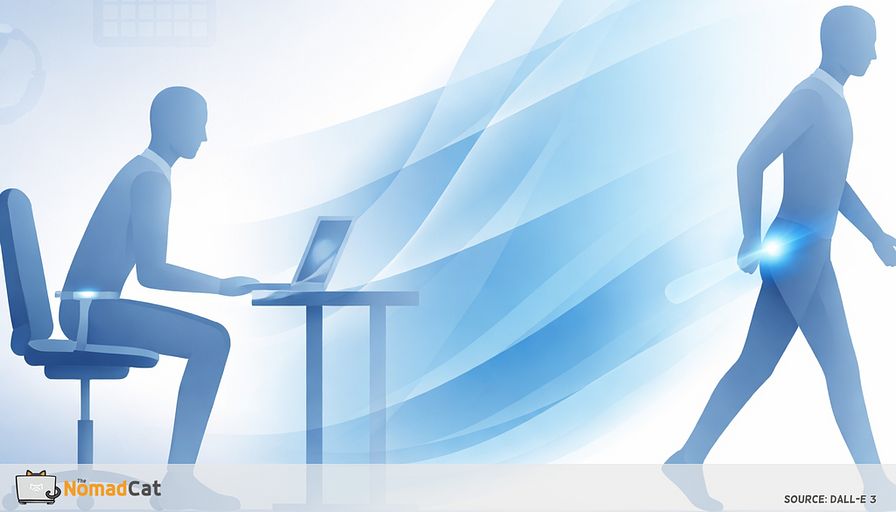
You sit for 60–120 minutes, stand up, and your body acts like it’s installing updates. Front-of-hip pinch. Low-back “hey buddy.” The first steps are short and cautious, like walking suddenly costs extra. Then, just to mess with you, it fades within a couple minutes and you’re mostly fine again. I’ve had this across too many desks to count—Beijing years, Berlin years, and now Lisbon—especially during those stretches of working past midnight on whatever chair is available.
That pattern is common. It’s also oddly specific. The question isn’t “why does my back hurt at 7pm.” It’s why the complaint shows up in the first 10–30 steps right after sitting, not an hour later.
This article treats that moment as a transition cost. You spent 90 minutes in hip flexion with low movement variety, then demanded hip extension and decent timing immediately. The mismatch is baked into desk work, especially now that remote work removed a lot of accidental walking.
Here’s what you’ll get, without heroic stretch plans and guilt:
- why the stand-to-walk handoff is where things feel worst, and why it often improves in 2–5 minutes
- what desk geometry does to hip angles over time, and how the low back sometimes “covers” when the hip is slow to wake up
- a quick checklist for the “missing hip extension” pattern, so it feels less mysterious
- 3 tiny movement inputs that fit near your chair, plus a simple way to attach them to real work events instead of timers you ignore
If your schedule is packed, your lunch is at the desk, and standing up mid-meeting feels socially illegal, that’s fine. The goal here is not perfect posture. It’s making the first steps less weird, more often, with changes small enough to survive a normal workday.
The weird first steps after sitting
A normal reboot that feels suspicious
After 60–120 minutes glued to a chair, you stand up and your body runs a small update. Front-of-hip pinch, low-back “hey buddy,” tiny cautious steps to the kitchen, and somehow even standing tall feels weirdly expensive. Then, annoyingly, it often fades in the first minute and trends back toward normal within roughly 2–5 minutes. Very common. It’s a bit annoying, but also useful.
If that scene feels familiar, the interesting question is why it shows up during the first steps, not an hour later.
It helps to treat it like a transition cost, not a sudden new problem. You just practiced hip flexion and low movement variety for 90 minutes, then asked for hip extension and stride in 10 seconds. Like a laptop switching modes and taking a second to stop lagging. Desk sitting tends to hold the hips around ~80–100° flexion, and posture drifts over time, so the mismatch is kind of built-in.
Once it’s a mismatch, the fix gets boring in a good way. Reduce the mismatch with tiny, frequent reminders that hip extension still exists. Not perfect posture. Not a heroic stretching session. And no guilt, because meetings, deep work, and “standing up on Zoom looks weird” are real constraints.
Why the first steps complain first
The stand to walk handoff
Standing up and starting to walk is a fast handoff between 2 jobs that don’t wait for each other. You rise, shift weight, then ask for hip extension and timing on the very next step. If you are still in “flexion mode,” you feel it right away.
A second clue is how fast it changes. In many lab setups, the biggest post-sitting gait weirdness shows up in the first steps or first minute, then trends back toward baseline within about 2–5 minutes in healthy adults. That quick normalization is boring, but useful. It often points to a temporary state, not some permanent downgrade.
If your day is built from long sitting blocks, you keep re-triggering the same loop. It is not really “1 problem at 7pm.” It is the same small tax, paid 6–10 times between calls. Studies on breaking up sitting generally show less discomfort when sitting is interrupted more often (e.g., Shariat et al., 2018; Benatti & Ried-Larsen, 2015).
The desk shape your hips memorize
Hip flexion is not a character flaw
Desk sitting is mostly geometry, not a virtue test. Typical setups put the hips around 80–100° of flexion, and over time posture tends to drift (often more slumped) as attention stays on the screen, not the pelvis (Dunleavy et al., 2016).
Remote work also removed a lot of accidental variation. Even a “good” chair can become a slow grind if the joint angles and muscle demands stay unchanged for long, uninterrupted bouts.
For many people, it is not that their body suddenly got worse. It is that commuting walks, meeting-room laps, and quick lunch errands vanished, replaced by 3-hour video blocks where standing up breaks the flow (Waersted et al., 2010).
Tight front quiet back
After a long sit, the “quiet back” pattern can feel like this. The step behind you is missing. Stride stays short, push-off is delayed, and the first steps are the weirdest ones.
There is some direct evidence for that narrow moment. Florez et al. (2016) reported reduced gluteus maximus activity during walking after prolonged sitting. In normal terms: after sitting, the muscle that helps push your leg behind you may be late to join the first steps.
The practical framing is simpler than muscle blame. That lab finding is specific to “walk right after sitting.” Bigger stories like “hip flexor dominance” are harder to prove, partly because some deep hip flexors are simply hard to measure cleanly in real-life movement. Useful theory, not a verdict.
When the low back covers for the hip
Here is a simple model. You stand up, try to “stand tall,” and instead you get rib flare and a little low-back squeeze, while the hip still refuses to send the leg behind you.
You need extension somewhere to be upright and to walk. If the hip does not offer it smoothly right away, the lumbar spine donates motion as a workaround. It does the job, but repeated borrowing can feel pinchy or “compressed” over a desk-heavy day.
That is why some hip flexor stretches feel productive but don’t really change the pattern. A lunge-type stretch can include a lot of pelvis and low-back contribution—basically borrowing the motion from the back (Harms-Ringdahl et al., 1992). A strong front-of-hip stretch sensation is not proof you trained the hip.
A quick desk checklist
Signals of “missing hip extension”
If the pattern is there, it usually looks boring and repeatable.
- front-of-hip crease tight standing
- first 10–30 steps short
- hard to let leg behind
- stairs feel quad-heavy early
- glutes absent until later
If a stretch feels better for 2 minutes, then you sit again and it returns, the lever is often break frequency, not stretch intensity (Benatti & Ried-Larsen, 2015). Also expect variability. Sleep and meeting density change how still the day is, and office work already loads the low back as a common complaint zone (Waersted et al., 2010).
The small win condition
Success is when hip extension stays “available” through the day, so the first steps after sitting feel normal faster.
The most reliable lever is not intensity, it’s interruption. Brief movement breaks tend to reduce discomfort, and shorter/more frequent tends to beat longer/rarer (Shariat et al., 2018; Benatti & Ried-Larsen, 2015). If you want a concrete starting point that shows up in a lot of protocols: about 1–2 minutes of easy walking every 20–30 minutes is a common dose (Dunstan et al., 2012). The exact move matters less than breaking the long sitting bout.
3 micro inputs that fit near your chair
Split stance stand
After hitting send, at the end of a call, before going for water, just stand and put 1 foot slightly forward and 1 slightly back. It looks like nothing. Clinically, that small split stance is a common way to bias hip extension without doing a dramatic stretch.
Shift a bit of weight until the back hip feels like it lengthens, while ribs stay quiet and the low back does not crank. Hold ~10 seconds, switch sides. Keep it conservative if extension is a sensitive direction for you. If you only feel the low back, make the stance smaller and reduce how much you dump the pelvis forward.
Back pocket squeeze
If the “quiet back” problem is glutes that show up late, a tiny reminder is sometimes enough. Standing tall or seated tall, lightly squeeze 1 glute like you are tightening a back pocket, 1 side at a time, for 3 breaths. Alternate sides.
This is not proof of anything, but it fits that narrow “right after sitting” lab finding (Florez et al., 2016) and the broader idea that small, frequent inputs tend to work better than rare heroic ones.
Common mistake: turning it into full-body bracing. If you catch yourself breath-holding or clenching the low back, effort is too high. Keep it comfort-oriented, not intense.
Walk out steps
When you leave the desk anyway, use the first 10 steps as your highest-leverage window. Let the step go a bit longer behind you, breathe easy, ribs quiet, and think “unfold the hip,” not “march.” That focus matches the fact that post-sitting weirdness is loudest in the early steps and often fades within minutes.
If you liked the simple dose mentioned earlier, this is the same idea in disguise: a short, easy walk break, done more often, with special attention to those first steps.
Stretching traps and safer checks
When a hip stretch becomes a backbend
If your daily pattern already uses the back as a helper, this matters. The classic lunge stretch error is big arch, ribs flared, pelvis dumped forward. It burns in the front, but a lot of that “range” can be lumbar extension and pelvic tilt (Harms-Ringdahl et al., 1992).
So keep the dial low and pick reminders that keep the spine quiet. Otherwise you end up practicing the same workaround you’re trying to reduce, right before those first steps that already complain loudest.
When to get checked
Get medical advice if there is progressive weakness, persistent numbness or tingling, bowel or bladder changes, saddle numbness, fever or feeling ill, major trauma, unrelenting severe pain, or cancer history with new unexplained pain (NICE NG59; Chou et al., 2007; ACR Appropriateness Criteria). Serious causes are rare, so single red flags often have low predictive value, but clusters and context matter, and cancer history is one of the higher-signal items (Henschke et al., 2007).
Make it frictionless at work
Attach it to work events
Timers can work, but they often lose to meetings and “not now.” Event anchors are quieter. Pick 1 moment, promise 10–30 seconds, then back to work.
- after sending a message
- after a meeting ends
- after a build compile export finishes
- after finishing a paragraph slide
- after closing a ticket
That “after X, do Y” structure is basically implementation intentions (Gollwitzer & Sheeran, 2006), and habits form easier in stable contexts (Lally et al., 2010). Time-based reminder software can increase breaks (van den Heuvel et al., 2003), but it also collides with norms and attention costs.
If you want the lowest-effort version, it’s usually one micro-input tied to one event for a week, just to see if the reboot shrinks. More knobs tends to mean less follow-through.
What progress looks like
Look for boring changes first.
- first 10–30 steps feel normal sooner
- standing tall feels less like negotiation
- stairs feel less instantly quad-heavy, like the hip helps earlier
- discomfort becomes mild end-of-day fatigue, not 1 loud spot
If you like a tiny bit of measurement, keep it low drama. Notice your rough “time-to-normal-walk” after standing. You can occasionally time sit-to-stand plus first 10 steps, but don’t turn it into a project. The reboots get smaller mainly because the long sitting bouts get interrupted more often.
Those weird first 10–30 steps after a long sit are rarely a mystery injury. They’re usually a transition cost: you spent 60–120 minutes in hip flexion, then asked for clean hip extension immediately, and the low back sometimes helps out a bit too eagerly. Once you see it as a handoff problem, the solution stops being a personality test—and starts being a small scheduling tweak that makes the first steps feel less expensive.
You might be interested by these articles:


Glutes offline after meetings the 30 second fix for first steps after sitting

The 15 second unclench that fixes your first steps after desk days

Your feet are shrinking under the desk and your 18:00 steps notice

Why desk pain hits right after you stop working

The 30 second range refeed that stops the 18:10 bug report after desk days

Transforming Manufacturing with Mixed Reality

Advancing Careers with Micro-Credentials




