Abstract:
The article explains why the familiar 18:00 “hamstring” stretch after a 10-hour desk day—often prompted by standing up from back-to-back calls, a barely noticed desk lunch, and a late coffee—can feel like it works for a moment yet fail to change anything long-term: the sharp behind-the-knee bite during a forward bend is a real signal, but it’s frequently the wrong structure getting blamed. Using a “debugging” mindset rather than posture perfectionism, it argues that long sitting quietly removes two key movement options—hip extension and ankle dorsiflexion—so when you suddenly demand them at day’s end, the hamstrings act like an emergency brake and may even mimic “tightness” due to increased guarding or nerve-like mechanosensitivity, where pushing harder can worsen symptoms (especially if sensations are sharp, tingling, or traveling). The author—who has spent years working late at desks in Beijing, Berlin, and Lisbon, and whose fitness-trainer wife’s posture reminders last about three minutes—proposes a small, realistic fix: a non-dramatic 20–40 second “unfreeze” done at existing work boundaries (like hitting Send or a meeting ending), consisting of a split-stance hip-extension weight shift and heel-down ankle rocks, optionally preceded by slow exhales if everything feels braced. Progress is tracked with “boring” checks (how quickly walking feels normal after standing, whether the second flight of stairs feels better than the first, and an optional weekly knee-to-wall test), while clearly flagging nerve-y stop signs and serious red flags that warrant medical evaluation; the core takeaway is that nightly stretching often changes perception briefly, but changing the daily inputs that create the pattern is what quiets the recurring alarm.
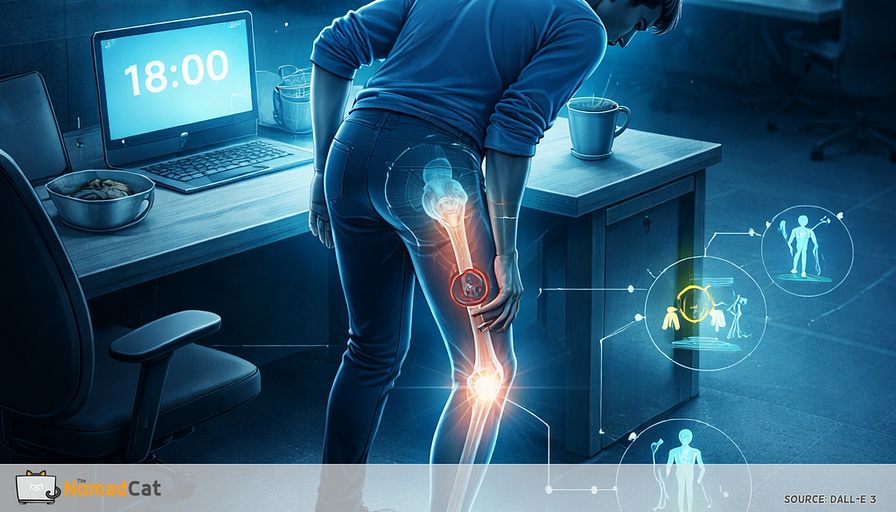
If your workday regularly eats 10 hours, the “hamstring problem” usually shows up at a very predictable time. Around 18:00. You stand up after back-to-back calls, a desk lunch you barely registered, maybe a late coffee. You fold forward because it feels like the obvious fix. Then there’s that sharp, specific bite right behind the knee.
It feels convincing because it’s real. But it’s often the wrong thing getting blamed.
This article is about why that end-of-day hamstring stretch keeps working for 30 seconds and failing for 30 days. It treats the alarm, not the wiring that keeps tripping it. I’m not aiming for perfect posture or a new personality built around mobility. The goal is a simple debugging mindset for desk-day stiffness, with inputs small enough to survive a messy calendar.
Here’s what you’ll get into:
- Why the loudest signal during a forward bend is not always the root cause
- How long sitting quietly removes 2 key movement options, hip extension and ankle dorsiflexion, then punishes you for asking them back at night
- Why “feeling looser” after stretching can be a perception change, not an instant mechanical fix
- How to spot when the behind-knee pull looks more nerve-y than muscle-y, and why pushing harder can make it worse
- A short, non-dramatic 20 to 40 second movement script that fits between real work boundaries like hitting Send or a meeting ending
- A few boring checks that tell you if it’s working without turning your life into a tracking project
No hype. No guilt. Just a clearer explanation for why your body keeps throwing the same error at the same time every day, and a practical way to change the inputs that cause it.
The hamstring stretch trap
The 6 pm stretch you never planned
You hold it. The first steps feel a bit less sticky. For about 30 seconds everything seems fine. Then tomorrow arrives and the same scene replays, like a calendar event you never accepted.
This is why it feels convincing. The sensation is real. The diagnosis is often wrong.
If the same stretch “fixes it” briefly but it comes back every day, it often means you are treating a symptom loop, not the input that keeps creating it.
Why the loudest signal gets blamed
The brain does a simple shortcut. The hamstrings complain during a forward bend, so the hamstrings get blamed.
It is like looking at the last error in a log and blaming that line, instead of the earlier thing that caused it.
Also, feeling looser after stretching is often about changes in tolerance and perception, not instant structural change. So the real question is what keeps triggering that behind-knee signal in the first place.
The desk-day habits that quietly feed the loop
It is easy to spend 10 hours avoiding the exact ranges you demand at night.
- Feet tucked under the chair or hooked on the chair base, so the ankle barely goes into dorsiflexion.
- Slumped sitting for long blocks, then “fixing posture” for 20 seconds. Real sitting is variability, not 1 perfect shape.
- Mini-walks that are technically walking, but never include a full stride with real hip extension.
- Long low-movement blocks where posture variability shrinks.
The trap is not sitting itself. It is losing range exposure all day, then demanding it suddenly at night.
A quick personal note before the mechanics
I’ve spent most of adult life at a desk: first in Beijing, then Berlin, now Lisbon, often past midnight. Not in pain, but very familiar with the low-noise signal when tightness builds until it forces movement. My wife is a fitness trainer and nutritionist and reminds me about posture, which usually sticks for about 3 minutes.
Small signals are useful. Not drama, diagnostics.
Why it feels like hamstrings
Hamstrings as the emergency brake
After 8 to 10 hours in hip flexion on a chair, plus ankles that barely bend, you still have to stand, walk, do stairs. Normal walking needs hip extension and ankle dorsiflexion. In late stance, hip extension is often around 10°.
When those options are basically offline for the day, the body chooses safer strategies. It stiffens. It reduces range. It finds the least risky way to get you from the kitchen to the sofa without starting a new problem.
Hamstrings sit in the middle of this. They help control hip motion and knee stability, so they become a convenient place to add braking when hip extension feels blocked and dorsiflexion is missing. That extra work can feel exactly like tightness even when “shortness” is not the main issue.
It is often less about a rope that needs length and more about a brake doing extra work.
Why it bites behind the knee
Sometimes the bite is not the hamstring belly at all. It can be sensitivity in tissues passing through the back of the knee, including neural tissue that gets cranky after long flexed sitting. Butler and Shacklock describe this as mechanosensitivity — basically nerves that get irritated by stretch after hours of sitting. More like a cable that reacts to tension than a short rope that needs to be pulled longer.
That matters because pushing harder into a sharp endpoint can make the system more protective, not more flexible.
So a useful first lever is often upstream. Restore the missing inputs:
In doses the system accepts.
What quietly disappears during a desk day
Hips that forget extension
When hip extension is missing, the body still finds a way to stand tall. A common workaround is borrowing from the low back. The pelvis tips forward, the low back arches, the chest lifts, front ribs pop forward. It is basically a small backbend to buy range.
Everyday sitting is not a cast, and evidence that desk sitting reliably shortens tissues in a structural way is mixed. But short-term stiffness, higher resistance, and lower tolerance to end range after sustained positions is a very desk-real pattern.
Practical signs it is happening
- Glutes feel late or absent on the first 10 steps or first stairs. Back of the thighs tries to stabilize everything.
- Standing upright turns into chest lifting first, instead of hips moving under you.
- Stride stays in front of you, shorter behind you.
Ankles that stop bending
During desk time feet are often parked. Then you stand up and immediately ask for ankle bend on the first walk and the first stairs.
In gait, peak dorsiflexion late stance is roughly around 10°. Stairs and squat-type patterns usually ask for more. Practical translation: if the knee-to-wall version feels cramped, start with the heel-down rocks only and keep them gentle tonight, rather than forcing a long, hard hamstring stretch.
One simple measurement for the data-inclined is the weight-bearing lunge test, knee-to-wall. My reflex is always to measure something small once a week instead of guessing daily. It is reliable. Weekly is plenty.
Why hamstring stretching rarely sticks
Relief fades when the inputs stay the same
A hamstring stretch at 18:00 can change how things feel right now. It does not change the 10-hour setup.
It is like clearing an error message without changing the code path that triggers it.
Short-term flexibility gains often reflect improved tolerance more than instant tissue change. Stretching can help over time. It just struggles to win against a full day of limited hip extension, limited dorsiflexion, and long sitting.
When pushing harder makes things worse
After long sitting, the nervous system can be guarded. A hard end-range stretch can get interpreted as threat, especially when the sensation is sharp or nerve-y. Neurodynamic approaches, in plain terms, care about how easily something flares up and how small a dose it tolerates — not forcing through a sharp endpoint.
Think rate limits. More force is often just more signal.
Sensation checklist
Usually ok to continue gently
- Warm, broad stretch in the muscle belly
- Mild discomfort that eases quickly when you come out
Modify or stop and switch strategy
- Sharp pull right behind the knee
- Tingling, burning, numbness, electric sensations
- Symptoms that travel down the leg, especially below the knee
- Symptoms that linger after release
- Next-day flare or suddenly worse tolerance to sitting
The 20 to 40 second unfreeze
Use boundaries not alarms
Timers that scream every 45 minutes are easy to ignore. Boundaries work better because they already exist in your workflow.
Useful triggers
- hitting Send
- a meeting ending
- a build finishing
- getting coffee
- waiting for a file export
Very short supplementary breaks can improve discomfort and can even support performance.
Aim for 20 seconds that fits between “Send” and the next meeting. That’s it. You’re restoring options so walking and stairs stop asking for compensations.
Make the rule small enough to survive a bad day.
- 1 boundary per hour is a win.
- If the day explodes and you do 3 total inputs, still useful.
The movement script
1) Split-stance weight shift for hip extension
Stand with 1 foot back. Keep most weight on the front leg. Shift pelvis forward until the front of the back hip wakes up, then come back out.
Cues
- tall, not arched
- ribs quiet
Common mistakes
- turning it into a backbend with ribs flaring
- twisting the pelvis open to fake range
2) Heel-down ankle rocks for dorsiflexion
Knee gently forward over toes. Heel stays down. Stop before it wants to lift. Do both sides.
Easy setups
- hands on desk
- holding chair back
This is the same pattern as the knee-to-wall format. It is not weird if it feels different within 30 seconds.
Optional if everything feels braced
- 2 slow exhales before the reps
Nothing mystical. Just a downshift.
Success is not a deeper forward fold. Success is that the first steps and first stairs feel less sticky. And when you stand up after a late meeting, you don’t immediately feel the need to fold in half by the desk.
Boring checks that prove it worked
Device-free checks
- How many steps until walking feels normal after standing up.
- Does the 2nd flight of stairs feel smoother than the 1st.
Optional metric
- Knee-to-wall test 1 time per week.
Reported minimal detectable change ballparks are roughly 0.6 to 1.5 cm or 3 to 5° depending on method. Day-to-day noise is real.
Another surprisingly good metric
- less urge to stretch the hamstrings at 18:00
Boundaries and stop signs
Do not push through nerve-y signals
If you get sharp behind-knee pulling, tingling, burning, numbness, electric pain, symptoms traveling down the leg, or lingering flares, treat it like a different bug class than normal muscle stiffness. Back off and reassess.
If sensations look nerve-y, go smaller and calmer. Prioritize the hip and ankle unfreeze, then do a few minutes of easy walking and see if it settles. If it keeps escalating, stop debugging and get evaluated.
Red flags that override desk debugging
This article is about common patterns, not ruling out serious problems. If any of the below fits, skip the experiments and get checked.
- Urgent: trouble starting urination or loss of bladder/bowel control; numbness in the saddle area; your leg is getting weaker day by day
- Prompt check: history of cancer; unexplained weight loss; immunosuppression; urinary infection; intravenous drug use; prolonged corticosteroid use; significant trauma; or a minor fall/heavy lift if you might have osteoporosis or you’re older
Absent those, the boring approach often wins. Restore hip and ankle options early and frequently, and the hamstring alarm often quiets down without needing to fight a nightly stretch.
If your day regularly disappears into 10 hours of sitting, that 18:00 behind-knee bite is not a character flaw. It is a predictable error from predictable inputs. The big takeaway is simple: the loudest signal in a forward fold is often not the root cause. After a desk day, hip extension and ankle dorsiflexion tend to go missing, and the hamstrings end up acting like an emergency brake. Stretching can change how it feels for 30 seconds, but it rarely changes the setup that recreates the problem tomorrow.
The more useful move is smaller and earlier. A 20 to 40 second hip and ankle unfreeze at real work boundaries can give walking and stairs better options, without turning your calendar into a fitness project.
Sources (non-exhaustive)
Shariat et al., 2016; Galinsky et al., 2007; Henning et al., 1997; Weppler & Magnusson, 2009/2010; Freitas et al., 2018; Konrad & Tilp, 2014; Neumann; Arnold et al., 2005; Perry & Burnfield; Winter; Bennell et al., 1998; Hall et al., 2017; Butler; Shacklock; Basson et al., 2017; Chou et al., 2007; NICE NG59.
You might be interested by these articles:


Your hips are booting up after sitting fix the first 60 seconds

The 30 second range refeed that stops the 18:10 bug report after desk days

The 6pm ankle reboot after a 2 hour statue block

Why your first steps after sitting feel broken

Why your after work stretch keeps losing to your desk day inputs

How moving and remote work can quietly change your taxes and pension

Zero Trust Networking Paradigm