Abstract:
The article explains why desk-related stiffness and aches often “dump” all at once right after you finish a focused task—like closing the laptop after the last email and suddenly noticing rusty hips, a “tight belt” low back, a shortened neck, and a shoulder creeping toward your ear—arguing this timing isn’t random fragility but an “invoice” arriving at a transition because deep concentration down-ranks body signals while long stillness builds a backlog that becomes obvious during the high-demand sit-to-stand switch. Instead of preaching perfect posture or expensive ergonomics, it frames the real exposure as too much uninterrupted static time and recommends a low-drama early warning system (e.g., not shifting for 20+ minutes, dry eyes and low blink rate, breath-holding, jaw clenching, shoulder hiking, first steps that ease in 30–90 seconds). Its practical solution is to use natural workflow transitions rather than ignored timers: after hitting Send, ending a meeting, exporting a file, or closing a ticket, take a repeatable 45-second “transition script” to stand tall without a dramatic stretch, do one long exhale to drop jaw and shoulders, add a few small weight shifts or gentle knee bends (or step in place), and reach forward like a lazy yawn—emphasizing that tiny, repeatable movement beats perfection and reduces the later “invoice,” while also noting clear red-flag symptoms (progressive weakness, persistent numbness, bowel/bladder changes, fever, severe illness, unexplained weight loss, or major trauma) that warrant medical advice.
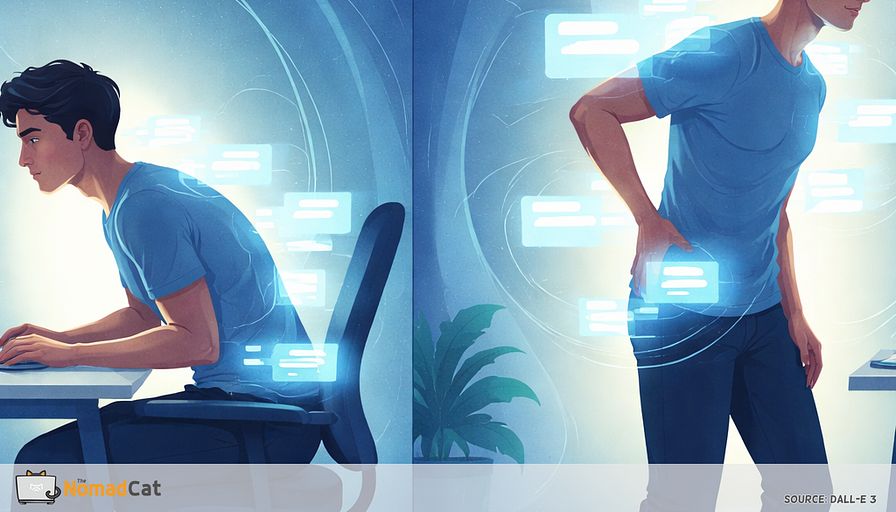
You finish the last email, close the laptop, stand up, and suddenly your body files 6 complaints at once. Hips feel rusty. Lower back tightens like a belt. Neck gets shorter. One shoulder tries to merge with your ear. The annoying part is the timing. You were “fine” 30 seconds ago, so now it feels random. Or worse, like you’re fragile.
This article is here to make that moment less discouraging and a lot more predictable. Not with a posture sermon, and not with a new chair you have to justify to finance. I’ve done Beijing offices, Berlin remote, and now Lisbon — same story, different chair. The point is simpler than that. When work is demanding, attention tends to down-rank body signals, then the invoice arrives at the first transition. And if long stillness builds a backlog, the fix is usually about changing what happens before you stop, not chasing 1 perfect sitting position all day.
What you’ll get in the next sections
- A clear explanation of why stiffness and aches often show up right after a task ends, not during it
- Why the stand-up moment can feel like a shock even when nothing is “wrong”
- The real exposure for desk discomfort, usually static time, not sitting “wrong”
- Early warning signs that stay low-drama and don’t require constant body-scanning
- A practical approach that fits inside a busy schedule, using transitions instead of timers
- A quick safety boundary for when it’s worth getting medical advice
If you’re remote, in back-to-back meetings, or deep in problem-solving where hours disappear, this is basically about building a tiny feedback loop that still works on chaotic days. Small adjustments count. Perfection is not required.
The end of task pain dump
When you stand up and everything loads at once
That timing is the clue: focus is a filter. Discomfort often waits its turn. Your body didn’t start sending signals only after you stood up. It just stopped interrupting while the task had priority.
Useful framing: it’s not random pain, it’s delayed notification — the invoice arriving at the transition.
Reduce the size of that later invoice by changing what happens before you stop, not by obsessing over 1 perfect posture.
Why this feels so discouraging
The guilt loop and the wrong diagnosis
The emotional pattern is familiar. “I was fine all day, so I must be fine.” Then 10 seconds later, “I stood up and I’m wrecked, so I’m fragile.” That jump is understandable, but it’s usually the wrong conclusion.
Learning a bit about how pain works can help reduce fear and spiraling thoughts. It doesn’t make discomfort disappear instantly, but it often makes it feel less alarming. This is often a system problem, not a character flaw.
A map, not a posture sermon
This is not an ergonomics checklist, and it is not a posture sermon where the solution is to sit “perfectly” forever. It’s more like a map of why signals get queued during focus and then dumped at transitions, and how small tweaks can shrink that dump.
Even official screen-work guidance is mostly about breaks and changes of activity, not chair-policing (UK HSE DSE guidance; EU Directive 90/270/EEC). That’s why the only “rule” I keep is simple: change something at task boundaries, not posture-perfection all day.
A quick safety boundary
Most desk stiffness and that “first stand feels awful” moment is benign.
But normalizing it should not hide red flags. Get medical advice for progressive weakness, numbness that does not settle, bowel or bladder changes, fever, severe unwellness, unexplained weight loss, or a major fall or crash (NICE NG59; NHS; Mayo Clinic).
Performance now, signals later
Focus is a real filter
You already know the effect, just not in pain-language. When a task is demanding, attention gets pulled outward and the brain pushes internal signals to the back. It changes what you notice, not necessarily what exists.
Deadlines, debugging, and high-stakes video calls can all make basic signals disappear for a while. People forget thirst, blink less, and only realize their shoulder has been climbing toward their ear when the call ends.
Stillness builds a backlog
Uninterrupted sitting changes things faster than most people expect. This isn’t meant to sound dramatic. It’s just a reminder that “just sitting” is still a physical input.
A few examples of what can show up
- Legs can start to feel heavy because the calf muscles aren’t doing much
- The first steps can feel stiff because you’re switching from a fixed position to moving again
- The low back can feel grabby for a minute even if nothing is actually wrong
Nothing broke. The system is switching from static loading to dynamic coordination.
Why the stand-up moment feels like a shock
Standing up is a high-demand transition
Sit-to-stand is not a gentle unfold. It’s a coordinated burst across ankles, knees, hips, and trunk. If something “grabs” on rep 1, that can just be the task exposing stiffness that sitting hid. And yes, it’s extra annoying because 30 seconds earlier you felt totally fine.
Be careful with the internet’s favorite explanation. Sometimes it’s not “your glutes are off.” Often it’s just that your body needs a moment to switch patterns. It reads like low readiness, not damage.
Variability beats perfection
Static time is the real exposure
The problem is rarely that someone sat “wrong.” It’s that the same position, even a pretty neutral one, got held for too long without interruption.
So instead of chasing perfection, build an early warning system. Treat task boundaries as prompts to shift something small, even if it’s just changing arm support or standing for 20 seconds.
Early warning signs that stay low drama
A quick desk check that catches the queue early
Sometimes pain is not the first signal, because attention can push internal sensations down the list while the task is loud. If you notice 2–3 of these, it’s not a verdict. It’s a prompt.
- You have not shifted in 20+ minutes
- Blink rate drops hard on screens
- Eyes feel dry when you look away
- You hold breath during edits
- Jaw is clenched without noticing
- Mouse-side shoulder creeps up
- First steps creaky, better in 30–90 seconds
Think of these as low-priority logs that say “you’ve been in static mode too long,” not “something is damaged.” For me, the quiet giveaway is upper-back tightness that builds so slowly I barely notice, until it forces me to adjust — très pratique, but a bit annoying.
Transitions beat timers
Why workflow cues stick on busy days
Timers get ignored in deep work, or they pop up mid-call and feel ridiculous. Transitions happen anyway, so they make better cues with less willpower.
“After I hit Send, then I stand up for 45 seconds” is basically an if-then plan. It tends to work better than “every 30 minutes.”
A 45-second transition script
Keep it small and repeatable.
Examples of triggers that fit real desk work
1. After sending an email
2. After ending a meeting
3. After exporting a file
4. After closing a ticket
Guardrails first. The goal is not “standing still.” Static standing has its own downsides. Tiny movement and angle changes are the win.
- Stand up and get tall, no dramatic stretch.
- Do 1 long exhale and let jaw and shoulders drop with it.
- Do 5 slow weight shifts left-right, or 5 tiny knee bends. Small range is fine.
- Reach both arms forward 1–2 times like a lazy yawn, then let them hang.
Safety swaps that keep it low-friction
- Use a stable chair, not a rolling one
- If dizzy on standing, hold the desk and go slower
- If knees hate knee bends, swap to stepping in place
- Exhale on effort, avoid breath-holding
- Any small movement counts. The “best” option is the one you’ll repeat
Reduce the backlog, don’t argue with the invoice. And keep the safety boundary in mind: red flags deserve medical advice.
You might be interested by these articles:


The 20 second desk handshake that stops pain from showing up after you log off

Your feet are shrinking under the desk and your 18:00 steps notice

The 30 second range refeed that stops the 18:10 bug report after desk days

Your posture is not broken your attention is running the brace

The 15 second unclench that fixes your first steps after desk days

Python for Enterprise Automation

Building digital trust through ethical leadership