Abstract:
The article argues that remote work didn’t reduce how much we talk, but it removed the natural movement, boundaries, and quick “social repair” that used to come with office life—so conversation gets “pinned to a chair,” making even normal video 1:1s feel performative and leaving people with lingering physical tension (tight jaw, raised shoulders, upper-back stiffness) and mental residue after clicking **Leave**. Drawing on research about video-call “nonverbal overload,” evaluation pressure, reduced idea generation, and the importance of recovery boundaries, it explains how offices quietly provided ambulatory communication (side-by-side talking while walking), incidental coordination from collisions and proximity, and built-in downshifts between events—while remote schedules compress interaction into formal, camera-on blocks that can silo relationships. Instead of adding a fragile new wellness routine, it recommends “container swaps” that keep the work the same but change the channel and posture: default to the cheapest medium that still achieves grounding (often audio-only), use walk-and-talks for exploratory or emotionally loaded discussions, use “stand-and-scan” to break up sitting when walking isn’t possible, and add 60-second “bookends” to stop calls from chaining into one long stress posture; it also offers simple permission scripts, accessibility and confidentiality cautions, and tiny at-home movement cues like a door-to-window loop or starting a call with “threshold pacing.” The author grounds the advice in personal experience of long desk-heavy years across Beijing, Berlin, and Lisbon, recognizing the early “error log” as quiet upper-back tightness—and insisting the goal is configuration changes, not becoming a new person.
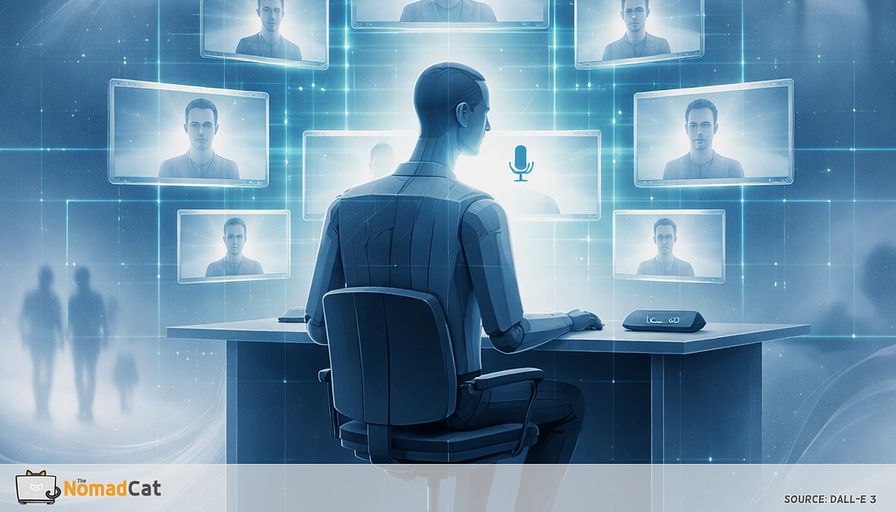
Remote work did something weird to conversation. It kept all the talking, but took away the part where your body gets to move while you do it. So the day ends up looking like this. Breakfast at the desk. Back-to-back invites. Lunch at the same desk with the mic on mute. Then you click Leave and somehow your shoulders are still in the meeting.
If you’ve felt that low-grade “why does a normal 1:1 feel like a performance” thing, you’re not being dramatic. Video calls add a quiet load. More self-monitoring, more face-forward staring, less natural shifting around. The office used to absorb some of that for free, mostly through motion.
This article is about that missing container, and how to get parts of it back without adding yet another habit you’ll do for 3 days and then forget.
Here’s what we’ll cover
- Why remote talk gets “pinned to a chair” and why it lands differently in the body and brain
- What office life provided automatically, like incidental movement, soft event boundaries, and quick social repair
- Which conversations suffer most when everything becomes scheduled and camera-on
- When video is actually the right tool, and when it’s just expensive default
- Simple swaps that change the container without creating extra meetings
- audio-first
- walk-and-talk when it fits
- stand-and-scan when it doesn’t
- 60-second bookends so calls don’t chain into 1 long stress posture
- audio-first
The goal isn’t to become a new person with a perfect routine. It’s to notice the cause and effect, then make small configuration changes so your body stops throwing errors you’ll ignore until 18:30.
The still seat problem
How talk got pinned to a chair
Remote days have a predictable pressure: the body barely moves, but the social load stays “on” all day. By 11:00, you’ve stared at your own face longer than any human should. Even a friendly 1:1 can feel like being observed more than simply talking, with that little self-view box sitting there like a mirror you didn’t ask for.
Video adds more staring, more self-checking, and fewer chances to move (Bailenson, 2021). Fauville and colleagues even built a validated way to measure this kind of fatigue across things like general tiredness, social strain, and motivation drop. The Tuesday version is simple: you end a normal call and feel weirdly spent, even though nothing “happened.” So no, it’s not just people being dramatic. It’s a lot, while sitting perfectly still.
Once you notice it, the next question is what the office used to provide without anyone naming it.
In an office, coordination was wrapped in motion. You walked to a room. You bumped into someone. You did a small detour that turned into a 30-second alignment. That movement wasn’t a break from work. It was part of how work happened. Mintzberg’s point lands here. A lot of real coordination is informal and interrupt-driven, not clean blocks of focus.
The classic Allen curve gives the mechanical reason. Proximity drives communication frequency. Waber and colleagues popularized the modern version. More collisions tends to mean more information flow.
Cause → effect is simple. In the office, a 30-second corridor detour prevented a 12-message Slack thread. Remote turns that detour into a scheduled slot with a camera.
- Remove shared space
- You don’t just lose steps
- You lose the low-friction starts and stops that soften conversations
A useful term is ambulatory communication. Talking while moving, often side-by-side, with the environment providing rhythm and easy “topic change permission.” It lowers intensity because you’re not locked into face-forward eye contact, and because the body is doing something other than holding a pose.
For brainstorming, this format often helps people generate more varied ideas, which matches Oppezzo and Schwartz’s work linking walking to better divergent thinking. For harder conversations, light movement tends to reduce state anxiety and improve mood on average (Ensari et al. 2015; Rebar et al. 2015). Not magic. Just a plain container that makes thinking out loud easier.
Remote tools remove that container and replace it with a very specific kind of stillness.
Video compresses talk into a tight, face-forward, highly readable format. There’s the camera light, the grid of faces, and your own face looking back at you like a status indicator. The mechanisms are direct: more sustained gaze, more self-monitoring, less ability to move naturally (Bailenson, 2021). Video can help calibration in some contexts (Bos et al. 2002), but it also adds a subtle evaluation layer to routine coordination. So a normal quick sync can start borrowing the energy of a performance.
What the office container handled for free
Why it lands differently in the body and brain
The physical part is easy to recognize. The jaw gets a bit locked. The shoulders crawl up toward the ears and stay there. Breathing turns shallow. You stop shifting position exactly when the topic gets tense. The call ends, and the body keeps the receipt as stiffness and that familiar upper-back tightness that builds quietly over hours. Research on computer work and neck pain risk factors points in the same direction. Sustained postures and low variation are part of the load (Wahlström, 2005; Ariëns et al.). Even ISO 9241-5 keeps repeating the unsexy point: posture variation matters.
Even if the meeting went fine, the end of it matters as much as the middle. When the channel makes talk feel more “on record,” attention narrows and evaluation pressure goes up. That can quietly shrink idea space even for competent people. Evaluative speaking reliably drives a stress response in lab settings (Kirschbaum et al. 1993). Classic brainstorming research mapped how evaluation apprehension and “only 1 person can talk at a time” dynamics reduce output (Diehl & Stroebe, 1987). Add evidence that video meetings can reduce idea exploration compared with in-person formats, and the result is predictable. People default to safer thoughts and call it alignment. If the call ends and you can’t remember 1 risky idea anyone said, that’s the signal.
Then there is recovery. The office had built-in downshift. The walk back. The corridor. The event boundary. Remote work often replaces that with a hard cut. Click Leave, then straight into Slack, then another invite, with the same posture and the same mental tab still open.
If your brain replays the call, your body stays switched on (Brosschot, Gerin & Thayer, 2006). Recovery research is annoyingly consistent that detachment needs boundaries, even small ones (Sonnentag & Fritz, 2007). Micro-break evidence suggests even short pauses can help fatigue and vigor a bit (Kim et al. 2017). Translation: 60 seconds between calls isn’t a luxury. It’s the difference between “next meeting” and “same meeting, again.”
There is also social repair. Offices created constant micro-repairs. A quick “did you mean X or Y,” a 10-second reassurance, a softening sentence added while walking to coffee. Remote work compresses interaction into scheduled, agenda-shaped blocks. Large-scale telemetry work suggests it can reduce cross-team ties and make networks more siloed (Yang et al. 2022). In real life, that looks like more careful wording, more “just to clarify” messages, and more stubborn threads that should have been a 20-second calibration.
Grounding theory is the clean explanation. Shared understanding is built through quick back-and-forth and low-friction checking (Clark & Brennan, 1991). In distributed settings, when checking is missing, people fill gaps with assumptions. Mutual knowledge problems show up as tone issues or stubborn threads that should have been a 20-second calibration (Cramton, 2001).
Where the loss shows up most
The conversations that used to happen in motion
The effect gets stronger when the task is exploratory rather than reporting.
1:1 check-ins and mentoring used to happen while heading somewhere. Remote turns them into face-forward status plus self-monitoring. People drift toward saying the safe thing because silence feels like a bug. Distance adds coordination cost in boring ways (Olson and Olson). Early on, richer cues can help trust calibration (Bos et al. 2002). But once basic trust exists, forcing video for every check-in often buys less than expected.
Alignment and problem-solving are basically a controlled mess. Someone has to think out loud without being punished for it. Walking helps because silence is not “staring at each other while buffering.” It’s just walking. Evaluation apprehension is a real brake (Diehl & Stroebe, 1987). Dropping the camera and adding a bit of movement often gives half-formed ideas enough oxygen to become useful.
Feedback and conflict is where camera-on intensity becomes accidental. Face-to-face orientation and direct gaze can read as confrontation even when nobody is trying to dominate. Work on proxemics suggests side-by-side or angled setups often feel less adversarial than straight across (Hall, 1966; Sommer, 1969). A walk approximates that geometry. Not a fix, just fewer threat cues so clarity has a chance.
When video is the correct tool
This is not an argument against video. It is an argument for task-fit.
Use video when visual reference or relational signal is part of the task, not as a default.
- Onboarding with low shared context and lots of “who are you” calibration
- Work that needs visual grounding like pointing, sketching, reading reactions to a prototype
- Live artifacts where screen share is the work
- Sensitive relational repair where facial cues reduce misreads
- Group settings where turn-taking and facilitation benefit from visible signals
The practical goal is choosing the cheapest channel that still achieves grounding and rapport. Everything else is a candidate for motion back into the conversation.
Swaps that change the container without adding meetings
3 low friction containers that work in real calendars
If the topic is exploratory or a bit loaded, it often helps to add light movement on purpose instead of hoping the body will relax while sitting still.
Audio-first is the simplest swap. For many 1:1s and alignment calls that do not need screen share, audio removes the self-view mirror and some of the self-monitoring pressure (Bailenson, 2021). Setup is boring on purpose: camera off, headset on, notes open so nobody thinks you disappeared. The main benefit is you stop performing “attentive face” and start listening again.
When walking is possible, walk-and-talk fits brainstorming and conversations where emotions can spike a bit. Evidence is stronger for walking’s general effects than for “walking meeting vs seated meeting” trials, so keep claims modest. Still, acute activity tends to reduce state anxiety and improve mood on average (Ensari et al. 2015; Rebar et al. 2015). Walking is also linked with better divergent thinking (Oppezzo & Schwartz, 2014). The takeaway isn’t “walking solves it.” It’s that movement gives silence somewhere to go.
When walking is impossible, use stand-and-scan, but keep it about alternation, not heroic standing. Reviews suggest benefits come from breaking up sitting, with limits if standing becomes static (Shrestha et al. 2018). Static standing can create its own discomfort (Waters & Dick, 2015). The point is variation, not virtue.
- Stand for 2–5 minutes, then sit again
- Slow weight shifts left-right, plus a few ankle pumps
- Change foot position or use a small footrest, then switch sides
If a call must be camera-on, add a tiny boundary. Use 60-second bookends. Stand up for the first or last minute, look away from the screen, then start typing again. Microbreak reviews generally show short breaks reduce discomfort and fatigue without clear performance harm (McLean et al. 2001; Galinsky et al. 2007; Wendsche & Lohmann-Haislah, 2017). The memorable part: if you don’t add a boundary, your body will add one later, usually at the worst time.
Permission scripts that sound like normal work
A neutral line reduces awkwardness and signals you’re not disengaged.
- “No screen share on this one—ok if we do audio only so I can walk a bit? I’m taking notes.”
- “I’m going to turn the camera off to focus. If you need video for anything, tell me and I’ll switch it on.”
- “Do you mind if I stand for this call? Helps my back. I’m still here.”
Walking is optional. Standing is optional. Camera-off is optional. There should always be an equivalent way to participate without explaining why. UK GDS guidance on hybrid accessibility flags that walking meetings can exclude, so they should not become an expectation.
If confidentiality is the blocker, keep it simple.
- If the topic includes personal data, performance issues, or anything sensitive, avoid public spaces
- Use a headset, keep volume low, prefer indoor loops if walls are thin
- Follow your company classification rules
- Skip public Wi‑Fi for sensitive calls
- If in doubt, switch to audio-at-desk or postpone the sensitive part
Make it work at home
Micro routes that feel like nothing
For harder topics, location can help segment the conversation even when the calendar is hostile. A cheap loop is the door-to-window walk, 30–90 seconds, repeated when there is a natural pause on an audio call. The goal is a buffer, not fitness. Even 6 steps back and forth counts.
If moving mid-call is not realistic, it can still help to start the call in a different context for a few minutes. Threshold pacing is a simple rule. Take the first 2 minutes at a doorway or by an open window, then sit. Event boundaries help the brain chunk experience (Zacks et al. 2007). The doorway effect literature is a reminder that moving between contexts changes what stays active in mind (Radvansky et al. 2011).
This is systems work, not character work. Remote work removed moving conversations and replaced them with reduced mobility plus higher self-monitoring (Bailenson, 2021). It also made interaction more scheduled and formal by default (Yang et al. 2022). The fix is often not doing more. It’s swapping the container so your body stops throwing errors you’ll ignore until 18:30.
I have spent most of my adult life at a desk, across Beijing, Berlin, and now Lisbon, often past midnight, and i know the early error log is upper-back tightness that builds quietly until it forces movement. My wife (she’s a trainer) tells me to sit straight. I usually manage about 3 minutes. Replace the container, don’t add another thing to be good at.
If your day is 8 hours of chair time wrapped in video squares, it makes sense that your neck is tight, your shoulders stay up, and even a normal 1:1 can feel strangely “on stage.” Remote work kept the talking and removed the built-in motion, the soft boundaries between events, and the tiny social repairs that used to happen in corridors.
The fix isn’t becoming a new person with a perfect routine. It’s changing the container: 1 cheaper channel when you can, a little motion when it helps, and 60 seconds of boundary so the day stops feeling like 1 endless meeting.
You might be interested by these articles:


Audio first gives your body permission to move on remote days

Instant-on calls killed the cheap pre-thinking layer

After you click Leave your brain needs a boundary not another tab

Remote work stole your hallway breaks and your neck feels it

Put your meetings on legs and stop the 18:00 rib grip

Wearable Tech: Transforming Healthcare

How to test ideas in public without burning out