Abstract:
The article argues that what makes remote work feel exhausting isn’t any single bad meeting but the “conversation treadmill” of spending a whole day in the same chair while contexts hard-cut from Zoom to Slack to documents with no natural transitions, so output can stay high even as internal strain quietly accumulates until late afternoon when even a small chat message feels strangely loud. It highlights how office life used to include an unnoticed but crucial 2–6 minute movement layer between conversations—walking to coffee, changing rooms, riding an elevator—that helped the brain close one topic and open the next, and explains why its absence shows up as boring, easy-to-ignore symptoms like after-call replay loops, tab-hopping, and inexplicable friction starting simple tasks. The proposed fix is deliberately unglamorous and “calendar-proof”: treat movement as a work interface, choose meeting modes that permit standing or walking when visuals aren’t essential (audio-only for many coordination calls, camera-on when needed, standing during screen shares), use simple scripts to avoid awkwardness, and protect the 30–90 seconds right after clicking Leave with a tiny physical boundary plus a one-sentence “commit” (e.g., “Decision: X. Next: Y by Thursday”) so the meeting ends in your head, not just on Zoom. Grounding it in personal experience, the author—French, born in 1974, long-time desk worker across Beijing, Berlin, and Lisbon—notes how “fine” can be misleading delayed feedback, with upper-back tightness and late-night sitting serving as a warning label rather than a hero story.
The conversation treadmill
Every conversation now lands in the same chair
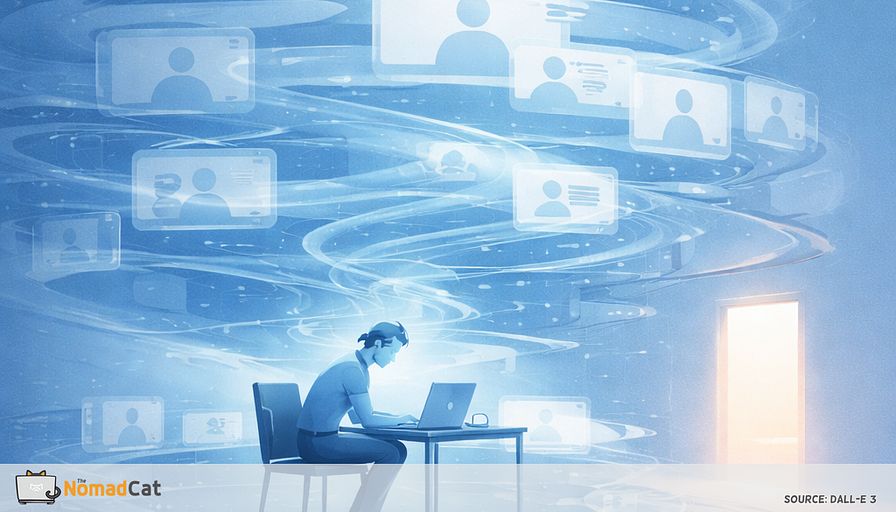
08:57, camera light on. 09:00, first call. 09:29, click Leave. 09:30, same chair, same frame, Slack already blinking like it was offended you looked away. At 10:15 you realize you have not moved more than your forearms and your eyebrows. Nothing dramatic happened, meetings were even fine, nice people, decent decisions. And yet by 16:40, a tiny question in chat feels strangely loud.
This is the remote-day loop. Call-to-call in 1 seated position, with the only transition being a tab switch.
The result is not 1 bad meeting. It is a day that feels brittle.
What quietly vanished is not exercise. It is the small 2 to 6 minute moving layer that used to sit between conversations. The walk to coffee while recapping what was decided. The short move to a room while framing the next discussion. The return to the desk where the last sentence of the meeting finished itself.
Remove that layer and the system gets jumpy. Instant switches with no ramp. The after-call minute becomes the weird part. You open the doc you are supposed to write, and the last 2 minutes of the meeting keep replaying anyway. Your hands are typing, but the previous topic is still running in the background, like a process you forgot to kill.
This is not a steps pitch. And it is not a sermon about long breaks. The topic is narrower and more work-compatible. Restore tiny transition channels so conversations close and the next block starts with less friction.
Why you only feel it late
The day looks fine until it does not
At 09:00, nothing is wrong. You answer fast. You ship the doc. You even feel a bit proud of how smooth it went.
The trap is that the missing thing was tiny and frequent, so its absence does not create an alarm. It creates drift. Output stays stable while internal cost rises, a bit like keeping latency low by burning the CPU. By 18:00 the system feels brittle because the small recovery inputs never happened.
The first signals are weird and boring
It usually starts as why is this annoying, not i am tired. Decisions feel heavier. Not harder objectively, just more expensive to even start.
- you reopen the same doc 6 times and somehow never enter it
- you tab-hop right after a call, looking for the easy task
- you postpone a message that is not hard, just socially sharp
- you rewrite the first paragraph again and again because it feels not right
- you replay a meeting sentence while staring at a different screen
- you check Slack just quickly and forget why you went there
None of this is dramatic. It is the small avoidance choreography of a brain that is a bit overloaded.
A quick note from my own desk life
I’m french, born in 1974, and i have spent most of my adult life at a desk, first in Beijing, then Berlin, now Lisbon, often past midnight. I’m not in pain, so for years it was easy to believe the system was fine.
My early alert is simple. A quiet tightness in the upper back that builds until it forces me to move, and my wife keeps reminding me to sit straight. I usually manage about 3 minutes, so yes, very impressive.
I started taking health seriously at 40 not because of a crisis, but because it was obvious i could work for hours without eating, drinking, or moving. If you can do that too, it is not resilience. It is delayed feedback.
Movement as a work tool, not a fitness hobby
Walking changes tone
Walking does not make you smarter. It changes tone. After a tense call, the replay loop is shorter if the body moved instead of staying frozen. For me the test is stupidly physical: if i stand up right after Leave, my upper-back tightness drops 1 notch, and the meeting sentence stops looping.
You do not need big claims here. In real work, the bigger win is often less internal noise and less time spent reloading. The next block usually fails on friction, not IQ.
Walking changes the social geometry
Video adds a performing-on-camera layer that is easy to underestimate. When a call can be audio-only, or when someone can walk, 1 layer of monitoring drops.
It can also feel less confrontational. Side-by-side orientation tends to soften the tone. Walking creates that side-by-side feel by default.
Camera-optional norms are also an inclusion choice, not just a fatigue tweak. Audio-first options plus captions and chat let people contribute without extra pressure, bandwidth problems, or awkward visibility expectations. It is the difference between taking the call while pacing (and staying present) vs staying frozen on camera and spending the next block tab-hopping.
Endings you can feel
A meeting ending is also a memory boundary
In the office version of work, a meeting ended and something boring but useful happened. You stood up. You walked 20 meters. You waited for an elevator. Your body changed scene, and during that tiny gap the brain had time to file what just happened.
This is mechanics, not nostalgia. Remote work often cuts the boundary out. The call ends and you are instantly in Slack. No chapter break, so the previous chapter bleeds into the next.
The cheap remote replacement is a micro commit
A remote-native substitute can be simple and calendar-proof.
Add a 30 to 90 second physical boundary plus a 1-sentence summary. Stand up, walk to the kitchen, touch a door frame, look out the window, whatever creates a clear edge. While doing it, write 1 line.
“Decision: X. Next: Y by Thursday.”
Think of it like version control. Not a documentation effort. Just a tiny commit that marks state so the system can move on.
Endings count. Your brain uses them.
Remote defaults that survive a real calendar
Match the mode to the information
A useful design rule is boring and effective. Match meeting modality to what the call needs to transmit. If faces add real signal, keep video. If it is mostly coordination, audio is often enough, and movement becomes compatible.
So instead of should i walk more, the question becomes does this call require visuals, or just words.
A small mapping that reduces decision friction
If the calendar is packed, the enemy is not motivation. It is the extra decision at 08:59.
-
Weekly 1:1 check-in → audio-walk if it is mostly alignment and updates
-
Project status with 4 people → off-camera pacing if you are mostly listening
-
Brainstorming → audio-walk when a whiteboard is not required, capture ideas in 1 shared doc
-
Screen-share review → standing in-frame, accept screenshare anchors you and just change load on the spine
-
Performance feedback → usually video on, standing in-frame, keep movement visually boring
-
External client call → video on, stable setup, then take a 2-minute walk before as a buffer
-
Large all-hands → camera off plus walk if it is mostly broadcast, use a headset and mute discipline
-
Deep technical pairing → sit or stand in-frame, walking tends to add noise
Basic guardrails help keep it adult. Use hands-free when possible. Manage cords and rugs. No reading docs while walking. Audio-only means audio-only.
Neutral scripts that remove awkwardness
A script is not about permission. It is about preventing misinterpretation.
- “I’m going audio-only for this one so i can move a bit, i’m fully here.”
- “I’ll keep camera on, but i’m going to stand for my back.”
- “If you’re ok with it, i’ll turn camera off while i listen and take notes.”
- “I’m outside, so let’s avoid sensitive details.”
Tiny routes that do not become a project
If movement requires planning, it dies. If it has a default path, it survives.
-
Door-touch loop: stand up, walk to the nearest door, touch the handle, walk back
-
2-room lap: desk to kitchen to desk, same path every time
-
Corridor out-and-back: walk to the far end, look far for 2 breaths, return
The 60 seconds after you click Leave
In-office, you got a free debrief while walking back. Remote work replaced it with a hard cut into the next tab, which is exactly where stuck thinking grows.
So the best moment is boring but powerful. The 30 seconds right after Leave meeting.
The walk to close protocol
Stand up when the call ends. Walk to a physical threshold. Stop. Then return and start the next block.
Use this template if you want something default.
“Decision: _. Next: _.”
The Next part matters. Make it concrete.
If talking out loud feels weird, whisper it, or type it. Same structure.
Keep it tiny
If that 1 sentence becomes paperwork, it will stop. The point is the boundary and the commit, not a new admin layer.
Try it like a small debug test. Change 1 variable for 7 days and see if late-afternoon everything-feels-louder reduces. If it fails, treat it like a dependency bug. Audio quality, privacy, camera norms, or the route is annoying. Annoyance always wins.
This is not a lifestyle overhaul. It is a small interface fix so your brain stops doing unpaid overtime between meetings.
Remote work did not only add more meetings. It removed the tiny scene changes that used to let your brain close 1 context and open the next. So you keep output, but you pay with replay loops and that late-afternoon moment where a simple Slack ping feels too loud.
The fix is small and unglamorous. Treat movement like an interface layer. Pick meeting modes that allow standing or walking when visuals are not the point. Then protect the 30 to 90 seconds after you click Leave with a physical boundary and a 1-line commit, so the conversation ends in your head, not just on Zoom.
The author’s desk-life note (french, 1974, lots of nights at a desk, some upper-back tightness) is basically the warning label. Delayed feedback looks like “fine” until it doesn’t.
The smallest transition is usually the one that survives the calendar: 30 seconds, a threshold, and 1 line that closes the loop.
You might be interested by these articles:


Video calls kept the talk and killed the movement

Audio first gives your body permission to move on remote days

Turn hard 1:1s into stand up calls not camera statues

Micro-exits for remote days that keep your body from timing out

Remote work stole your hallway breaks and your neck feels it

Mastering Data Protection Techniques

Stop money whiplash with a freelancer payroll system