 Gilles Crofils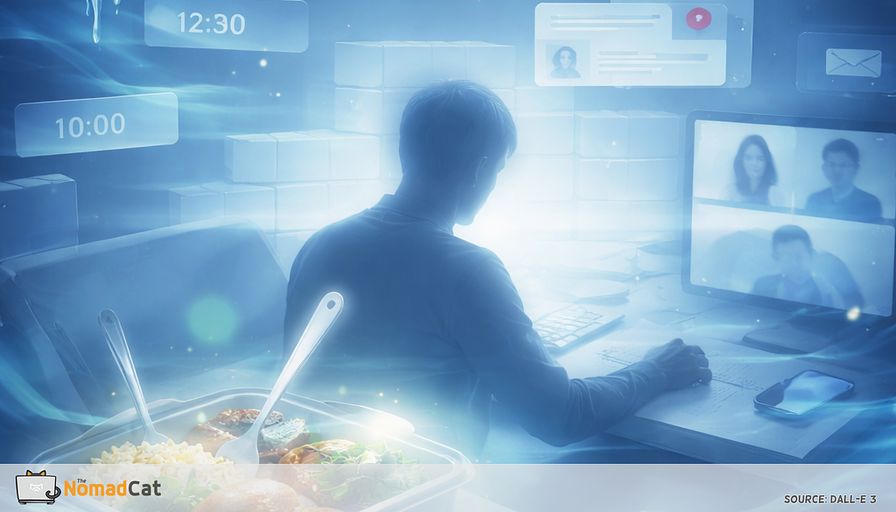
Lunch is on the calendar, but somehow it does not land.
A call ends 4 minutes late. The next one starts in 11. You open a container, chew a bit, scan the next agenda, answer 1 ping, and then someone asks later “what did you eat” and your brain goes blank. Not dramatic. Just… I don’t have the data.
If your days look like 10 hours at a desk, meetings stacked like bricks, and lunch happening somewhere between tabs, this is for you. Not for perfect lunches, not for people with a quiet hour at noon. For desk days where food has to fit between work. (I write this from Lisbon, but the pattern was the same in the Berlin remote years: bad chairs, worse desks, and lunch squeezed between calls.)
The point here is to name the problem so it stops feeling like a discipline issue. Lunch collides with urgency, posture, and pre-loading the next task, so a real meal gets stored in your brain like a snack. Research on distraction and meal memory lines up with this. Weaker meal memory is linked to higher later intake.
Then it gets practical, fast: a 2 minute downshift that fits inside hostile calendars, plus a degraded mode for days that are on fire.
No big lifestyle speech. Just a small configuration change, so lunch shows up in your brain like it actually happened.
Lunch that does not show up in your brain
The midday blank spot
Someone pings on Slack after a packed block of calls and asks, casual, “what did you eat for lunch”. And there is this small pause where the honest answer is… wait. You vaguely remember opening a container, maybe putting a lid back, maybe chewing while scanning the next calendar block. Lunch happened, but it did not register as an event.
When that happens, it is often not a discipline problem. It is a signal-quality problem. If the meal is not really logged by attention and context, later your brain treats it like it barely counted. That matches work on distraction and meal memory, including Higgs and Woodward’s findings linking weaker meal memory to higher later intake.
Collision meals as a scheduling bug
A simple name for this is collision meals: lunch collides with urgency, posture, and pre-loading the next task, so a real meal behaves like a snack in the brain. Not because the food is bad, but because the conditions are wrong.
This is also why it feels repeatable. Remote and hybrid work can mean more meetings and fewer buffers. The point is not to blame meetings. It is to name the failure mode so you can spot it quickly.
The collision meal in plain desk terms
What it looks like
A meeting ends 4 minutes late. The next one starts in 11 minutes. That “gap” turns into a countdown.
Hidden steps eat it alive.
- Close tabs
- Answer 1 ping
- Bathroom
- Refill water
- Open the next doc
- Check the agenda
- Plug headphones back
So lunch becomes a transfer operation, not a break. There is also the small social pressure of timing. Nobody wants to be the person still chewing when everyone is already talking.
The signature is a triad
- Urgency
- Constrained posture
- Pre-loading the next task while chewing
It is not skipping lunch. It is intake, but time-terminated and stress-layered, so the “I refueled” signal does not land cleanly.
A quick input check is often enough
- Less than 10 minutes before the next meeting
- Eating while reading the agenda
- Half standing or perched on the chair edge
- 1 hand on mouse or trackpad
- Swallowing fast to free the mic
- Stopping because the clock ended it
The delayed rebound
The weird part is the timeline.
T+0 you can feel full fast, sometimes too full for what you ate.
T+60 there is a quiet window where you think lunch is handled.
T+120 the system starts throwing little alerts. Snack-specific cravings, something sweet or crunchy, and often the temptation of coffee #2 because focus feels expensive—usually right in that tiny gap where you stand up “just to refill water” and somehow end up at the kitchen drawer or hovering by the espresso machine.
There is evidence that distraction during eating can increase later intake (Robinson et al., 2013). Bodies vary, this is not a diagnosis. It is just a common desk pattern.
How collision meals differ from other lunch problems
- Skipping is no intake and often a direct crash.
- Collision is intake, but rushed and calendar-driven, so the “I refueled” signal is noisy and shows up later as compensation.
It is also not generic distracted eating because the clock is the driver. Speed under deadline matters. Fast eating has its own satiety effects in controlled work (Kokkinos et al., 2010). Distraction adds a second layer on top.
Why urgency breaks the refuel signal
Fast meals outrun your own feedback
Your system does not update instantly. Finishing a meal in 4 to 6 minutes can beat your own “okay, we ate” message. It is like hitting send and closing the laptop before you see the confirmation.
Kokkinos et al. (2010) is a clean anchor. Same meal. One version eaten fast in about 5 minutes, the other slowly over about 30 minutes. The slow condition showed higher satiety signals and higher reported fullness.
Overshoot and undershoot both happen
The same rushed lunch can create opposite afternoons because the signal is noisy.
Overshoot
The calendar is the stop condition, so it is easy to go 2 bites too far. In the moment it can feel like “wow I am full”, then you get heavy and sleepy.
Undershoot
You stop early because the meeting starts, not because the meal feels complete. Stress makes it harder to notice in real time because the brain is already doing “next task.”
Meeting mode keeps the system in alert
If lunch happens while you are still mentally inside the meeting, the body does not get a clean state change. The call is “over” on the calendar, but you are still keyed up—shoulders high, jaw tight, replaying the last tense bit while you start eating.
Stress also has a lag. The body often stays revved for a while after the stressful moment, not just during it. Combine that with back-to-back calls and video meeting fatigue (Bailenson, 2021), and lunch can land on top of sustained arousal instead of replacing it.
If the meal is not encoded, the brain keeps asking
The “did I even eat” problem is not just drama. When attention is split, meal memory can be weaker. Weaker meal memory is linked to higher later intake in experiments like Higgs and Woodward (2009).
Collision meals are a perfect setup.
- No clear start
- No clear end
- Attention half in the next agenda doc
So later the system keeps requesting input.
The 2 minute downshift experiment
A tiny protocol for hostile calendars
Treat this as a 5 workday experiment, not a new lunch identity. Use it only on collision lunches, the ones with a short gap and a meeting already warming up in the next tab.
The goal is not to eat perfectly or to fix macros. It is a small configuration change, like giving yourself just enough buffer so lunch doesn’t get filed as background noise.
Microbreak research suggests even short breaks can reduce fatigue and improve vigor (Kim, Park and Niu). So 120 seconds is not ridiculous.
The 120 second sequence
If you can, set a 120 second timer. If you can’t, just count 6 slow breaths. Keep it simple.
- Start a 120 second timer
- Take 3 real sips of water
- Do 2 slow exhales, longer out than in
- Sit fully, feet on floor, shoulders drop 1 cm
Note for data people. Stronger “water preload” effects in trials usually use around 500 mL about 30 minutes before a meal (Davy, 2008). This is not that. Here water is mostly a cue plus comfort.
The first 3 bites constraint
After the 120 seconds, make the first 3 bites screen free. No Slack, no agenda doc, no “just 1 email while chewing”. Then do whatever, because this has to survive real life.
The mechanism is not spiritual. It is logging. Distraction can weaken meal memory, and weaker meal memory is linked to more later snacking in studies like Higgs and Woodward (2009). Even a few undistracted bites may help the meal count more.
Degraded mode for brutal days
If the day is on fire, degraded mode is 20 to 30 seconds.
- 1 long exhale
- Sit fully
- 1 sip of water
- 1 screen free bite
Not heroic. Just better than zero.
If lunch gets interrupted, do not do the “welp, ruined” thing. When resuming, do 1 slow exhale and 1 screen free bite to restart the boundary. Think of it like drawing a quick line again so lunch does not dissolve into 1 long distracted work block.
How to tell if it worked without turning lunch into tracking
Use boring signals you already notice.
- Coffee urgency. Not a biomarker, just a behavior. If the downshift helps, the “need coffee now” moment sometimes slides from urgent to optional. That matters because caffeine can reach into sleep even 6 hours before bed in controlled work (Drake et al., 2013).
- Snack pull. The difference between “I could eat” and “I need something sweet now.”
- Dinner urgency. If lunch was half-encoded, compensation often shows up later.
A minimal log can be almost insulting. That is the point.
Day Gap Downshift T+90 state Mon 10 Y / N steady / snacky / sleepy / edgyReading rule.
Compare “gap <10 with downshift” versus “gap <10 without downshift”. Ignore the rest. Do not average. This is not finance.
When timing experiments should stop being cute
When low blood sugar is a real risk
If someone is on insulin or a sulfonylurea, delayed or missed meals are a normal hypoglycemia trigger. In that case, the 2 minute downshift is not a reason to push food later or to “see if hunger goes away.” Use it only when food is already there and it is safe to eat now.
Symptoms that mean the lunch bug is not the main problem
Stop tweaking lunch mechanics and get evaluated by a clinician if any of these show up.
- Dizziness that is new or strong
- Fainting or near-fainting
- Severe fatigue that does not match the day
- Unintentional weight loss
Eating disorder safety and rule traps
If a protocol increases anxiety, guilt, or compulsive control, it is a stop sign. The goal is signal quality, not perfect behavior.
Lowest risk fallback.
- Sit down
- Do 2 longer exhales
No bite rules, no timing rules. Screen-free bites can help memory, but they are optional, not a virtue test. If there is history, support beats experiments. Organizations like NEDA and Beat are common starting points.
If lunch keeps disappearing from memory, it is probably not a willpower bug. It is a scheduling bug.
Collision meals happen when urgency, stiff posture, and pre-loading the next task turn a real meal into background noise, so the brain keeps asking for “more input” later.
The fix is not a perfect lunch hour. It is a tiny state change that helps the meal register. Try the 2 minute downshift, then keep the first 3 bites screen free. On brutal days, degraded mode still counts. Watch boring signals like coffee urgency, snack pull, and dinner intensity, not a fancy tracker.
And keep the safety rails. If symptoms show up, or if rules start feeling sharp, stop experimenting and get support.
Most days, the “fix” is not more discipline. It is giving lunch enough of a boundary that your brain can file it as a real event.


