Abstract:
The article argues that what many people label a “post‑lunch crash” is often not caused by the food itself but by the abrupt handoff from “eating like a human” to instantly becoming an “inbox triage machine,” where opening Slack within seconds triggers switch costs, resumption lag, and urgency cues that masquerade as fatigue—showing up as “tab pinball,” rereading the same lines, sharper-than-intended replies, snacky thoughts without hunger, and “coffee emergencies” 30–90 minutes later. Using a deliberately boring, incident-response mindset, it предлагает a tiny 5‑day “bite switch audit” (check whether you opened Slack/email within 60 seconds of your last bite, then note at T+75 minutes whether you feel steady, foggy, snacky, or coffee‑urgent) to see if “fast re-entry” predicts the slump more than lunch content does. If it does, the fix is a simple boundary protocol: a 7‑minute “landing strip” that blocks new inputs (no Slack/email), physically marks lunch as finished (close containers, clear the desk), and re-enters through one small “maker mode” task like writing three bullets for what “done” looks like today; for “hostile calendar” days, a 90‑second degraded version (three off-screen bites, clear the desk, jot one next step) provides damage control. The piece also sets guardrails—don’t keep tweaking lunch if sleep debt, caffeine timing drift, or an overloaded schedule are the real constraints, and stop self-experimenting if fatigue is severe or unsafe (e.g., nodding off while driving) or if medical issues like hypoglycemia risk are in play—framing success as a boring return to normal work rather than a new lifestyle.
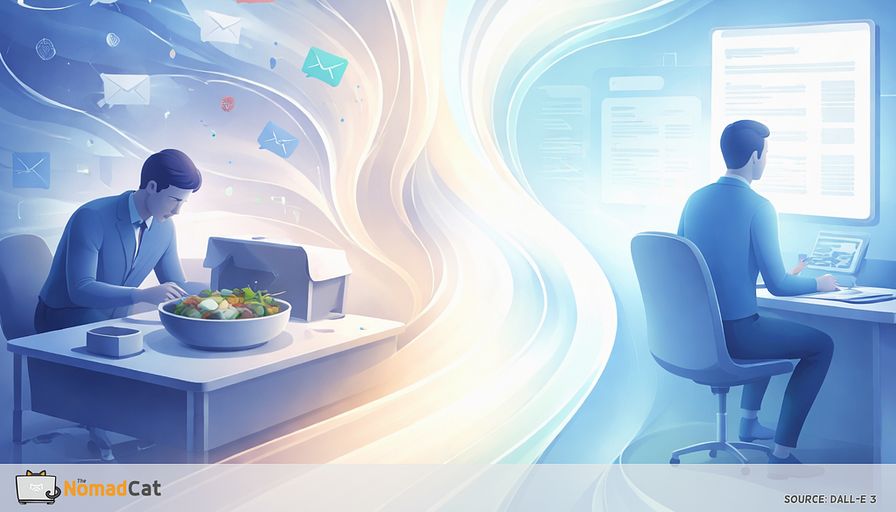
You finish lunch, close the lid, and your hand goes to Slack like it’s muscle memory. 10 seconds later you feel late, a bit guilty, and somehow already behind on a conversation you were not even part of. Then comes the wobble. You open a doc, close it, scroll a bit, re-read the same line twice, and nothing really starts.
If you deal with stiff neck, tight shoulders, lower back pain, poor sleep, or that weird low energy after lunch, this will feel familiar. You sit all day, meetings stack up, lunch is rushed, and the second you are done eating you are back in reactive mode.
This article is here to make 1 annoying point useful. A lot of the so-called post‑lunch crash isn’t your lunch. It’s the handoff back into work. The moment you switch from “human eating food” to “inbox triage machine,” your brain pays a restart tax. It looks like low energy, but often it’s context switching, interruptions, and a messy re-entry hitting at the worst time.
What you’ll get is practical and small, not a new personality.
- A clear explanation of why re-entry feels like fatigue even when you ate normally
- A tiny 5-day audit that checks if “fast re-entry” predicts fog, snacky thoughts, or coffee-urgent afternoons
- A 7-minute landing strip after lunch that protects focus before Slack and email start yelling
- A 90-second version for days when your calendar is hostile
- Guardrails for when to stop debugging lunch and look at bigger constraints like sleep debt or unsafe sleepiness
If you’re skeptical because most advice assumes free time, gym access, high motivation, and a quiet afternoon, fair. This is closer to basic incident response at work. Look at the logs. Change 1 variable. Keep it boring. The goal isn’t to win lunch. It’s to make the first hour back at your desk feel like normal work again.
The bite switch at your desk
When lunch stops counting
The annoying but useful point is this. A lot of the “post‑lunch crash” begins at re‑entry, not in the lunchbox.
Switching tasks has a cost, and it reliably shows up right when you change modes (Monsell, 2003). When you come back, you don’t just resume work, you rebuild what you were doing, which adds a resumption lag (Altmann & Trafton, 2002).
It shows up like office telemetry, even after a normal lunch.
- Coffee urge around T+30 to 90 minutes
- Tab pinball between inbox, doc, calendar, Slack
- Re-reading the same 2 lines, twice
- “Maybe a snack” thoughts, not even hungry
- Replies get a bit sharper than intended
- More typos, small misses, sloppy paste
- Starting tasks feels heavy for no clear reason
That cluster matches mental fatigue, where “feeling tired” often comes with measurable performance drift (Boksem & Tops, 2008).
The desk‑day hallmark is what happens next. Lunch ends and reactive channels restart instantly, as if responsiveness is the only setting. Email, chat, notifications, meeting reminders, plus the half-finished problem you left before eating all hit at once. Switch costs are a robust finding (Rogers & Monsell, 1995). Add interruptions and you often get more effort and frustration for the same output (Zijlstra et al., 1999). Modern work is built for handoffs, not clean state saves.
Why the switch feels like low energy
A small reload at the worst time
Lunch is not just food. It is a predictable interruption with a restart lag. Think of it like reopening a laptop that didn’t really sleep. Everything is “there,” but your brain still has to reload the rules, priorities, and what matters right now.
Plain version: your brain has to remember the rules of the game again—what matters, what’s next, what can wait. In cognitive terms, that reload is “task-set reconfiguration,” and the slowdown is the switch cost (Monsell, 2003). Now stack it onto the early‑afternoon dip where alertness tends to be biologically lower (Monk, 2005). Put those together and the label becomes “I’m tired,” even when the issue is more “my brain is paying the restart tax.” Timing problem, not a character flaw.
Resumption lag makes Slack feel like a fire drill
Lunch functions like an interruption, and getting back on track takes a resumption phase where you reconstruct what you were doing and why (Trafton & Monk, 2007). If the first click is Slack or email, you rebuild priorities under pressure. The meeting reminder pops up while you’re still swallowing, the Slack red badge is yelling, and the half-written doc you left open is just sitting there like an accusation.
Fragmentation can hurt performance and increase time-on-task even when the “work” looks tiny (Bailey & Konstan, 2006). It’s not that the messages are heavy. It’s that you are trying to recompile your day while people keep adding new requests.
Urgency cues can masquerade as a caffeine problem
Notifications can steal attention and degrade performance even when you don’t engage with them (Stothart, Mitchum & Yehnert, 2015). That arousal often gets misread as low fuel. Then coffee looks like the fastest state-changer, not because you are broken, but because your system just got paged.
Lunch without an endpoint
If lunch was rushed or screen-filled, your brain may not have logged it as finished. Meal memory matters for later eating decisions (Higgs, 2015). So you leave lunch without a clear done flag, and switching straight into reactive work keeps reopening the ticket later as “maybe a snack.”
Notes (if you want the receipts without the clutter): checking frequency can track with higher stress (Kushlev & Dunn, 2015); distraction during meals can increase later intake (Robinson et al., 2013); faster eating can weaken satiation signals (Robinson et al., 2014).
A tiny diagnostic that stays small
The 5-day bite switch audit
This is debugging, not a new lifestyle. You are testing 1 idea: the crash tracks the handoff moment more than the lunch content.
Keep it small on purpose. 2 inputs, because anything more becomes a new failure mode and you quit on a bad Tuesday. Log in the moment, not from memory, because recall gets creative (Stone & Shiffman, 1994). I treat this like I treated product incidents when I was in Berlin: 1 variable, 1 week, no heroics.
Run it for 5 days, then stop.
-
Checkbox 1 at last bite
- Fast re-entry means Slack or email opened within 60 seconds
- Yes / No
-
Checkbox 2 at T+75 minutes
- Steady
- Foggy
- Snacky
- Coffee-urgent
T+75 is not magic. It is late enough that the “back at desk” adrenaline is gone, and early enough that you still remember what happened.
Only tag confounders when they are obvious. Not “I slept a bit less.” The obvious stuff.
- Short sleep can swamp your signal (Van Dongen et al., 2003)
- Caffeine timing drift means “same coffee” is not always the same effect
- Meeting-wall pressure can make the early afternoon dip worse (Monk, 2005)
After 5 days, interpretation should be visual and boring.
- If fast re-entry = yes clusters with coffee-urgent or foggy at T+75 even when lunch varies, the lever is probably the transition design.
- If there is no pattern, you just saved yourself weeks of tweaking lunch for nothing. Look elsewhere like sleep debt, caffeine drift, total intake, or calendar load.
Optional, only if you love an extra knob. Use the Karolinska Sleepiness Scale once pre-lunch and once at T+75. It is a 1 to 9 rating used for momentary sleepiness (Åkerstedt & Gillberg, 1990). Consistency matters more than precision.
If daytime sleepiness feels severe, is worsening, or comes with unsafe moments like nodding off while driving, stop experimenting and get evaluated using a real clinical framework (BMJ Best Practice).
The 7-minute landing strip
The boundary protocol that saves your state
You are not trying to become a new person at 13:17. You are trying to stop the urgency loop from taking over before lunch even feels finished.
Treat it like saving state before a context switch. If you don’t preserve the goal you had before the interruption, your brain has to reconstruct it on re-entry, and that’s where resumption lag shows up (Altmann & Trafton, 2002).
Minute 0 to 1 is the whole trick. Stop new inputs so no new tickets enter the queue.
- No Slack, no email, no news
- No “quick check” that becomes 12 minutes (you know the one)
- A sip of water because desk days are weird like this
Minute 1 to 3 is the completion marker. Make lunch look done in the physical world.
- Close the container or throw the wrapper
- Wipe hands, move food away from the keyboard
- Put the last item fully out of reach, not next to the trackpad
Meal memory and attention matter for later eating decisions (Higgs, 2015).
Minute 3 to 7 is re-entry through maker mode. Not communication mode. Do 1 low-stakes, non-reactive task before any messages.
Writing a concrete plan can reduce intrusive thoughts from unfinished tasks (Masicampo & Baumeister, 2011).
Pick 1, the easiest, not the most virtuous.
- Open 1 doc and write 3 bullets for what done looks like today
- Draft a 5-line agenda for the next meeting, then stop
- Write the next physical action for the hardest task, 1 line only
- Add 2 bullets to a project log, what changed since this morning
- Tiny if–then note: If lunch ends, then 3 bullets before Slack
This will not delete the circadian dip (Monk, 2005). Success looks boring. Fewer rereads, fewer sharp replies, fewer “coffee emergency” moments, smoother first hour back.
Degraded mode
When you only have seconds
If you are going straight into a meeting, run the 90-second version. Damage control, not a ritual.
- Take the last 3 bites off-screen
- Close the container and physically clear the desk
- Jot 1 next-step line for what you were doing before lunch
A tiny plan reduces open-loop thoughts (Masicampo & Baumeister, 2011), and unfinished tasks can leave “attention residue”—meaning part of your brain stays stuck on the thing you didn’t finish while you try to do the next thing (Leroy, 2009).
If this makes lunch tense or weirdly stressful, scale it down further or drop it. These tools should reduce strain, not add a new layer of it (Sonnentag & Geurts, 2009).
When to stop
Success signals that look like normal work
If the landing strip is doing its job, the first post‑lunch hour looks more like normal work telemetry.
- Fewer panic coffees that feel mandatory
- Less tab pinball between chat, inbox, calendar, doc
- Less edgy wording in Slack and email, fewer micro-regrets after send
- Fewer rereads of the same lines
- Fewer typos and sloppy paste mistakes
Reducing reactive checking can reduce perceived stress in field research (Kushlev & Dunn, 2015). Mental fatigue often shows up as small performance drift, not a big “I feel tired” banner (Boksem & Tops, 2008). I like metrics, so I’d rather track 2 checkboxes than argue with myself all week.
If dinner is still a cliff
With a data-driven mindset, it’s easy to keep tuning inputs and blaming lunch for everything because lunch is visible and measurable.
But if evenings still collapse, don’t force the lunch theory. Treat it like debugging, not identity work. If dinner still feels like a cliff most days, the main constraint may be elsewhere.
- Sleep debt (Van Dongen et al., 2003)
- Late caffeine that quietly harms sleep (Drake et al., 2013)
- Total intake and timing across the day, not the 12:30 meal
- A brutal calendar with no runway after lunch
Keep the landing strip if it helps. Just don’t expect it to carry the whole week.
Guardrails and red flags
This is not a diet plan, supplements plan, exercise plan, or sleep tinkering project. It is a boundary protocol for 1 moment after lunch.
If there is risk of hypoglycemia because of insulin or medications that can cause lows, avoid experimenting with meal timing without clinician guidance. It is safer to check glucose than guess from symptoms.
If fatigue is new, severe, escalating, or comes with safety risks, stop “debugging” and get evaluated (BMJ Best Practice). This isn’t to scare you—just a reminder that persistent, worsening fatigue usually isn’t a lunch problem.
A practical stop list
- Fainting or near-fainting
- Chest pain, shortness of breath, or heart-racing that feels wrong
- Unexplained rapid changes in weight or appetite
- Daytime sleepiness that creates unsafe moments like nodding off while driving
- Symptoms that keep worsening despite basics like sleep, hydration, reasonable breaks
The promise stays narrow and honest. You are designing a better handoff after lunch, not trying to control your whole biology.
If your afternoons feel like tab pinball, rereading the same line twice, and a sudden “coffee emergency,” it may not be your lunch plotting against you. Often it’s the handoff. The brain pays a restart tax when you jump straight from last bite to Slack, and urgency cues make everything feel late and heavier than it is.
The good news is you don’t need a new personality. Treat it like incident response. Run the 5-day audit to see if fast re-entry predicts foggy or snacky T+75 minutes later. Then protect the handoff with a 7-minute landing strip, or the 90-second degraded mode when the calendar is hostile.
If the pattern doesn’t show up, good. You can stop blaming lunch and look at sleep debt, caffeine drift, or load.
For a lot of desk days, the 7 minutes isn’t about rest. It’s about not letting Slack choose your priorities while your brain is still booting.
You might be interested by these articles:


The 11:00 desk dip behind your typos and tab pinball

Your lunch is too fast to count in your brain

Why your lunch feels like background noise in back to back meetings

Stop letting Slack eat breakfast fuel before feed for desk days

Your calendar is giving you jetlag and lunch keeps missing the handoff

simplifying debt for indie tech pros

Your watch logged the workout but your shoulders still filed a bug report at 18:00