Abstract:
The article explains how starting the day by checking reactive channels like Slack or email can flip your brain into a constant “monitoring mode” that quietly demotes eating, hydration, and even standing up into optional background tasks, so you end up chewing between pings (sometimes on camera and barely remembering what you ate), living on coffee because it’s the only “available” breakfast, and hitting a familiar 15:30 crash marked by rereading threads, tab sprawl, and irritability while your neck and shoulders tense at the desk. Instead of framing this as a meal-plan or willpower problem, it describes a predictable loop driven by telepressure (the urge to respond), interruption resumption costs, and the social risk of going “offline,” which pushes people toward “keyboard-compatible” food that’s silent, one-handed, instantly pausable, and low-mess. The proposed fix is a small sequencing lever—“fuel before feed”—meaning no Slack/email/news until you’ve had one quick, chewable “anchor intake” (like fruit and nuts, yogurt, or a small sandwich), plus a short post-lunch buffer before reopening channels, supported by a simple 5-day micro-log (whether you checked before eating, whether caffeine came before your first chew, and how you feel at 15:30) and “degraded mode” options for hostile calendars (brief pre-feed chewing and water, capped triage bursts via timers or quotas). Success is measured less by perfect nutrition and more by reduced work friction—fewer frantic snack patches, less “coffee 2” urgency, less afternoon context-reloading—while also noting to stop if it becomes anxiety-provoking or to seek clinical guidance if fatigue or appetite changes are severe.
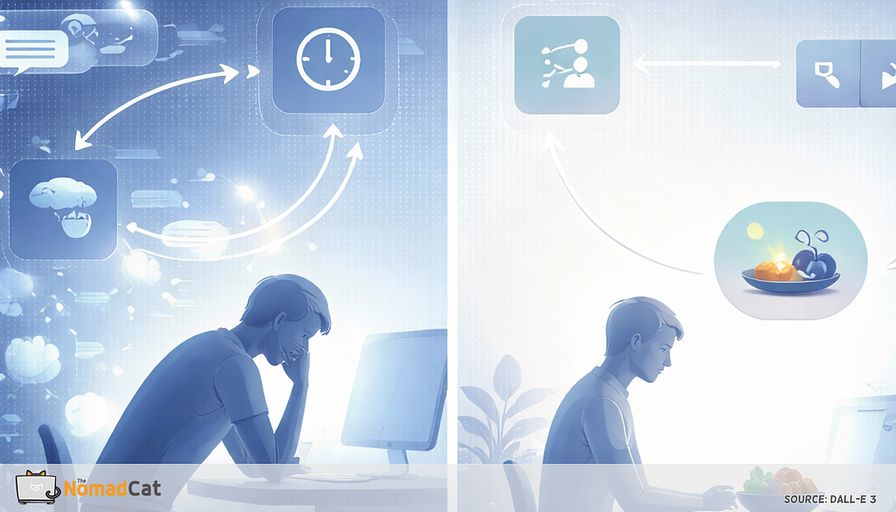
If your workday starts with a quick Slack check and somehow ends with you realizing you never really ate, this is for you. Not the dramatic kind of “forgot to eat.” The boring, frequent kind where food becomes what happens between pings, half off-camera, barely remembered. Meanwhile your neck is tight, shoulders creeping up, lower back glued to the chair, and lunch does nothing for the 15:30 crash except add crumbs to the keyboard.
I’m writing this from the same desk-heavy universe I’ve done across Beijing (2008–2017), Berlin (2017–2023), and now Lisbon: long screens, late-ish nights, and mornings where “just check Slack” feels like the smallest possible move.
This article is not a meal plan. It treats reactive channels like a system input that changes everything downstream. When Slack or email is the first thing your brain touches, the day boots into monitoring mode. Meals get demoted to background tasks. Coffee becomes the only reliable breakfast because it is the only thing compatible with being “available.”
What you’ll get here is a clean way to see the loop, then a small lever to change it without redesigning your whole life. We’ll cover
- what reactive channel eating looks like and why it’s so easy to miss
- the mechanism underneath it (the pressure to reply, and the cost of getting interrupted), not “lack of willpower”
- the predictable bug report loop that keeps checking louder and meals quieter
- a simple sequencing rule called fuel before feed
- a tiny 5-day log to debug your own pattern without turning your desk into a lab
- degraded mode options for days when the calendar is hostile and you can’t pretend otherwise
No perfection. No branding. Just a calmer boot sequence so your breaks stop getting eaten by the green dot.
The bug and the loop
When food becomes what happens between pings
Camera on. You keep your shoulders square while Slack lights up on the second screen. You answer two threads, then realize you have been chewing something but you can’t say what.
Reactive channel eating is when food becomes what you do in the gaps between messages, instead of what supports the workday.
A quick self-check
- You remember the first Slack thread more clearly than the first calories.
- You eat during camera-on calls, then forget the meal existed.
- Your attention is glued to the green dot, like going offline is a small social crime.
Behind it is often telepressure: that itchy feeling you should reply right now, even when nothing is actually on fire (Barber and Santuzzi). When the “normal” day starts earlier and stretches later, meals don’t get removed so much as quietly outcompeted by pings.
Not a meal plan problem, more a boot sequence problem
This is not a meal plan article.
It’s about sequence. And I’m biased toward sequence because I’ve spent a couple decades watching systems fail from the first input: once the day starts in monitoring mode, everything else gets pushed into “later” by default.
When reactive channels are the first input of the day, attention flips into monitoring mode. Eating, water, even standing up turns into optional background tasks. The kind you postpone forever because nothing breaks hard enough to force a fix.
A loop you can write like a bug report
Once the loop is visible, it becomes annoyingly predictable.
- Open Slack or email “just to check”.
- Absorb urgency and evaluation signals, who is waiting, what is blocked, what looks bad.
- Postpone food because there is no clean breakpoint anymore.
- Patch the gap with caffeine, sugar, or random bites while staying at the keyboard.
- Hit cognitive drag, reread threads, lose context, feel slower than you should be.
- Compensate by checking even more, because uncertainty feels expensive.
This lines up with interruption/resumption work (Altmann and Trafton): the practical version is you pay for every “quick check” with rereading, context reload, and more time spent re-entering the same task.
Common coupling points are boringly consistent
- pre-standup triage
- the post-lunch inbox hit
- the pre-14:00 “quick check” that eats the afternoon
Why the loop steals your meal timing
Why messages feel unsafe to ignore
Messages in reactive channels are not just information. They carry evaluation and obligation, like a tiny performance review that refreshes every time someone types. An open thread keeps running in the background, so eating can feel like stepping away from a live console.
In production monitoring terms, it is leaving the dashboard and hoping nothing pages you. Slack norms make this worse with timestamps, read receipts, and fast-reply culture. Barber and Santuzzi call the urge layer telepressure. Cue-poor text channels also make tone easy to misread, so silence can look like attitude.
That pressure shapes what kind of food feels allowed at the keyboard. Under monitoring mode, the “best” food is not tasty. It is interruption-proof.
Keyboard-compatible usually means
- quiet, no crunchy evidence on mic
- one-hand operable while the other hand is doing damage control
- pausable in two seconds if a message pops
- low cleanup and no plate that forces a real break
Short pauses do help with fatigue (Wendsche and Lohmann-Haislah). But reactive channels punish pauses socially, so the “safe break” becomes a sip, not a meal—and you end up defaulting to yogurt cups, protein bars, or whatever can be unwrapped and erased without leaving a trace.
With the mechanism in place, the crash stops looking mysterious.
Interruptions have resumption costs: extra time and more errors (Gillie and Broadbent). So the brain pays a tax in rereading threads and reloading context. As fatigue builds, control gets shakier, and the fastest patch tends to win. Often that means coffee, sugar, or whatever is reachable without leaving the screen.
Where the schedule breaks
Slack first makes coffee the only compatible breakfast
The sequence is familiar. You wake up, check Slack or email “just to see,” telepressure kicks in, and suddenly you are triaging. Breakfast becomes “after”. After never ships.
If coffee lands before first chewable calories, caffeine becomes the start signal. You often “pay” later with
- irritability or low-grade edginess
- fog and slow rereading
- snack urgency that feels like a pager, not hunger
Midday eating with one eye on messages does not register
The mechanism is not macros. It is memory and attention.
You sit down for lunch with your neck tight and shoulders up, open Slack “just in case,” reply mid-chew, scan the next meeting invite, and the meal becomes low-signal background noise. Later, it’s weirdly easy to feel like you “didn’t really eat.”
Like writing to disk, if you never commit the event, the system keeps asking for input later. Distracted eating can weaken meal memory, and that tends to push later intake up (Higgs and Woodward).
This wobble shows up mid-afternoon, when fatigue and checking reinforce each other.
Afternoon drag makes checking louder
Not every slump is food, so keep the model honest. The 15:00 to 16:30 signature often shows up first in work artifacts
- rereading the same thread three times
- harsher drafts and shorter patience
- tab sprawl and compulsive checking
So the goal is not perfect eating. It is protecting sequence around reactive channels.
One lever that changes the boot order
Fuel before feed rule
No reactive channel until one anchor intake happens.
Reactive channels means Slack, email, news, and feeds. Calendar-only is fine for logistics. This is one if-then rule, useful because it removes decisions, not because you suddenly got motivated.
Anchor intake means chewable, minimally messy, and done in 2 to 4 minutes, so it signals “day started” with better fidelity than coffee alone.
Examples
- a piece of fruit plus a few nuts
- yogurt or cottage cheese with a spoon
- a small sandwich or leftover bite on a plate
The point is sequence, not perfect meal timing claims.
Midday variant is the same idea after lunch. Delay reactive channels for 10 minutes so lunch ends with a downshift, not a fresh threat spike.
Make it falsifiable with a micro log
To debug it without turning your desk into a lab, use a 5-workday micro log with 3 fields
- Reactive check before first intake yes or no
- First caffeine before or after first chew
- 15:30 state label steady, foggy, snacky, edgy
Optional (only if you already wear one):
4. Sleep hours from your Decathlon sport watch
It should take under 20 seconds per day.
One limits note, so it doesn’t get weird: this is a within-you pattern check, not proof that Slack “caused” anything. If the sequence shifts your afternoon and you notice fewer rereads and fewer patch snacks, that’s enough to keep it.
If Slack wins the race, close it, do anchor intake, then restart. Not purity, just fewer loops.
When the calendar is hostile
Degraded mode in 90 seconds
If comms must open, treat it like an interrupt handler, not a morning personality test.
Smallest viable version is 60 to 90 seconds of chewing plus water before the feed, so coffee does not become the only input. It’s the difference between the 15:30 reread spiral and finishing a thread once.
Keep screens out of that chewing window when possible, because distraction is exactly how lunch turns into “did I even eat?”
Meeting-safe intake has three interface requirements
- quiet so mic anxiety does not run the decision
- low-mess so you can stop instantly
- pausable so a ping does not kill the whole thing
Batch the first check
After that 90-second intake, cap the first triage burst so a “quick check” cannot turn into an infinite queue. Pick one endpoint and commit to it.
- Timer endpoint: 5 minutes total, then close comms.
What success looks like and when to stop
If this works, it shows up as less work friction and fewer patch behaviors, not as a clean nutrition spreadsheet. Interruption costs tend to surface as rereading and rework. Fatigue can make regulation shakier and tone sharper.
- fewer snack urges right after message spikes
- less “coffee 2” urgency
- less rereading, tab sprawl, and context reload at 15:30
- dinner feels like dinner, not recovery mode
If fatigue is severe, new, worsening, or paired with appetite loss or unintentional weight loss, treat it as a clinical problem, not a calendar problem. Timing constraints matter for things like diabetes meds or pregnancy glucose management, so get proper guidance (NICE NG206; NHS).
If the rule makes eating feel rigid or anxiety-heavy, stop the experiment. Self-experiments are noisy and easy to overinterpret anyway.
Ticket closed when Slack stops being breakfast.
You might be interested by these articles:


Your lunch is too fast to count in your brain

Your calendar is giving you jetlag and lunch keeps missing the handoff

When stress turns lunch into a 16:30 invoice

Chew Gate for Meeting Days When Your Tools Keep Picking Coffee for Lunch

The 7 minute buffer after lunch that stops the Slack restart tax

Shaping Tomorrow's Work through DEI

5G Network Slicing