Abstract:
The article argues that remote work didn’t just remove commutes and daily friction—it erased the subtle cues that used to switch the brain between “work mode” and “home mode,” leaving people technically finished but still feeling mentally on the clock, especially when the same hoodie, chair, and Slack-enabled mindset cover everything from standups to dishes to late-night scrolling. Drawing on habit and boundary research, it frames motivation as largely context-driven and explains why psychological detachment functions more like a switch than a checklist, why meeting-dense days eliminate natural state changes, and why living in “soft clothes” quietly disables “exit readiness,” turning simple acts like stepping outside or taking out the trash into a multi-step negotiation where small hassles defeat good intentions. The author—an analytics-minded, physics-background desk worker who’s lived in Beijing, Berlin, and Lisbon—notes how a metrics-focused brain can misread skipped food, water, and movement as efficiency until the cost shows up as evening “sticky” restlessness and poor downshifting. The proposed fix is intentionally boring and low-friction: treat clothes as a personal role token rather than a fashion project (minimum viable “daywear” you could answer the door in, ideally with pockets), stage a “ready shelf” by the door for keys and essentials to remove leaving-the-house tax, and run a simple 7-day experiment using one lever and a single 10-second daily log (e.g., an 18:00 stuckness score) to see whether better cues and defaults help the day actually end when the calendar says it ends.
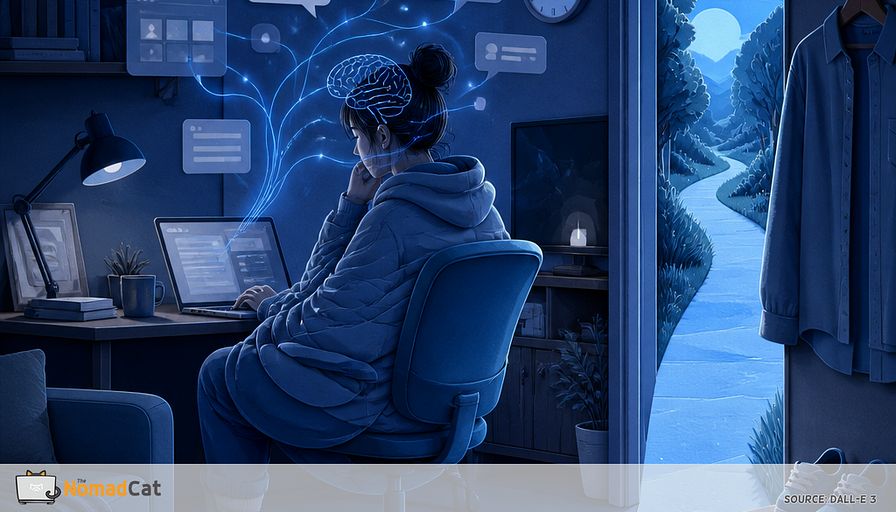
Remote work removed a lot of friction from the day. Nice. It also removed the small cues that used to separate “work mode” from “home mode”. Now it is easy to be technically done and still feel… not done. Same hoodie, same chair, same Slack tab open in the brain. And now, even when it’s finished, it’s not finished.
This piece is about a surprisingly boring lever that can help. Not discipline. Not a new schedule. Just cues. Habit research is pretty clear that a lot of what feels like motivation is really context running in the background. When the context changes, the behavior falls apart. Remote work is basically one big context change.
You’ll see why the endless soft-clothes default can make evenings feel sticky, why meeting-heavy days leave almost no natural state changes, and why “detachment” works more like a switch than a checklist. Then we’ll get practical with low-friction patches that fit real calendars.
What we’ll cover, without turning it into a fashion project
- Why getting dressed used to act like a boundary, even if nobody noticed it
- How one outfit for everything can blur the work-off switch
- The idea of “exit readiness” and why small hassles beat good intentions
- A simple daywear token, a door setup, and a 7-day test with 1 tiny log line
If any of this sounds slightly silly, good. Systems that work often look a bit silly from the outside. The goal is just to make the default path a bit smarter, so the day ends when the calendar says it ends. More often, anyway.
The daywear layer that used to start the day
Getting ready was a small movement bundle
Before remote work, getting ready was a default script. Socks, belt, pockets, keys, shoes, bag. None of it felt like movement. It ran on cues, not on motivation. Habit research describes habits as context-triggered behavior, more like auto-run than a decision (Wood & Neal, 2007).
Those tiny actions were also a boundary. Not a deep one, just a practical threshold you crossed without thinking. Clothing is a portable cue because it is literally on you (Ashforth, Kreiner, & Fugate, 2000). Remote work changed the context, which is exactly when habits get disrupted (Wood, Tam, & Witt, 2005). The commute disappeared, but more importantly the threshold got deleted.
Now the “before” can be a single click. Laptop open, hoodie, slippers, Slack already running before the brain is fully online. With fewer built-in ramps, work can also leak more easily into home time (Allen, Golden, & Shockley, 2015). Eurofound and the ILO (2017) describe the broader pattern as working anytime and anywhere. Nice for flexibility. Less nice for stopping.
When the calendar says done but the body disagrees
One hoodie for everything makes the day feel endless
This is where “I finished my tasks” and “I feel off duty” split.
If the same hoodie covers standup, email, dishwasher, snacks, and late scrolling, there are fewer checkpoints. Work stops being a place. It becomes a tab that stays open. Detachment is also linked in consistent ways to fatigue and sleep outcomes (Wendsche & Lohmann-Haislah, 2017). When nothing looks different, nothing feels different.
Detachment is a switch not a checklist
Psychological detachment is the ability to mentally disconnect from work during nonwork time (Sonnentag & Fritz, 2007). A day can be done on paper, but still running in the background.
The signs are small. Heating food while checking messages “just in case.” Reading a doc on the phone with the pan already on the stove. Work-related rumination and cognitive arousal are associated with disturbed sleep (Åkerstedt et al., 2012). And if your day is stitched together with meetings, there is no long clean slot to power down.
Meeting density leaves few state changes
On meeting-heavy days, classic buffers vanish. Every 30 minutes you are on camera, and even standing up can feel like a weird statement. Videoconferencing fatigue research points to constrained mobility and constant self-presentation as part of the load (Bailenson, 2021; Fauville et al., 2021).
In that setup, changing clothes is one of the few state changes that still works. No 20-minute break. No workout. No announcement.
The quiet invoice of staying in soft mode
Exit readiness quietly turns off
The point is not motivation. It is the activation sequence you created without noticing.
When the default is soft pants and slippers, being “ready to exit” stops being a background state. Taking the trash out becomes a mini project. Find socks. Find shoes. Decide if you are public-ready enough. Clothing is a quiet context cue that can steer behavior without a decision (Wood & Neal, 2007). Once exit readiness is off by default, leaving costs intention, and intention is expensive.
Evenings that stay sticky
It can be 18:00 and you are both stiff and restless. You were productive, yet oddly irritated. Shoulders up near the ears, jaw tight, lower back stiff from the same chair and the same angle all day. And because you weren’t exit-ready, the tiny maintenance moves (three minutes outside, one flight of stairs, a quick walk to the corner) don’t happen, so the body keeps the bill.
Going outside feels like a big deal, not because you hate outside, but because you never left indoor mode.
This “good day, bad landing” pattern fits what detachment research keeps showing (Wendsche & Lohmann-Haislah, 2017). Remote work can also stretch the day with more meetings and longer working hours (DeFilippis et al., 2020). The output is not drama. It is a system that refuses to downshift.
A metrics brain can misread the signals
A small personal lens helps here. I was born in 1974, and I’m the kind of person who can run a full desk day without eating, drinking, or moving, then call it “efficient.” I’ve been in Lisbon since 2023, and my wife is a fitness trainer and nutritionist, so yes, I get feedback. My early warning signal is boring: upper-back tightness and that neck/shoulder clamp that shows up when I ignore the basic stuff.
It’s not a character flaw. It’s a configuration problem.
Clothes as a permission system
Daywear as a role token for you
There is research on clothes and behavior, but the most solid support for this idea comes from boundary and habit theory, not from a magical “shirt makes you disciplined” story.
Daywear can be a small state token you wear for yourself. A visible flag that says work is running, then later work is not running. Role transitions are often managed with tiny cues and props, and clothes are unusually portable (Ashforth, Kreiner, & Fugate, 2000).
The useful part is simple. A token can make small exits feel legitimate again. The 3-minute step outside that somehow became a negotiation. Habits run on context cues more than motivation, so changing a stable cue can reduce the need for a pep talk (Wood & Neal, 2007).
This is not “dress up for others.” It is a cheap boundary marker that still works on messy meeting days.
What clothing research can and cannot prove
Some studies suggest that symbolic clothing can shift how you show up on certain tasks in certain contexts (Adam & Galinsky, 2012). Fine. I don’t trust any “one weird outfit trick” reading of this.
The claim worth keeping is smaller and more reliable: clothes act like a cue, and cues help mode switches stick.
So the rule for remote days is: pick 1 outfit that signals “door-ready” and treat it as your on/off flag.
Defaults beat intentions
A practical way to think about it is software.
If the default path is “already dressed enough to open the door,” the system runs with fewer clicks. If the default path is “infinite hoodie mode,” the system throws a permission dialog every time you want to leave. You can click OK. You just keep clicking later.
Low friction patches that reinstall exit readiness
The 2 minute clothes switch
To work in real calendars, it has to fit camera life. The minimum viable version is not “dress well.” It is a single enacted transition, a quick change that makes the work role feel on without turning the morning into a styling project.
What tends to count as minimum viable daywear
- Real pants or shorts you could stand outside in
- A top you would answer the door in without doing mental math
- Pockets because pockets quietly reduce friction all day
- Optional layer for camera that does not itch or overheat
Attach it to a cue you already hit, not to a perfect time slot.
Examples of workable cues
- When the laptop opens
- When the first meeting link gets clicked
- When the first coffee happens
A concrete Tuesday could look like this:
08:55 laptop opens → pants/top on.
12:30 keys already staged → 3 minutes outside between calls.
18:10 last meeting ends → change-out, work role off.
Repeat the same cue. That consistency is what builds the context-response link habits run on (Wood & Neal, 2007).
The ready shelf at the exit
Shoes can help, but the door setup often removes the bigger tax. The “where are my keys” tax. A ready shelf is just staging. It turns “leave the house” from a tiny planning meeting into a 30- to 60-second action.
Typical shelf items
- Keys
- Wallet
- Headphones
- Reusable bag
- A jacket or light layer depending on season
- Sunglasses or umbrella if those are frequent blockers
If the door area is shared or tiny, the shelf can be a hook, a bowl, or a tote that always hangs in the same place. The mechanism stays the same. Make the cue hard to miss at the moment the decision appears.
Compatible with real remote life
Camera culture does not leave much room to move
Exit readiness is not a mandate to go out. It removes the barrier so leaving can happen without a 10-step setup. On camera-on days, movement is socially constrained. Videocall fatigue research points to self-presentation load (Bailenson, 2021). Changing clothes is a private state change that does not ask anyone’s permission.
It also does not require going outside to count. Some days the calendar is locked, or the body is cooked, and the system chooses the couch. That is fine. Cues and defaults mostly change what is easy when the moment appears. They do not force a good day out of a bad one.
Caregiving and sensory constraints
Caregiving adds rapid context switching. A day can include 6 work re-entries after kid logistics, elder care, deliveries, or basic home chaos. Telepressure also adds that “I need to respond fast” pull (Barber & Santuzzi, 2015). A simple repeatable “uniform” can act like a resume button after interruptions.
For neurodivergent people, “work clothes” may need to mean sensory-safe and predictable. Concrete versions are boring on purpose. Same soft fabric, no tags, no tight waistbands, maybe 2 identical tops so laundry does not break the system.
A 7 day debug with one signal
Pick 1 lever and 1 log line
If this sounds silly, good. Many effective patches do.
Keep the test small. Pick 1 lever only
- Daywear on by 09:30
- Shoes token for the first work block only
- Change-out right after the last meeting
No mixing. If you stack levers, you get vibes, not signal.
Then pick 1 measurement that takes under 10 seconds. Anything longer becomes a new hobby and quietly dies (Li et al., 2010).
3 examples
- At 18:00, stuckness score 0 to 10
- Was stepping outside easy or a project today
- Did the day feel ended at dinner yes or no
If the number moves a little, that is information. If it does not move, that is also information, not failure. It may mean clothing is not the bottleneck. The real constraint could be meeting load, sleep debt, or after-hours expectations that keep the brain in work mode. In practice, a flat line just points to what to debug next, without escalating effort or guilt.
Remote work didn’t just erase the commute. It erased the small signals that used to tell your brain “work is on” and later “work is off.” When the same hoodie covers standup, dishes, and doomscrolling, the day can end on the calendar but keep running in the background. The fix is boring on purpose: a 2-minute change plus keys staged at the door, so “step outside for three minutes” doesn’t turn into a negotiation.
A simple daywear token can act like a role flag. A ready shelf by the exit keeps “go outside” from becoming a 10-step project. And the 7-day test keeps it honest, with 1 tiny log line instead of a new hobby.
This isn’t about dressing up. It’s about making detachment easier, so evenings feel less sticky and sleep has a fair chance.
You might be interested by these articles:


Debugging the 18:40 crash between work and movement

Your remote day needs a commit button you can do with your feet

Add a physics layer back to your remote day with 10 second role exits

Bring back the out tray so remote work can feel done

Your habits are fine your calendar is the bug

Eco-Driven Transport Solutions

Stop letting Slack eat breakfast fuel before feed for desk days