Abstract:
The article argues that the oddly unfinished, “did I forget something?” feeling many people get after a remote workday isn’t a discipline failure but a design flaw: office work naturally created closure through a “handoff economy” of tiny physical transfers (badging in, walking to a meeting room, dropping a folder in an OUT tray, handing over a cable) that acted as punctuation, forced brief posture changes, and made tasks feel truly shipped. In remote work, tasks stay in the same chair and visual field and are endlessly editable, so “done” feels reversible and drives cheap, habitual checking (telepressure-style vigilance: rereading threads, tweaking already-sent messages, keeping too many tabs as “open tickets”), while the body pays an “invoice” after hours of uninterrupted sitting even if you work out later. Instead of adding another productivity system, the piece recommends restoring closure with minimal “delivery proxies” that take 5–20 seconds and piggyback on unavoidable breakpoints like Send, leaving meetings, uploads, or approvals: stand and move one object to a defined outbox spot, write a one-line “Decision: X. Next touch: Y.” note and move it off the desk, return a mug/charger to another room, or switch to a second station for 30 seconds. It also suggests creating 2–3 simple physical stations at home—Inbox, Outbox, Hold—so work can “travel” again, keeping the approach non-performative (no streaks or moralizing), optionally tracking for a week with a single question at 18:00: “How delivered did the day feel, 0–10?” and stopping if any concerning pain symptoms appear.
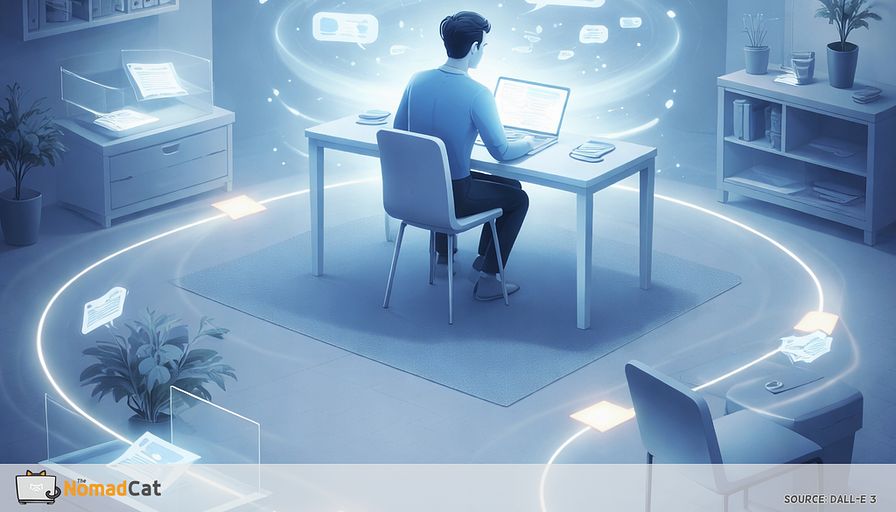
A remote day can look clean on paper and still feel weirdly unfinished. The meetings happened. Messages got sent. The doc is “done.” Yet it’s 19:30, your shoulders are somewhere near your ears, and your brain is running a tiny background process that keeps asking if you forgot something. That’s the hum that eats the evening and—at least for me—tends to show up right before sleep gets worse.
That stuck feeling isn’t really about discipline. It’s more like a design problem: remote work removed some physical friction that used to tell your body and attention, “this part is over.”
Work used to move through space. Even small office logistics created real punctuation. Badge in. Walk to a room. Hand someone a cable. Drop a folder in an out tray. Those little transfers weren’t clutter. They were state changes. Remote work kept the tasks but deleted the handoffs, so “done” became soft and reversible. Everything stays in the same chair, in the same visual field, with an Edit button next to it.
This article is about bringing back closure without turning your day into another system to maintain. You’ll see:
- why digital “sent” often doesn’t register as finished in your body or your attention
- how cheap checking turns into low-grade vigilance and open-ticket brain
- what gets lost physically when delivery disappears, even if you still do a workout later
- simple “delivery proxies” that take 5–20 seconds and work on busy days
- a small way to set up 2–3 physical stations at home so work can “travel” again
The goal isn’t more willpower, or perfect breaks. It’s restoring the missing punctuation so the day can actually end.
The handoff economy you stopped noticing
Work used to move through space
There’s a familiar early warning for this kind of day: quiet upper-back tightness. For me, it’s the first thing that shows up—before I notice the clenched jaw or the “why am I still at my desk” mood. I’ve also learned (the hard way, across too many improvised desk setups between Lisbon, Berlin, and Beijing) that if the day doesn’t contain transitions, my posture will happily turn into a single long screenshot.
The unfinished feeling has a structural cause.
The handoff economy = small physical transfers that moved work between people, places, and objects, and made it feel like something actually changed.
In an office, work “traveled” via tiny deliveries and receipts.
- badge in
- drop a signed form on a desk
- hand over a cable
- walk to a meeting room
- stand at a whiteboard and then leave it behind
Those artifacts and their placement weren’t clutter. They were coordination. Part of the task state lived in objects and locations, not only in your head.
Remote work kept the tasks but removed the punctuation. This wasn’t “exercise.” It wasn’t some virtue break. It was loop closure plus a forced posture change that didn’t require motivation. On busy days, optional actions get deleted first. The defaults survive. That’s why this mattered.
One more twist: digital work is not only immobile, it’s also reversible.
In the office, work left your hands and your space. At home, it lingers. You “send” the doc, but it still sits in the same visual field, in the same chair, at the same desk that also holds a tax letter, a half-open dinner plan, and that support ticket you already answered.
With fewer distinct contexts, separation gets harder. When work never actually leaves the space, it keeps pinging you softly, even after you technically finished.
Reversibility keeps you on call
Why digital done does not feel done
Dropping a folder into an OUT tray had brutal clarity. You could still regret it, but you couldn’t quietly reach in at 22:40 and rewrite paragraph 3. A Slack message sits there with Edit and Delete, plus the uncertainty of whether the other side even noticed.
When something is editable, it stays psychologically reopenable. You did the action (sent), but your brain doesn’t get the certainty (received, accepted, acted on) without extra checking.
When checking is cheap, it turns from a tool into a reflex. The brain starts running a tiny internal ticketing system in the background. Not panic. Just low-grade vigilance—because vigilance is basically frictionless.
It usually looks like this.
- did they see it
- did it send with the right attachment
- is the tone weird
- should i add one more clarification
- will i look slow if i don’t follow up
- is there a new reply
This is close to what research calls telepressure—basically, the pressure to answer fast even when nothing urgent happened. And when checking is repeatedly rewarded (sometimes there is a new reply), it becomes habitual.
The cost isn’t only “screen time.” It’s the repeated reopen. Iteration is efficient, but shutdown gets expensive.
Every reopen also has a cognitive price. After an interruption, there’s a delay while your brain reloads what you were doing. If “done” is always reversible, when does the day get to end?
When delivery disappears
The body invoice at 18:00
You can have a solid day and still feel a little rusty when you finally stand up. First steps feel like a reboot. Hips complain. Shoulders sit too high, like they’ve been trying to become headphones. Not an injury, not drama. Just 10 hours in the same shape because nothing forced the small stand-and-deliver moments.
The usual advice—don’t sit for long unbroken stretches—matters here for a specific reason: offices didn’t reduce sitting by reminding you. They reduced it by forcing tiny deliveries. You stood up because the work had to move somewhere else.
And those little interruptions aren’t a trivial input. Research on breaking up sitting keeps landing on the same practical takeaway: the pattern matters. Frequent small stand-ups change how your body feels and behaves across the day in a way that one big workout later doesn’t fully replace. In this article’s terms: handoffs weren’t only “movement,” they were closure cues plus posture variation baked into the workflow.
A 45-minute workout after work is great. It still doesn’t fully cancel 3 blocks of 2-hour sitting slabs during the day. Office life used to inject posture variation without asking permission. Remote work makes it a choice, and choices get deleted when the calendar is on fire.
The brain stays in open tickets
Once work state is fuzzy, interruptions get more expensive. The symptoms look small, but they add up.
- reopening the same thread to reread it
- rewording a message that was already sent
- keeping 18 tabs open as external memory
- checking a doc “one last time” because you can
This is less a personality flaw and more an environment with unclear state changes. Working memory is limited, so people offload to the environment. Tabs and pinned threads become the digital desk pile that says “still pending.”
In the office, handoffs often included acknowledgement. “Got it.” Closed-loop communication reduces guesswork because the sender doesn’t have to carry the uncertainty.
Remote messages often lack that satisfying “received” moment, so the sender becomes the confirmation by checking repeatedly.
With weak closure cues, detachment becomes willpower-based, which is a bad design. After-hours checking is linked to poorer recovery and more work-home interference. If the cues are thin, work bleeds into home time through tiny re-checks and “just to be safe” edits.
So instead of “take more breaks,” a more realistic fix is to bring back a delivery layer: closure cues and small transitions that can survive real days.
Delivery proxies that survive real days
One rule that brings back closure
To survive busy weeks, the trigger has to be something the day already forces, not another reminder that gets snoozed into oblivion.
When something is finished digitally, deliver it physically once.
That’s it. Not a new system. Just an if-then seam that replaces the missing office layer using stable cues instead of motivation.
Event anchors beat timers for a simple reason. Send and leave meeting still happen on the worst calendar days. A timer will go off during a client Q&A and you’ll ignore it like any reasonable person.
The physical action can be comically small. The goal isn’t calories. It’s a state change.
4 delivery proxies you can steal in 90 seconds
After a key breakpoint, do 1 tiny physical “deliver” so the task stops living in RAM.
After a key Send
Stand up and move 1 object into a single defined outbox spot. The object can be arbitrary. The spot is the point.After a decision
Write 1 line on paper, then relocate it off the desk. Not journaling. Just a minimal commit artifact.
“Decision: X. Next touch: Y.”After an upload or attachment
Return 1 physical thing to another room. Mug, charger, cable. It recreates the deliver-and-return loop and breaks up sitting without turning your day into a fitness project.After a review or approval
Move the laptop or notes to a 2nd station for 30 seconds. Even if you come right back, the station switch gives the task a clearer ending.
No equipment. No theatrics.
Use breakpoints your day already provides
Useful breakpoints are boring and unavoidable, which is exactly why they work.
- Send (email, Slack, ticket comment)
- Leave meeting
- Upload or attach finishes
- Approve or request changes
- Join meeting loading screen
Most of these fit inside the 5–20 seconds of reconnect time between calls. That matters because video meetings already constrain movement and add their own fatigue tax. On dense days, fragmentation is the bigger enemy than laziness.
If the day is hostile, shrink the action instead of abandoning the mechanism. Degrade to 20 seconds. Keep the endpoint idea alive. “Stand + move pen to tray” still creates a seam.
Turn your home into a tiny mailroom
Small stations that make work move again
Offices had visible state because things sat somewhere meaningful. At home, everything collapses into 1 glowing rectangle on 1 desk.
A practical workaround is to add 2–3 fixed locations so work “travels” again, even if it’s just a shelf and a chair. Place acts like a retrieval cue. When you’re tired, location can do the remembering.
Even small distance matters because thresholds are the whole trick. Keep the stations dumb and readable without opening apps.
-
Outbox: shipped, waiting for reply, not to be reopened tonight
-
Inbox: ready to start next, the smallest possible “next touch”
-
Hold: blocked by someone else, don’t keep it in your head
This is not a full GTD cathedral. It’s closer to desk piles where position encodes meaning.
To keep it from becoming another self-improvement project, keep it boring. A route of 2–5 meters is enough to force standing, steps, and a micro-boundary. It won’t fix a chaotic week. It can help bring back endings.
Keep it non performative
Treat this like a short debug, not a program. Skip streaks. Skip moral framing. The point is a default that removes discipline from the loop.
If you want a simple check, keep it low effort. For 7 days, pick 1 trigger (like Send) and 1 proxy (like “move 1 object to Outbox”). Keep it the same each time. At 18:00, rate it on a 0–10 scale.
I like numbers (I’ve spent enough time tracking sleep and HRV to know the danger of overthinking), but this one stays intentionally dumb.
“How delivered did the day feel, 0–10?”
If it doesn’t move, fine. That’s a signal, not a failure.
Stop experimenting if there’s a pain spike, dizziness, numbness, radiating pain, or anything clearly trending worse. This isn’t treatment. It’s just bringing back missing variation and small breaks. If it doesn’t feel easy and reversible, it’s not a good default.
If your remote day keeps ending with that “did I miss something” hum, it’s probably not a character flaw. It’s missing punctuation. Office work had tiny handoffs that forced state changes, posture changes, and a clear sense of shipped. Remote work kept the tasks, made everything editable, and left you with cheap checking, open-ticket brain, and 10 hours in the same shape.
The fix doesn’t need another system. It can be a small delivery layer. Pick 1 breakpoint your day already creates (Send, leave meeting, upload) and add 1 physical proxy that takes 5–20 seconds. Move 1 object to an outbox. Write 1 line, then move it off the desk. Switch stations for 30 seconds. Work travels again, and your body gets micro-variation for free—and the day gets a cleaner ending.
You might be interested by these articles:


Your remote brain needs endings not more willpower

Micro-exits for remote days that keep your body from timing out

Give remote work a done signal so your brain stops polling

Add a physics layer back to your remote day with 10 second role exits

Stop relying on break reminders and steal movement from meeting transitions

Green Concrete Innovations

The Rise of Edge Computing in IoT