Abstract:
The article argues that the real reason remote work makes people feel “glued” to their chairs isn’t a lack of motivation to take breaks, but the loss of the office’s “shared tempo”—those socially synchronized, built-in transitions (chairs scraping, walking to another room, coffee lines, printer trips) that used to create automatic movement without anyone having to decide to do it. In remote work, meetings remain but the punctuation disappears: you click “Leave” and immediately enter the next call in the same posture, while back-to-back scheduling and camera optics (the fear that standing looks like you’re leaving) quietly lock people into long, uninterrupted sitting blocks that reminders and stretch timers can’t beat because they fire at socially impossible moments. The proposed fix is a small systems change called “borrowed synchrony”: replace time-based nudges with event-based cues that piggyback on moments already happening, using boring, repeatable 15–45 second micro-movements that don’t draw attention on video. It offers four practical “anchors” that fit real calendars—an end-of-call “shadow” loop (stand, cross a threshold like a doorframe, return), an always-upright rule for any calendar seam, standing for the first minute of the hour when possible, and standing while others connect and test audio—plus tips to make movement invisible on camera and a low-drama 7-day test using just one anchor and a simple end-of-day “neck and shoulders invoice” self-rating to notice reduced stiffness and cleaner mental handoffs rather than chasing fitness outcomes.
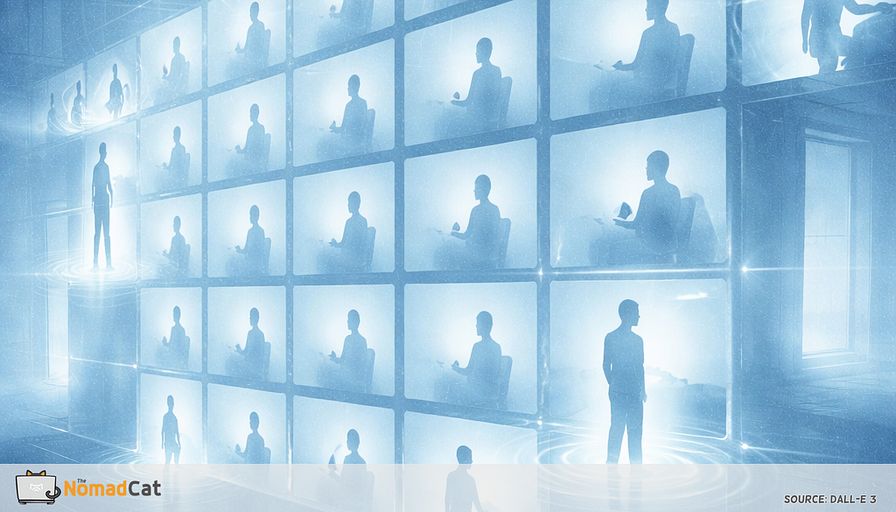
You know the day. 10 hours at the desk, meetings stacked like Lego, lunch that somehow becomes “just 1 more message,” and the workout that keeps getting rescheduled to a calendar that does not exist. And yes, you already know you “should take breaks.” That is not the issue.
The weird part is that a lot of movement used to happen without effort—the commute walk, the stairs, leaving the building for lunch. Not because people were virtuous. Because the office had a shared tempo. Meetings ended and chairs scraped. People stood up. You walked to the next room. Tiny transitions got bundled, and your body came along for free.
Remote work kept the meetings and removed the punctuation. Now a call ends, you click Leave, and nothing moves. Same chair, same screen distance, same posture, straight into the next conversation. So reminders and stretch timers fight a losing battle against back-to-back calls, plus the quiet fear that standing on camera looks like you are stepping out.
This article is about putting the punctuation back, without turning your day into a behavior project. It breaks down:
- Why the missing “shared tempo” matters more than motivation
- How meeting density and video norms quietly lock you into stillness
- Why time based prompts fail in real calendars, and why event based cues work better
- A simple idea called borrowed synchrony, using moments that already happen to trigger 15 to 45 seconds of movement
- 4 practical anchors that fit inside remote days, plus a low drama 7 day test
No heroics. No wellness branding. Just a small systems fix, so your calendar stops turning your body into a statue.
Shared tempo
The group rhythm you did not notice until it was gone
Shared tempo is the office’s background metronome. Workdays had a collective timing, so transitions happened because the group moved, not because anyone suddenly found discipline.
The mechanism was not the building. It was the bundling of tiny transitions.
- A meeting ends, chairs scrape, laptops close, everyone stands at once
- A hallway fills for 2 minutes, then clears
- The coffee line forms, then dissolves
- Someone gets up for the printer, and 2 other people “might as well”
- A room change forces a walk, even if it is short
The real trick was that it lowered the weirdness cost. When everyone stands, nobody is “doing a posture thing.” Shared tempo made movement socially invisible.
Offices also acted like collective punctuation. Even on brutal days, those bundled transitions put an upper bound on statue-time. Public health guidance keeps making the same boring point: break up long sitting (WHO, 2020). The office did not require you to remember—room changes and hallway waves enforced it automatically. Remote work keeps the meetings, but removes the room change, and now every transition becomes a private decision.
Silent transitions
Click leave and nothing moves
On a remote day, a meeting ends and… nothing happens. You click Leave, and you are already in the next thing. No chairs scraping, no wave of bodies standing up, so no physical cue gets attached to the transition. It looks like time management, but it is mostly a trigger problem. The chair, the light, the screen distance, the desk, even the air around you stay exactly the same.
When there is no clean boundary, it is harder to mentally detach and shift state.
It is not a discipline lecture
This is not about people being ignorant or weak. Most knowledge workers already know they “should” take microbreaks. The old trigger was external and shared, so it fired automatically. Now the trigger is internal and optional, which means it competes with higher-priority social obligations like replying fast and not being the person who is “missing.” Conditions and defaults matter more than another poster telling you to do better.
Meeting density deletes the seams
Remote schedules also tend to cluster on the clock. 10:00 ends, 10:30 starts, and the gap is a myth because someone drops a “quick question” in chat at 10:29.
You can see it in your own calendar without any report: how many meetings start exactly on :00 or :30, and how many end-to-start gaps are under 5 minutes? Fewer seams means fewer chances to stand, and the day becomes 1 long sitting exposure disguised as “being busy.”
The camera adds an optics tax
Even when a seam exists, video norms can freeze people anyway. Standing up can feel like it creates a story, and the simplest fear is plain: standing looks like you are leaving. Zoom fatigue work includes constrained mobility and constant self-view pressure as part of the load (Bailenson, 2021).
This is why simple reminders tend to fail in the real world of stacked calls. The problem is not the reminder. It is what the reminder is fighting against.
Why your reminders keep losing to the calendar
Optional prompts lose to meeting walls
When the day is a wall of calls, there is an obvious priority queue. Meetings first. The next meeting second. Everything else is best effort. A timer to stand up is easy to snooze because it is private, and staying seated has basically 0 social cost.
Also, notifications decay. If your brain learns “this ping is never urgent,” it becomes wallpaper.
Time based timers are cron jobs firing at the wrong moment
A fixed timer is like a cron job that runs even when production is on fire. It fires mid-discussion, right when you are answering a question, and you kill it because it is poorly timed. That is not a behavior problem, it is a scheduling bug. Prompts tend to work better when they match context instead of a clock (Nahum-Shani et al., 2018). End of call is a real event. Middle of call is social chaos.
Defaults were doing more work than motivation
In the office, the default after a meeting was standing because other people stood and the room changed. Remote, the default is to stay seated because the setup is already perfect and the next call is 1 click away.
Meanwhile guidance keeps repeating the boring part: break up sitting (WHO, 2020). The default is currently “keep sitting.”
Honest caveat: direct field evidence that “group synchrony causes more incidental standing” in desk-work days is limited. Treat it as a design guess with good adjacent support, not a settled RCT fact.
The real cost is longer sitting blocks
It is not only fewer steps it is fewer breaks
Remote days tend to inflate the longest unbroken sitting block. Someone can still do a 30-minute gym session, then spend 4 hours like a statue between calls.
Sedentary research suggests the pattern of sitting matters, not only the total minutes (Diaz et al., 2017). Plain version: if you only stand up twice between 09:00 and 13:00, that’s the problem—even if you trained yesterday.
Short interruptions matter because they wake up muscles and change the load on the same joints. In lab settings, interrupting sitting with light walking improves post-meal responses (Dunstan et al., 2012). Translation: a tiny loop between calls can do more for your afternoon “heavy body” feeling than an heroic stretch you never do.
There is also a blunt realism. High levels of activity can reduce some of the risk associated with lots of sitting, but the dose is high (Ekelund et al., 2016). So “workout later” becomes fragile when the calendar keeps stretching the sitting bouts.
How it shows up around 18:00 without any tracker
The late-day invoice is rarely dramatic. It is boring stiffness. Neck and shoulder creep, hips that feel heavy, the 1st steps that sound like a door hinge, and that weird sense of being stuck in “meeting posture” even after the meeting is gone.
For me it’s often tightness in the upper back that builds quietly until it forces me to move. And my wife reminds me regularly to sit straight. I usually manage about 3 minutes.
The fix is not more motivation. If the cost comes from missing punctuation in the day, the fix should bring punctuation back, using timing more than willpower.
Borrowed synchrony
Make timing do the work
Borrowed synchrony means piggybacking on timing that already exists—I think of it as “stealing the boundary” from the meeting. When the group creates a boundary, add a tiny physical change at that exact instant. The goal is a predictable trigger, not a heroic break. Event-based cues tend to beat random clock pings (Nahum-Shani et al., 2018).
The social survival rule is simple. It must look boring. If the movement is small and always the same, it stops reading like a statement. No dramatic stretching. Just stand, maybe 2 steps, return.
Design constraints help it survive real calendars.
- 0 gear
- 0 privacy needed
- 0 visible disruption
- 0 decision making once the rule exists
4 anchors that survive real calendars
1) End-of-call shadow
Every time a meeting ends, do the same micro-loop to recreate “walking out of the room.” Spec: 15–45 seconds, always the same. Stand, cross a threshold (doorframe counts), come back. The point is posture variation, not cardio.
2) Calendar seam rule
Any gap, even 60 seconds, means upright. Not “use the time well.” Not “if you feel like it.” No negotiation.
Again, you can verify the problem locally: look at one day and count how many gaps are under 5 minutes. Those tiny seams are rare and valuable, so treat them like automatic standing moments.
3) First minute of the hour
Meetings often cluster around :00 and :30, so :00 to :01 becomes a shared moment even when working alone. If listening, stand for that 1 minute. If presenting, skip. It reduces sitting without creating a visible disruption.
4) While-they-connect default
While people join, test audio, or do the polite “can you hear me,” stand up. It replaces the old walk-in-and-settle phase that remote work deleted. Waiting moments already have ambiguous norms, so movement costs less socially.
Make it invisible on camera
Boring beats impressive
Durability comes from being unremarkable, not from being optimal. On video, self-view plus “being observed” pressure makes every weird move feel louder than it is (Bailenson, 2021). The goal is to be forgettable.
- Stand just out of frame, then sit back in the same position
- Widen the camera slightly so a small rise does not look like you “left”
- Use a headset so the head stays stable and the audio does not change
- Keep shoulders and face quiet, move from feet and hips
- If standing is too visible, do subtle weight shifts and foot swaps under the desk
If someone notices, a tiny neutral script helps. Not an announcement, just status. Options like “Give me 10 seconds, adjusting my setup.” “Still here, just standing for audio.”
One nuance so it does not turn into a new problem. Do not replace sitting with rigid standing all day. The target is more changes, not a heroic number of upright minutes.
A 7-day test without turning it into tracking
One anchor only for 7 days
1) Pick exactly 1 anchor.
2) For 7 days, do the same tiny move every time that anchor happens.
3) Do not add “just 1 more rule” mid-week.
Success signal, deliberately low-tech: “did it happen more often than it would have happened by accident”. A wearable is optional, not required.
A blunt end of day signal you can repeat
At around 18:00, ask: “Do I feel less glued than usual?” If you want one number, add a 0 to 10 score once per day, same time, same wording. Example: “Neck and shoulders invoice today 0–10”. Numeric rating scales are common low-burden tools (Dworkin et al., 2005).
What to notice and what not to expect
- First steps after a long call feel less like rusty hinges
- Less shoulder creep by late afternoon
- Posture shifts happen with less friction
- The mental handoff after meetings is slightly cleaner
In 7 days, do not expect fitness gains, weight loss, or miraculous posture. This is not that layer. It is adding 1 missing input so the system runs a bit cooler.
If anything feels wrong, stop. If there is severe pain, numbness or weakness, sudden swelling, or anything alarming or progressive, this is not the right tool.
If your remote day feels like 1 long uninterrupted sit, that is not a motivation flaw. The office used to insert movement for free, via shared tempo and visible transitions. Remote work kept the meetings and removed the punctuation, so timers and reminders end up fighting meeting walls and camera optics.
The practical fix is boring on purpose. Swap time-based nudges for event-based cues, and borrow the moments you already have. End-of-call shadow. Calendar seam rule. First minute of the hour. While-they-connect default. Tiny moves, 15 to 45 seconds, repeated until they become the new default.
Most calendars won’t tolerate 4 new habits. But they can tolerate 1 rule tied to meetings you already have.
You might be interested by these articles:


Remote work stole your hallway breaks and your neck feels it

Micro-exits for remote days that keep your body from timing out

Build an interruption ecology for remote work so your body stops billing you at 18:30

Make movement non-narrative on video calls

Your remote day needs friction to make movement normal again

Biotechnology's Role in Turning Waste into Wealth

The calm second shift that quietly eats your sleep