Abstract:
The article argues that remote work’s efficiency comes with a hidden cost: it removes the small, socially normal “excuses” to stand up that office life created by default, so a day can collapse into a single seated posture until, by 18:00, your upper back has been quietly “complaining” for hours. Instead of preaching workouts or generic “move more” reminders (which get ignored when the calendar gets brutal), it proposes restoring the lost mechanism through “micro-exits”—10–90 second, work-legible bursts of movement that still look like doing the job, such as standing before replying, walking 30–60 seconds after pressing Send, using meeting seams as movement points, making refills kitchen-only, or even moving a small object to a “delivered” spot after a consequential message. These micro-exits work because they’re tied to unavoidable workflow triggers (pre-reply, post-send, join/leave, post-PR merge) and create two benefits at once: physical posture variation and tiny cognitive boundaries between tasks, reducing end-of-day stiffness and the feeling of “10 hours of the same screenshot” without turning movement into fitness theater. The piece closes with a simple 7-day “debug” (one trigger, one loop, one relief-focused 0–10 signal like “how compressed did my body feel?”) plus practical scripts to make movement non-weird on calls and safety guardrails emphasizing that this should stay boring, sane, and never override concerning medical symptoms.
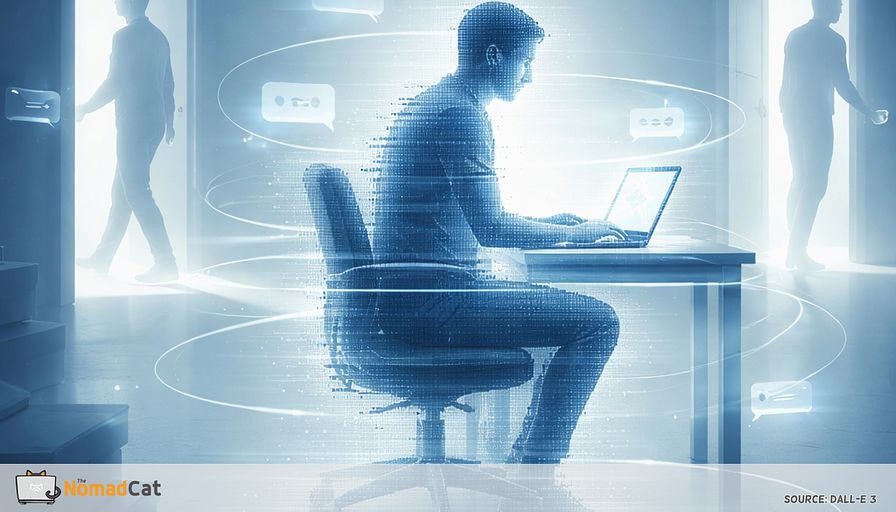
A full remote day can be weirdly efficient. Threads get resolved in place. Meetings stack. Lunch becomes a keyboard event. And somehow it is 18:00 and the first time you stand up is to notice your upper back has been complaining all afternoon.
I’ve been doing this across Berlin, Beijing, and now Lisbon, including too many “workations” around Europe on bad chairs and worse desks, often working past midnight. My wife reminds me regularly to sit straight. I usually manage about 3 minutes.
If most “move more” advice makes you roll your eyes, fair. The problem is not awareness. The problem is that remote work deleted the small, normal reasons to get out of the chair. Not workouts. Not big breaks. Tiny movements that still looked like work.
This article is about getting that mechanism back.
The goal is not fitness theater. It is fewer “statue stretches”, cleaner mental boundaries between tasks, and a workday that stops feeling like 10 hours of the same screenshot.
The micro-exit economy most people lost
Micro-exits are work-legible movement
Micro-exits are tiny, socially normal reasons to leave the chair for 10 to 90 seconds, and they still look like work. They happen inside responsiveness, not inside a fitness plan. Not “taking a break”, not exercise, not a posture crusade. They interrupt long sitting streaks and the classic chair trance.
What used to trigger them in an office
In an office, being physically available created movement almost by accident. A few steps were the price of being reachable.
- Quick desk-side clarification to unblock a thread
- Walking someone to a room
- Standing near a group to look available
- Turning to point at a screen or whiteboard
- Dropping by to align before a meeting
- Picking up a printout to share right now
Distance kills interaction fast, and simple closeness increases contact. When work is visible, small responses feel expected without anyone saying it.
Small movement, 2 outputs
Physically, micro-exits added bursts of standing and posture variation without needing decisions. Cognitively, they created micro-boundaries, tiny cuts between events. That helps the brain separate what just happened from what happens next.
The win is not faster output. It’s fewer end-of-day body invoices.
Put together, micro-exits were the rare productivity feature that also reduced “body error logs”.
Why it worked without motivation
Micro-exits worked because the triggers were external. Prompts baked into the environment beat willpower. Optional prompts get overridden, like software alerts people dismiss on autopilot. Office life made movement closer to a default interrupt than a personal choice, and that was the whole trick.
Movement needs permission
Permission beats intention
In an office, standing up to answer a question looks like work because it is work, and other people can see it. At home, the exact same 30 seconds can feel oddly ambiguous. In low-cue channels, neutral actions get interpreted. Movement becomes a decision with social meaning.
Co-location also turns tiny requests into tiny movement. Someone leans in, you swivel, you stand, you point at the thing, done. In chat, the same interruption resolves with zero posture change. The “help” stays inside the chair.
This is not an “open office good” argument. Still, even imperfect co-location creates a dense layer of micro-prompts that are hard to ignore, because bodies share the same space.
The boring, repeatable version is this. Long remote days can build quiet upper-back tightness, and for me it shows up hard after midnight sessions. A reminder to “sit straight” lasts about 3 minutes. That’s the point. Remote work doesn’t just remove printers and stairs. It removes the permission structure that used to trigger movement before the body had to file a complaint.
Remote work compresses work into 1 posture
Fast coordination becomes low-movement work
The default remote loop is brutally efficient. A thread gets clarified in place, a “2 min” screen share fixes the thing, a doc gets edited live, and nobody has to move. Same chair, same wrist angle, same eye distance.
And yes, it is possible to work a full day without eating, drinking, or moving. Not a superpower. Just a missing interrupt.
The cost is not a dramatic injury story. It is longer unbroken sitting bouts, fewer sit-to-stand transitions, and end-of-day stiffness that feels like an invoice you did not knowingly accept.
Office days forced state changes. Walk to a room, stand to greet someone, hunt for a cable, restart. Remote deletes most of that, so the day becomes 1 continuous seated session unless boundaries are inserted deliberately.
Why prompts get ignored on the worst days
Timers are negotiable. Under urgency they compete with “just send this” and get snoozed into oblivion. The problem is not that people don’t know movement helps. It’s that knowledge doesn’t deploy cleanly inside remote norms and calendar pressure.
On meeting-wall days, the reliable seams are not “every 30 minutes”. They are tied to workflow.
- pre-reply
- post-send
- post-upload
- join
- leave
So the goal is simple: swap self-initiated breaks for tiny work-adjacent loops that are socially legible and low-friction.
Service loops that replace office movement
Movement that looks like delivery
In offices, movement was hidden inside small acts of service. You got up because something needed doing for someone, not because you were “being healthy”. Remote can recreate the same permission by tying movement to delivery moments like sending, checking, fetching, confirming.
Think “make the work physically present”, not physically absent. Less motivation, more environment design.
Legitimacy reduces the awkward part
In low-cue channels, silence gets interpreted fast, and so does unexplained movement. A micro-exit lands better when it comes with a quick explanation.
Useful rule: move only when it can be explained as delivery.
Example: “Give me 20 seconds, I’m grabbing the cable” lets you stand without it sounding like a performance.
If then beats willpower
Implementation intentions are the unglamorous tool here. Simple if-then rules work surprisingly well for how small they are.
- If a message is sent, then stand up for 30 to 60 seconds while the next thing loads
- If a meeting ends, then walk for 60 seconds before opening the next tab
A boring daily dose that adds up
A workable target is 6 to 20 micro-exits per day, each 20 to 90 seconds. The goal is frequency and feasibility, not heroic duration. Steps can show up as a side effect, but that is just telemetry, not the objective.
The remote micro-exit menu that survives busy weeks
Pick 2 loops and stop
Set a constraint up front. Pick 2 to 3 loops that match the shape of the day, and don’t add more for now. The goal is survivability under load, not maximal movement. More reminders usually just means more ignoring.
A small menu of loops
Help loop
Trigger: before replying to a non-urgent message.
Steps: stand, walk to a threshold (doorway, hallway, balcony), then reply from there.
Escort loop
Trigger: when thinking through someone’s ask and the thread starts to sprawl.
Steps: switch to audio only or mute for 30 to 60 seconds and walk to a fixed point and back, then send. Video is a mobility constraint by design.
Delivery loop
Trigger: after pressing Send on a consequential message.
Steps: move 1 physical object (notebook, sticky note, coin) to a “delivered” spot in another room, then come back.
Clarify loop
Trigger: when a thread is ambiguous and the re-reading starts.
Steps: switch medium to a quick voice note or short call while standing, then do a threshold walk before reopening the doc.
Refill as a service
Rule: water or tea refills are kitchen-only, no desk refills. If the week is brutal, scale down to 1 refill a day and call it infrastructure.
This should feel boring. Not exercise. Not a ritual. Just tiny state changes so the day doesn’t become 10 hours of statue time.
Meetings are the hard mode
Seams that survive meeting heavy weeks
Many people can’t just stand up mid-call, and some roles sit in video far more than others. So use seams that already exist.
Treat ship points like movement points.
- post-PR merge
- post-ticket comment
- post-decision note
- post-calendar accept
- post-file export
Tiny boundaries also help the brain close the last thread, so the next one feels less sticky.
Short scripts that make it non-weird
Unexplained silence or movement gets interpreted. Small scripts prevent people from inventing a bad story.
- “Give me 20 seconds, checking 1 thing.”
- “I’m going to pace while I think, I’m listening.”
- “Audio only for a minute, still here.”
- “Quick pause, pulling up the file.”
- “2 seconds, grabbing the charger.”
Avoid fake precision and stopwatch vibes. If it turns performative, it dies the first week the calendar gets violent.
A 7-day debug with no dashboard
1 trigger, 1 loop, 1 signal
Run this like a tiny experiment, not a “challenge”. For 7 days, pick 1 trigger only (either before replying or after pressing Send) and 1 loop only (stand up, walk to a doorway or threshold, come back). Fewer variables means the result is actually believable.
At 18:00, log 1 boring number from 0 to 10.
Pick 1 question and keep it.
- “How compressed did my body feel today, 0 to 10?”
- “How rusty were my first steps after work, 0 to 10?”
Define success in body terms, not step terms. Look for quieter signals.
- fewer long statue stretches
- easier first steps when work ends
- less end-of-day upper-back stiffness and a cleaner downshift into evening
If it fails, assume design, not motivation. Usually the trigger is too optional, or the loop is too big.
- move the trigger closer to something unavoidable (Send, leave meeting)
- shrink the loop to 10 to 20 seconds
Guardrails that keep this boring and safe
Basic guardrails
Keep loops short and unheroic. No pain spikes, no pushing through sharp or worsening symptoms. Scale down to standing-only or slower transitions if there is higher fall risk, balance issues, neuropathy, or orthostatic intolerance. Stop if the loop makes you feel unstable. Relief is never worth a fall.
Red flags
If symptoms suggest something beyond desk stiffness (chest pain, sudden weakness or numbness, fainting, severe headache, trouble speaking or walking, major vision changes, signs of stroke, signs of DVT or PE), treat it as a different class of problem and seek urgent medical care using local emergency guidance.
This whole idea is just restoring a lost mechanism, not testing bravery. Keep it work-legible, keep it boring, and when the signals are wrong, treat that like a hard override, not a productivity problem.
Remote work didn’t just remove commuting. It removed the tiny, normal excuses to stand up. So the day compresses into 1 posture, and the body starts sending quiet error logs at 18:00.
Micro-exits fix the mechanism, not your motivation. They are small, work-legible loops tied to real triggers like pre-reply, post-Send, and meeting seams. The point is not step counts. It is more posture variation, fewer statue stretches, and cleaner mental boundaries between tasks, so the day stops feeling like 10 hours of the same screenshot.
On the busiest days, the only trigger that survives is the one already welded to the workflow.
You might be interested by these articles:


Remote work stole your hallway breaks and your neck feels it

Your remote day needs a commit button you can do with your feet

Build an interruption ecology for remote work so your body stops billing you at 18:30

Audio first gives your body permission to move on remote days

Stop relying on break reminders and steal movement from meeting transitions

The 30 second screen to hallway reset for floaty first steps after desk days

Nanotechnology Revolutionizing Sustainable Packaging