
Abstract:
The article argues that most desk-job “healthy routine” advice fails not because of weak willpower but because workdays are effectively “multiplayer”: your calendar functions as shared infrastructure where last-minute invites, habitual meeting overruns, and “2 mins?” chat pings quietly claim veto power over your time, turning planned water, lunch, or movement into a series of broken assumptions. Drawing on the author’s own long years of late-night desk work across Beijing, Berlin, and Lisbon—where lunch can be whatever’s closest to the keyboard, upper-back tightness becomes the first warning sign, and a spouse’s posture reminder lasts three minutes—the piece reframes the problem as a systems and coordination issue (telepressure, low control, unstable cues, restart lag) rather than a motivation one. Its core prescription is to replace fragile routines (“walk at 12:30”) with protocols that include failure modes (“if the meeting runs late, do X; if a ping arrives, do Y”), supported by a few “minimum fields” that make breaks executable without drama: defined response windows, a one-sentence definition of “urgent,” a real escalation channel (e.g., call), an overrun rule, a low-key unreachable signal with a return timestamp, and a fallback version when time collapses. It offers a blameless 10-minute “co-ownership audit” to debug exactly when a plan died by identifying the moment, the other “owners,” and the implied rule in force, then installing one missing dependency (like meeting stop-times or camera/self-view adjustments). Finally, it emphasizes pause-safe micro-actions—standing while listening, refilling water between calls, walking a doorway loop as people join, shoulder rolls during loading, brief eyes-off-screen breaks—and proposes measuring success as “minimum viable consistency”: whether even one tiny health action happens on a normal Tuesday, treating misses like a failed deploy to be debugged, not a personal flaw.
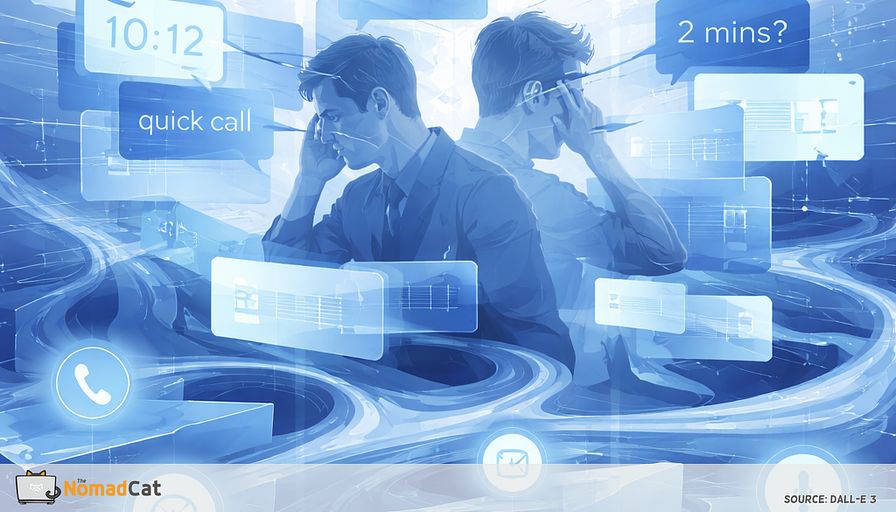
You can start the day like a single player game. Clean inbox. Neat calendar. Water bottle filled. Then 10:12 happens. A last minute invite that “should be quick”. A meeting that spills past the end time because it always does. A “2 mins?” ping that feels easier to answer than to explain why not.
By mid afternoon, the plan is dead. Not because you lack motivation, but because your calendar is not actually yours. It is shared infrastructure. Other people can place claims on your time, and the default settings often treat those claims as urgent.
This article is for that gap between “drink water at 10:30” and “how, exactly, with back to back calls and chat pressure”. The goal is not a more heroic routine. It is a design that still works when your day gets preempted.
Here is what you will get, in plain language.
- Why desk day interruptions don’t just annoy, they quietly break the assumptions behind most health advice
- A simple diagnostic that turns a failed plan into something debuggable instead of personal
- The shift from fragile routines to protocols with failure modes, like “if the meeting runs late, do X”
- A small set of minimum rules that make breaks executable, without drama or long explanations
- Micro actions and coordination tweaks that survive a normal Tuesday, even with meetings, pings, and overruns
Single player plans in a multiplayer day
The day you thought you owned
You start clean. Inbox at 0, a neat calendar, water bottle filled. At 10:12 someone drops a last-minute invite that “should be quick”. At 10:58 the meeting overruns anyway, and the 2 minutes buffer becomes a myth. At 11:06 a chat ping lands with “2 mins?” and you answer because it’s easier than explaining why not.
By mid-afternoon you notice you have not stood up. Lunch becomes whatever is closest to the keyboard. The walk you scheduled is now a stack of reschedules.
Interruptions don’t just annoy. They raise stress and time pressure (Mark, Gudith & Klocke, 2008). And when you have low control over your day, strain goes up (Karasek, 1979). Once you see the pattern, the real question is what your original plan quietly assumed.
Most health advice has 1 hidden input: you control your blocks.
Advice world is simple- drink water at 10:30
- walk at 12:30
- train at 18:30
Desk world is shared. Your 12:30 walk is competing with a meeting that runs to :58, a sandwich, and 4 follow-ups.
A useful, blameless diagnostic question is this
At the exact moment the plan died, who had veto power
Worked example, using the morning above: if your walk depended on the 10:58 stop-time and the meeting didn’t stop, the veto wasn’t “you”. It was the overrun norm. If the break was still possible at 11:06 but you answered “2 mins?” anyway, the veto was the “reliable responder” reflex (plus the fear tax behind it).
Sometimes it’s a person with authority. Often it’s indirect.
- the “reliable responder” identity that makes chat feel non-deferrable
- the team norm where meetings overrun without anyone naming the cost
- the quiet rule that stepping away looks like disengagement
Add task switching costs and “just 5 minutes” off-plan becomes 25 minutes to get your head back in the right place (Monsell, 2003).
So the fix is not a more heroic routine. It is a design that survives preemption.
Your calendar is a shared system
A desk calendar looks personal, but it behaves like shared infrastructure. Meetings, chat, clients, and expectations mean people can book you by default. Co-ownership just means other people can place claims on your day, and the system treats many of those claims as valid unless you install different rules.
Even low message volume can feel suffocating if each message comes with an expectation of an immediate reply. That pressure has a name. Workplace telepressure is the urge and mental preoccupation to respond quickly (Barber & Santuzzi, 2015).
A shared system also fails when it has no escalation ladder
- everything uses the same ping channel
- nobody uses “by tomorrow” as a normal deadline
- there is no real emergency path, so everything pretends to be one
That ambiguity keeps your nervous system on watch because you have to scan constantly for what might be urgent. It blocks real recovery: your brain actually disconnects for a minute, and you feel in control again (Sonnentag & Fritz, 2007).
The personal part, for credibility, not drama. The author has spent most of adult life at a desk, with years in Beijing, then Berlin, and now Lisbon, often working past midnight. It is possible to work a full day without eating, drinking, or moving and call it focus if you squint. The early signal is annoying and specific. Upper-back tightness that builds until it forces movement. It’s the thing that makes you stand during the “I’m just listening” parts of calls, because sitting still starts to feel like a clamp. A spouse reminder to sit straight works for about 3 minutes.
So yes, plans fail in predictable ways.
Health plans that survive real calendars
A routine is fragile, a protocol has failure modes
A routine sounds like this. 12:30 take a 10-minute walk.
Then it’s 12:28 and the meeting is “just wrapping”. At 12:31 a chat ping arrives with “quick question”. You think, fine, later. Later becomes never, partly because resuming after an interruption has real restart lag (Trafton & Monk, 2007).
A protocol is the same intent with reality branches included
- if the meeting runs late, do X
- if a ping arrives, do Y
- if both happen, do Z
Boring, yes. Runnable, also yes.
Think of blameless postmortems in SRE culture. When something fails, the question is not who messed up. It is what conditions made the failure likely. Treat health the same way.
The minimum fields that make a break executable
These are not rules for perfection. They reduce negotiation in the moment, which is where most plans die.
Minimum protocol fields that tend to work in desk jobs
- Response window for messages in normal mode
- Urgent definition in 1 sentence
- Escalation channel like “urgent via call”
- Overrun rule when meetings eat the break
- Return timestamp like “back at 14:10”
- Unreachable signal that is consistent and low-drama
- Fallback version when time collapses
Scripts matter because they make the boundary clear. Short phrasing like “Heads down, back at 14:10” or “If urgent, call” is boring on purpose.
Why clarity lowers pressure more than willpower does
When expectations are unclear, people monitor. One eye on chat, one ear for the next calendar alert, and a third invisible eye on reputation.
That constant readiness is where telepressure grows (Barber & Santuzzi, 2015). More clarity means less guessing. Less guessing means less monitoring. Less monitoring creates small pockets of real recovery: your attention comes off the leash, and you get a tiny sense of control back (Sonnentag & Fritz, 2007).
Not a long lunch on a beach. Just 3 minutes where attention is not tethered to the possibility of being needed.
The permission stack behind every basic need
A 5-minute walk looks like a fitness decision. In a desk job, it is usually a permission stack.
- visibility
- reply latency norms
- calendar power and buffer theft
- role pressure, the need to justify basic human maintenance
Fix the first failing layer and everything downstream gets easier. It is demand-control translated into daily life.
Visibility rules and the green dot problem
Presence indicators and camera norms turn movement into a story.
Video calls can be high nonverbal demand environments, with sustained self-presentation (Bailenson, 2021). Research on Zoom fatigue also points at self-view as its own drain.
So people freeze. They delay water. They wait for a “clean moment” that never comes. The green dot becomes a leash.
Latency rules that turn breaks into risk
If instant replies are the norm, any break becomes a bet on your reputation.
It’s not only about message volume. Expected response time becomes a social SLA. That reply-urge is part of the same pressure we named earlier. Constant connectivity is also linked with poorer recovery and more exhaustion in after-hours smartphone research (Derks, van Mierlo & Schmitz, 2014).
Meeting overruns that erase usable gaps
Meeting overruns are not just longer meetings. They erase the seams your day needs.
A calendar can look reasonable with 10-minute buffers. Then 1 meeting runs 8 minutes late, the next starts “right now”, and lunch becomes a myth made of Slack reactions.
Overrun is not physics. It is a rule we pretend we cannot touch.
The narration tax of being reliable
Role pressure is when being reliable is paid for with your body.
If water needs a reason, it gets postponed. If a stretch needs a reason, it disappears. If a 5-minute walk needs a calendar invite plus an apology, it won’t happen.
With the stack visible, the next step is practical. Pick 1 recent “plan died” moment and identify which layer failed first.
A 10 minute co-ownership audit
This is a one-time review you run once, for 10 minutes, on 1 recent failure.
Keep it blameless. Conditions and rules, not a culprit.
5 steps
1) Name the attempt
2) Pin the exact death moment with a timestamp
This stops you rewriting the whole day as “I was busy”. It also matters because unfinished threads leave attention residue (Leroy, 2009), and interruptions add restart friction (Trafton & Monk, 2007).
3) List the other owners in the moment
4) Write the implied rule that was operating
Common ones
- “I must accept last-minute invites.”
- “I must stay visible and responsive.”
- “I must reply fast on chat.”
- “Meetings end when they end.”
5) Pick 1 missing dependency to install
Examples
- a response window like “reply within 2 hours unless urgent”
- an escalation path so real urgent things do not cosplay as urgent
- a meeting stop-time rule to protect seams
- a camera-off segment or self-view off
Pick 1. Most redesign is boring, which is good news.
Coordination light changes that survive Tuesday
Runnable actions are compatible with interruptions. They are instantly pausable, easy to resume, and not dependent on a protected block.
Microbreak research supports the basic idea that short breaks can reduce fatigue (Kim, Park & Niu, 2017). Brief breaks can also reduce discomfort without costing productivity, which is the hidden worry behind many skipped breaks (McLean et al., 2001).
Examples that often fit real desk days
- stand during listening segments when you are not presenting
- refill water and take 10 slow sips between 2 calls
- walk a doorway loop while a meeting starts and people join
- switch a low-stakes 1:1 to audio only when video adds nothing
- turn self view off
- do 3 shoulder rolls while a file exports or a page loads
- take a 30 to 60 second eyes-off-screen break mid task (Ariga & Lleras, 2011)
These work because they minimize narration tax and re-entry cost. They also stay compatible with responsiveness, which is often the real constraint.
Micro-agreements help when micro-actions are not enough
- urgent via phone call
- normal replies within 2 hours
- a reusable status line with a return time
Once urgency is separated, reply timing becomes negotiable instead of implicit. Clarity is the main lever on that reply-urge (Barber & Santuzzi, 2015).
Buffers also need protection because meetings are the biggest buffer thief
- default 25/50-minute meetings when possible
- keep the last 2 minutes for wrap so “quickly” does not spill
- require an owner and a 1-line agenda so the end has a shape
Camera expectations are another veto layer worth renegotiating. Camera optional is bandwidth and fatigue management. If camera-off feels risky, self-view off is a decent intermediate option.
Minimum viable consistency in a shared calendar
A better metric than streaks is this
Minimum viable consistency is the rate at which a tiny health action still happens on a normal workday, without needing ideal timing or an explanation.
Habits need stable cues (Wood & Neal, 2007). Desk days are unstable. So measure executability under interruption.
Keep tracking embarrassingly small so it survives busy weeks
- Today during work did 1 pause-safe movement or meal anchor happen ☐ yes ☐ no
Treat that checkbox like a metric, not a moral score.
When this becomes normal, the system calms down in a mechanical loop
clarity → less monitoring → more recovery → easier follow-through
If the checkbox stays empty, treat it like a failed deploy, not a character flaw. A missed action usually means a missing dependency in the interface with other humans, unclear reply windows, no escalation path, meetings that eat seams.
Annoying, but at least it is debuggable.
If your “drink water at 10:30” plan keeps dying by 10:12, it is probably not a motivation problem. It is a systems problem. In a meeting-dense desk day, your calendar is shared infrastructure, and default norms make everything feel urgent. The useful shift is from fragile routines to simple protocols with failure modes, plus a few minimum rules that remove negotiation in the moment. Response windows, a real urgent channel, a meeting stop-time rule, and a boring status line with a return time can buy back a bit of control. Then tiny, pause-safe actions can actually happen, even on a normal Tuesday.
The bar here is not perfection. It is executable.
Annoying, but at least it is debuggable.
You might be interested by these articles:


Microbreaks that survive pings and meeting overruns

Stop treating breaks like optional when your calendar is shared

Why Your Desk Lunch Keeps Disappearing and What Is Stealing the Gaps

Your calendar is the boss not your motivation

Why your 3-minute break still needs permission at work

Harnessing AI with Java for Scalable Business Solutions

Neuromorphic Computing Trends




