Abstract:
The article argues that when your workday is chopped into “meeting crumbs” and punctured by overruns, “2 mins?” pings, and the silent rule to always look available, repeated failures to exercise, eat real meals, or protect sleep are usually a coordination problem—not laziness or a character flaw—because much of your schedule is “co-owned time” that other people can legitimately preempt. Using a shared-server metaphor for desk work (constant interrupts, handoffs, and fast-response expectations like telepressure), it explains how health habits get displaced mechanically and why sleep collapses first when after-hours availability norms leak into the evening and nobody defines what “done” means (the author notes this is their own unsolved variable and default tendency: working late into the night). The proposed fix is to treat habits like operational systems by adding a small “runbook” layer—clear interruption rules, a normal response window (not ASAP), one true emergency channel, an escalation threshold, a meeting-overrun stopping line, and explicit “back at 15:40” return timestamps—plus a guilt-free 90‑second “veto receipt” that turns misses into data (what you planned, what replaced it, what rule you felt bound by, and whether urgency was real or undefined) while logging categories not names. It also recommends “multiplayer-safe” habits that are interruptible, low-setup, relocatable, and socially non-weird, and replacing fragile streaks with ops-style metrics like missed-session rate and time-to-reschedule so one chaotic Tuesday doesn’t become “I blew it,” emphasizing that systems can be reconfigured without turning self-care into another full-time job.
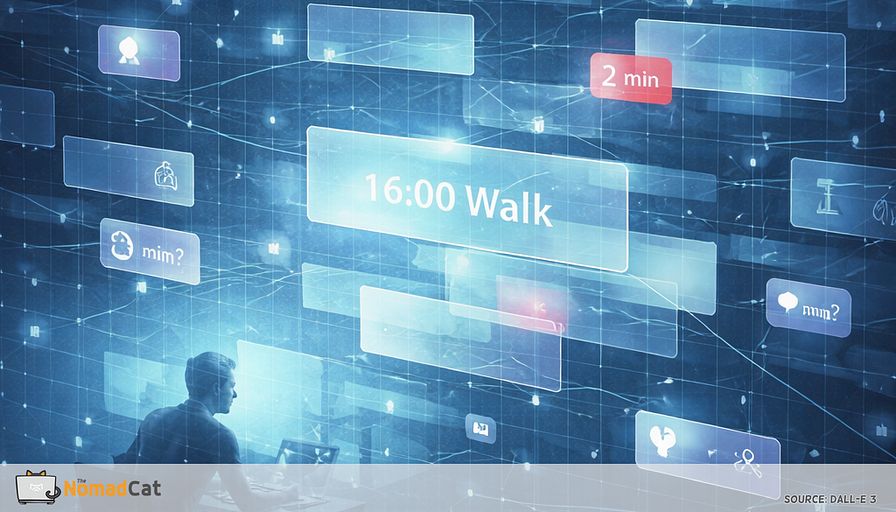
If your calendar feels like a multiplayer game you didn’t agree to, you’re not imagining it. The day gets chopped into tiny gaps that look usable on paper, then a meeting runs long, someone pings “2 mins?”, lunch becomes a quiet snack on camera, and the “quick stretch” turns into “tomorrow”. Not because you don’t care. Because the time wasn’t fully yours to spend. For me the early signal is always the same: that upper-back tightness that builds quietly until it forces me to move.
This is for people whose “12-minute walk every day at 16:00” sounded reasonable and still keeps disappearing. Not because you lack discipline. Because when your time is shared across meetings, handoffs, and “be responsive” norms, a missed habit is often a coordination problem. The fix is less motivation talk and more basic rules—like adding a small runbook to something that keeps getting interrupted.
Here’s what you’ll get in the sections ahead:
- A clear model for why desk work keeps deleting movement, real meals, and sleep, even when intentions are good
- The idea of co-owned time and why that 16:00 walk can be correct but not runnable in a chopped-up Tuesday
- A small protocol (interruptions, response windows, meeting overruns) plus a 90-second “veto receipt” and a better scoreboard than streaks
If sleep is the variable that keeps collapsing, and the default is working through the night when nobody defines “done”, that’s not a personal mystery either. It’s a system doing what it’s currently set up to do. The good news is that systems can be reconfigured. Without turning this into a new full-time job.
The multiplayer gap in your calendar
A habit is not fighting laziness
Most health advice hides one big assumption: you have time you can defend.
A normal desk day doesn’t. The 10:30 meeting runs 7 minutes late, so the “quick stretch” becomes “later”. Someone pings “2 mins?” and the seam between tasks gets eaten again. Lunch slides by 5 minutes, then 15, then it’s suddenly a sad snack while the camera is on and everyone pretends not to chew. At 18:40 you close the laptop, then reopen it for “just one follow-up” that becomes a thread, and the evening is now tied to other people’s timelines.
Coordination, not caring, is what breaks the plan. When time is interdependent, it gets allocated through dependencies and responsiveness norms, not personal intention (Malone and Crowston, 1994). Meaning: other people’s dependencies decide your gaps. When health plans fail here, it’s often a control problem, not a motivation problem.
Co-owned time and why plans keep breaking
Co-owned time is the part of your day where other people can legitimately create work for you, move your start times, or re-prioritize your attention. It’s not “bad time”. It’s just not yours alone.
Most habit plans quietly assume the opposite, something like private time with:
- fixed blocks that stay fixed
- predictable transitions
- a “no” that actually holds
When work gets more uncertain, the overhead of syncing with other people grows (Galbraith, 1974). So your calendar becomes more “multiplayer” exactly when things are messy. In that setup, movement, real meals, and sleep are usually the first things traded away.
The plan’s hidden spec sheet
The routine you were handed assumes private time
That 16:00 daily walk plan is often correct but non-runnable in the environment it’s dropped into.
It requires a runtime with protected blocks, predictable transitions, and a low chance of being interrupted. It’s like code that runs fine on a single-threaded machine, then you deploy it on a shared server with random interrupts.
And the interrupts aren’t abstract. They come from role expectations. When a teammate messages, a manager “needs 5 mins”, or a stakeholder asks for an update, the implied contract of the role beats the calendar (Kahn et al., 1964).
Desk work is built from interruptions and handoffs
For many knowledge jobs, meetings and quick questions are the work. People switch working spheres roughly every 3 minutes (González & Mark, 2004). After an interruption, it can take about 23 minutes to return to the original task (Mark, Gudith & Klocke, 2008). Add attention residue (Leroy, 2009), and the “tiny gap” between calls stops being a clean slot you can always use.
That’s why “I’ll walk between calls” keeps losing: the gap gets eaten by switching, catching up, and remembering what you were doing.
The health effect is boring: displacement. Movement gets squeezed out first. Proper meals next.
When long hours become the proxy for coordination load
The painful part is emotional. The deletion feels like a choice. Like “why didn’t you just go for a walk”.
The evidence is less moral and more mechanical. Long working hours are associated with reduced leisure-time physical activity (Artazcoz et al., 2009) and with lower activity and poorer diet behaviors across studies (Wong et al., 2019). Long hours bundle high demands, low control, and coordination load. When that expands, health behaviors get pushed to the edges. Edge items get deleted.
Why it still feels like your fault
When a notification becomes a moral verdict
A meeting overrun deletes your plan, and the brain turns it into a values problem. The calendar got preempted; you interpret it as proof you “don’t care enough”.
The veto usually comes from silent workplace rules like be responsive and don’t look unavailable. Barber and Santuzzi (2015) call the felt pressure to reply fast telepressure. Add role conflict and role ambiguity, which link to strain (Örtqvist & Wincent, 2006), and the missed workout becomes perfect rumination fuel.
After-hours reachability hits sleep first
After-hours connectivity is where the cost is easiest to spot because it lands on sleep. After-hours work ICT use links to worse sleep quality, partly through reduced psychological detachment (Barber & Jenkins, 2014). Nighttime email predicts reduced sleep and next-day fatigue with rumination as a pathway (Lanaj, Johnson, & Barnes, 2014). Smartphone work use shows similar interference (Derks et al., 2015).
I’m in Lisbon since 2023, and if nobody defines “done”, I’ll keep working past midnight. Sleep is still the variable I haven’t solved. That’s not a personality quirk. It’s what a system does when availability norms leak into the evening and the day has no stopping rule.
Once sleep is unstable, “discipline” becomes a weak lever. Recovery sits upstream of good decisions.
The missing layer is a small protocol
Habits need protection rules, not just intent
Teams already do this for anything important. Launches have runbooks. Incidents have escalation. Nobody ships “we’ll just try harder” as an ops plan.
A habit in a multiplayer calendar is the action plus the protection logic around it. The minimum useful layer:
1) Interrupt rule
What can interrupt this break, and what cannot. Priority is basically impact × urgency.
2) Response window
A normal reply time that is not “ASAP by default”.
3) Escalation path
One channel for true emergencies, with a threshold, so the signal means something.
4) Meeting overrun containment
A rule for what happens when the meeting is still expanding at minute 30. Example: at :28, decide whether you’re shipping a decision or scheduling it.
5) Return timestamp
If stepping away, leave “back at 15:40” so people don’t fill the silence with anxiety.
Habits survive busy weeks when they have explicit rules for how they compete with requests.
Maintenance loses when it has no agreed priority
Most orgs have a negotiation layer for incidents and launches because downtime has a cost. Health breaks are also maintenance, but they usually have no agreed expectation. So they lose to anything loud.
This is bigger than personal time management. WHO/ILO (2021) treat long hours as a preventable exposure with real health costs. When the exposure is normalized, maintenance needs explicit protection or it gets traded away silently.
A tiny set of norms that reduces “ASAP by default”
Keep it simple and non-weird:
- 1 emergency channel: if it’s a true emergency, call. If it’s not, don’t.
- Normal reply window: chat within 2 hours during work hours.
- Away status with return time: “Walking, back 15:40.”
- Overrun stopping line: “I need to drop at :30. Can we park decisions and do async?”
- Escalation clarification: “If it’s urgent, what breaks if we wait until 16:00?”
One boring but effective script: “I’m offline 15 minutes, back at 15:40. If it’s urgent-urgent, call.” Not a hostage negotiation.
The 90-second veto receipt
A miss is an incident report, not a personality test
When a habit gets deleted, treat it like a tiny post-incident report. Not for guilt. For debugging.
Relapse prevention research is blunt: a lapse is a lapse, not an identity statement, and shame makes the next lapse more likely (Marlatt & Gordon, 1985). Brief self-monitoring is also one of the higher-yield behavior change techniques (Michie et al., 2009). It can be small enough to survive a messy day.
The 4 fields that turn shame into data
After a miss, write a “Veto Receipt” with only 4 prompts:
1) Planned action (ex: 12-minute walk at 16:00)
2) What replaced it (meeting overrun, Slack thread, “2 mins?” becoming 25)
3) Rule you felt bound by (reply fast so you don’t look absent, aka telepressure)
4) Urgency real or undefined (no impact stated, loop stays open)
After a few receipts, the tone changes. Less “why am I like this” and more “ok, so that channel is basically a pager”.
Sort vetoes into 2 buckets:
- Legit emergencies
- Ambiguity pretending to be urgency
Then pick the smallest negotiation that buys the most habit uptime.
Privacy note: log categories, not names. “Meeting overrun” is useful. “Paul did it again” is a document you don’t want on a work laptop.
Two veto types and what to do with each
Legit vetoes need an incident mode
Sometimes the day really is all hands. The goal isn’t denial. It’s damage control.
A resilient plan includes an incident mode:
- Use If X happens, then Y planning. Example: if a true emergency day eats the walk, do 6 minutes of movement before shower and stop (implementation intentions, Gollwitzer & Sheeran, 2006).
- Keep re-entry cheap. A lapse is a lapse.
Default vetoes need governance
Default vetoes are the repeatable ones: ambiguous asks, meeting overruns that “only need 5 more minutes”, escalation-by-chat, the “quick question” that becomes a new project.
This is telepressure territory. It’s solved by clarity.
Shopify reported deleting about 10,000 recurring meetings and removing roughly 76,500 hours of meeting time via policy changes (Shopify, 2023). That doesn’t prove health outcomes. It does show the lever is real.
Multiplayer safe habits
What makes a habit hard to delete
Judge a habit by “does it still run on a chopped-up Tuesday”, not “is it ideal”. Multiplayer-safe habits tend to be:
- Interruptible (pause and resume)
- Low-setup (no gear, no shower, no 12-step prep)
- Low-explanation (no speech required)
- Relocatable (home, office, hallway)
- Socially non-weird (fear of looking unprofessional is a real barrier, Shrestha et al., 2018)
Defaults beat heroism. Friction is the real tax (Madrian & Shea, 2001).
A scoreboard that does not punish Tuesdays
Streaks work until the first chaotic day, then one miss becomes “i blew it” (hello, abstinence violation effect in spreadsheet form).
Use boring ops metrics instead:
- Missed-session rate (planned then deleted with no salvage)
- Rescheduled-within-24h rate
- Median time-to-reschedule
If habits survive normal Tuesdays, calm weeks become easier. And the desk invoice shows up less in stiffness, low energy after lunch, convenience eating, and sleep debt. Sleep stays the keystone: after-hours messaging and weak detachment land there first (Barber & Jenkins, 2014). The scalable fix is designing for the worst common day, not the best imaginary one.
If your days keep getting chopped into meeting crumbs, the problem usually isn’t motivation. It’s that your time is co-owned, so that perfectly reasonable 16:00 walk gets preempted by overruns, “2 mins?” pings, and the silent rule to look available. Add a tiny protocol around the habit with response windows, one real emergency path, an overrun stopping line, and a return timestamp. When things still break, log a 90-second veto receipt and fix the repeatable veto—not yourself.
Most weeks, the real veto isn’t urgency. It’s undefined urgency wearing an “ASAP” costume.
You might be interested by these articles:


Stop losing breaks to the shared calendar

Stop treating breaks like optional when your calendar is shared

Microbreaks that survive pings and meeting overruns

Write desk health like software with degraded mode built in

Why your 3-minute break still needs permission at work

How data-driven mental health apps are reshaping wellness

minimalist onboarding for freelancers made easy