Abstract:
The article argues that when desk-day “nice gaps” vanish and lunch shrinks to a rushed 8 minutes at your keyboard, it’s usually not a motivation failure but a structural scheduling problem caused by work time behaving like shared infrastructure—contested bandwidth that can be preempted at any moment by Slack pings, meeting overruns, drive-by questions, or even your own “quick check.” Using a vivid example of standing up to refill water only to get pulled into a Slack thread, a screen share, and an early-starting meeting (leaving the untouched glass beside you), it reframes missed movement, meals, and microbreaks as “interoperability bugs” created by preemption without a social protocol, where fast replies become an implied SLA through reciprocity and ambiguity about what’s truly urgent—leading to “coordination debt” that peaks midweek as buffers disappear and you start canceling breaks in your head before anyone asks. Instead of adding another habit system, it recommends a lightweight debugging approach—briefly logging who/what preempted the break, through which channel, and what unspoken rule you felt forced to follow—then fixing the interface with small team/personal protocols like defining emergencies, mapping channels to urgency, aiming for predictable response latency over heroic speed, using Slack check-in windows and time-bounded away statuses, and treating meeting overruns as deletion of the only maintenance space you had, so that tiny, interruption-tolerant health actions (even short walks) can reliably survive a real “multiplayer” workweek without turning into another guilt-inducing dashboard.
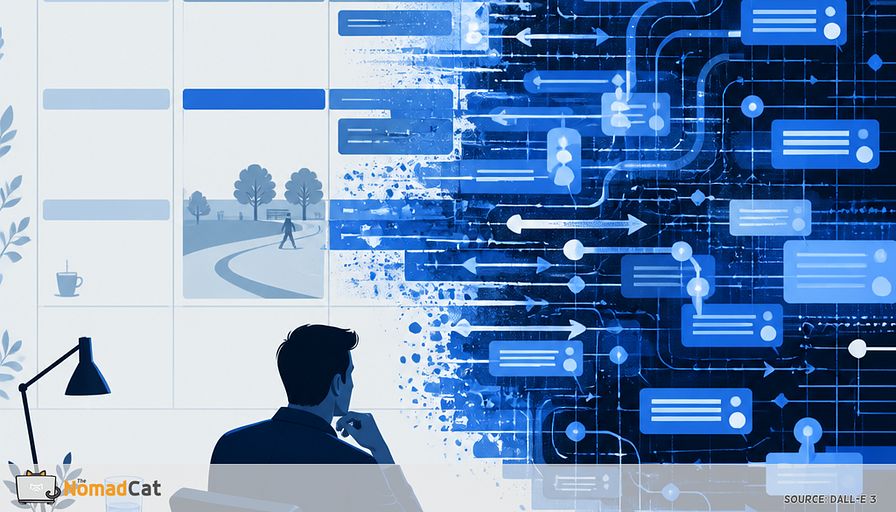
By 09:30 the calendar looks fine. A couple meetings, 2 “nice gaps”, lunch somewhere in the middle. By 18:00, lunch was 8 minutes at the desk, the gap got eaten by a late start plus a “quick question”, and the only movement was reaching for a charger. If that sounds familiar, it is not a motivation problem. It is a scheduling problem disguised as personal failure.
A normal desk day, it doesn’t behave like private time. It behaves like shared infrastructure. Your open slots are not empty space. They are contested bandwidth. Beijing offices, then Berlin workations on bad chairs: my calendar always looked reasonable at 09:30, and still the day got “filled in” anyway. Slack, email, meeting overruns, and drive-by requests can take those slots at any moment. That is why “I’ll do a 2-minute break” keeps losing to “just this one message”.
This article is here to make that pattern easier to see, and therefore easier to fix, without adding another system to manage. It is a practical way to think about missed habits as interoperability bugs. Not character flaws.
We’ll cover
- why visible gaps are not the same as usable time, and how interruption patterns quietly erase breaks
- the real failure mode, preemption without a protocol, and why willpower is a weak tool in a multiplayer workday
- coordination debt, or how fast replies turn into an implied SLA that makes Wednesday feel impossible
- a simple way to “debug” missed movement and meal breaks by naming who or what preempted them, through which channel, and which rule you felt forced to follow
- lightweight team and personal protocols that make small health actions doable during real work, not just on calm weekends
If you do only 1 thing: define a non-urgent response latency for Slack, so a 10-minute lunch doesn’t feel like disappearance.
No hype, no perfect morning routine fantasy. Just a more honest model of the day you already have, and a few small configuration changes that survive contact with it.
A normal desk day that behaves like shared infrastructure
The hidden assumption is unilateral time control
You can run like that for years, until the early signal shows up, upper-back tightness that slowly becomes the new default.
That feeling makes more sense once you separate visible gaps from usable time.
Desk time is contested time. It is less like a private diary and more like shared bandwidth, meaning: other people can grab it faster than you can protect it. An open slot is not empty space. It is a queue that anyone can preempt with a ping, an invite, a “can you look,” or a meeting that overruns.
Research on “time famine” describes how interruption becomes structural, not personal (Perlow, 1999). Eurofound’s EWCS 2015 is also a reality check: many people are not actually able to take a break when they want (Eurofound EWCS, 2015).
Once time is co-owned, the question becomes where habits die in real time.
The real failure is preemption without a protocol
How a 60 second window gets consumed
Stand up to refill a water glass. Laptop stays open because it is “just 60 seconds.” A Slack ping lands. Thumb answers while walking. The reply triggers a second thread, then a quick screen share request. While the glass fills, the calendar reminder pops up and the meeting starts 2 minutes early because “everyone is here.” Back at the chair, the water is there, untouched, and the body is already back in desk mode.
The action was not skipped. It was preempted.
Interruptions explain why it feels like time evaporates. Once attention moves, the original goal decays and coming back to it is not automatic (Altmann & Trafton, 2002). Interruptions that hit before a clean boundary are harder to recover from (Monk, Trafton & Boehm-Davis, 2008).
The missing layer is social permission
The odd part is why the default is instant compliance even when nothing is truly urgent.
If you reply 20 minutes later, you can already picture the follow-up: “did you see this?” Or worse, the quiet story you imagine people telling themselves: “they’re hard to reach.”
In ambiguity, response time becomes a signal. Replying “too slow” can read as dismissive, so people protect themselves by replying fast (Burgoon, 1993). And fast replies create an unspoken “now you reply fast too” loop (Gouldner, 1960). In that environment, a 2-minute mobility break has the weakest external legitimacy.
So the fix is not more willpower. It is defining what “urgent” means and how fast “fast” is.
Turn the mess into simple design questions
When a team has no explicit protocol, health loses by default. It helps to ask a few unglamorous questions.
- What counts as an emergency here
- What is an acceptable response time for non-urgent requests
- What is each channel for, and what is it not for
If those are undefined, the ambiguity bill gets paid in small units, by the body, all day.
Coordination debt is why Wednesday feels impossible
How responsiveness turns into an implied SLA
A useful name for it is coordination debt, meaning accumulated implied SLAs. If replies land in 2 minutes on Monday, that latency quietly becomes the “normal” by Tuesday. Reciprocity escalates it.
The midweek signature is self preemption before anyone asks
This is not about bad coworkers. It is about how systems drift toward the loudest urgency.
By Wednesday, the pattern is usually recognizable.
- Meetings overrun, so the next meeting starts late, so the next one also overruns
- Lunch becomes “flexible” which means it disappears first
- Breaks start needing a reason, even if nobody said that out loud
- Health actions get pre-cancelled in your head because you predict the contention
Perlow describes how time pressure becomes structural, negotiated minute by minute (Perlow, 1999). Meeting load itself correlates with fatigue and lower perceived productivity, so the body tax ramps while the calendar gets more dense (Luong & Rogelberg, 2005).
No villain needed just missing routing rules
With that frame, missed habits become debuggable instead of moral failures. In a system without routing, “urgent-ish” messages will win because they are easiest to justify.
Missed habits are interoperability bugs not character flaws
Write a blameless incident report in 30 seconds
The useful question is not why didn’t I do it. That invites personality stories and guilt. It is what preempted it.
Once you can name the preemption pattern, you can stop trying to “optimize the habit” and fix the interface.
1) Preempting agent (person, meeting, self-checking)
2) Channel (Slack, email, calendar, someone at your desk)
3) Implied rule (reply instantly, be visibly present, don’t miss kickoff)
Example: Agent: exec ping. Channel: Slack. Rule: “fast reply proves I’m on it” (Elsbach, Cable & Sherman, 2010; Munsch, 2016).
This beats adding yet another micro-habit because you are not shrinking behavior. You are reducing coordination failure so the behavior can run.
A quick compatibility checklist for contested time
Tiny inputs can matter, but only if they survive contact with your day.
- Interruption tolerant: can stop at a boundary (Monk et al., 2008)
- Status safe: doesn’t scream “I’m unavailable” (Elsbach, Cable & Sherman, 2010)
- Low handoff cost: easy to resume after a ping
- Negotiable: can be justified when break autonomy is low (Eurofound EWCS, 2015)
A 2-minute walk to refill water is interruption tolerant and cheap to resume. A 20-minute “quick workout” in the middle of a hot chat thread is usually none of the above.
That is why the goal is not to do more. It is to do the smallest thing that survives.
Very short walking breaks have shown measurable effects on post-meal glucose in lab settings (Dunstan et al., 2012; Dempsey et al., 2016). WHO’s baseline advice is basically “replace sedentary time with any activity” (WHO, 2020). So the bottleneck becomes deployability, not intensity.
Why tiny habits still fail when the real constraint is permission
If the calendar has a 3-minute gap but using it makes you look slow or unavailable, then time is not the scarce resource. Authority is.
A quick diagnostic is whether it works on weekends but dies on weekdays.
Weekend-only success is a test result. If it runs Saturday and crashes Wednesday, it is likely a coordination interface bug, not a sizing problem.
Lightweight protocols that make health runnable during a normal workday
Give urgent work 1 explicit lane not 7 vague ones
When everything is “urgent”, the brain lives in preemption mode. It helps to keep urgent rare, explicit, and slightly annoying to invoke.
Map channels to urgency so deferring is socially safe
Even a rough mapping removes most ambiguity. For example, a call as P0, chat as P1, email as P2, where P2 means “when you can” and nobody acts shocked.
Rule: P1 = reply within 2 hours; P2 = same day.
Channel meaning has to be consistent to become real (Walther, 1992, 1996).
Aim for predictable latency not heroic speed
If replies land in 2 minutes all week, then 12 minutes starts to look like a snub, not a normal delay (Gouldner, 1960; Burgoon, 1993).
So instead of being fast, it is often more sustainable to be boringly predictable.
Use check in windows so breaks do not look like disappearance
A low-drama approach is message-check windows instead of continuous interruptibility. Something as plain as “I check Slack at :00 and :30, call me if it’s blocking” can work because it replaces silence with a contract.
Treat meeting overruns as buffer deletion not a small delay
A 10-minute overrun deletes the transition buffer where lunch, water, and 2 minutes of walking would have lived. Boundary timing affects interruption cost (Monk et al., 2008), and meeting load links to fatigue (Luong & Rogelberg, 2005).
Overruns do not only steal minutes. They erase the only maintenance space you had.
Make non response legible with time bounded away signals
Away signals work because they convert ambiguity into a predictable expectation. Keep them time-bounded and uninteresting.
Two examples that are plain enough to normalize are “Away 10 min back at 14:40” and “In a meeting until 15:10 email ok”. Clarity helps because not everyone even has full break autonomy to begin with (Eurofound EWCS, 2015).
Minimum viable consistency in a multiplayer week
Consistency can mean there is at least 1 non-reclaimable window.
A more honest metric is not “did the habit happen daily”, but “did any maintenance window exist that other people could not instantly reclaim”. Something like 2 protected 10-minute blocks per week, visible on the calendar, with status set, counts.
If you cannot create even 1 window, treat that as data about workload and culture, not as a motivation problem. Microbreaks tend to reduce discomfort and fatigue without obvious productivity damage, when they actually happen (Kim, Park & Niu, 2017). Sitting interventions work better when there is organizational support rather than advice-only posters (Shrestha et al., 2018). WHO’s framing is refreshingly plain. Move more and sit less. It still counts (WHO, 2020).
A reusable log format for the next time it breaks is 3 fields.
- Who preempted you
- Through which channel
- What rule you believed you had to follow immediately
One final caution for metrics-inclined readers. If you are physics-trained and use tools like a Polar H10, it is tempting to build a dashboard for everything. The practical win is fewer renegotiations and fewer context switches, not prettier charts. Measurement is only helpful if it reduces ambiguity. If it adds admin and guilt, it is just more coordination debt.
If your 10-hour desk day keeps eating the “nice gaps” and turning lunch into 8 minutes with one hand on the mouse, that is not a character issue. It is what happens when your time works like shared infrastructure and every open slot is contested bandwidth.
The useful shift is treating missed movement, water, and real meals as preemption events you can debug. Name what stole it, which channel did it, and which unspoken rule forced the instant reply. That tiny log turns guilt into a fixable interface problem. Then a few lightweight protocols do the heavy lifting. Clear channel meanings, predictable reply latency, check-in windows, and treating meeting overruns as buffer deletion make small health actions doable on a Wednesday.
Most weeks, it’s not the big deadline that kills movement. It’s the small, socially-risky 10 minutes that nobody agreed you’re allowed to take.
You might be interested by these articles:


Stop losing breaks to the shared calendar

The green dot trap why empty calendar time still is not yours

Stop blaming motivation when your calendar preempts your health

Why your 3-minute break still needs permission at work

Your calendar is the boss not your motivation

Transforming Shopping with AR Tech

Transforming Learning Through VR