Abstract:
The article argues that many “simple” health habits fail for knowledge workers not because of laziness but because modern work makes you effectively on call: even with an empty calendar, an 8‑minute break can feel socially risky when Slack is open, your dot is green, and any gap can be preempted by a “quick question” or an early-starting meeting. It reframes the problem as a multiplayer coordination system where time is co-owned, unclear response expectations create “coordination debt,” and “latency theater” turns instant replies and visible availability into reputational insurance—often hitting lower-power employees, caregivers, and women harder via flexibility stigma. Because undefined urgency and micro-interruptions keep attention in standby mode (not deep work or real rest), people hover near the laptop, eat at the desk, skip movement, and then misdiagnose the outcome as a discipline issue even on moderate-workload days. Instead of moralizing or fantasizing about protected 45‑minute blocks, the piece recommends treating missed plans like incident data: run a quick, blameless coordination postmortem to identify the hidden “felt rules” (visibility risk, telepressure, assumed immediacy), then choose “coordination-safe” health actions—small, stoppable, low-explanation behaviors that fit into 3–10 minute gaps and don’t depend on meetings ending on time—while advocating for team protocols like explicit response windows to reduce the constant default-to-now pressure.
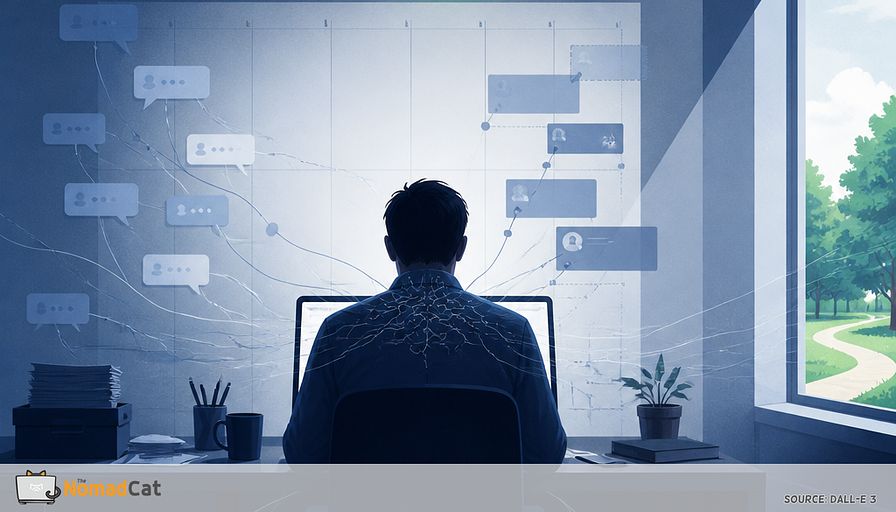
Slack is open. Your dot is green. The calendar looks empty for once, yet standing up for 8 minutes feels weirdly risky. Not because you are “lazy” or “unmotivated”, but because your day is basically on call. Any gap can be taken over by a “quick question”, a meeting that starts early, or the quiet expectation that you should be instantly reachable.
For me, this shows up in one very specific way: the lunch-walk plan. The simple one. “At 12:30, I go outside for 15 minutes.” It looks harmless on paper, and it fails in the same dumb way again and again.
That is the problem this article is here to name.
A lot of health advice assumes your schedule is single-player. You block lunch, take a walk, do a short workout, done. But knowledge work is multiplayer. Time is shared. And when the coordination rules are fuzzy, everything defaults to now. You end up hovering near your laptop, eating at the desk, skipping movement, and calling it a discipline issue. Even on “moderate” days.
What you will get here is a clearer model for what is actually happening, plus a way to work with it without pretending you can suddenly protect 45 perfect minutes in the middle of a meeting stack. We will cover
- The callable gap and why empty calendar time still does not feel free
- Coordination debt, the hidden tax of unclear response expectations
- Latency theater and the green-dot pressure that turns availability into reputation
- Why micro-interruptions break health habits even when workload is not extreme
- How to run a quick, blameless “incident review” on a missed plan
- What coordination-safe health actions look like when your day can be vetoed at any minute
No moral lecture. No “just wake up earlier”. Just a systems view of why your body keeps throwing errors and your work setup keeps ignoring the logs.
When the calendar is empty but you are still on call
The callable gap
Slack sits open like a smoke alarm that never rings but still owns the room. Your green dot is on. You keep half an eye on it like it is a pulse oximeter for “professionalism.” There is white space on the calendar, yet stepping away for 8 minutes feels like a small social scandal.
This is not just being busy. Busy is having a lot to do. Interruptible is being in a state where any minute can be vetoed by someone else’s “quick question.” Workload can be moderate while the interruption risk is high.
A lot of health plans quietly assume you can start and stop, and be unreachable without explanation. Real lunch away from the desk. A quick walk. A short strength circuit. But when control over your time is low, strain goes up even if tasks are manageable.
And the body does keep score. After too many months of this (for me it was also workations across Europe on bad chairs and worse desks), the first “log” is not a dramatic injury. It’s the quiet tightness in the upper back that builds without asking permission.
It also explains why it feels personal. Nobody says “you cannot stand up” or “you cannot eat,” but you still act like you need permission. When expectations are unclear, people go with the safest interpretation.
Respond fast. Stay visible.
The missing piece is not motivation. It is the unwritten coordination protocol that makes the lunch-walk plan feel like it needs approval.
Single player plans in a multiplayer day
Time is co-owned
Most health advice assumes you own your schedule like a single-player game. Desk work does not. It runs like shared infrastructure with response expectations, meeting norms, and invisible dependencies. Once time is shared, even a small break becomes a social event. That is the real bug.
The hidden cost of starting
A 20-minute gap appears between 2 meetings. You notice it. You hesitate, because leaving creates social overhead.
Will you look available.
Will someone have to “hunt” for you.
Then a “quick question” lands, or the next call starts early, and the gap disappears. The walk was not the cost. The explanation was. That is how the lunch-walk plan dies: not with “too much work”, but with too much social friction.
Coordination debt
That overhead builds up. Call it coordination debt.
It is the tax you pay when response expectations are unclear and urgency is guessed instead of stated.
It tends to come from
- Unclear response windows that create telepressure
- Undefined urgency that makes every ping feel like “now”
- Meeting creep that eats buffer time and re-entry time
- Spillover contact expectations that keep you listening after hours
Coordination debt turns basic human needs into high-friction operations work. So it helps to separate it from simple workload.
The coordination layer you do not see
The invisible rules that turn everything into now
The coordination layer is the unwritten rules for availability, response speed, meeting behavior, and interruptions. When it is underspecified, everything defaults to now. A message says “ASAP” but gives no deadline, so you treat it like a pager.
The quickest diagnostic is not “how busy am i.” It is “what feels risky.”
This is not a productivity rant. The system does reward low latency. Fast responders look helpful, projects move, nobody has to wait. Nobody is evil here. The incentives are just badly configured.
The problem is recovery. When you must stay interruptible, you do not detach even in the gaps. And without detachment, the lunch-walk plan stays theoretical.
If you catch yourself hesitating before standing up, eating, or even stepping out for fresh air, that is usually not discipline. It is social math.
If you disappeared for 12 minutes right now, would it create anxiety because of the work, or because of what it signals to other people?
That answer is the doorway into the mechanisms.
Moderate days still break you
Infinite preemption
Soft requests arrive all day with no clear “ignorable threshold.” Your attention stays in standby mode.
Not deep work. Not rest. Just continuous partial attention.
Knowledge work often happens in short, fragmented episodes. So the day becomes a line that never ends, where anything can cut in. Unfinished tasks leave a kind of hangover in your head, still running in the background even when you try to switch.
The brutal twist is you end the day calling it a discipline problem. But the system kept preempting you into fragments that cannot hold the lunch-walk plan.
Back-to-back meetings make this worse. They erase buffers and normalize overruns. More meetings often means more fatigue and more fragmentation. The norms are almost funny once you notice them.
5 minutes late is fine.
5 minutes early is weird.
The only truly unacceptable thing is “i was away from my laptop.”
And when availability norms extend into the evening, the body never really clocks out. Even if the laptop stays closed, being reachable keeps part of you listening.
A taxonomy of soft preemptions that erase health
Undefined urgency turns into nervous-system urgency
Most messages arrive without deadline info. So your brain guesses urgency from vibe, sender, and timing. “Can you look at this” and “quick question when you can” become P0 anyway.
This is why the lunch-walk plan loses first. Not because it matters less, but because it needs clean boundaries.
Undefined urgency leads to
- More monitoring even when you do not answer
- More checking “just in case”
- Less detachment
- Higher re-entry fear
Movement and meals need a clean start. If there is no “safe to ignore until 15:00,” the start never happens.
Latency theater and green dot competence
Latency theater is when reply speed becomes reputational insurance, not a work requirement. You keep the dot green because it signals commitment. Busyness reads as status.
And not everyone can safely opt out. Penalties for “unavailable” tend to be harsher for people with less power, newer roles, caregivers, and often women. You can see it in small moments: when a junior teammate replies 25 minutes later, the follow-up is “where were you?”; when a senior replies 2 hours later, it’s “no worries.”
So breaks become a justification problem. You can feel it as pre-payment.
“If i go now, i will have to explain it later.”
That is why you cancel the walk at the planning stage, before you even stand up.
Meeting creep and micro requests with veto power
Then the day fills with “quick questions” that are not quick in cognitive cost. Meeting creep is often a norm, not a scheduling error. Buffer time becomes a shared resource that gets quietly raided.
Micro requests are not micro because the cost is context capture and restart. A “2 mins” ping breaks your working set, then you pay again to reload it.
When nobody owns the cost, you end up owning the blame. No single person “caused” the missed lunch-walk. Coordination costs spread across many hands.
So instead of blaming motivation, treat misses like incident data.
Assumption audit and blameless coordination postmortems
What your lunch-walk plan required socially
A plan is a spec. When it fails, ask what it depended on socially.
- Permission to be offline
- Meetings ending on time
- Stable response windows
- Low visibility risk
The lunch-walk plan assumes lunch cannot be preempted and coming back 15 minutes “late” is acceptable. In an on-call-feeling day, that assumption is false more often than you think.
If you are metrics-minded, the next failure mode is predictable: you instrument the wrong thing. More tracking does not buy you social permission. Sometimes it increases monitoring and blocks detachment, which is the real recovery mechanism.
Seams are negotiation points
Small health actions feel expensive even when they are physically easy because the seams are high-traffic.
Post-meeting. Pre-lunch. End-of-day.
Overruns happen there. Pings land there. And that pushes you toward the most interruptible behaviors.
Eating at the desk.
Staying still.
Not because you love them. Because they reduce coordination friction.
Some is better than none. Microbreaks can help with fatigue when they are small enough to fit. But the pattern is structural.
A 2 minute coordination incident review
Keep it short enough that you can do it even on a brutal day. Treat it like a blameless postmortem, not self-judgment.
The output should be a protocol gap, not a personality verdict.
- What was the habit spec in 1 line
- What was the felt rule in the moment
- Was urgency explicit or inferred
- Did telepressure show up yes or no
- What was the visibility risk yes or no
- Who benefited from me staying instantly available
- What was the smallest permission i did not have
End with 1 testable statement like
- No defined response window for chat
- Meeting overrun treated as default
Compatibility with chaos is an expectation problem
Micro actions still work but only when they can run
Micro actions still matter. Not because breaks are magical, but because small inputs add up when they can happen at all.
The constraint is simple: can you actually do it mid-day, in real life, during a workday that can interrupt you at any minute? If 90 seconds of being away feels suspicious, you hover. You respond. You never detach enough to recover.
There are precedents for changing the social layer, not just the individual. Teams can reduce interruption by making response windows explicit and protecting focused time. Small protocol changes can move outcomes because they reduce coordination debt.
Properties of coordination safe health behaviors
Coordination-safe behaviors survive the current day.
- No explanation required if interrupted
- Can be stopped mid-way with near-zero penalty
- Works in a 3 to 10 minute gap, not only in a 45 minute block
- No dependency on meetings ending on time
- No cleanup debt or follow-up obligations
- Low cognitive restart cost
A few concrete examples that fit those rules:
-
2 minutes of shoulder circles + slow neck/upper-back mobility by the desk (no gear, can stop instantly, zero cleanup)
-
Walk to fill a water bottle, drink it standing, then come back (stoppable, low visibility, no re-entry drama)
-
A 5-minute stair loop or hallway loop in your building (fits a small gap, no setup, you can abort and return fast)
Brittle behaviors are not bad habits. They are behaviors with too many prerequisites under time famine.
- Anything needing a protected block plus a shower plus a full gear change
- Anything very visible and socially legible as “i am away”
- Anything dependent on calendar punctuality
- Anything that creates new obligations like prep, setup, long cooldowns
When you see the lunch-walk plan as socially interruptible work, you stop debugging your discipline and start debugging protocols. Burnout and physical decline are often responses to chronic workplace stressors, not character defects. The misses were not proof you are broken.
They were logs from a system that kept you on call.
If your health plans keep failing on “not even that busy” days, it is probably not a character flaw. It is the coordination layer doing what it does best: turning every gap into a callable gap, making you pay coordination debt, and rewarding latency theater over actual recovery. When time is co-owned, even an 8 minute break can feel like a social risk, so you stay parked, eat at the desk, and wonder why your neck and shoulders keep filing bugs.
The useful shift is treating misses as logs. Run a quick, blameless incident review, find the protocol gap, then pick actions that can survive preemption. Most days don’t need more discipline. They need clearer response windows.
You might be interested by these articles:


Your breaks keep getting deleted by the calendar

Microbreaks that survive pings and meeting overruns

Stop losing breaks to the shared calendar

Stop treating breaks like optional when your calendar is shared

Your calendar is the boss not your motivation

Secure SDN for Remote Workforce

Thriving in the Startup World: Turning Resource Constraints into Opportunities