Abstract:
The article argues that when a workday becomes a wall of back-to-back meetings and constant pings, skipped water, bathroom breaks, real lunches, and tiny walks aren’t a discipline failure but a scheduling-and-coordination failure: the “seams” of time that make basic health habits possible get claimed first, and the body “logs” the cost later as tight shoulders, dry eyes, headaches, and the 16:00 realization you’ve only stood up to grab a charger. It explains why breaks feel unusually expensive on busy days (context switching and resumption costs), and how remote-work responsiveness—green dots, timestamps, rapid replies—turns stepping away into reputational risk, making “typing ‘on it’” socially safer than standing up. Framing calendars and status as a public “API” others can call, it shows how overruns create a veto cascade where a 7-minute slip deletes the only gap, lunch becomes a few bites while typing, and evening time gets eaten by “just 10 minutes,” especially with global teams and weak boundaries. The proposed solution is deliberately unheroic: treat habit failure as a systems bug, identify 1–3 repeating patterns via a short blameless log, then install “micro contracts” (predictable unreachable windows, an escalation channel for truly urgent items, and clear response expectations), plus meeting defaults like ending on time, shortening meetings to create buffers, protecting a small meeting-free block, and using shared urgency ladders and reply-latency norms so microbreaks become pause-safe and optics-safe in “multi-player” life—perfection not required, just better configuration.
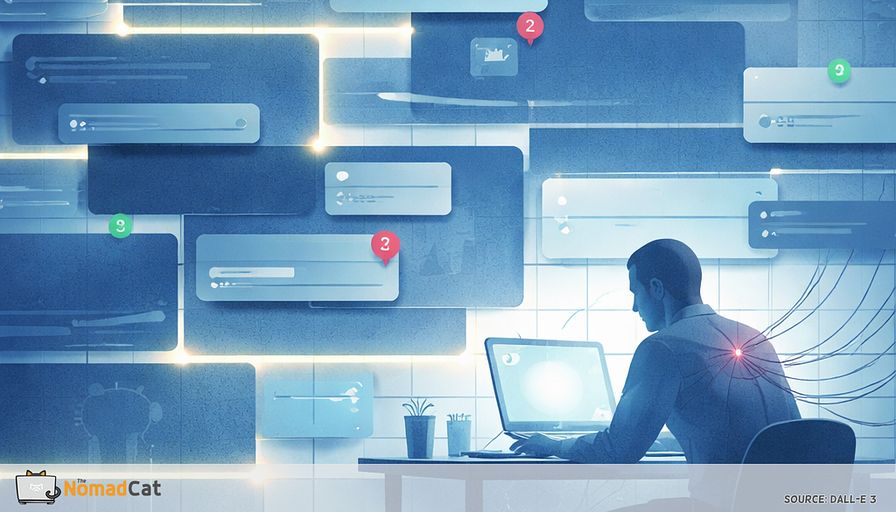
Back-to-back calls start at 9:00 and somehow never stop. You had a reasonable plan at 8:45. Water nearby. A quick walk at lunch. Maybe 10 minutes to stretch. Then a meeting runs long, the next one starts early, and lunch becomes “2 bites while typing.” At 16:00 you notice you have not stood up except to grab a charger. Classic. For me, that’s usually when the upper-back tightness shows up first, quietly, like a status light you ignored all day.
It is easy to label this as bad discipline. But most of the time it is not a motivation problem. It is a scheduling problem. When the calendar gets chopped up and interruptions stack, the tiny gaps that make health habits possible get deleted first. Water refill. Bathroom. A real lunch. A 5-minute walk. Those are not luxuries. They are the seams that keep your body from throwing errors all afternoon.
This article is about making those seams exist again, without adding another complicated system to your life. Not “perfect posture all day” or heroic workouts after a 10-hour desk day. Just plans that still work when other humans are involved.
Here is what you will get, concretely
- Why interruptions and context switching make breaks feel expensive on busy days
- How responsiveness became a performance signal, and why that turns movement into reputational risk
- A simple way to spot the repeat patterns that keep vetoing your plan, without self-blame
- Practical “micro contracts” that make breaks actually doable, like buffers, coverage, and clearer urgency rules
- Meeting and messaging defaults that create real gaps, even when nobody is trying to be healthy
If your shoulders tighten up right on the last call, your eyes feel dry by mid-afternoon, and evenings keep getting eaten by “just 10 minutes,” you are not broken. The system is configured to erase recovery time. The good news is that small configuration changes can do a lot. Perfection not required.
When your plan meets other humans
A plan that works until the calendar fills up
On the surface it looks like bad discipline. Under it, the schedule changed shape. A seven-minute overrun doesn’t just “take seven minutes.” It deletes the only gap you had for a water refill, and now you’re choosing between starting the next call late or staying dehydrated.
Remote work pushed a lot of calendars into this back-to-back mode—more meetings, fewer gaps—and it became normal fast (Yang et al., 2022). Interruptions are not small either. After one, it can take around 23 minutes on average to fully get back to the original task (Mark, Gudith, and Klocke, 2008). So yes, the plan works on calm days. Then one meeting-heavy day arrives and the plan disappears. If it only works on quiet days, it is not a character flaw. It is a mismatch with the runtime.
A quiet day has seams you can defend. Interactive time deletes seams first because every gap becomes useful to someone else.
Typical seams that vanish first
- water refill
- bathroom
- a 5-minute walk
- a real lunch
Those tiny breaks matter more than they look. Microbreaks are linked to better well-being, and usually without hurting performance (Wendsche and Lohmann-Haislah, 2017). The scarce resource is not motivation. It is seams.
And your body still logs the cost, quietly, hours later. Upper back gets tight. Eyes feel dry from staring. You get that post-lunch slump even if lunch was 6 bites taken between 2 slides. Lower back starts to grumble during the last call, like it has opinions about your chair. For me it’s always the upper-back tightness that builds until it forces me to move.
Public guidance is boring but useful here. WHO (2020) is blunt: replace sedentary time with movement of any intensity, as much as possible. Ergonomics guidance leans toward short, frequent breaks and posture variation, not “perfect posture all day.” I’m annoyingly data-driven about this: the older I get, the more I notice the metrics don’t lie when I let meetings erase movement for weeks. These end-of-day sensations are not a moral failure. They are delayed logs from a day where recovery seams never existed.
Why interruptions win on busy days
The hidden price of stopping
On a packed day, taking a break does not feel “healthy.” It feels expensive. Context switching has a cost, and resumption cost helps explain why people start protecting continuity (Mark, Gudith, and Klocke, 2008). Even if you can tolerate the cognitive cost, there is also a social cost to looking unavailable.
Availability as a performance signal
A 2-minute ping lands in the only micro-window between calls, and silence can look like avoidance. Telepressure is that felt need to respond quickly. It is linked to more checking and worse detachment from work (Barber and Santuzzi, 2015). And “face time” logic did not disappear, it moved into green dots, timestamps, and rapid replies. Presence signals can affect evaluations (Elsbach, Cable, and Sherman, 2010). In practice, that can show up as “always responsive” being remembered at review time, even if it quietly destroyed your lunch.
So breaks start to look like reputational risk. Replying is discreet. Standing up is visible.
Pause-safe beats pause-unsafe
On interactive days, replying is pause-safe. You can do it instantly, without leaving the screen, and without creating a visible gap.
Water, walking, and eating a real meal are pause-unsafe. They require leaving the screen and breaking continuous availability. Awkwardly, those are exactly the small inputs that tend to help.
In meeting-heavy reality, the easiest executable action is more responsiveness, not recovery, even when the cost shows up later as tight shoulders and a dry-eyed 16:00 headache.
Your calendar is a public API
Availability is externally callable
Your calendar, chat status, and inbox are not private productivity tools. They are how other people route work to you. “Open” time becomes claimable time, because it’s visible.
Think of it like an API. You publish endpoints called free at 11:30 or green dot, and other systems start calling them automatically. That “meeting-free block” you thought was yours becomes an invite with a polite title and zero buffer, because it looked available.
The biggest illusion is that a calendar block is a boundary by default. A block is only a boundary if other people agree it is one.
This is why evening plans are fragile too. Global teams stretch the workday, and unfinished coordination leaks into “just 10 minutes” after dinner. Connectivity increases flexibility and also expectations of responsiveness (Mazmanian, Orlikowski, and Yates, 2013). Some countries even wrote rules about this. France introduced a right-to-disconnect requirement in 2017. Ireland followed with a Code of Practice in 2021.
That is a hint the issue is not personal. It is how work gets coordinated.
The coordination layer most health advice ignores
When urgent is undefined everything feels urgent
When nobody shares a definition of urgent, ambiguity becomes risk. People monitor channels to avoid being the bottleneck. That monitoring loop is telepressure in action, and it weakens recovery (Barber and Santuzzi, 2015).
A lightweight fix is separating impact from urgency, like incident management does. Something can be high impact but not time critical.
As an illustration
- Sev 1 service down or safety risk
- Sev 2 major degradation
- Sev 3 normal bug or request
- Sev 4 nice-to-have
The point is not the labels. It is a shared ladder. Without one, every ping competes with lunch, water, and the 5-minute walk that would keep the shoulders from turning into concrete.
Channels without reply latency rules become always on
When latency is undefined, breaks feel like rule-breaking. Slack feels real-time, email feels real-time, WhatsApp feels real-time, plus the calendar invite that is basically a request with a timer.
Microbreaks help, but they need both a slot and a norm. Otherwise you keep eating at the keyboard because monitoring stays possible.
Typing “on it” is socially clean. Standing up is socially noisy.
Buffers and coverage make breaks runnable
Back-to-back compression is the normal shape of many calendars now (Yang et al., 2022). If every meeting touches the next, there is no execution slot for water, bathroom, or a short walk.
Even when a break is “allowed,” it is not safe if nobody covers when you disappear. If something lands while you step away and ownership is unclear, the safest behavior becomes staying online.
With coverage and permission, a short break becomes normal work hygiene instead of a reputational gamble.
The veto cascade in plain sight
A 7-minute overrun is not 7 minutes. It deletes the seam you were going to use. The next call starts immediately so you pick the least visible option, you stay seated and you stay online. Lunch becomes a few bites while reading pings. A third meeting gets booked into the only remaining crack because “free” time is legible and claimable.
Then the plan changes form. What was take 5 minutes becomes find a safe 30-minute block later, because stopping mid-stream starts to feel costly. And once the micro-actions are gone, they do not stay small.
- Missing water becomes a headache later, so now you need a longer pause
- Missing a real lunch becomes a late heavy meal, and the afternoon dip gets worse
- Missing a 5-minute walk becomes “i should do a full workout tonight,” which is harder when work spills into the evening
Self-blame shows up right here, even though the plan depended on stable seams you never had. Habit automaticity relies on repetition in a stable context (Lally et al., 2010). A calendar that keeps changing destroys the cue.
So the diagnosis is simple. In multi-player work, tiny interruptions veto health plans unless coordination rules protect seams.
Compatibility diagnosis for a plan that keeps getting vetoed
Most days do not break because of 25 different surprises. They break because of 1 to 3 repeating patterns that keep deleting seams.
Common repeat offenders
- back-to-back meeting norms
- fast-reply chat expectations
- client “ASAP” as default priority
- time zone overlap compression
- after-hours pings on mobile email
- family handoffs that collide with spillover work
For each one, look for the unspoken rule and the perceived penalty if you do not comply. The useful question is not how do i get more disciplined. It is what expectation is attached to this channel.
This is the pattern-spotting step. A small 5-day log can help, blameless postmortem style, not as a tracking project
- time | what got in | what you did instead | what rule was missing
- 12:10 | “quick ping” | ate at keyboard | reply latency undefined
- 15:55 | meeting overrun | skipped water | no buffer norm
After a few days, guilt usually drops because the pattern reads like requirements for the next version of the plan.
Home time is also multi player time
Evenings are not free time just because the last meeting ended. They have handoffs that cannot be postponed like a spreadsheet.
And variability keeps habits feeling effortful. Stable cues matter for habit formation (Lally et al., 2010). If the cue changes every day, “after dinner” is not a cue. It is a different time, different length, different energy, different interruptions.
One coordination-friendly tool is implementation intentions. If–then planning survives variability better than vague goals.
Example
- if the handoff is done and there is a 20-minute quiet window, then do a short strength block
- if not, then do 5 minutes of mobility while something is in the oven
The point is not perfection. It is making the plan workable inside the real system.
Micro contracts that make plans runnable
Small reachable windows are often easier to defend than big blocks. A 10-minute slot has less political weight than a 90-minute deep work block, and it still creates the seam where water, bathroom, and 3 minutes of shoulder movement can happen.
The key is that the edge is predictable to other people. Boundaries only work when they are legible as signals too.
A minimal structure has 3 elements
- window: a predictable unreachable slot
- escalation channel: 1 place where true urgent items go during that window
- response expectation: what “normal” means elsewhere, so silence is not read as avoidance
When there is a real urgent path, everything else can wait by default, without guilt. It sounds a bit robotic, but it beats living with this permanent maybe-urgent anxiety.
Meeting defaults that create real seams
Meeting norms are health infrastructure in a very unsexy way. If the default calendar shape includes gaps, drinking water and standing up stop being “a thing.” They become the path of least resistance.
A few primitives go a long way
1. end on time as a norm because overruns delete the only usable gap
2. default shorter meetings so buffers exist even when nobody is trying to be healthy
3. protect 1 small meeting-free block because fragmentation kills basic physical maintenance
Microbreak evidence supports why those gaps matter (Wendsche and Lohmann-Haislah, 2017). And more broadly, defaults beat intentions. Environment changes can reduce sitting time because they change what is easy by default (Shrestha et al., 2018).
Coordination diagnosis not character diagnosis
Plans fail at the coordination layer. When reply speed becomes a performance signal, breaks become socially expensive. When time is legible to others, it stops being private.
Most drink, move, eat advice breaks because it assumes
1. uninterrupted time exists
2. time is privately controlled
3. scheduling is single-user
That is why the “stand up every hour” app streak dies on the first day your calendar turns into a solid block: it assumes those seams will appear on their own, and on busy days they don’t.
In real desk life, those assumptions often do not hold. The assumptions are the bug. Not you.
A durable plan tends to be pause-safe, optics-safe, and negotiation-safe. When it fails, treat it like a systems issue. Ask what condition made failure likely and add a guardrail.
Design for the day you actually have, not the one your calendar pretends you have.
If your day is a wall of meetings, the problem is rarely discipline. It is that the seams got erased, and nobody agreed to protect them.
You might be interested by these articles:


Microbreaks that survive pings and meeting overruns

Stop treating breaks like optional when your calendar is shared

The green dot trap why empty calendar time still is not yours

Your calendar is the boss not your motivation

Why Your Desk Lunch Keeps Disappearing and What Is Stealing the Gaps

Advancing Green Manufacturing

A health plan that still works in 3 stolen minutes