Abstract:
The article explains a common desk-worker sleep problem it calls “braced sleep,” where you fall asleep normally but wake between about 02:00 and 05:00 with a quiet mind and a tense, “on shift” body—upper traps held, jaw clenched, hands half-clenched, low back unable to settle—leading to thin, sliced-up sleep and next-day signs like late-morning neck stiffness and heightened irritability, even after doing “responsible” sleep hygiene like turning off notifications. It argues this pattern is often misattributed to telepressure, rumination, or “bed equals awake” conditioning, and instead traces it to all-day low-level muscle guarding from long desk hours and camera-on meetings that reward stillness, creating a high “duty cycle” of subtle tension that doesn’t fully clock out at night and triggers micro-awakenings as sleep gets lighter. To test the hypothesis without overhauling your life, it proposes a tiny 2-night A/B check (one normal night, one night adding a 3-minute pre-bed “de-brace”), a simple morning log focused on stiffness/tension and repositioning rather than wearable graphs, a survivable 3-minute routine (jaw cue with long exhales, shrug-and-drop shoulders plus hand release, and a brief “unhook” from sitting by bringing knees toward the chest), and a 30-second 03:00 version designed to prevent escalation without problem-solving or phone use. It also suggests “upstream desk knobs” like reducing precision grip, supporting forearms, leaning back during listening, and using event-based cues (e.g., after hitting Send, drop shoulders and soften jaw) to lower nighttime guarding, while emphasizing safety guardrails and when to seek screening (e.g., snoring/gasping, breathing pauses, dangerous sleepiness, neurological symptoms, reflux, or persistent impairment where CBT-I may be the fastest path).
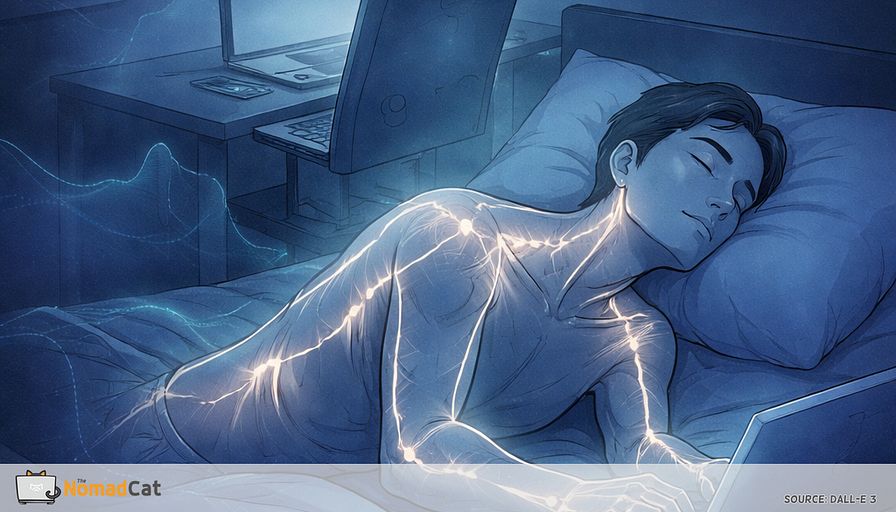
You did the “responsible” things. Notifications off. Inbox closed. Screen time cut. Maybe even a podcast about sleep, because why not. And still, somewhere between 02:00 and 05:00, the body boots up like it has a night shift.
Sleep starts fine, then it gets weirdly physical. The mind is not even spiraling, which almost makes it more annoying. It’s like a laptop fan running with no apps open.
This article is here to name that pattern and skip the usual time-wasting explanations. Not every wake-up is rumination. Not every bad night is “stress” in the abstract. Sometimes it’s simple. After years of long desk days across Beijing (2008–2017), Berlin (2017–2023), and now Lisbon (since 2023), the pattern is hard to miss: work runs late, midnight slides, and the next thing you notice is that upper back tightness that didn’t get the memo. The body kept the desk configuration, and it shows up when sleep gets lighter.
What you’ll get here is a practical map, built for people with 10-hour desk days, camera-on meetings, and evenings that start too late.
We’ll cover
- What “braced sleep” looks like in the 02:00 to 05:00 window, and why sleep can feel thin even with enough time in bed
- Quick contrasts with telepressure, rumination, and classic “bed equals awake” conditioning, so you don’t chase the wrong lever
- A straightforward chain from daytime low-level muscle guarding to broken sleep continuity
- A 2-night A/B check that stays small, plus a tiny morning log that matches the hypothesis (not everything a watch wants to graph)
- A 3-minute de-brace for bedtime, plus a 03:00 mini version if you wake up tense
- A few upstream desk knobs that reduce night guarding without needing a perfect setup
- Safety guardrails, including when posture tweaks are not the main issue and it’s time for a proper screen
Nothing here requires a new personality, extra free time, or a full stretching session on the living-room floor. The goal is just to give the system a clear “off duty” signal and see what changes. If it helps, good. If it doesn’t, at least you’ve cleared one hypothesis without burning a month on it.
The braced sleep pattern
How it shows up between 02:00 and 05:00
Sleep onset can be fine. Then somewhere around 02:00 to 05:00, a window opens and the body looks quietly on shift. Same signs: traps up, jaw set, hands half on, low back not finding neutral, and the endless reposition loop.
The mind is not racing, but the body is awake anyway. That split is real. You can feel calm mentally and still have a body that won’t let go.
The emotional tone is often oddly flat. Not panic. Not a spiral. More like a laptop fan running with no apps open.
Thin sleep here means broken continuity, not “you didn’t spend enough hours in bed”. In practice it looks like more awakenings and more time awake after sleep onset. You can have enough time in bed and still wake up not really restored. Morning is okay-ish, then late morning neck stiffness arrives like an email you didn’t ask for. Around 11:00, small irritations land harder than they should. After lunch, the dip feels less like laziness and more like the system didn’t recover during the night.
Once you can name this pattern, it’s easier to stop chasing the wrong explanation.
Not the usual desk worker insomnia
Three quick contrasts that save you time
A common mix-up is assuming all awakenings are caused by thoughts.
Telepressure is that feeling a message might land and you should respond. That can absolutely mess with sleep. But braced sleep can show up even when notifications are off and the inbox is closed. If the 03:00 body-alert window stays identical offline, information intake is probably not the main lever.
Rumination is a cognitive loop at 02:47. Braced sleep is different. It’s persistent muscle tone and discomfort that keep nudging the arousal system even when there’s nothing to solve.
Bed conditioning is when the bed itself becomes the trigger and your brain learns “bed equals awake”. Braced sleep can be the opposite. The bed is fine. The body just arrives already wearing the desk configuration.
A simple tell is the couch vs bed test. If the shoulders drop on the couch at 22:30 and stay down through the first part of the night, but the jaw clamps and traps climb later in bed, it points more toward “carried-in tension” than “the bed is the trigger.” If you’re tense everywhere (couch included), it’s probably a broader arousal problem and this specific lever may be smaller.
Why your desk muscles do not clock out at night
Desk work is low-level strength work with terrible uptime
A 10-hour desk day is not nothing. It is sustained isometrics in disguise. Head a bit forward, shoulders a bit up, forearms hovering, fingers doing precision work. Each contraction is small, but it runs all day, and some muscles never get real silence.
There’s research using muscle-activity readings during computer work showing the issue often isn’t high effort. It’s low activation with too little rest time, especially in the upper trapezius. In plain terms: the problem isn’t intensity, it’s that the “on” switch never fully goes off.
Meetings add a second layer. Camera-on calls reward stillness and self-monitoring. Reduced mobility, nonverbal load, self-view, and messy home setups can leave you finishing a boring call with a tight neck and a jaw that’s been working overtime. Remote work removes a lot of incidental movement too. No stairs, no walking to a room, no “accidental” break.
A simple chain from daytime guarding to broken sleep
A useful model is a 3-step chain you can test.
- Day: long low-level bracing nudges baseline body arousal up. The body stays slightly ready even after work.
- Night signal: that tone plus discomfort triggers small internal check-ins, tiny shifts, micro-awakenings you may not remember.
- Sleep continuity: more awakenings and more time awake after sleep onset. Sleep feels sliced up.
Pain and sleep affect each other, and more discomfort often means lighter, more fragmented sleep. Desk posture is not chronic pain, and nobody can claim “desk work causes insomnia” from this. But you don’t need dramatic pain for discomfort to fragment sleep for some people.
A 2-night check that stays small
Night A and Night B only
Keep it brutally simple.
- Night A is a normal night.
- Night B is the same, except you add a 3-minute de-brace right before sleep.
Not a lab test, just a quick signal check. With 1 night per condition, randomness wins often. Still, a quick A/B check can catch big differences and stop you over-investing in the wrong lever.
A tiny morning log for braced sleep
Track outputs that match the hypothesis, not everything a watch likes to graph.
- Morning neck or upper trap stiffness 0–10
- Jaw tension on waking 0–10
- Reposition loop during the night 0 none, 1 a bit, 2 a lot
- Sleep felt like 1 block or many slices 0 one block, 1 mixed, 2 many slices
- Overall sleep quality 0–10
What the result means and what it does not
If Night B shows a clear drop, body-level arousal is probably worth attention. “Clear” can be simple:
- stiffness or jaw tension drops by 2+ points, and/or
- reposition loop drops from 2 → 1 (or 2 → 0)
If nothing changes, it does not mean you did it wrong. It often means the effect is smaller than nightly variability. A boring upgrade is to repeat the same check a few times with the same simple outputs.
The 3-minute de-brace that fits a Tuesday
The point is a downshift signal
This has to survive real life. Not a stretch session. Not a new identity. Just a clear “off duty” signal.
Rule of survival
- If it takes more than 3 minutes, needs floor space, or requires a special mood, it dies on day 4.
Three parts you can recombine
1 Jaw cue plus long exhales
- Lips closed.
- Teeth not touching.
- Tongue resting.
- 5 slow breaths with the exhale longer than the inhale.
This is not a promise to control sleep bruxism. It’s just a low-effort de-tension signal.
2 Shoulder and hand drop
- Shrug up hard for 2 seconds, then drop heavy. Repeat 3 times.
- Open and close the hands 10 times.
- Shake them out for 10 seconds.
If the problem is low-level activation with too little rest, you’re giving the system a short patch of actual silence.
3 Unhook the sitting shape
- Sitting on the bed edge or in bed, bring 1 knee toward the chest.
- Hold just a moment.
- Switch sides.
- Total 30 to 45 seconds.
Not deep stretching. Just a change in joint angle. A message that chair mode is over.
Upstream desk knobs that reduce night guarding
Cut precision grip before it becomes neck tension
Run a 30-second input audit.
- Is the mouse grip stronger than needed
- Is pointer speed so slow you do micro-surgery
- Are the forearms hovering
Small fixes can buy more rest time in the upper traps.
- Slightly faster pointer speed
- Mouse closer to the body
- Forearm support on the desk
Support and variation beats sitting straight for 10 hours
Real setups are messy. Some days it’s a good chair, some days it’s a kitchen table. So instead of “sit straight”, aim for supported.
- Forearms on the desk when possible
- Back against something when possible
- Lean back during listening parts
If then rules that fit between meetings
Timers are cute until your calendar becomes a Tetris wall. Event-based cues survive better.
- If you hit Send, then drop the shoulders once and let the jaw soften for 1 breath.
- If you’re in a deadline stack and forget all of this until 19:30, congratulations, you are still employed.
No stretching. No performance. Just removing tension you didn’t need to ship that email.
A 2-minute meeting default
Video calls push stillness and self-monitoring. So give the first 2 minutes a default.
- Feet flat
- Lean back
- Forearms supported
- 1 slow exhale before you start talking
It’s basically “do not lock the armor at minute 1”. The next 28 minutes tend to follow whatever your body picked at the start.
The 03:00 protocol for a tense body
A 30-second physical reboot
Rules first.
- No problem-solving
- No stretching session
- No phone
- Ideally no clock watching
Run the exact same 30-second de-brace as bedtime so it stays automatic when the brain is half offline.
- Jaw soft, teeth not touching
- Shoulders up 2 seconds then drop heavy
- 5 slow breaths with a longer exhale than inhale
The win condition is preventing escalation.
If you are still awake
Try a small state change.
- Sit up with feet on the floor for 5 slow breaths, then back to bed.
If wake time is long and this happens often, the classic option is to leave the bed in dim light until sleepy, then return. The real win is less time spent fighting at 03:00, not perfect sleep on command.
Scope and safety guardrails
This is just a label for one desk-shaped tension pattern that can fragment sleep, for self-debugging only. It’s not a diagnosis, and it won’t catch everything that can wake you up at 03:00.
If sleep problems are persistent and impairing, the shortest path is often CBT-I, not more tiny tricks.
When to get checked
If any of these show up, posture and de-brace work are not the main lever. Get a proper screen.
- Loud snoring most nights
- Gasping or choking in sleep
- Witnessed breathing pauses
- Dangerous daytime sleepiness, especially drowsy driving moments
Other signals that need a different owner include numbness, tingling, progressive weakness, severe or unusual headaches, pain that escalates and wakes you, classic RLS pattern, or reflux-style awakenings with burning and regurgitation.
If your day is 10 hours of desk time, camera-on meetings, and lunch eaten while answering “quick” messages, a 03:00 wake-up isn’t always a mystery. Sometimes it’s just the body still running the desk configuration. The key shift is naming the pattern: quiet mind, braced body, and sleep that gets sliced into little blocks.
From there, the plan stays small. Do a 2-night A/B check. Log the outputs that actually match the hypothesis. Try the 3-minute de-brace before bed, and the short 03:00 version if you wake up tense. Then tweak a few upstream desk knobs so muscles get more real downtime, not more “sit straight”.
Most people can tell within a couple of nights whether this is their pattern: the flat mood, the quiet mind, and the body that refuses to fully clock out.
You might be interested by these articles:


The 02:17 reboot after a 10-hour desk day and how to make it boring again

03:00 planning mode is a context bug not stress

Why your brain starts work at 05:00 and how to stop rewarding it

8 hours in bed and still tired debug your fragmented sleep

Your bed is not a workspace fix the cues that boot up work brain at night

Revolutionizing Retail with AR

When minimalist routines become the new burnout trap