Abstract:
The article explains a common “sleep cliff” where a day that looks productive and orderly—threads cleared, a doc shipped, calls survived, normal dinner—still ends with a body stuck in “on” mode (tight shoulders and jaw, shallow breathing) and a night that feels “thin”: you may fall asleep fine but wake 2–4 times and your brain instantly “reopens 12 tabs,” leaving you feeling unfairly behind by morning. It argues this is often not classic insomnia but low restoration driven by fragmented, interruption-heavy knowledge work and constant reachability, especially in remote/hybrid life where commutes and natural transitions disappear, so the first real pause happens only in bed and sleep is forced to do all the downshifting. The piece warns that trying to fix this by perfect wind-down rules, strict cutoffs, and wearable metrics can backfire by turning bedtime into a performance dashboard (orthosomnia), and instead предлагает a simple upstream diagnostic (“When was the last 2–5 minutes today with zero input, zero output, and no performance attached?”). Its practical, low-drama solution is to insert small decompression “seams” earlier in the evening: a 7-minute no-performance buffer (quiet window-staring, a silent shower, a boring chore without audio) and a 2-minute “unload” done before bed-planning starts (one thing done, one thing parked with where it lives next, and one small first move for tomorrow), with guardrails not to escalate these into another checklist or measurement project and a note to seek clinical evaluation if sleep problems are severe or persistent or suggest apnea.
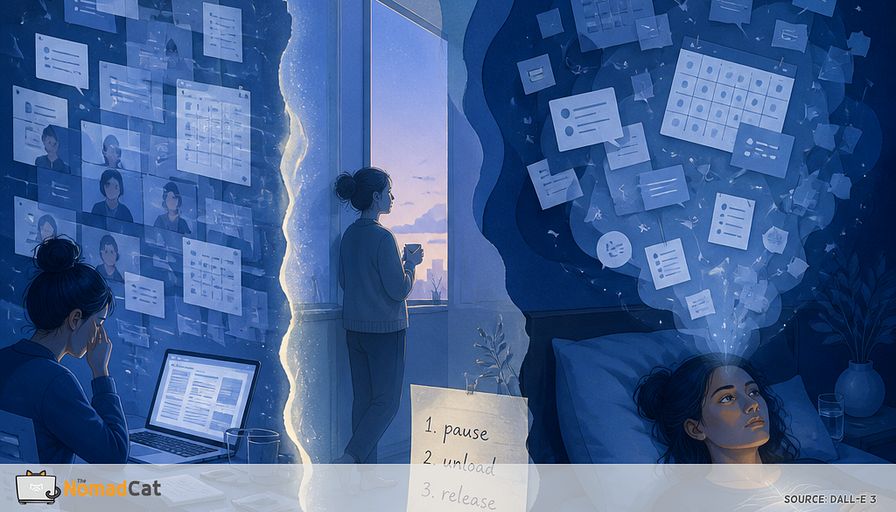
The day looks good on paper. You clear the threads, ship the doc, survive the calls, even eat a normal dinner. Then you get into bed and your body is still in “on” mode. Shoulders up. Jaw tight. Breathing weirdly shallow. You’re tired, but also… ready. Like your nervous system missed the meeting where everyone agreed we’re done for the day.
I’m French, I live in Lisbon now (since 2023), and I’ve done the desk-work grind across places like Berlin and Beijing. Remote/hybrid made this pattern louder: the commute disappeared, and with it the little “doorway moments” that used to tell the system we’re switching modes.
If that sounds familiar, the problem is often not classic insomnia. Falling asleep can be fine. The issue is the night feels thin. You wake up 2–4 times, and each time the brain boots instantly, like it reopens 12 tabs by itself. Morning arrives and somehow you already feel behind, which is a rude feature for something called “sleep.”
This article is for that specific pattern. Not the messy evening with Slack at 23:00 and doomscrolling (yes, that matters too). The frustrating one where the evening is quiet and you still drop off a sleep cliff anyway.
You’ll get a simple, systems-style explanation for why a “productive” day can lead to low recovery at night, plus a couple of small fixes that fit inside a real calendar. No extra apps. No bedtime turning into another performance review.
We’ll cover:
- Why fragmented knowledge work keeps the system running even when nothing “bad” happens
- The difference between hours slept and sleep continuity, and why the second one often hurts more
- How tracking and perfect wind-down rules can backfire and add arousal
- A quick diagnostic check that points upstream instead of blaming the last 30 minutes
- 2 small interventions, a short no-performance buffer and a 2-minute unload, placed earlier so bed doesn’t have to do all the downshifting
This is not about becoming a new person with a perfect evening. It’s more like fixing a configuration issue. Small changes, low drama, and yes, it still counts even if the day is chaos.
The sleep cliff after a productive day
What a normal good day looks like right before the drop
The day is fine on paper. Back-to-back calls, but nothing explodes. You ship a doc, answer the important threads, close a couple of loops. Dinner is normal. The evening is quiet enough that you almost feel proud.
Then you get into bed and notice the body never really got the memo. Same signals as before: shoulders creeping up, jaw locking, breath staying high. A day can look calm and still be death by context-switching—doc, Slack, calendar, quick reply, back to doc, repeat.
This isn’t a personal flaw. Knowledge work is interruption-heavy and fragmented by design (Mark, Gonzalez & Harris, 2005). A day can look controlled and still leave the system running.
The signature is not insomnia it is low restoration
When this pattern hits, the story people tell themselves is often off. Sleep onset can be normal. The problem is the night feels thin.
You wake up easily, sometimes 2–4 times. Each wake-up comes with instant mental boot, like the brain opens 12 tabs by itself. Morning arrives and you feel like you’ve already been online for 1 hour before coffee.
This matters because next-day functioning tracks sleep quality and continuity, not only total hours (Watson et al., 2015). “7 hours” can still feel like a bad deal when continuity breaks.
Why bedtime becomes another performance problem
Because the failure shows up at night, it’s tempting to blame bedtime behavior. So people add rules. A perfect wind-down. A strict cutoff. A wearable score. More tracking, more checking, more “did I do it right.”
For some people, that turns the bed into a dashboard. Dashboards create arousal, even if the numbers look “good.” Sleep-tracker-driven anxiety has a name, orthosomnia (Baron et al., 2017). And trying hard to sleep can backfire (Broomfield & Espie, 2005).
If bedtime becomes a KPI, the system often adds the exact background stress that breaks sleep.
When a clean evening still fails
The usual suspects are not always the bug
Yes, late Slack, late email, and late scrolling can mess with sleep. After-hours work tech use is linked with worse sleep (Barber & Jenkins, 2014).
But the “sleep cliff” here is different. It’s when the evening is already quiet and the night still breaks.
Quick exclusions, mostly to remove guilt:
- After-hours messages that re-open work brain (Barber & Jenkins, 2014)
- Late-night phone time that keeps attention in high-input mode
- A “relaxing” last hour that is secretly 47 tabs of information
If the evening is clean and it still doesn’t hold, the lever is probably upstream.
It is not one big worry it is vague readiness
For this pattern, it’s often not one named worry you can point to and fix. It’s more like “nothing is wrong, but nothing is off.” The brain isn’t dramatic. It’s on standby. Like a laptop that never sleeps, it only dims the screen.
One useful idea here is that activation can stick around even without a clear conscious worry. Background unfinishedness can keep stress systems engaged (Brosschot, Pieper & Thayer, 2005).
Also, if you are metrics-minded, you’re at higher risk of turning vague activation into a nightly audit. Audits are not calming.
A better diagnostic question than bedtime behavior
A simple model is that sleep gets asked to do too much.
If the day is dense with switching, coordination, and small urgencies, and the first real pause happens only when your head hits the pillow, then bed becomes the first place the system tries to downshift. Like waiting until production is down to run maintenance.
Microbreaks, even short ones, are linked with lower fatigue across studies (Kim, Park & Niu, 2017). Not magic. Just a small nudge to the system.
So the useful diagnostic question is not about the last 30 minutes. It’s this:
When was the last time today you had 2 minutes with zero performance attached to it?
The transition failure that makes sleep fragile
The decompression threshold
Think of a decompression threshold as the moment your system shifts from output and evaluation into low gear.
Desk work keeps you in coordination mode for hours, even when nothing is “stressful” in the dramatic sense. You produce, you judge your output, you wait on others, you re-check, you context-switch, you stay reachable. If you never cross that threshold while awake, sleep starts with leftover readiness in the background. Then it becomes easier to reactivate at 02:00.
You can often see it in body logs:
- Neck and upper traps doing the slow creep up
- Jaw tension that returns as soon as the next call starts
- Shallow breathing, like the chest is bracing
Remote and hybrid work remove the last free transitions. No commute. No hallway. No doorway moment. You can go from a hard conversation at 18:00 to cooking at 18:00 plus 30 seconds, still carrying the same tone and posture.
Fragmentation is part of the mechanism. Attention gets chopped, and strain rises (Mark, Gonzalez & Harris, 2005). The human version: it’s the 30‑second jump from doc → Slack → calendar → back to doc, all day. Your brain pays for every jump even if you don’t notice it.
The result is boring but expensive. If recovery never starts while awake, sleep inherits the job, and often does it badly.
2 checks and 2 fixes
The last quiet minute check
Same idea as the 2‑minute question, but stronger: 2 minutes is the minimum viable signal; 5 minutes is where you usually feel whether you ever downshifted at all.
When today was the last 5 minutes with no input, no output, no performance attached?
No “just one message.” No planning tomorrow. No news.
If the honest answer is “in bed,” that is probably the lever.
What counts vs what doesn’t:
- Counts: sitting and looking outside, a short walk with no audio, doing dishes in silence
- Doesn’t count: podcasts, relaxing scrolling, replying to 1 thing, planning, reading about sleep
If you want a tiny, low-stakes experiment, track boring signals only:
- 1 long block vs 3 broken blocks
- how fast the mind goes online after a wake-up
No need to guess “deep sleep” from a consumer device.
Fix 1 a 7-minute no-performance buffer
Try a 7-minute buffer right after work ends, or right after dinner. No content. No planning. No “learning.” It’s not a special moment. It’s just a transition placed earlier so bedtime doesn’t have to do all the downshifting.
Low-effort examples:
- Stand at a window and do nothing interesting
- Take a shower without audio and without rehearsing tomorrow
- Do 1 boring chore in silence
If you feel too wired, slow breathing is a reasonable mechanical lever. If you want a default: 4 seconds in, 6 seconds out, for 2 minutes. No scoring, no “leveling up.” Reviews suggest paced breathing and HRV biofeedback can shift autonomic markers toward calmer physiology (Lehrer & Gevirtz, 2014; Shaffer & Ginsberg, 2017). Keep the claim modest.
Fix 2 a 2-minute unload that prevents bed-planning
Place this earlier than bedtime. 2 minutes, on purpose.
- Done: 1 thing actually finished today
- Parked: 1 thing you are not solving now and where it lives next
- First move: 1 next action for tomorrow that is small and concrete
A practical idea from CBT-I is to reduce arousal and keep the bed for sleep, not problem-solving (Qaseem et al., 2016; Riemann et al., 2017). Brief to-do list writing has also been shown to reduce sleep onset latency in an experiment (Scullin et al., 2018). Practical translation is not “journal forever.” It’s “move thinking earlier so it doesn’t spill into bed.”
Placement rules
Seams beat intentions.
Remote life (and workations on bad chairs and worse desks) can erase the natural seams even more, so you have to place one on purpose.
- After the last meeting and before the first quick check
- Right when you close the laptop, before you drift into apps
- Before personal apps, so the first free minute isn’t instantly consumed
Guardrails so this doesn’t become another performance domain:
- Do not add a checklist called perfect evening
- Do not extend the buffer to 45 minutes because it felt good once
- Do not measure 12 variables nightly then troubleshoot at 02:00
- Do not punish yourself for skipping it on a chaotic day
If sleep problems are persistent for weeks, severe, or come with apnea signs like loud snoring, choking, gasping, or dangerous daytime sleepiness, it’s worth a clinical evaluation rather than endless self-experiments.
If your day looks “fine” but your night feels thin, it’s probably not a character flaw and not even classic insomnia. It’s a systems issue, yes, but also a very human one. Fragmented work, constant switching, and staying reachable can keep the nervous system on standby, so bed becomes the first quiet moment where everything tries to power down at once. Then you get the 02:00 tab-reopening effect, and the morning starts with that unfair already-behind feeling.
The main shift is to move decompression earlier, without turning it into another KPI. A 7-minute no-performance buffer and a 2-minute unload can reduce the amount of downshifting sleep has to do, and it still counts even when the calendar is chaos.
Small inputs, placed at the right seam, compound. When was the last 2 minutes today with zero input, zero output, and no performance attached?
You might be interested by these articles:


Your 1st 45 minutes are training your 02:00 brain so change the input order

8 hours in bed and still tired debug your fragmented sleep

After dinner no more invisible work so your sleep can actually power down

Thin sleep is leftover context from a chopped up desk day

Your brain needs an off duty signal not an earlier bedtime

Breaking the portfolio plateau for tech minimalists

When automation isn’t enough how freelancers can avoid hidden admin risks